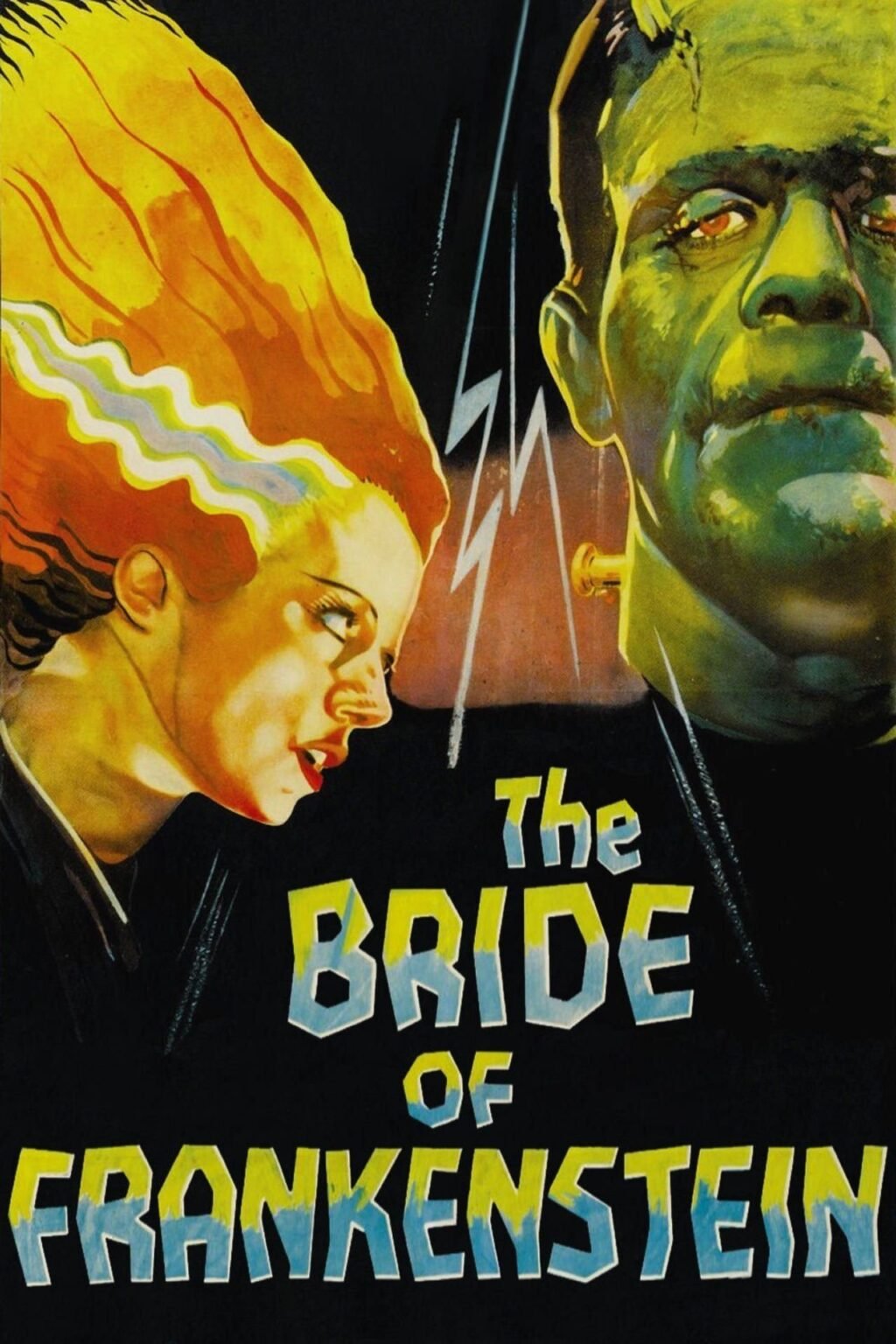
Bride of Frankenstein (1935) is Universal’s first sequel to Frankenstein (1931), and many critics consider it better than the original. James Whale returned to direct, with Boris Karloff as the Monster and Colin Clive as Henry Frankenstein. Elsa Lanchester plays both Mary Shelley, in a prologue, and the Bride. Ernest Thesiger plays the sinister Doctor Septimus Pretorius. It picks up straight after the first film’s burning windmill and takes its premise from a subplot in Shelley’s novel: the Monster’s demand for a mate. Darker, funnier and more tender than its predecessor, it is often called Whale’s masterpiece. It was added to the National Film Registry in 1998.
At a glance
| Release date | April 19, 1935 (San Francisco premiere); April 20, 1935 (US) |
| Director | James Whale |
| Writers | William Hurlbut (screenplay); story by William Hurlbut and John L. Balderston |
| Based on | Frankenstein; or, The Modern Prometheus (1818) by Mary Shelley |
| Starring | Boris Karloff, Colin Clive, Valerie Hobson, Elsa Lanchester, Ernest Thesiger, O. P. Heggie |
| Runtime | 75 minutes |
| Rating | Released before the MPAA rating system; approved under the Production Code on April 15, 1935 |
| Budget | About $397,000 |
| Box office | About $2 million (Universal report, 1943) |
| Franchise | Universal Monsters: sequel to Frankenstein (1931); followed by Son of Frankenstein (1939) |
Plot summary
On a stormy night, Lord Byron and Percy Shelley praise Mary Shelley for her tale of Frankenstein. She tells them the story isn’t finished. Back at the burning windmill, the Monster has survived. He kills the parents of the girl he drowned and wanders the countryside. Henry Frankenstein, thought dead, is nursed back to health by his fiancée Elizabeth (Valerie Hobson) and swears off his experiments. But he still believes he may be destined to unlock the secret of life.
Then Henry’s former mentor, Doctor Pretorius, arrives. He shows Henry a collection of tiny homunculi he has grown in jars and proposes that they build a mate for the Monster. Meanwhile, the hunted Monster finds brief happiness in the cottage of a blind hermit (O. P. Heggie), who teaches him words like “friend” and “good” and shares bread and wine with him. Hunters soon find the Monster, and he flees to a crypt, where he meets Pretorius.
Spoiler section: the ending
Henry refuses to help, so Pretorius has the Monster kidnap Elizabeth, forcing Henry back to work. In the tower laboratory, lightning brings the bandaged Bride to life. The Monster reaches out to her and asks, “Friend?” She screams and recoils. “She hate me! Like others,” he says. He lets Henry and Elizabeth go (“Go! You live!”). He tells Pretorius and the Bride, “We belong dead,” and as she hisses at him he sheds a tear and pulls the lever that destroys the tower. Whale had first filmed an ending in which Henry dies too. Even after the reshoot, Clive can still be seen in the collapsing lab.
Production and behind the scenes
Universal considered a sequel as early as the 1931 previews and changed Frankenstein‘s ending so Henry would survive. Whale at first refused, believing he had “squeezed the idea dry.” After the success of The Invisible Man, producer Carl Laemmle Jr. decided only Whale could make it. Whale agreed in exchange for being allowed to direct One More River. He decided that, since the sequel could not top the original, it should be a memorable “hoot.” The script went through several writers. John L. Balderston returned to the novel’s episode in which the Monster demands a mate, and wrote the Mary Shelley prologue. William Hurlbut and Edmund Pearson finished the script.
Whale wanted the same actress to play both Mary Shelley and the Bride, suggesting that horror springs from the dark side of the imagination. He chose Lanchester, who based the Bride’s hiss on the sound of swans. Valerie Hobson replaced an ill Mae Clarke as Elizabeth. Karloff objected strongly to the Monster speaking. Whale and the studio psychiatrist reportedly limited him to 44 simple words. Jack Pierce adjusted the Monster’s makeup to show scars from the fire that heal over the course of the film. With Whale, he also designed the Bride’s look, including the towering, lightning-streaked hairstyle based on Nefertiti. Kenneth Strickfaden brought back his laboratory machines from the first film. Franz Waxman composed a score with separate themes for the Monster, the Bride and Pretorius. Shooting began on January 2, 1935, and finished on March 7. It ran ten days over schedule, partly because Whale waited for Heggie to be available, and the final cost of $397,023 was more than $100,000 over budget.
Release and reception
Joseph Breen of the Hays office objected to dialogue comparing Frankenstein to God and to the number of killings. Cuts included a murder by Dwight Frye’s “Nephew Glutz” and revealing shots of Lanchester as Mary Shelley. Even after it was approved, the film was challenged in Ohio, and censors in England and China objected to the Monster gazing at the Bride’s body. Universal pulled it from Sweden rather than make the cuts demanded there, and Trinidad, Palestine and Hungary rejected it outright. It premiered on April 19, 1935, in San Francisco and was profitable, earning about $2 million by 1943. Variety praised Karloff’s “subtleties of emotion.” It was nominated for an Academy Award for Sound Recording.
Legacy and influence
The film’s reputation has only grown. It was added to the National Film Registry in 1998, and Time put it on its All-Time 100 Movies list as “one of those rare sequels that is infinitely superior to its source.” Roger Ebert added it to his Great Movies in 1999, calling it “the best of the Frankenstein movies” and writing that “Some movies age; others ripen.” It holds 98% on Rotten Tomatoes and 95 on Metacritic. Scholars have explored its Christian imagery, including the Monster tied to a pole like a crucifixion and his “last supper” with the hermit. They have also discussed its gay subtext: Whale was openly gay, and Thesiger’s Pretorius has been read as a camp, tempting figure who pulls Henry away from his bride. The Bride’s silhouette, with its white streaks and wild hair, is one of horror’s most recognizable images.
Trivia
- In the opening credits, the Bride is listed only as “?”, echoing the way Karloff was credited in Frankenstein. Karloff himself is billed simply as KARLOFF.
- Dwight Frye, who played Fritz in the first film, returns as Pretorius’s assistant Karl.
- Karloff couldn’t remove his dental plate because the Monster speaks, so his cheeks lack the sunken look of the 1931 film.
- Lanchester gave herself a sore throat filming the hissing scene, which Whale shot from several angles.
- Whale cut the running time from about 90 minutes to 75 only days before the premiere.
- Japanese censors objected to Pretorius chasing his miniature Henry VIII with tweezers as “making a fool out of a king.”
Related links
- Frankenstein’s Monster (character)
- Frankenstein (1931) and Son of Frankenstein (1939)
- Universal Monsters and Frankenstein (novel and franchise)
- James Whale (director)
- Boris Karloff and Colin Clive (cast)
- Frankenstein (2025), a later adaptation of the novel