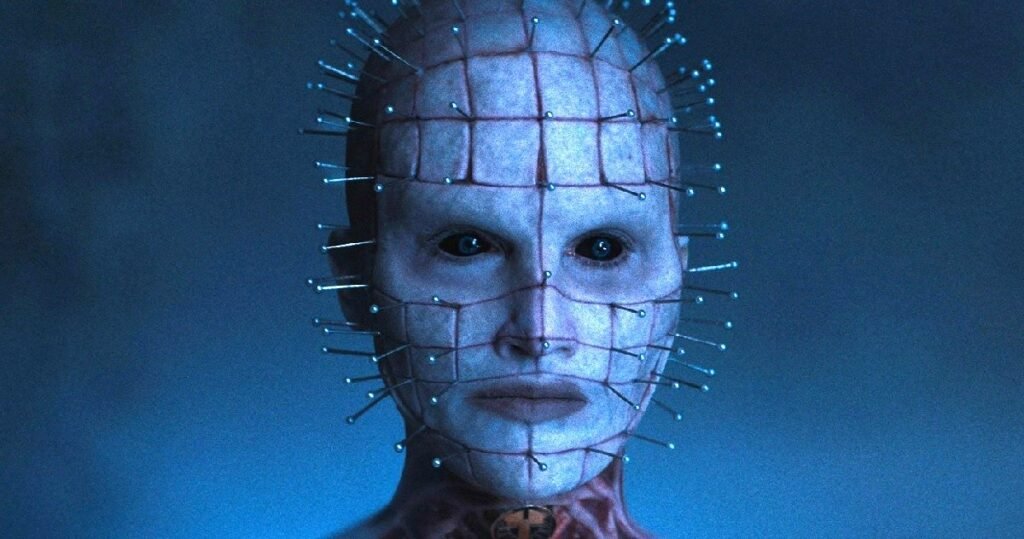
Pinhead is the lead Cenobite of Clive Barker’s Hellraiser franchise: a pale, black-clad figure whose head is studded with nails in a neat grid. Open the wrong puzzle box, and he and his fellow Cenobites arrive to take you to their realm for an eternity of “experience.” Doug Bradley played him in the first eight films, starting with Hellraiser (1987). Unlike the silent slashers of the 1980s, Pinhead is calm, articulate and bound by his own strict code. Barker himself never liked the nickname and calls the character the Hell Priest.
At a glance
| Franchise | Hellraiser |
| First appearance | The Hellbound Heart (novella, 1986), as an unnamed Cenobite; first film appearance in Hellraiser (1987) |
| Creator | Clive Barker |
| Portrayed by | Doug Bradley (Hellraiser, 1987, through Hellraiser: Hellworld, 2005) Stephan Smith Collins, voiced by Fred Tatasciore (Hellraiser: Revelations, 2011) Paul T. Taylor (Hellraiser: Judgment, 2018) Jamie Clayton (Hellraiser, 2022) |
| Weapon of choice | Hooked chains that appear from nowhere, the power of the Lament Configuration puzzle box, and the Cenobites’ tools of torture |
Origin story and backstory
In the films, Pinhead was once Captain Elliot Spencer, a British Army officer who came home from World War I disillusioned with life and humanity. Looking for something beyond ordinary pleasure and pain, he solved the Lament Configuration, a puzzle box that opens a door to the realm of the Cenobites, and became one of them. Hellbound: Hellraiser II (1988) reveals this history. Hellraiser III: Hell on Earth (1992) splits the two halves of the character apart, with Spencer’s human spirit trying to stop Pinhead.
The Cenobites call themselves “explorers in the further regions of experience. Demons to some, angels to others.” They serve Leviathan, the god-like ruler of their labyrinth, and see no real difference between pain and pleasure. They don’t hunt for victims; people summon them by opening the box. In the 1987 film that means Frank Cotton, who opens the box and later escapes them, and later his niece Kirsty Cotton, who bargains with them. Pinhead also keeps to a code. In Hellbound, when a young girl named Tiffany opens the box, he spares her because she was manipulated into it by others. That sense of rules, rather than random cruelty, is what sets him apart from the decade’s other movie monsters.
Novella, films and novels
Pinhead started small. In Barker’s novella The Hellbound Heart (1986), the Cenobite with the grid of jeweled pins is unnamed, androgynous and speaks with “the voice of an excited girl.” When Barker adapted it as Hellraiser, he called the character “the Priest” in early drafts. The film credits him only as “Lead Cenobite,” and he has only about eight minutes of screen time. The crew nicknamed him “Pinhead,” fans adopted the name, and it is first spoken on screen in Hellraiser III. Barker’s 2015 novel The Scarlet Gospels gives him the title “the Hell Priest.” It leaves open whether he has been the same being for millennia or is only the latest person to hold the role, and it doesn’t confirm that the book’s Hell Priest is Elliot Spencer. David Bruckner’s 2022 reboot cast Jamie Clayton as a new version of the Priest, separate from the earlier film continuity.
Iconic moments
- “We have such sights to show you” (1987): Pinhead’s promise to Kirsty, part invitation and part threat, became the franchise’s signature line.
- The chains (1987): Hooked chains shoot out of the darkness to claim the man who cheated the Cenobites. Barker keeps the moment nightmarish rather than lingering on gore.
- The bargain (1987): Kirsty buys her life by offering to lead the Cenobites to her escaped uncle, Frank. Pinhead accepts, which shows how bound to the rules he is.
- The photograph (1988): In Hellbound, Kirsty shows the Cenobites a photo of a young Captain Spencer, reminding Pinhead that he was once human.
- Unleashed (1992): Freed from his human half in Hellraiser III, Pinhead tears through a nightclub and mocks a priest in a church.
- A new Priest (2022): Jamie Clayton’s quiet, precise Priest reimagines the character for a new continuity, 35 years after the original film.
Appearances
Films in release order
- Hellraiser (1987), written and directed by Clive Barker
- Hellbound: Hellraiser II (1988)
- Hellraiser III: Hell on Earth (1992)
- Hellraiser: Bloodline (1996)
- Hellraiser: Inferno (2000)
- Hellraiser: Hellseeker (2002)
- Hellraiser: Deader (2005)
- Hellraiser: Hellworld (2005), Bradley’s last film in the role
- Hellraiser: Revelations (2011)
- Hellraiser: Judgment (2018)
- Hellraiser (2022), directed by David Bruckner, released on Hulu
Books, comics, games and what’s next
On the page, the Hell Priest returns in The Scarlet Gospels (2015) and the novella Hellraiser: The Toll (2018), and Barker oversaw Hellraiser comics from Marvel in the 1990s and from BOOM! Studios starting in 2011. The video game Clive Barker’s Hellraiser: Revival, from Saber Interactive and Boss Team Games, is scheduled for release on October 8, 2026, with Doug Bradley voicing Pinhead again. A sequel to the 2022 film has been discussed but not officially greenlit.
Trivia and behind-the-scenes facts
- Barker and Bradley trace the character back to Hunters in the Snow, a 1973 play Barker directed, in which Bradley played an undead torturer called the Dutchman.
- Barker’s early sketches gave Pinhead quills on his head, but the budget didn’t allow it. The crew tried six-inch nails in a grid, then swapped them for thin pins because the nails looked too crude.
- Barker has said he drew on Christopher Lee’s Count Dracula for the character’s cold, aristocratic presence.
- Bradley wanted Pinhead to be a 20th-century man and told Fangoria he saw him as “the chief Cenobite of the 20th century.” The sequel’s World War I backstory fit that idea.
- Hellraiser was Barker’s first film as director. He wrote The Hellbound Heart as a step toward directing after being disappointed with how producers handled his scripts for Underworld (1985) and Rawhead Rex (1986).
- The famous line “Jesus wept” in the 1987 film is spoken by Frank Cotton, not Pinhead.
- In 1998, Barker promised to kill the character off in The Scarlet Gospels so thoroughly that no producer could ever bring him back. The book finally came out in 2015.