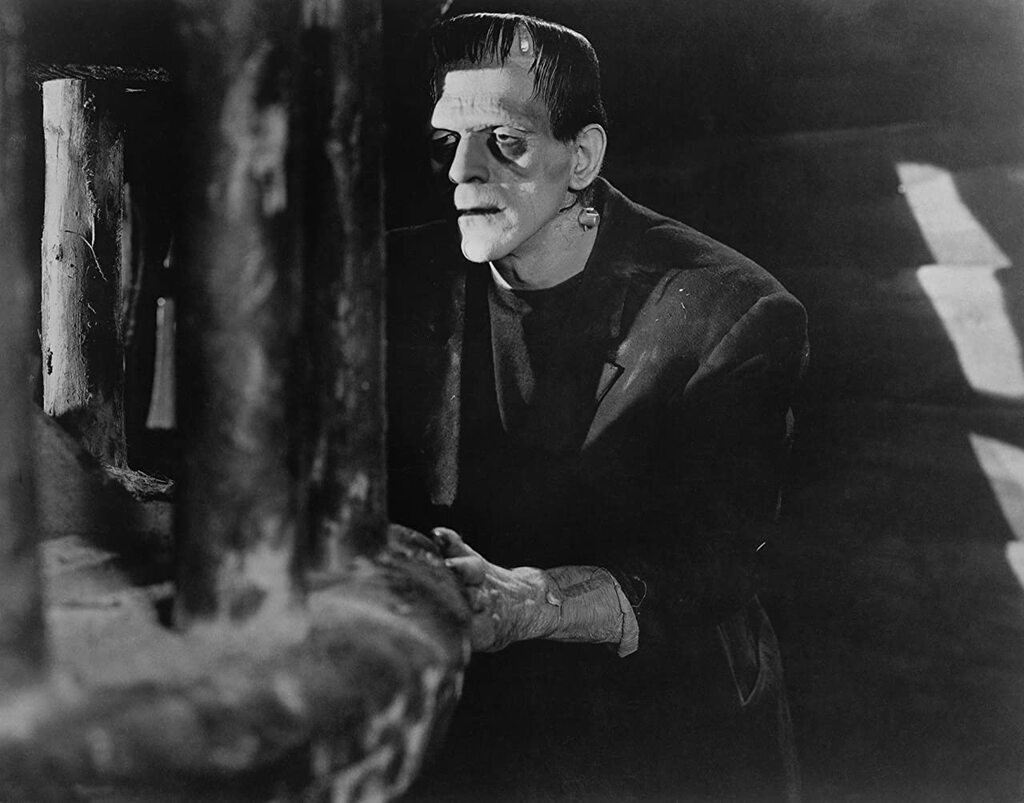
Frankenstein’s Monster is the being that young scientist Victor Frankenstein builds from dead bodies and brings to life in Mary Shelley’s novel Frankenstein; or, The Modern Prometheus (1818). In the book he has no name. He is eloquent, lonely and furious at the creator who abandoned him. The image most people know, with the flat head, the neck bolts and the stiff walk, comes from Boris Karloff in Universal’s Frankenstein (1931). This page follows the Monster through the novel and his major screen versions. And yes, strictly speaking, “Frankenstein” is the doctor, not the Monster.
At a glance
| Franchise | Frankenstein (Mary Shelley); Universal Monsters; Hammer‘s Frankenstein series |
| First appearance | Frankenstein; or, The Modern Prometheus (novel, 1818); screen icon in Frankenstein (Universal, 1931) |
| Creator | Mary Shelley |
| Portrayed by | First on film: Charles Ogle (Edison Studios’ Frankenstein, 1910) Universal: Boris Karloff (Frankenstein, 1931; Bride of Frankenstein, 1935; Son of Frankenstein, 1939); Lon Chaney Jr. (The Ghost of Frankenstein, 1942); Bela Lugosi (Frankenstein Meets the Wolf Man, 1943); Glenn Strange (House of Frankenstein, 1944; House of Dracula, 1945; Abbott and Costello Meet Frankenstein, 1948) Hammer: Christopher Lee (The Curse of Frankenstein, 1957); later Hammer films used different creatures and actors, including Kiwi Kingston and David Prowse Other notable versions: Robert De Niro (Mary Shelley’s Frankenstein, 1994), Rory Kinnear (Penny Dreadful, 2014–2016), Jacob Elordi (Guillermo del Toro’s Frankenstein, 2025), Christian Bale (The Bride!, 2026) |
| Weapon of choice | Enormous strength, speed and endurance; in the novel, also a sharp mind that he turns to revenge |
Origin story and backstory
In the novel, Victor Frankenstein, a student at Ingolstadt, discovers how to give life to dead matter and spends two years building a man about eight feet tall. The moment the creature opens its eyes, Victor is horrified and runs away. The abandoned creature wanders alone, teaches himself to speak and read by secretly watching a family in a cottage, and finds Victor’s journal describing how he was made. When the family finally sees him and drives him away, his longing for companionship turns to hatred for his maker.
The creature kills Victor’s young brother, William, and frames Justine Moritz, a young woman who lives with the Frankensteins, who is then executed. He then confronts Victor in the Alps and asks for a female companion, promising to vanish forever with her. Victor starts work on a mate in Orkney but destroys it before it is finished. “I will be with you on your wedding night,” the creature promises, and he keeps his word. Victor pursues him into the Arctic, where the story ends.
Shelley’s Creature, Universal’s Monster and everything since
Shelley began the story in 1816, during the summer she spent near Geneva with Percy Shelley, Lord Byron and John Polidori, when Byron suggested they each write a ghost story. The novel was published anonymously on January 1, 1818, when she was 20. Hollywood’s version came mostly from Peggy Webling’s 1927 stage play and from Universal’s 1931 film, which changes a great deal. Victor becomes Henry Frankenstein, a hunchbacked assistant steals a criminal’s brain for the experiment, and the creature is mute and childlike. It is lightning in a tower laboratory, not the novel’s vaguely described science, that brings him to life. Hammer’s The Curse of Frankenstein (1957) avoided Universal’s copyrighted makeup and made the Baron, played by Peter Cushing, the real monster. Later versions, from Kenneth Branagh’s 1994 film to del Toro’s 2025 adaptation, have gone back toward Shelley’s articulate, suffering Creature.
Iconic moments
- “It’s alive!” (1931): Colin Clive’s Henry Frankenstein shouts the line as lightning animates the body. AFI ranks it No. 49 on its list of the greatest movie quotes.
- The reveal (1931): The Monster backs through a doorway and slowly turns, and director James Whale cuts closer and closer to Karloff’s face.
- Maria at the lake (1931): The Monster happily tosses flowers into the water with a little girl, then, not understanding, throws her in too. The tragedy is kept off-screen.
- The blind hermit (1935): In Bride of Frankenstein, a blind man takes the Monster in, shares bread and wine with him, and teaches him to say “friend.”
- The Bride (1935): Elsa Lanchester’s Bride, with her hair streaked with lightning, sees her intended mate and screams.
- The wedding night (1818): In the novel, the creature carries out his threat and kills Elizabeth on her wedding night.
Appearances
The novel and key screen versions
- Frankenstein; or, The Modern Prometheus (novel, 1818; revised edition 1831)
- Frankenstein (1910), Edison Studios, generally considered the first film adaptation
- Frankenstein (1931), Universal, directed by James Whale
- Bride of Frankenstein (1935), directed by Whale
- Son of Frankenstein (1939), Karloff’s last time in the role on film
- The Ghost of Frankenstein (1942), Frankenstein Meets the Wolf Man (1943), House of Frankenstein (1944) and House of Dracula (1945)
- Abbott and Costello Meet Frankenstein (1948)
- The Curse of Frankenstein (1957), Hammer, directed by Terence Fisher, with Christopher Lee
- Young Frankenstein (1974), Mel Brooks’s comedy, with Peter Boyle as the Monster
- Mary Shelley’s Frankenstein (1994), directed by Kenneth Branagh, with Robert De Niro
- Penny Dreadful (Showtime, 2014–2016), with Rory Kinnear
- Frankenstein (2025), Netflix, directed by Guillermo del Toro, with Jacob Elordi and Oscar Isaac
- The Bride! (2026), directed by Maggie Gyllenhaal, with Christian Bale and Jessie Buckley
Trivia and behind-the-scenes facts
- In the novel, Victor calls his creation “creature,” “fiend,” “daemon,” “wretch” and more, but never gives him a name. Shelley was amused that an 1823 stage version listed the role in the cast simply as a row of dashes.
- The opening credits of the 1931 film list the Monster as played by “?” Karloff’s name appears only in the closing credits.
- Universal quickly copyrighted Jack Pierce’s makeup design, which is why other studios’ monsters look different.
- Christopher Lee was reportedly annoyed to discover that his Hammer creature had no dialogue at all.
- Del Toro had long wanted to make the film, at one point for Universal with Doug Jones as the Creature. His 2025 version won three Oscars, for costume design, makeup and hairstyling, and production design, and Elordi was nominated for Best Supporting Actor.
- The Bride!, a reimagining of Bride of Frankenstein, calls the Monster “Frank,” and was a box-office disappointment.