Remembering Ryū Murakami — The Man Who Wrote Audition Was 74
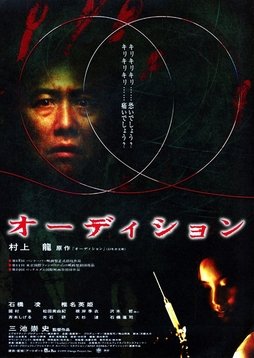
Official theatrical poster. © Omega Project
Ryū Murakami (February 19, 1952 – October 17, 2026) was the Japanese novelist and filmmaker who wrote Audition, horror’s quietest nightmare.
The phone has not rung in four days. She sits beside it in a nearly empty apartment, perfectly still, a large sack on the floor nearby — waiting for a widower she met once, at an audition that was never really an audition, to decide that she is the one. He has no idea what he is deciding. Neither, the first time, do you.
That stillness — that patience — is Ryū Murakami’s gift to horror. Other writers built haunted houses. He built a woman sitting by a telephone, and made it the scariest room in the world.
Ryū Murakami died at his home in Tokyo on Saturday, October 17. He was 74. His longtime publisher, Gentosha, announced his death on Friday, October 23, and said his family has already held funeral services and asked for privacy. No cause of death has been announced. Gentosha wrote: “We pray for the peaceful rest of a man who raced through his era as one of its leading trailblazers.”
Quick Specs
- Born: February 19, 1952, in Sasebo, Nagasaki, Japan
- Died: October 17, 2026, in Tokyo (aged 74); announced October 23 by his publisher, Gentosha
- Cause: None announced
- Full name: Ryūnosuke Murakami
- Horror signature: Audition (1997 novel), adapted by Takashi Miike into the 1999 film
- Also in the crypt: Piercing (1994), In the Miso Soup (1997), Coin Locker Babies (1980)
- Career: 1976–2026; more than forty books; Akutagawa Prize winner at 24; also directed films, including his own Almost Transparent Blue (1979)
The Book That Waited by the Phone
Murakami published Audition in 1997. The setup is a lie that tells on itself: Shigeharu Aoyama, a widowed film producer, stages a fake casting call to find a new wife, and chooses Asami Yamazaki, a quiet former ballerina whose references cannot be reached and whose past will not sit still. It reads, for long stretches, like a melancholy romance. That is the trap, and Murakami sets it with a craftsman’s patience — by the time the sack in Asami’s apartment matters, you are already inside it.
Takashi Miike filmed the novel two years later, from a screenplay by Daisuke Tengan, with Ryo Ishibashi as Aoyama and Eihi Shiina — a model making her acting debut — as Asami. The film premiered at the Vancouver International Film Festival on October 2, 1999, won the FIPRESCI Prize and the KNF Award at Rotterdam in 2000, and went on to a permanent place on best-horror-films-ever-made lists. Every bit of that afterlife starts on Murakami’s page. Asami is his invention before she is anyone else’s — Shiina’s performance is the one every later version gets measured against, and the character walked out of his novel to do it.
A Résumé Written in Bruises
Audition was not his only gift to the genre. Piercing (1994) — a husband and father who checks into a hotel room planning a murder and meets the one woman who can match him — became Nicolas Pesce’s 2018 film with Christopher Abbott and Mia Wasikowska. In the Miso Soup, published the same year as Audition, follows an American tourist through Tokyo’s nightlife at New Year in the company of a guide who may be a killer. Coin Locker Babies (1980) follows two boys abandoned in station lockers into the city’s underbelly. The settings change; the subject doesn’t. Murakami wrote about people the modern city had used up, and what the using left behind.
He worked the camera himself, too. He directed the film of his debut novel, Almost Transparent Blue, in 1979, and went on directing — All Right, My Friend, Raffles Hotel and Because of You among his films. In later years Japanese television audiences knew him in an unlikely second costume: from 2006 he co-hosted a TV Tokyo talk show about business and finance. The enfant terrible, discussing markets. He would have enjoyed the contradiction.
The Enfant Terrible
His career began like a detonation. Almost Transparent Blue, written while he was still at university and published in 1976, follows a nineteen-year-old adrift in sex, drugs and violence near an American military base — drawn from the Sasebo he grew up in — and it won both the Gunzo Prize for New Writers and the Akutagawa Prize, Japan’s most prestigious literary award, when he was 24. He never really slowed down after that: more than forty novels and story collections across fifty years, each one aimed, as his publisher put it, at younger generations.
Adam Freudenheim, who publishes Murakami’s novels in English, said: “It has been a huge privilege to bring many of Ryu Murakami’s strange, original and cinematic novels to an English-speaking audience.” Strange, original and cinematic — three words, and all three of them load-bearing. Horror took two of his books and built landmarks out of them. Literature got the rest, and it was just as dangerous.
Trivia & Facts
- Asami’s whispered “kiri-kiri-kiri” in the film’s climax almost wasn’t spoken aloud: Eihi Shiina first whispered the lines, and she and Miike decided saying them out loud was scarier. They were right.
- Miike shot Audition in roughly three weeks in Tokyo — about a week longer than his usual pace at the time.
- The company behind the film, Omega Project, had just made Ring and bought Murakami’s novel specifically to make a horror film with no ghosts in it at all.
- At high school in Sasebo, Murakami drummed in a rock band called Coelacanth — and earned three months of house arrest after he and his classmates barricaded the school rooftop in protest.
- He was no relation to Haruki Murakami. Same surname, same generation, entirely different haunting.
Harper’s Extras
- Tonight, honor him the hard way: Audition (1999), lights off, no phone in your hand. Sit with the quiet. The quiet is the point.
- Then read the novel and meet Asami on the page, where she is colder, sadder and even harder to escape.
- Pair it with Piercing (2018) later this week and watch a second filmmaker discover that Murakami’s hotel rooms are not safe either.
- He joins a hard month of farewells in our crypt: Tom Skerritt, Richard Riehle and Bob “Hoolihan” Wells. Hold the great ones close, fiends.
FAQ
When did Ryū Murakami die?
He died on Saturday, October 17, 2026, at his home in Tokyo. He was 74. His publisher, Gentosha, announced his death on October 23; no cause has been announced.
What is Ryū Murakami best known for in horror?
His 1997 novel Audition, which Takashi Miike adapted into the 1999 film with Ryo Ishibashi and Eihi Shiina — one of the most celebrated Japanese horror films ever made.
What other Murakami books became films?
Piercing (1994) became Nicolas Pesce’s 2018 film with Christopher Abbott and Mia Wasikowska, and Murakami directed several films himself, including the adaptation of his own debut, Almost Transparent Blue (1979).
Was Ryū Murakami related to Haruki Murakami?
No. The two novelists share a surname and a generation, nothing more.
Some horror screams. His sat perfectly still, beside a telephone, and waited for you to come to it. Thank you for the patience, and for the nightmare, sensei.
Sleep tight.