
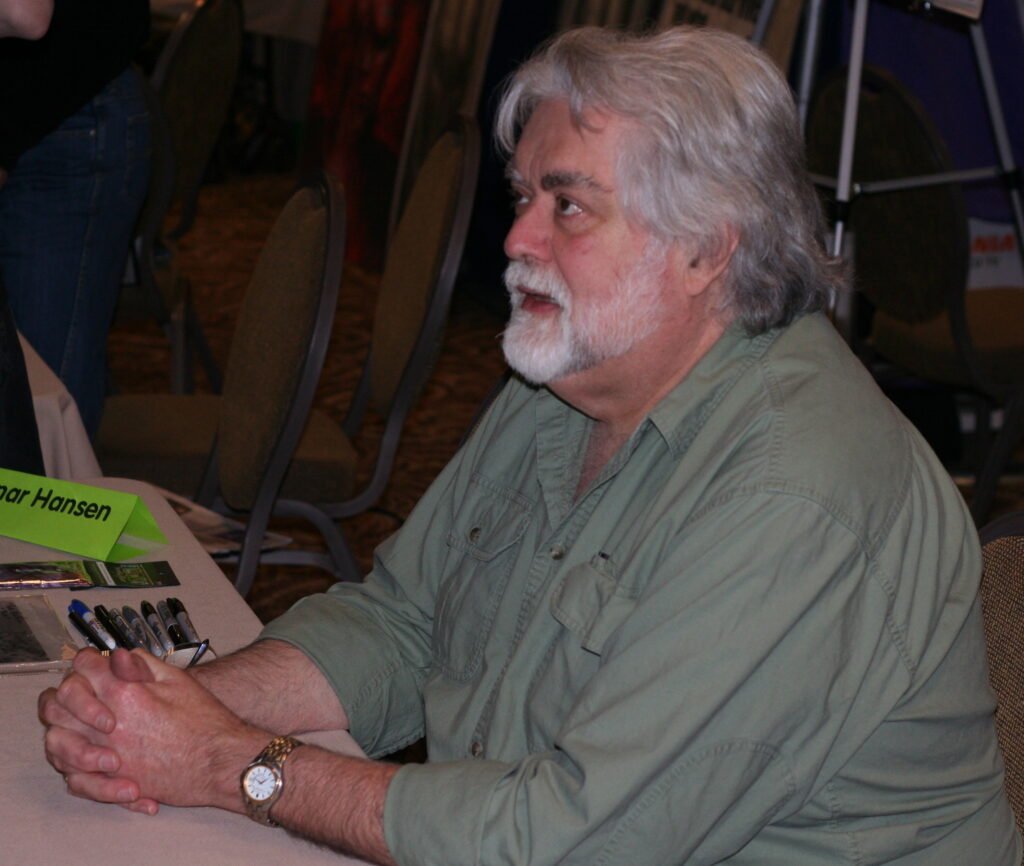
Gunnar Hansen (1947-2015) was an Icelandic-born American actor and writer who created Leatherface in The Texas Chain Saw Massacre.
Quick Specs
| Born | Gunnar Milton Hansen, March 4, 1947, Reykjavik, Iceland |
| Died | November 7, 2015, Northeast Harbor, Maine, of pancreatic cancer, aged 68 |
| Education | Austin High School; University of Texas at Austin (English and mathematics, then graduate study in Scandinavian Studies and English) |
| Signature role | Leatherface in The Texas Chain Saw Massacre (1974) |
| Later films | Hollywood Chainsaw Hookers (1988), Mosquito (1995), Reykjavik Whale Watching Massacre (2009), archive footage in Texas Chainsaw 3D (2013), Death House (2017, co-writer) |
| Books | Islands at the Edge of Time (1993); Chain Saw Confidential (2013) |
Who He Is
The man behind horror’s most famous mask always said he was a writer first. Hansen was born in Reykjavik to an Icelandic father and a Norwegian mother, and he came to the United States with his mother and brother at five. The family lived in Maine until he was eleven, then moved to Austin, Texas. He went through Austin High School and the University of Texas, where he graduated in English and mathematics and stayed on for graduate work in Scandinavian Studies and English. Along the way he worked as a computer operator, and his size got him work as a bouncer.
The Movies, and What He Did on Them
The Texas Chain Saw Massacre (1974): in the summer of 1973, fresh out of graduate school, Hansen heard that local filmmakers in Austin were making a horror movie and needed someone to play the killer. He had done some plays in college, so he auditioned and got the part. As he told it, he figured it would beat tending bar or pounding nails for a summer job.
He took the role more seriously than the paycheck deserved. Under an expressionless mask, with no real dialogue, he made a killer that audiences feel uneasy about rather than simply afraid of.
The chainsaw was real, and so was the danger. Any time Leatherface cut into something, the saw had its teeth. Hansen said he only understood how dangerous it was years later, chopping firewood to heat his house in Maine. He was nervous about the scene where Leatherface falls with the saw running. Tobe Hooper kept reassuring him it would be shot last. Hansen later realized what that meant: if he got hurt, the movie would already be in the can.
The money never matched the legend. In his own account, his shooting salary worked out to about two dollars an hour. His first royalty check was for roughly forty-seven dollars, and the film paid him around eight thousand dollars in total.
Hollywood Chainsaw Hookers (1988): Hansen came back to the screen after years of writing, playing The Stranger in the horror spoof. About twenty more films followed, mostly low-budget horror. He treated acting as a side project. His last screen appearance was a cameo in Death House (2017), a film he co-wrote and was producing when he died; it was released after his death.
The Writer
After the Chainsaw shoot he did not move to Hollywood. In 1975 he moved back to Maine and settled on the coast to write. He worked for years writing and sometimes editing for magazines, then moved into books, documentary films and screenplays. His 1993 book Islands at the Edge of Time follows the barrier islands from Texas to North Carolina and asks how people can keep living on them as seas rise. He objected when his publisher put Leatherface in the author blurb: if someone was deciding whether to buy a serious environmental book, he said, that line would make them put it down.
In 2013 he finally wrote the Chainsaw book himself. Chain Saw Confidential interviews as many of the cast and crew as he could find and looks at how the film’s reputation grew. He wrote it partly because four of the original company had already died.
Signatures, Habits and Behind the Scenes
- “I never was trying to have a career as an actor,” he said. “My interest has always been writing.”
- On why Leatherface still frightens people, he said that if you took the mask off, there might be no face there at all. “Just an empty black spot.”
- He lived in Maine for about forty years. He was survived by Betty Tower, his partner of thirteen years.
Why He Matters
Every Leatherface since has been measured against Hansen’s. He gave the character a body language of panic as well as menace, which made the monster pitiful and terrifying at once. That he did it for a summer job, then walked away to write about islands and sea levels, makes him one of the strangest and most admirable figures in the genre.