
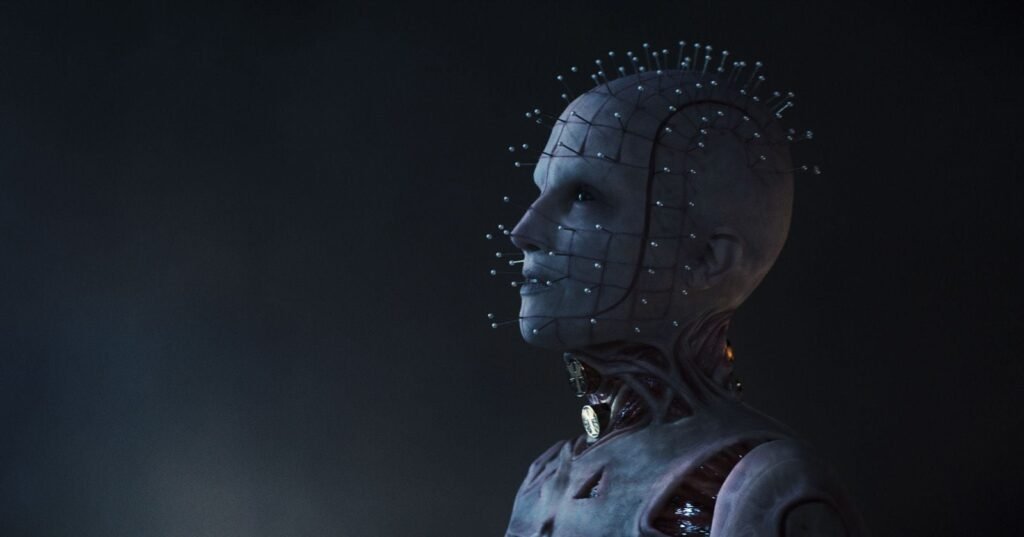
The Cenobites are Barker’s Order of the Gash — summoned experimenters who no longer distinguish pain from pleasure, and horror’s most courteous monsters.
They are a fictional group, and this page keeps their five continuities separate: Clive Barker’s 1986 novella The Hellbound Heart, the original film sequence (1987–2018), Barker’s later prose, two separate comics continuities, and the 2022 reboot. There is no fixed, franchise-wide roster — the Cenobites vary in number, appearance and motivation depending on the medium — so every membership claim below names its work. A list that opens with one film’s line-up as if it were timeless is describing that film, and this page says which.
Quick Specs
- Type: Extradimensional religious order (fictional)
- Created by: Clive Barker
- First appearance: The Hellbound Heart (1986)
- Summoned by: The puzzle box — Lemarchand, on the page; Lament, on screen
- Roster: Varies by work — there is no single fixed line-up
The Novella’s Order (1986)
“Cenobite” is a real English word for a member of a religious order who lives in a communal, monastic community, and Barker’s beings are a deliberate inversion of it: an order who have pursued experience so far that pain and pleasure have dissolved into one another, and who conduct “experiments” on the humans who summon them. In The Hellbound Heart they are called the Order of the Gash, and the text also calls them Hierophants. They do not roam freely: they reach Earth’s reality only through a schism opened by solving a puzzle box — the Lemarchand Configuration in the novella, made by Philip Lemarchand, a maker of mechanical singing birds. The summoner is usually seeking experience beyond human limits; the Cenobites take that literally, and the summoner is taken to their realm as an experiment, which the human experiences as eternal torture. The novella’s four are never named. They are sexless, scarred and ash-dusted, described through four mutilation portraits: one with stitches through its eyelids and chains with bells hooked into its body; one with a grid tattooed on its head and jeweled pins driven into the skull at the intersections; one with eyes swollen shut and a heavily disfigured mouth; and a female Cenobite with elaborate scarification. There is no clear leader among the four. The being who presides is the Engineer, who appears briefly as an apparently ordinary human whose body glows with intense light. The grid-pinned figure who would become the films’ leader is in the novella just one of the four, speaks in the voice of an excited girl, and is never named — importing film names, film ranks or film genders into a novella sentence is the commonest error on this subject. Frank Cotton solves the box expecting beautiful women and untold pleasures, is taken for their experiments, escapes by a trick of blood, and is reclaimed when his escape is exposed; Kirsty — in the novella a friend of Frank’s brother, not a daughter of the house — bargains and survives. Their realm in the prose is deliberately uncodified: no named god presides over the Order in the passages the record carries, and nothing here serves Leviathan.
The 1987 Film: The Original Four
Barker’s Hellraiser (1987) — his feature directorial debut, made, on his own figure, for $900,000 — fixes the group in the public mind as four: the Lead Cenobite (Doug Bradley), the Female Cenobite (Grace Kirby, Barker’s cousin), the Chattering Cenobite (Nicholas Vince) and Butterball (Simon Bamford). Those are the 1987 credits, and the credit discipline matters: he is not credited as “Pinhead” — that was a crew nickname Barker had no say in and thought undignified — and Vince is credited “Chattering,” not “Chatterer.” Summoned first by Frank and then accidentally by Kirsty Cotton, the four honour Kirsty’s bargain — Frank, their escapee, in exchange for her — tear him apart with hooked chains when he is delivered, then move to take Kirsty anyway; she works the box in reverse and banishes them. Their screen time is short, and the Lead Cenobite does almost all the talking, because Chatterer and Butterball’s scripted dialogue proved unplayable under their makeups and was redistributed, much of it to Bradley. What he says became the group’s thesis, and it is a film line, quoted here in the film’s form: “Explorers in the further regions of experience. Demons to some, angels to others.” Its companions are the same film’s: “We have such sights to show you,” “We will tear your soul apart,” and the performance in one sentence, “No tears, please. It’s a waste of good suffering.” The film’s Engineer, note, is a completely different thing from the novella’s — a monstrous, animal-featured creature prowling Hell’s corridors, not a glowing human superior. And the breakout was an accident of reception: Barker designed Julia Cotton to carry the series as its continuing villain, with the Cenobites reduced to a background role. The audience chose the Cenobites.
Hellbound: The Cosmology, and the End of the Four
Hellbound: Hellraiser II (1988) is where the film cosmology arrives — and it is a sequel layer, not the novella’s furniture and not the first film’s. It introduces Leviathan, the great rotating lozenge levitating over an Escher-like labyrinth, with the Cenobites as its priests. It gives the Lead Cenobite a human origin the novella never gave him: Captain Elliot Spencer — Elliot, one final t, in the Hellbound-era record — a British officer of the Great War who solved the box in 1920s India and was transformed. That origin belongs to the film sequence from this point forward, and to no other layer. The Female Cenobite is recast — Kirby declined to return, and Barbie Wilde plays her here, with visibly different features and a reduced throat-wire design; it is one character with two performers, not two characters. The film also demonstrates the early Cenobites’ moral position, which is not simple villainy: they spare Tiffany, the puzzle-gifted patient Dr. Channard used to open the box, because she was manipulated into summoning them. When Kirsty shows the Lead Cenobite a photograph of Spencer, memory and humanity return — and the original four fight the newly made Channard Cenobite, the obsessive psychiatrist transformed, and lose. Channard destroys them, each reverting toward human form as they die. The sequence’s honest shape is death, then repair: Hell on Earth (1992) brings Pinhead back by explaining that Spencer’s death split him — the human soul in limbo, the Cenobite half unrestrained — until the two re-merge, and the later sequels simply have him present. This page lets that seam show rather than writing a smooth “they survived.”
The Later Films: Manufactured Cenobites and a Hardening Nature
From Hell on Earth onward, Pinhead is not merely the group’s leader but its maker. Freed without his Spencer half, he manufactures “Pseudo-Cenobites” from that film’s victims — Pistonhead, Camerahead, Dreamer, Barbie, the CD Cenobite — people given traits of their lives and professions, one-film creations who carry forward as nobody’s standing membership. Bloodline (1996) adds Angelique, a demon princess summoned in 18th-century France and treated by Pinhead as something close to an equal before being forcibly converted, plus the fused Twin Cenobite and the Chatter Beast — and re-spells the box’s maker Philippe Lemarchant, an innocent commissioned craftsman, which is that film’s layer only: the novella’s birds-maker and the Epic comics’ murderer who built boxes from human fat and bone are two other men in two other continuities. Across these films the group’s nature visibly hardens: the amoral experimenters of 1986–88, bound by the bargain’s terms, become malicious villains who delight in harm, with Pinhead a would-be conqueror. That is a drift in the writing — much of it after Barker’s direct involvement ended — not one consistent doctrine. The direct-to-video era (2000–2005) contracts the group to Pinhead and brief attendants; Hellseeker brings Kirsty back for a final bargain. The count that governs this era is Bradley’s: exactly eight films as the character, 1987 through Hellworld (2005). Not nine, not ten, not all of them. Revelations (2011) is Stephan Smith Collins, voiced by Fred Tatasciore; Judgment (2018) is Paul T. Taylor.
Barker’s Prose and the Comics: The Office Changes Hands
Barker’s later prose gives the leader his formal rank: in The Scarlet Gospels (2015) he is the Hell Priest — Barker’s preferred title, formalised there — and the character himself hates the “Pinhead” nickname. The novel pointedly does not settle that its Hell Priest is Elliot Spencer: the text indicates debate over whether the Hell Priest has been the same being for centuries or whether several have held the rank, with evidence for both. The house form is therefore double: in the films he is Elliot Spencer; Barker’s novel leaves the Hell Priest’s human identity deliberately unsettled. The BOOM! Studios comics (2011 onward) prove the same point inside their own continuity: Spencer, tired of the office, is restored to humanity, and Kirsty Cotton agrees to take his place as Hell’s priest, grid-and-pins visage and all, vowing to change Hell from within. That is comics canon only — on film, Kirsty bargains and survives and is never transformed — and it is the clearest demonstration in the whole record that the Hell Priest is an office, not a person.
The 2022 Reboot: A Separate Group
David Bruckner’s Hellraiser (2022) is, in his own words, not a remake but a new story in the Hellraiser universe — a separate continuity with a complete, separate roster of seven: the Priest (Jamie Clayton), the Chatterer (Jason Liles), the Weeper, the Gasp, the Asphyx, the Mother and the Masque. None of them is a returning original recast: Clayton’s Priest is not Bradley’s Spencer continuing, Liles’s Chatterer is not Vince’s character, and Butterball, the Female Cenobite and Channard do not exist in this film. The design philosophy is deliberately opposed to 1987’s — concept designer Keith Thompson’s governing idea was “what if they were their own leather”: bodies flayed, sectioned and re-fastened, flesh as the garment rather than leather costumes worn over wounds. The film keeps Leviathan, and ends with the hedonist Roland Voight taken by its chain and shown being transformed — an unnamed, in-progress new Cenobite, not a seventh named member — while its heroine refuses the final bargain and accepts a life of regret. Barker, a producer on the film, praised the designs as paying homage to the first film and then taking it “to places it’s never been before.”
The Design: Repulsive Glamour
The original look was built by Bob Keen and Geoff Portass’s Image Animation for makeup and Jane Wildgoose for costume. Barker’s brief to Wildgoose was for four or five “super-butchers” — something between a butcher’s outfit and a monk’s habit, with areas of revealed flesh where torture “has, or is occurring” — summed up in his phrase “repulsive glamour.” Wildgoose worked from piercing-trade journals and Vesalius’s anatomical drawings, in distressed leather, designing costumes that attach to the body with fish-hooks so that costume and wound become one thing. Barker’s stated inspirations in the record are punk fashion, Catholicism, and the S&M clubs he visited in New York and Amsterdam. The result is the group’s portrait grammar: each member’s modification as their name and face — a grid of pins through a skull, a throat held open on wires, a mouth wired into a perpetual chattering grimace, eyes behind dark glasses. Barker also insisted on actors rather than cheaper stunt performers under the prosthetics, which the production coverage credits for the group’s personalities surviving the makeup. Against all of it stands the arrival itself as signature: bells, light through slats, walls opening, and the hooked chains that fly from nowhere to take the summoner — the group’s weapon in every film layer, from Frank’s tearing in 1987 to Leviathan taking Voight in 2022.
Why They Matter
The Cenobites broke the 1980s villain template. The decade’s horror antagonists were either completely mute or provided glib commentary while killing; Barker’s were theologians — articulate, ritual, bound by rules, and not even the protagonists’ enemies in any simple sense, since they came only for those who solved the box and could be bargained with. Stillness and courtesy are the design: the Lead Cenobite speaks softly, negotiates, and keeps his word — which is why a group with minutes of screen time in a $900,000 film anchors a franchise. They are also a group icon before they are a solo star: the grid-pinned leader only works against the wired throat, the chattering mouth, the sewn eyes, and the franchise’s later re-centring on Pinhead alone — against Barker’s own Julia-led intention — charts horror’s industrial logic in miniature. The design lineage runs forward as well as back: the 2022 redesign, by a director who refused to do a Bradley impression, was received as a legitimate second vision rather than a costume update, and few 1980s creations sustain two full, opposed design philosophies inside one mythology. And they carry Barker’s transgressive signature into the mainstream: the novella’s sexless, gender-indeterminate beings become, layer by layer, a Hell Priest whose identity the prose leaves unsettled, a Kirsty who holds the office in the comics, and Clayton’s Priest in 2022 — the leader treated, across forty years, as an office anyone might hold. Pain and pleasure as philosophy, worn as butcher’s leather and a monk’s habit: no other horror group is built like them, because no other horror group was built as a religion.
Keep it locked on Think Horror — we have such pages to show you.