A Nightmare on Elm Street (1984) Review
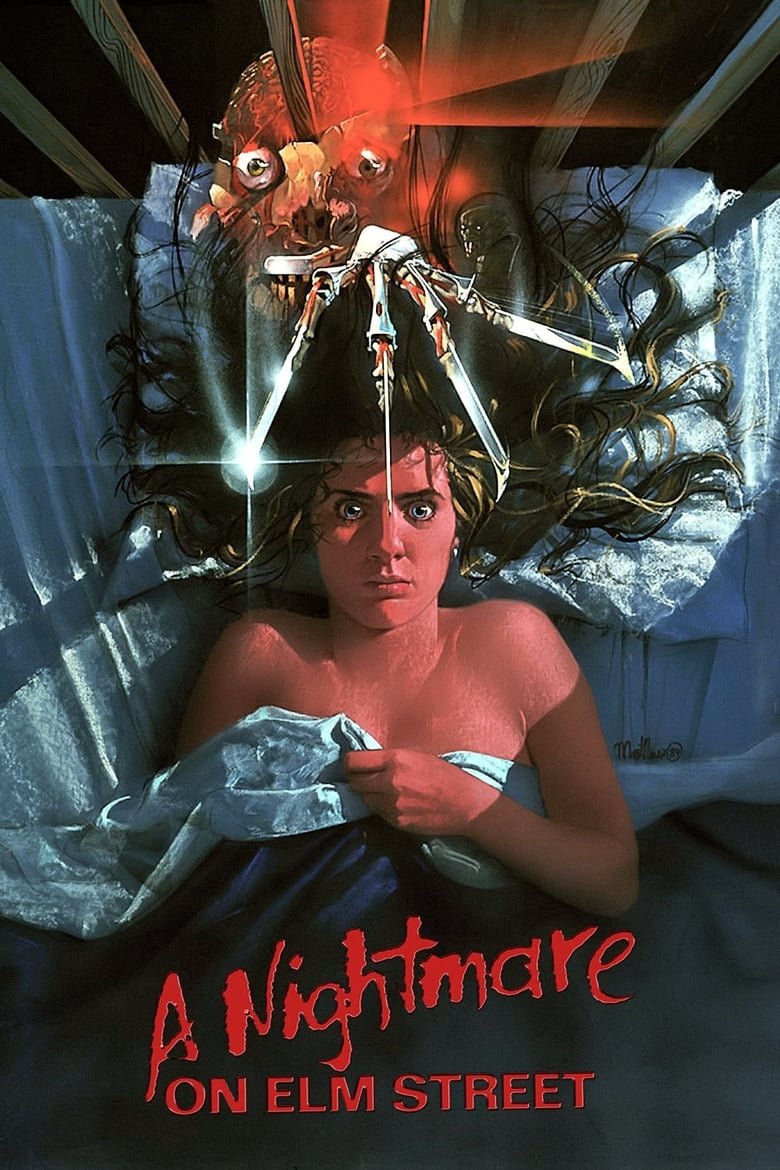
Theatrical poster for A Nightmare on Elm Street (1984). New Line Cinema.
Your eyelids are getting heavy. You fight it — God, do you fight it — but they keep sinking, and the bedroom around you starts to warp at the edges. The walls breathe. And somewhere far away, metal scrapes against metal. Shhhk. Shhhk. Shhhk.
You know that sound. A leather work glove, blades for fingers, dragged slow across a boiler pipe just so you’ll hear it coming. Then you see him — fedora pulled low, face like a roadmap of Hell, that filthy red-and-green sweater. He’s grinning, and the little girls are chanting behind the steam: “One, two, Freddy’s coming for you…”
You try to run, but the hallway stretches. Your feet move through molasses. And here’s the thing that freezes your blood solid: out there, in the real world, you’re safe in bed. But in here? In here, if he gets you, you don’t wake up. Welcome to Elm Street, horror lover. Population: you.
The Review
Okay, maybe that’s a little dramatic. But here’s my confession, horror lover, and I’m putting it right up front: A Nightmare on Elm Street is my all-time favorite horror movie. Not top five. Not “one of the greats.” The one. The film that rewired my brain and never gave it back. So when I tell you this 1984 gut-punch from Wes Craven didn’t just join the slasher boom — it reinvented it — understand I’m not being objective here. I don’t want to be objective about this one.
Here’s the setup, and I’ll keep it spoiler-light: a group of teenagers start sharing the same nightmare about a burned, razor-gloved maniac stalking them in their dreams. Then the nightmares start killing them for real. Nancy Thompson — our heroine, our final girl, our absolute warrior — has to figure out who this thing is and how to drag it out of the dream world before she’s next.
What makes this film immortal isn’t the body count. It’s the idea. Jason stalks the woods. Michael stalks the suburbs. But Freddy? Freddy stalks the one place you can never escape: your own head. Craven took the single most vulnerable thing every human being does — sleep — and turned it into a hunting ground. There’s no running, no hiding, no calling for help. Sooner or later, everybody sleeps. That concept alone puts this movie in the horror hall of fame.
And then there’s Robert Englund. Oh, Englund. Before the one-liners and the cartoon villainy of the later sequels, his Freddy here is genuinely feral — a grinning, twitching, barely-contained thing that moves wrong and laughs at your terror. It’s not just one of the great horror performances. In my book, it’s the great horror performance. He doesn’t just play a killer; he plays your worst nightmare wearing a human face, and forty-plus years later, nobody has touched him.
Opposite him, Heather Langenkamp gives us Nancy Thompson — and let me tell you, Nancy is one of the finest final girls the genre ever produced. She’s not just surviving; she’s studying. She reads up on booby traps, sets a plan, and goes to war. In an era of screaming teenagers tripping over nothing, Nancy Thompson is out here engineering a battlefield. Respect.
Craven’s direction is lean and mean — no fat on this thing. The dream logic is the real star: walls stretching like taffy, a glove rising from the bathwater between Nancy’s legs, Tina dragged up the walls and across the ceiling in a sequence that still makes audiences gasp. The practical effects are gloriously tactile — real blood, real latex, real rotating rooms. When Glen gets pulled into his own bed and the room erupts in a geyser of blood, that’s not CGI. That’s craftsmanship, and it shows.
Now, I’ll level with you: the ending is famously messy — a studio-mandated reshoot that Craven never loved, and yeah, you can feel the seams if you go looking for them. But you know what? I don’t care. I’ve watched this movie more times than I can count, and that ending has never once dented my love for it. If anything, the dreamlike confusion of those final minutes feels right — like the film itself is slipping back into the nightmare. The atmosphere, the concept, the performances — they’re bulletproof. This movie made $25 million on a shoestring budget and built an entire studio. They called New Line “the house that Freddy built,” and every brick in that house was earned.
Harper’s Rating: 5 out of 5. My favorite horror film ever made — the rare slasher that’s as smart as it is scary, and the reason I fell in love with this genre in the first place. Sleep tight.
Frequently Asked Questions
Is A Nightmare on Elm Street (1984) scary?
Yes — it’s Harper’s all-time favorite horror movie for a reason. The dream logic, Robert Englund’s feral Freddy, and the inescapable premise (if he gets you in the dream, you don’t wake up) make it genuinely terrifying.
Who directed A Nightmare on Elm Street (1984)?
Wes Craven — who also wrote it, inspired by newspaper articles about refugees who died in their sleep. It’s the film that made him a horror legend.
Where can I watch A Nightmare on Elm Street (1984)?
As of October 2026, it’s streaming on HBO Max in the US, and available to rent or buy on Apple TV, Amazon Video, Google Play, and YouTube. Check JustWatch for the latest options in your region.
Is A Nightmare on Elm Street (1984) worth watching?
Absolutely — 5 out of 5 skulls and Harper’s favorite horror film ever made. The rare slasher that’s as smart as it is scary. Just maybe don’t watch it right before bed.
Harper Recommends
If this review has you itching for a return trip to Springwood, do yourself a favor and grab the Nightmare on Elm Street Blu-ray collection — all seven original films, cleaned up and looking better than they have any right to. Watching Freddy’s evolution from genuine nightmare fuel to pop-culture punchline across one box set is a horror education in itself. The first film alone is worth the price; the rest is a gloriously bloody bonus.
Harper’s Extras
Every Think Horror review comes with a little something extra rattling around in the goodie bag. Dig in:
- The sweater: Freddy’s red-and-green sweater wasn’t a fashion choice — Craven read that red and green are the two hardest colors for the human eye to process together. He wanted you uncomfortable before Freddy even opened his mouth.
- The inspiration: Craven got the idea from newspaper articles about refugees who died in their sleep after fleeing to America — young, healthy people who simply never woke up. He combined that with the name of a childhood bully, Fred Krueger. Sleep tight, indeed.
- The rotating room: Tina’s infamous ceiling death? The entire bedroom set was built to rotate while the camera stayed fixed. Practical effects, baby — no computers, just engineering and nerve.
- The debut: That baby-faced kid playing Glen? That’s Johnny Depp in his very first film role. He got the part partly because he showed up with a friend who was auditioning — and partly because Craven’s daughter took one look at him and said him.
- Want the full Freddy deep dive? Check out our Freddy Krueger wiki page — backstory, iconic moments, trivia, and everything that makes the Springwood Slasher tick.
Where to Watch
As of October 2026, A Nightmare on Elm Street (1984) is streaming on HBO Max in the US. It’s also available to rent or buy on Apple TV, Amazon Video, Google Play, and YouTube. Streaming lineups shuffle constantly, so check JustWatch for the latest options in your region.
Sweet dreams, horror lover. This one’s personal for me — I hope it gets under your skin the way it got under mine. Just don’t blame us for the nightmares.
Trailer
Go Behind the Screams
Check out these behind-the-scenes looks at how A Nightmare on Elm Street (1984) was made: