
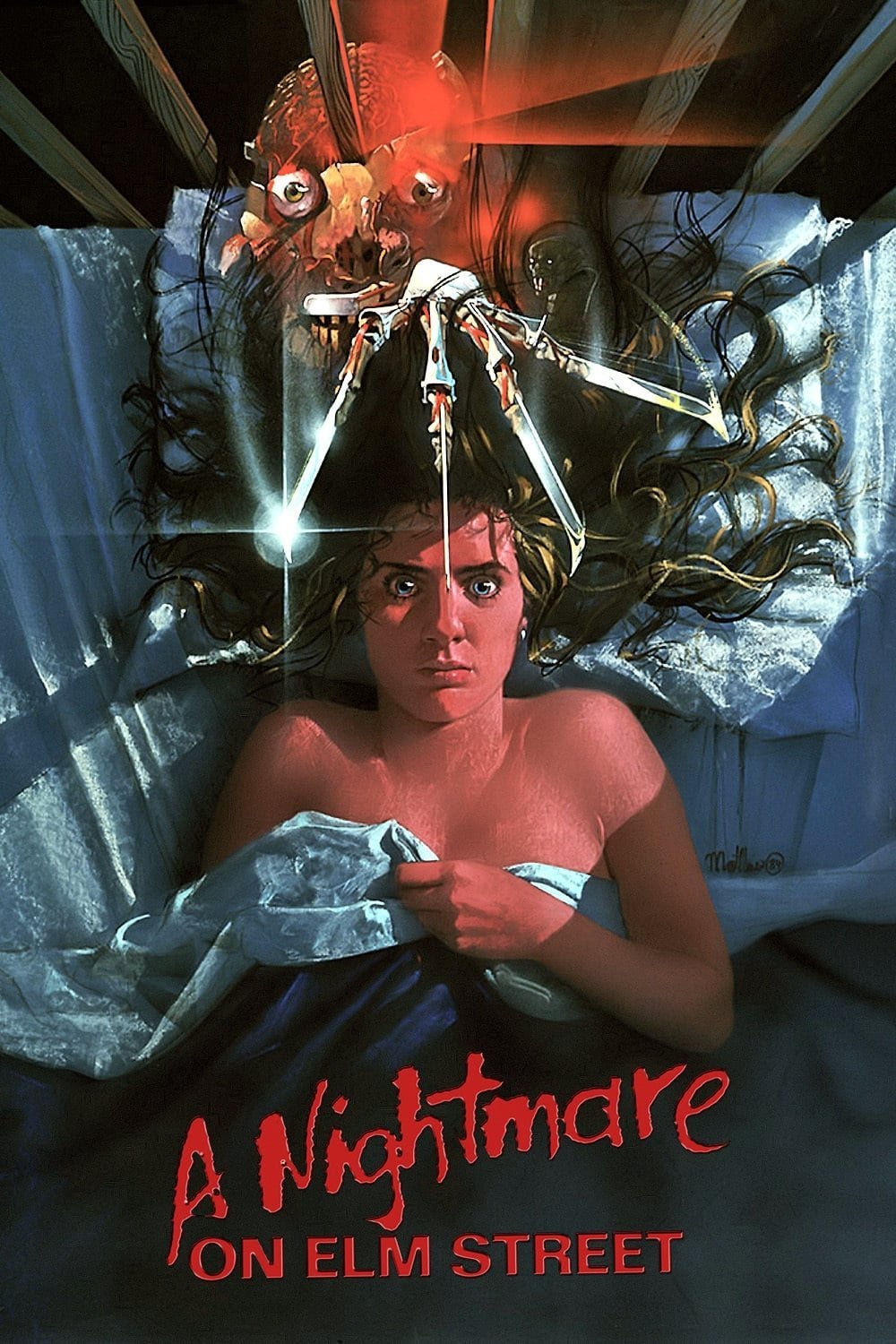
A Nightmare on Elm Street is Wes Craven’s dream-slasher franchise — nine films, one television series, horror’s most theatrical killer.
This rewrite corrects the stub it replaces, which claimed no Elm Street feature followed Freddy vs. Jason while describing the 2010 remake two paragraphs earlier — the remake did follow it, and a new film was announced in July 2026. It also corrects the killer’s job: in the 1984 film Fred Krueger worked in a boiler room, where the parents burned him; the preschool-gardener backstory is the 2010 remake’s invention and is never imported into the original here. Money figures carry their trackers throughout, because with this franchise the trackers genuinely disagree — starting with the first film.
Quick Specs
- Creator: Wes Craven
- Studio: New Line Cinema — “the house that Freddy built”
- Films: 9 (1984–2010)
- Freddy Krueger: Robert Englund (8 films) · Jackie Earle Haley (2010)
- Address: 1428 Elm Street, Springwood, Ohio
The Creation: Nightmares, a Glove, a Boiler Room
Wes Craven wrote and directed the 1984 original, produced by Robert Shaye for New Line — then primarily a distribution company with minimal production history, whose success with this film turned it into a production studio: the industry nickname is “the house that Freddy built.” By Craven’s account — and it is printed here as his account — he built the premise from Los Angeles Times articles about Southeast Asian refugees who died in their sleep during nightmares; his most-quoted telling describes a young refugee who stayed awake for days fearing the thing chasing him in sleep, then “died in the middle of a nightmare.” The documented record beneath the anecdote is separate and corroborated: through 1981 the press covered dozens of sudden unexplained nocturnal deaths among Laotian and Hmong refugee men, a syndrome the CDC formally described in December 1981. Craven shopped the script for roughly three years — Disney wanted the violence toned down and he refused; Paramount and Universal passed — before New Line took it. Fred Krueger, billed in the 1984 credits by that shorter name (“Frederick Charles” is later-franchise material), is the “Springwood Slasher,” a child murderer in fictional Springwood, Ohio, arrested and released on a legal technicality, then hunted down by the Elm Street parents and burned alive in the boiler room where he had taken his victims. He returns in the dreams of those parents’ children, where death in the dream is death in reality — near-invulnerable there, but hurtable if pulled into the real world. The look is burned face, brown fedora, red-and-green striped sweater — the colours, Craven said in interviews, chosen for their retinal clash, and the name taken from a school bully of his own childhood, both printed as his anecdotes — and a glove with four blades on his right hand. The glove’s documented account is short: Craven conceived it verbally, “a glove with steak knives,” wanting a weapon more primal than a knife, and effects artist Jim Doyle built it, in hero and stunt versions. Nancy’s address, 1428 Elm Street, is the franchise’s connective number — the real exterior house stands at 1428 North Genesee Avenue, Los Angeles, and the Never Sleep Again documentary company is named 1428 Films.
The mythology the sequels built on that foundation is labelled as later addition wherever it appears on this site: Freddy’s mother Amanda Krueger, a nun — Sister Mary Helena — raped by asylum inmates, making her son “the bastard son of a hundred maniacs,” arrives in Dream Warriors and The Dream Child, not the original; and the rule that Freddy feeds on fear and memory, powerless in a Springwood that has forgotten him, is Freddy vs. Jason‘s engine, not 1984’s. One more piece of oft-repeated colour is fenced the same way: Freddy’s exact screen time in the original is often cited as roughly seven minutes, endlessly repeated with no authoritative timing source behind it — the brevity is real, the stopwatch is not.
The Original Run (1984–1991)
A Nightmare on Elm Street (1984) opened on 9 November 1984: Heather Langenkamp‘s Nancy Thompson dreams of the same burned, razor-gloved man as her friends, learns he is the murderer her own parents burned, and discovers she can drag him out of the dream into the real world. Its budget is a conflict — $1,800,000 by The Numbers against roughly $1.1 million widely reported — and its worldwide gross is the franchise’s great irreconcilable figure: $25,865,606 by Box Office Mojo against $59,240,066 by The Numbers, which carries some $33.4 million of international that the Mojo original-run record nearly omits; neither is printed here without its tracker. Johnny Depp made his film debut as Glen, whose blood-geyser death, like Tina’s, was shot in a rotating room set. The ending’s sequel door was Shaye’s insistence, by the participants’ accounts, against Craven’s preference for a clean ending. Freddy’s Revenge (1985), directed by Jack Sholder, is the series’ rule-breaker: five years on, Jesse Walsh has moved into 1428 Elm Street, and Freddy uses Jesse’s body as a door into the real world, possessing him to kill — manifesting outside dreams, against the first film’s logic. Budget $3 million by The Numbers; gross $29,999,213 domestic on both trackers, essentially all of it domestic. Shaye has recounted that a pay dispute briefly saw a stand-in wear the Freddy makeup before Englund’s deal closed — printed as his retelling. The film’s gay-subtext reading is documented at length in the 2019 documentary Scream, Queen! Dream Warriors (1987) brought Craven back as co-writer — his only sequel writing return before New Nightmare — with Patricia Arquette, in her film debut, as Kristen, whose gift of pulling others into her dreams becomes the weapon as Langenkamp’s Nancy, now an intern therapist, teaches the last Elm Street children to fight as a group. It opened at number one in the US and grossed $44,793,222, domestic and worldwide the same figure in both trackers; Nancy dies in it, killed by Freddy posing as her father, and its Max is played by an actor credited as “Larry Fishburne.” The Dream Master (1988), directed by Renny Harlin and shot during the Writers Guild strike with an unfinished script, was the original run’s commercial peak: $49,369,899, again domestic-only in both trackers — dying Kristen passes her power to Lisa Wilcox’s Alice, who absorbs a trait from each friend Freddy kills. The Dream Child (1989) arrived under a year later on less than half the budget — the series’ fastest turnaround — as Freddy returns through the dreams of Alice’s unborn son, and the gross fell steeply to $22,168,359: the original run’s commercial turning point. Freddy’s Dead: The Final Nightmare (1991), Rachel Talalay’s feature directorial debut, carries a budget conflict — $9 million by The Numbers against $5 million in the AMC filmsite lineage — and rebounded to $34,872,033 despite its “final” billing, with its last stretch shown theatrically in 3-D, a cameo by Depp as a teen on an anti-drug PSA credited as “Oprah Noodlemantra,” and Alice Cooper, uncredited, as Freddy’s foster father.
New Nightmare, the Crossover, and the Remake
Wes Craven’s New Nightmare (1994) is the only sequel Craven directed: an ancient evil, using Freddy’s shape, crosses into the real world and stalks Langenkamp — playing herself — until the only way out is to play Nancy one last time, with Englund, John Saxon, Craven and Shaye all appearing as themselves. The meta construction predates Scream by two years and is its clearest template. It is the original run’s lowest-grossing entry — $19,721,741 worldwide, on which both trackers agree exactly — and, in the standard account, the strongest-reviewed sequel. Freddy vs. Jason (2003), directed by Ronny Yu, opens with Freddy forgotten by Springwood and powerless, resurrecting Jason Voorhees to make the town fear him again — then going to war when Jason will not stop killing his prey. Its budget is a conflict ($25 million by The Numbers, $30 million widely reported) and so is its worldwide gross: $116,643,421 by Box Office Mojo against $115,514,766 by The Numbers. It is Englund’s eighth and final film as Freddy. Jason’s casting is a genuine three-way conflict, carried here without a winner: Yu’s stated reason for replacing Kane Hodder, Jason in the previous four Friday films, was a taller, slower, more deliberate Jason in Ken Kirzinger, to tower over the 5-foot-9 Englund; Hodder’s account is that New Line never gave him a reason, after an unexpectedly low contract offer; crew accounts say the decision was made by New Line executives above Yu. A Nightmare on Elm Street (2010), the Platinum Dunes remake directed by Samuel Bayer, recasts Freddy as Jackie Earle Haley and rewrites the backstory — this Freddy is a preschool gardener accused of molesting the children, burned by their parents — a version that belongs to the remake only. It is the series’ most expensive film at $35 million by The Numbers, the only Elm Street feature without Englund, and its worldwide gross is another printed conflict: $117,729,618 by The Numbers against $115,695,418 by Box Office Mojo. It opened at number one, fell 72 percent in its second week, drew the series’ worst reviews, and no sequel followed — the remake line stopped at one film. Which film is the franchise’s biggest is itself a tracker disagreement: Freddy vs. Jason on Box Office Mojo’s worldwide, the 2010 remake on The Numbers’. Summing the nine films’ worldwide figures gives roughly $493.4 million on The Numbers’ figures and roughly $459.1 million on Box Office Mojo’s — arithmetic on the figures above, not a tracker total, and both understate the truth, because parts 3 through 6 carry domestic-only “worldwide” numbers in both trackers.
Television and the Documentary
Freddy’s Nightmares (1988–1990) is the syndicated anthology spin-off: two seasons, 44 episodes, each telling two Springwood stories hosted by Freddy, with Englund in character — though Freddy is the actual antagonist in only eight episodes. Its pilot, “No More Mr. Nice Guy,” directed by Tobe Hooper, is a prequel dramatising Krueger’s trial, acquittal and burning. All 44 episodes arrived on Tubi in 2025, the series’ widest availability in decades. The franchise’s documentary monument is Never Sleep Again: The Elm Street Legacy (2010) — 240 minutes, directed by Daniel Farrands and Andrew Kasch, narrated by Langenkamp, who also executive-produced — covering every film except the 2010 remake. Englund, who played Freddy in eight features and hosted the series in character, reprised the role once more on screen in a 2018 Halloween episode of The Goldbergs. Langenkamp’s three features across ten years — Nancy, Nancy again, then “herself” — remain the franchise’s human face.
Status: The Rights Came Home, and Paramount Called
In September 2019 the US rights to the original reverted to Wes Craven’s estate under the Copyright Act’s termination provision, 35 years after 1984 — a reclamation handled by copyright attorney Marc Toberoff, with no opposing party and no litigation, in pointed contrast to the Friday the 13th fight; New Line and Warner Bros. retained international rights, and by November 2019 the estate was actively taking pitches. On 13 July 2026, the trades reported that Paramount Pictures had closed a deal licensing the US rights to Craven’s original 1984 screenplay from the estate, for a new feature “set in the world of A Nightmare on Elm Street, based on the original screenplay,” from Paramount Primal, the studio’s genre label — with the estate’s Iya Labunka and Jonathan Craven and Toberoff producing. Labunka’s statement: “We can’t wait for all of us to sit together in a dark theatre — around the campfire of today — as the next chapter of the Nightmare story unfolds.” The status line for this page is exact: in development at Paramount — announced, not in production on any public record. As of October 2026 no writer, director, cast, title or release date has been announced, Englund’s involvement is unaddressed in the reporting, and tabloid-layer casting talk carries no trade confirmation and is not printed here.
Why This Franchise Matters
Elm Street inverted the slasher’s physics. Jason and Michael are weather; Freddy is theatre — a killer who talks, performs, and kills inside the one place his victims cannot leave, which made the dream itself the set-piece engine and let every sequel reinvent the visual rules while the glove stayed constant. It also built its studio: a distributor’s $1–2 million gamble became the house that Freddy built, an auteur’s one-off became a repertory of returning survivors — rare in the genre — and its creator’s meta sequel quietly drafted the blueprint for Scream. That the rights finally came home to Craven’s own estate, and that the next chapter begins from his original screenplay rather than a remake of it, is the franchise’s neatest rhyme: the man who was nearly separated from his creation has, through his family, the last word on it.
Keep it locked on Think Horror — never sleep again.