
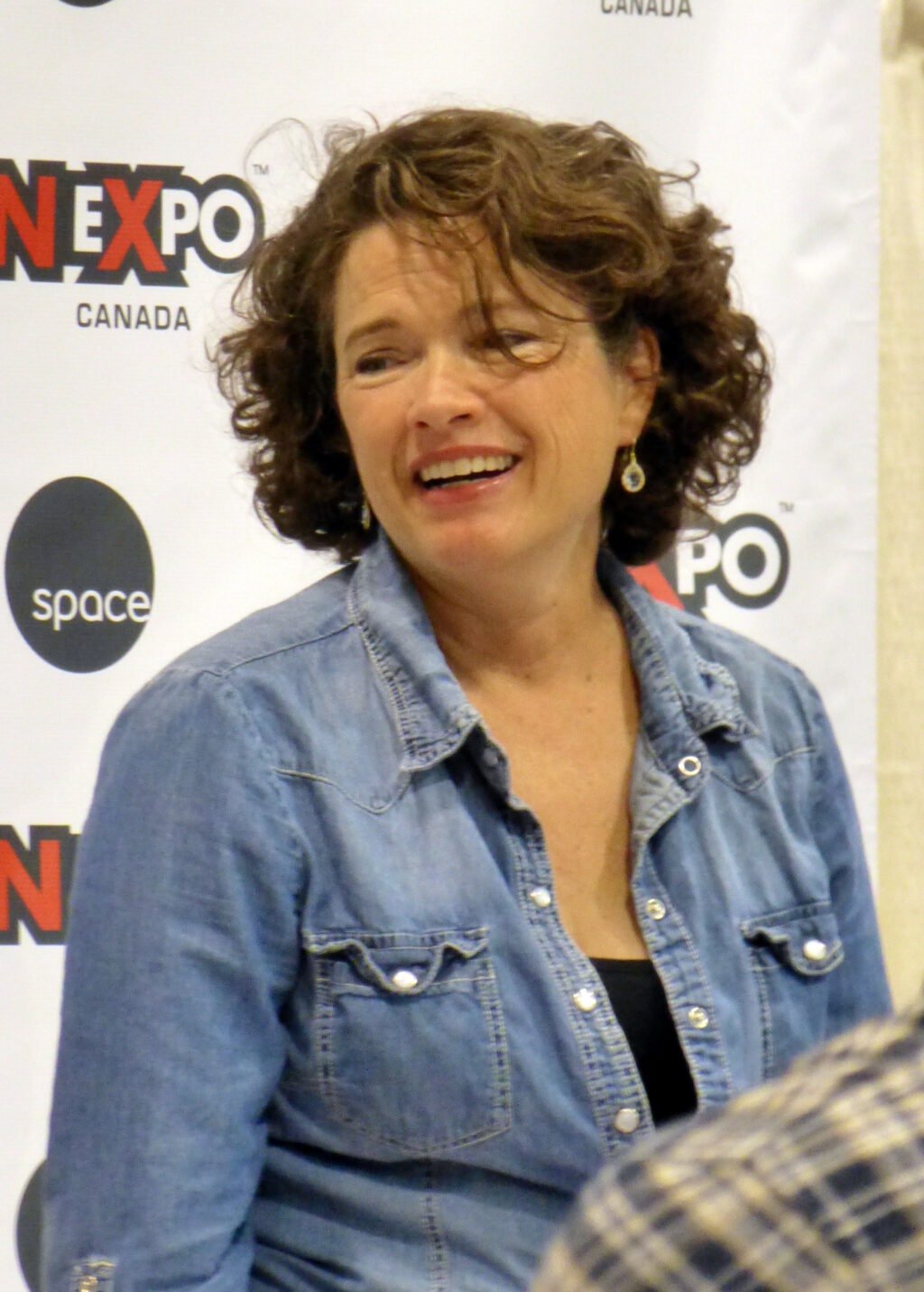
Heather Langenkamp (born 1964) is the actress who made Nancy Thompson horror’s smartest Final Girl — then became Elm Street’s keeper and a monster-maker.
Every slasher series has a face it hunts. Elm Street has two faces that matter — Freddy’s, and the teenage girl who out-thought him. Heather Langenkamp was twenty years old when A Nightmare on Elm Street made Nancy Thompson the template for every resourceful heroine who followed: the Final Girl who doesn’t just survive the monster but studies him, builds traps for him, and finally refuses to feed him. Then Langenkamp did something no other slasher heroine has done — she became the franchise’s historian, its documentary narrator, and, in a second career behind the camera, one of the people who builds monsters for a living.
Hers is the rare horror biography where the quiet decades are as interesting as the scream. This is the Tulsa girl who got her union card from scenes that were cut, married into makeup-effects royalty, ran a monster studio’s business for twenty years, and came back in her fifties to play a hospice matriarch with a cult tattoo in a Mike Flanagan series — the full arc.
Quick Specs
Full name: Heather Elizabeth Langenkamp
Born: 17 July 1964, Tulsa, Oklahoma, USA
Family: Married makeup-effects artist David LeRoy Anderson in 1990; two children
Known for: Nancy Thompson in A Nightmare on Elm Street (1984), Dream Warriors (1987) and — as a fictionalised herself — Wes Craven’s New Nightmare (1994); narrator and executive producer of Never Sleep Again (2010); Dr. Georgina Stanton in The Midnight Club (2022)
Second career: Co-owner of AFX Studio, the makeup-effects company she runs with Anderson
Tulsa, Washington, Stanford — and a Union Card from Deleted Scenes
Heather Elizabeth Langenkamp was born on 17 July 1964 in Tulsa, Oklahoma, into a family split between art and power: her mother, Mary Alice, was an abstract-expressionist painter, and her father, Robert “Dobie” Langenkamp, was a petroleum attorney who served as a Deputy Assistant Secretary of Energy in the Carter administration. The job moved the family to Washington, D.C., where Heather attended the National Cathedral School for Girls, graduating in 1982, before enrolling at Stanford University — class of 1986, though she stopped out repeatedly for film work, flew to Los Angeles for auditions during term, and paid most of her way through school with acting income.
The acting started with one of the strangest debuts on record. The summer she turned eighteen, working at the Tulsa Tribune, she answered an extras ad for Francis Ford Coppola’s Tulsa-shot The Outsiders (1983), and was then given dialogue opposite Matt Dillon in Coppola’s Rumble Fish (1983). Her scenes were cut from both films — neither finished movie contains her — but the Rumble Fish dialogue earned her Screen Actors Guild membership while she was still seventeen turning eighteen. Her actual feature debut is the little-seen independent drama Nickel Mountain (1984), shot on breaks from Stanford, in which she played an unwed teenage mother. It is a gentle, serious performance. Nobody could have guessed what the same year held.
Nancy Thompson: The Girl Who Fought Back
Wes Craven cast her as Nancy Thompson in A Nightmare on Elm Street, released 9 November 1984 — one of New Line Cinema’s first productions, the film that earned the studio its “House that Freddy Built” nickname, and a hit that grossed $57.1 million worldwide. Langenkamp took the role against the advice of nearly everyone around her. “Nobody wanted me to do it,” she recalled. “There was a huge stigma as an actor to have been a ‘scream queen’ in a horror movie back then. But I loved the script, and I wanted to get paid, and I thought, ‘Oh, no one will ever see it.'” She now embraces the label she once feared.
What she did with Nancy rewrote the job description. Nancy is the investigator of her own haunting: she researches Freddy Krueger, runs experiments on the rules of dreams, learns she can pull objects — and finally Krueger himself — out of a dream into the real world, rigs her house with booby traps, lures him in, sets him on fire, and at the end simply turns her back on him, withdrawing the fear that feeds him. In Craven’s own telling, given to Langenkamp years later for her documentary, the seed was his young daughter’s question after Swamp Thing: “Why do women always fall down? Women aren’t so clumsy.” Craven: “That planted the germ of the idea… I wanted somebody who was strong and willing to face the truth.” Critics have built on it since — the New York Times‘ horror columnist Erik Piepenburg contrasts the “kind of bumbling, somewhat helpless” Laurie Strode with a Nancy who “was unafraid… fought Freddy in a way people found refreshing,” and Carol Clover’s landmark Men, Women, and Chain Saws framework counts Nancy the grittiest of the Final Girls. Langenkamp’s own summary is plainer and better: Nancy endures “because she uses her mind… She’s very resourceful and logical about how to attack Freddy.” The film has since been selected for the National Film Registry (2021) — and the production’s favourite joke still lands: Nancy, beaten down mid-film, looks in a mirror and sighs, “God, I look 20 years old.” She was.
Dream Warriors: Nancy Returns, and Dies
She came back for A Nightmare on Elm Street 3: Dream Warriors (1987), directed by Chuck Russell from a script Craven co-wrote — and the sequel honoured the first film’s intelligence by growing Nancy up. She is now an intern specialising in pattern nightmares at Westin Hills, treating the last surviving Elm Street children; she pushes for the dream-suppressant Hypnocil, teaches her patients to fight together inside a shared dream, and in the climax Freddy — disguised as her dead father — gets close enough to stab her. Dying, Nancy drives his own glove into him and saves Kristen Parker before dying in Kristen’s arms. Nancy Thompson dies in 1987, and that death is canon. Remember it, because the internet keeps forgetting what the 1994 film actually is.
Between the Freddy films came the work most of America actually knew her by: sitcoms. She played Marie Lubbock first as a guest on Growing Pains, then as main cast — the eldest, model daughter of a large Catholic family — across three seasons of the spin-off Just the Ten of Us (1988–1990). She also made a cameo for Craven as a victim in Shocker (1989). The sitcom fame carried a shadow: in the early 1990s she received threats from an obsessed fan of the show, serious enough that the FBI cautioned her to be alert. That experience fed directly into her most unusual film.
New Nightmare: Playing Herself
Wes Craven’s New Nightmare (1994) is not a resurrection, and listings that bill her role as simply “Nancy Thompson” erase the film’s whole premise. Langenkamp plays Heather Langenkamp — a fictionalised version of herself: an actress, wife and mother whose young son is being reached by an ancient entity wearing the Freddy form, and who must agree to play Nancy one last time to trap it. Craven built the film partly from her real stalker experience, and her layered performance — an actress negotiating with her own most famous character — won her a Chainsaw Award for Best Actress in 1995. The same year, in a namesake coincidence aggregators love to garble, she played figure skater Nancy Kerrigan in the TV movie Tonya & Nancy: The Inside Story. Two Nancys, one year, entirely different women. She does not appear as Nancy in Freddy vs. Jason (2003), for the record — that is archive footage under a thanks credit, not a performance. The whole series, in order, lives on our Nightmare on Elm Street franchise page.
The Keeper of Elm Street
Then she stepped back — raised her family, built a business — and returned to Elm Street not as an actress but as its historian. Never Sleep Again: The Elm Street Legacy (2010) is the franchise’s definitive documentary, a four-hour chronicle of the series and of New Line’s rise, and Langenkamp is both its executive producer and its narrator — the heroine literally telling the whole story in her own voice, interviewing the world that Robert Englund’s Freddy built. A year later she produced her own follow-up, I Am Nancy (2011), touring conventions to ask the fandom a pointed question — “Why Freddymania and not Nancymania?” — and interviewing fans, Englund and Craven himself. No other principal from a classic slasher series has done this: she didn’t just survive the franchise, she archived it, and argued on the record for her character’s place inside it.
AFX Studio: The Monster Business
The second career began, as so much in her life did, at a Craven wrap party — the 1988 wrap for The Serpent and the Rainbow, where she was introduced to makeup artist David LeRoy Anderson. He proposed while she visited him on the Pet Sematary set; they married in 1990 (the 1989 date in some listings is the infobox error — the proposal year). Her first marriage, to musician Alan Pasqua (1984–1987), belongs to the record in one plain line, and so does this: her son Daniel “Atticus” Anderson died in 2018, aged 26.
Anderson is one of makeup’s decorated masters — two Academy Awards for Best Makeup, both shared with Rick Baker, at the 1997 awards for The Nutty Professor and the 1998 awards for Men in Black — and together they run AFX Studio. The division of labour, in her own words, is exact, and the internet reverses it constantly: “My husband is the designer and creator of all of the monsters and makeup effects that we do, and I am the humble CFO.” She began working at the studio around 2000 so the family could stay together on locations; her screen credits on effects films are as a special makeup effects coordinator, under the name Heather Langenkamp Anderson. The studio’s work runs through modern horror — Dawn of the Dead (2004), Cinderella Man (2005), Evan Almighty (2007), The Cabin in the Woods (2012), American Horror Story seasons including Freak Show and Hotel (AFX built, among other things, the fake head for Twisty the Clown’s shooting) — and she still pops up inside the work: a cameo in Freak Show‘s “Tupperware Party Massacre” episode (a cameo, not a season role), the alien officer Moto in Star Trek Into Darkness (2013) when AFX’s makeup department needed another alien in a scene, and the Landlady in Hellraiser: Judgment (2018). There was even a sideline: a Malibu chewing-gum venture with Anderson in the early 2000s, gum packaged with trading cards of local surfers. The woman Freddy hunted had become one of the people who builds the monsters.
The Return: Brightcliffe
The acting return built slowly — The Butterfly Room (2012), as Barbara Steele’s daughter, was in her account “the first role I’d been offered in many years that actually had substance” — and then Mike Flanagan called. In Flanagan’s The Midnight Club (2022), ten episodes adapting Christopher Pike, she plays Dr. Georgina Stanton — not “Georgia,” as careless listings print it — the founder and head of Brightcliffe, a hospice for terminally ill teenagers, presented as a kind, maternal authority. The finale reveals her bald head beneath the wig and the hourglass tattoo of the Paragon, the cult that once occupied Brightcliffe; Flanagan’s own post-cancellation account confirms Stanton is Athena, the cult founder’s daughter, who built the hospice to atone. The casting was deliberate lineage: co-creator Leah Fong screened Dream Warriors at the first writers’-room meeting and called it influential on the series. Langenkamp has said that reading the scripts moved her to tears when she discovered her character had also lost a son — a parallel to her own life that she has discussed openly. Flanagan cast her again in The Life of Chuck (2024), as Vera Stanley — the Final Girl, in her sixties, working with the defining horror director of the new generation.
Why Heather Langenkamp Matters
Nancy Thompson reset the slasher heroine. Before Nancy, the surviving girl mostly endured; Nancy investigates, experiments, builds traps, drags the killer into her world and finally refuses him the fear he feeds on — the template the genre still measures itself against, recognised in the critical record from Carol Clover onward. That the same actress then played herself confronting Freddy’s escape into reality makes her the franchise’s heroine in both the fiction and the meta-fiction, a double no other Final Girl has. And where her peers became convention guests in someone else’s history, Langenkamp became the historian, the narrator, the producer — and then, quietly, a monster-maker in her own right, until Flanagan brought the matriarch back to the screen. Freddy had a face. Elm Street’s other face is hers. You’ll find her in our Horror Actors index.