
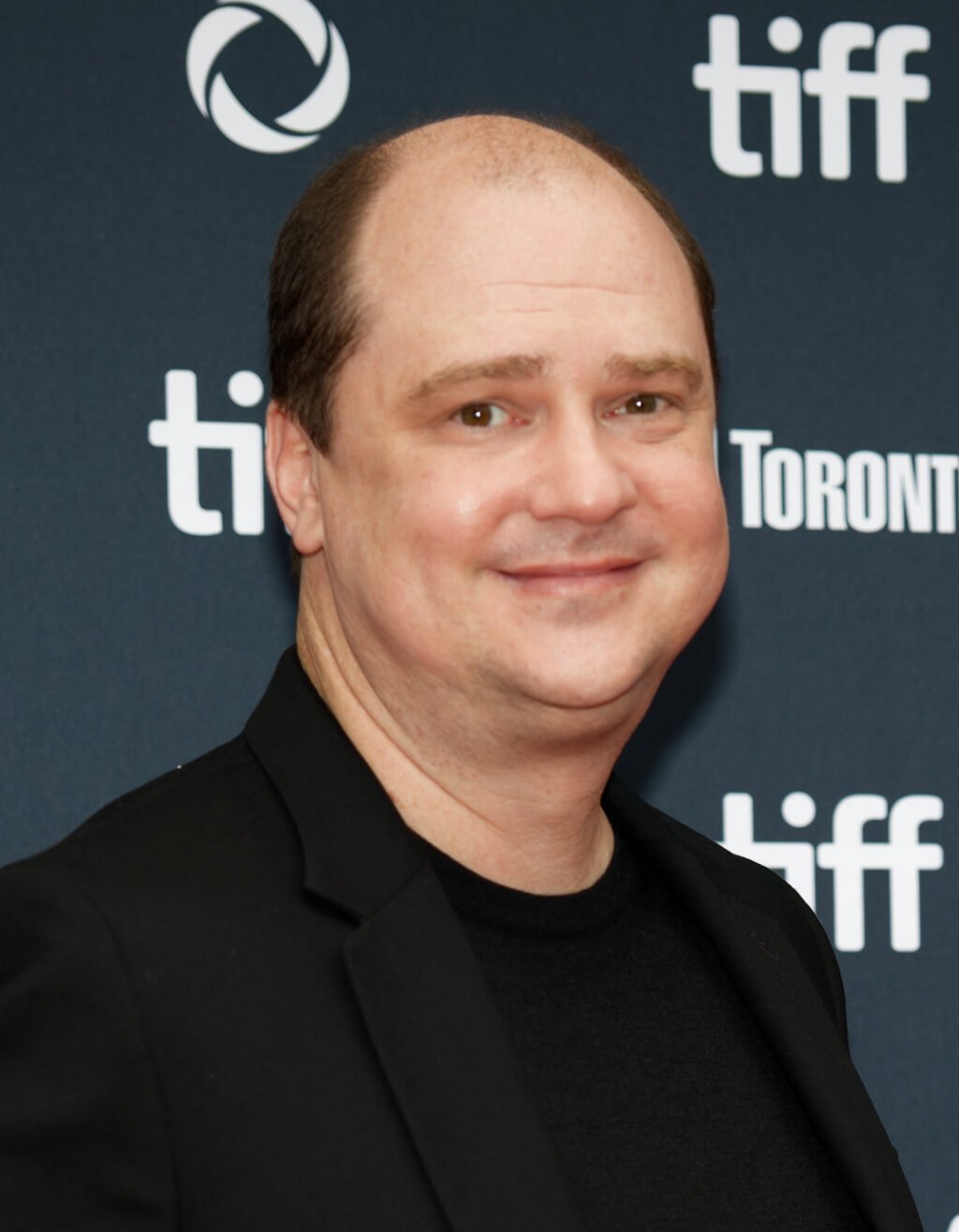
Mike Flanagan is an American writer-director-editor who re-centred modern horror on grief and faith, from Hill House to Midnight Mass.
Mike Flanagan’s work runs a particular confidence trick: he hands you a haunted house, a cursed mirror, a vampire in a priest’s collar — and then, somewhere around the third act, you realise the ghost was never the point. The grief was. The addiction was. The family was. Flanagan is the rare modern horror filmmaker who can build a scare like an engineer and land an emotion like a playwright, and he does most of it with his own hands — writer, director, and his own editor.
Quick Specs
Born: 20 May 1978, Salem, Massachusetts
Raised: Bowie, Maryland
Education: Towson University — BA in Electronic Media & Film, minor in Theater (2002)
Occupations: Writer, director, producer, editor, showrunner
Known for: The Haunting of Hill House, Midnight Mass, Hush, Doctor Sleep, Gerald’s Game
Spouse: Kate Siegel (married February 2016)
Companies: Intrepid Pictures; Red Room Pictures (founded 2024)
A Scared Kid from Salem, by Way of Maryland
Flanagan was born in Salem, Massachusetts, on 20 May 1978, to Timothy and Laura Flanagan — but hold the postcard image of a childhood spent among the witch-trial gallows. His father was a U.S. Coast Guard officer, and the family moved with his postings, living for a time on Governors Island in New York before finally settling in Bowie, Maryland. Salem was a brief early stop, but it left a mark — a lasting interest in the witch trials and ghost stories, and a boy already shooting and editing movies on the family video camera.
The deeper truth is that the future king of the elevated scare was, by his own account, a very scared kid — one who couldn’t watch horror movies at all. What he could do was read. He grew up a Stephen King devotee, read It in the fifth grade — “absolutely traumatized me,” he has said — and in college read Gerald’s Game, the novel he would one day adapt. In Maryland he attended Catholic schools, including Archbishop Spalding High School — drama department, student-government president, morning-TV anchor. He was also an altar boy — the raw material of his most personal work, banked early.
At Towson University he arrived with a sensible plan — train as a high-school history teacher — and an elective film course taught by former department chair Barry Moore dismantled it. He graduated in 2002 with a BA in Electronic Media & Film and a minor in Theater. (He is sometimes misattributed to Georgetown; he is a Towson man, and Towson made him its spring 2024 commencement speaker.) He was making features before he even graduated: Makebelieve (2000), shot on campus with faculty and student support while he was still an undergraduate, then Still Life (2001) and the Maryland-shot Ghosts of Hamilton Street (2003). He has since called those student melodramas “unfit for public consumption” — and, in the same breath, “incredible learning experiences.”
The Editor’s Apprenticeship
After Towson came Los Angeles, and the unglamorous years: Flanagan survived as a working editor, cutting reality television including Untold Stories of the ER. It was the making of him. Editing is the craft underneath everything he does — the rhythm, the sense of how long a look can hold, of how two timelines can be braided into one heartbeat — and he has never surrendered the chair. He edits his own films to this day, a rarity at his level, and a large part of why his work feels like his work in every cut.
The calling card was a short: Oculus: Chapter 3 – The Man with the Plan (2006), made with Towson-era collaborator Scott Graham for $1,500. He had imagined a series of Oculus chapters; the money didn’t exist, so he shot the chapter carrying the backstory as his argument for the feature. Producers circled, but with conditions — make it found footage, or let someone else direct. He refused both. That refusal is why Absentia happened first.
Absentia (2011) is the breakthrough built from nothing: written, directed and edited by Flanagan, financed through a Kickstarter campaign, made for $70,000, and filmed over about fifteen days in his own Glendale apartment with a cast of friends. Released direct-to-video, it found its audience when Netflix carried it on streaming — strongly enough to unlock the Oculus feature on Flanagan’s terms.
The Mirror, and the Flood
Oculus (2013) was co-written with Jeff Howard and produced by Trevor Macy’s Intrepid Pictures — the partners who did not demand found footage and did not demand a different director. Shot in Mobile, Alabama, in October 2012, it premiered in TIFF’s Midnight Madness strand and reached theatres through Relativity Media in 2014. Its engine is pure Flanagan: two braided timelines, the siblings’ childhood catastrophe and their adult attempt to prove the Lasser Glass mirror committed it, the edit cutting between then and now until the two bleed together. Made for $5 million, it grossed about $44 million worldwide. It also started his long collaboration with composers the Newton Brothers, who have scored his work ever since.
Before I Wake — in which a foster couple’s son, Cody (Jacob Tremblay), finds his dreams and nightmares physically manifesting as he sleeps — was shot in 2013, then acquired by Relativity Media, which scheduled it, pulled it, rescheduled it and pulled it again as the company slid into bankruptcy. It screened internationally in 2016; American audiences only got it when Netflix acquired the film and released it in the US on 5 January 2018.
Silence, Séances and the Unfilmable Book
While the Relativity saga dragged on, Flanagan made Hush (2016) — and made it in secret. Co-written with his wife Kate Siegel, who stars as Maddie, a deaf horror author living in isolation who is stalked by a masked killer, the film was written in 2014 and shot in March 2015 under total confidentiality. It premiered at SXSW on 12 March 2016 — but Netflix had already acquired worldwide rights before that premiere, and released it on 8 April 2016. A home-invasion film rebuilt around a heroine who cannot hear her attacker — one house, one performer, no dialogue to hide behind.
The same year, his period prequel Ouija: Origin of Evil (2016) outclassed its original in every department — Elizabeth Reaser, Annalise Basso, Lulu Wilson and Henry Thomas starring, over $81 million grossed on a budget of around $9–10 million. Then came the dare: Gerald’s Game (2017), his first Stephen King adaptation, from the 1992 novel long pronounced unfilmable — a woman handcuffed to a bed in a remote house after her husband’s heart gives out, alone with her own mind. Flanagan’s solution, his biggest change from the book, was to externalise Jessie’s interior war as conversations with imagined versions of Gerald and of herself; in the novel, Gerald dies on page fifteen and never returns. Carla Gugino and Bruce Greenwood carried it. The film premiered at BFI Southbank on 19 September 2017 and reached Netflix on 29 September. King himself, having seen the rough cut, delivered the verdict: “hypnotic, horrifying and terrific.”
Hill House, and Holding Two Kings at Once
The Haunting of Hill House (2018) is where everything converged. Created by Flanagan for Netflix, it loosely reworks Shirley Jackson’s 1959 novel into the story of the Crain family across two timelines — a haunted house that is also a family wound that never closed. Flanagan’s control was close to total: he directed all ten episodes and edited the series. Episode five’s Bent-Neck Lady reveal remains one of the century’s great horror gut-punches, and episode six, “Two Storms,” is pure engineering bravado — five long takes, the longest around seventeen minutes, stitching the funeral home and the house together through a purpose-built adjoining set. “Production was murder and almost killed us all,” Flanagan later said, “but it was the easiest edit of my life. Took 10 seconds.” Netflix responded: in 2019 it signed Flanagan and Macy’s Intrepid Pictures to an exclusive overall television deal.
His next film served two masters whose visions famously cannot be reconciled. Doctor Sleep (2019) adapts King’s sequel to The Shining — a book that continues the novel, while the world remembers Kubrick’s film. Flanagan wrote and directed a bridge between the two continuities, with Ewan McGregor as the adult Dan Torrance and Rebecca Ferguson as Rose the Hat, rebuilding the Overlook for the climax. The numbers were unkind — a $45 million budget against roughly $72 million at the worldwide box office — and the film was received in its day as a disappointment. Time has reversed that verdict: on home viewing and streaming it has been steadily reappraised as one of the finest King adaptations ever made.
The Haunting of Bly Manor (2020), the second stand-alone Haunting season, drew principally on Henry James’s The Turn of the Screw. Flanagan created and showran it — but where Hill House was all his, this time he directed the opening episode and handed the season to a team of other directors.
Midnight Mass: The Personal One
Every Flanagan work is personal in pieces. Midnight Mass (2021) is personal in whole. Created, written and directed by Flanagan — all seven episodes — it is set on Crockett Island, where a charismatic young priest arrives alongside Riley Flynn (Zach Gilford), a son returning from prison after killing a girl in a drunk-driving crash. The show had been hiding inside Flanagan’s own filmography for years: Midnight Mass exists as a novel within Hush and within Gerald’s Game, planted long before Netflix’s deal made the series itself possible.
A former altar boy who describes himself as having become an atheist, he began writing it a decade before it was made, as a Catholic battling alcohol — and, in his words, “I could write about alcoholism, but I couldn’t write about sobriety, not intelligently.” He got sober in 2018; the series followed, with Riley’s crime drawn from his own stated biggest fear: “not that I would die in a horrible drunk driving accident… that I would kill someone else and live.” The famous monologues — on faith, on death, on what an addict owes the people he hurt — are, as he told Baltimore Magazine, “dialogue versions of myself on either side of sobriety.”
The End of the Netflix Run
The Midnight Club (2022), co-created with Leah Fong from Christopher Pike’s novels, cast Flanagan as showrunner and director of the first two episodes — the premiere packs 21 jump scares into a single hour, a Guinness World Record he has cheerfully explained was engineered in response to executive notes demanding more jump scares, precisely to render the device meaningless. Netflix cancelled the series after one season. Flanagan’s response was characteristic: rather than leave the audience hanging, he publicly posted the answers to the show’s unresolved mysteries. The overall deal expired with it. In December 2022, Intrepid signed a new overall deal with Amazon Studios.
One Netflix obligation remained. The Fall of the House of Usher (2023), an eight-episode limited series built from Poe’s title story and a shelf of his other works, arrived on 12 October 2023 — Flanagan directed four episodes and his regular cinematographer Michael Fimognari the other four, with Bruce Greenwood (a mid-production replacement for Frank Langella) and Carla Gugino leading a cast drawn from the family. It was his final Netflix project, the end of a run of five series in six years. In May 2024 he launched his own banner, Red Room Pictures.
The King Custodian, Still
The Life of Chuck (2024) — written, directed and produced by Flanagan from the novella in King’s If It Bleeds, a life told in reverse, with Tom Hiddleston and Mark Hamill — premiered at TIFF on 6 September 2024 and won the People’s Choice Award. His own career favourites, named in 2025: Midnight Mass on television, Chuck in features — “I got to do Midnight Mass and Chuck. I’m good.”
His first Amazon series closes the circle back to Stephen King: Carrie, with Flanagan as showrunner — he wrote every episode and directed four of the eight, with Kate Siegel, Axelle Carolyn, Kyra Sedgwick and Hiromi Kamata directing the rest — premiered on Prime Video on 7 October 2026, all episodes at once, with Summer H. Howell as Carrie White, Samantha Sloyan as Margaret White and King himself among the executive producers; we covered its arrival here. He also wrote the “Stowaway” segment of the anthology V/H/S/Beyond (2024), was invited to join the Academy of Motion Picture Arts and Sciences in 2025, holds the television rights to King’s The Dark Tower, and has an announced Exorcist film ahead of him with Blumhouse and Universal. Nobody else in Hollywood is holding that much of King’s library at once.
The Signatures
The edit is the argument. Flanagan’s habit of cutting his own work is not control-freakery; it is his stated philosophy. At the ATX Television Festival he told of cutting a seven-minute monologue down to three silent reaction shots — then phoning the actor to apologise for having overwritten the scene. “If you can tell the story silently,” he says, “that’s pure, and that’s cinema.”
The monologue is the counterweight. For all that, the long single-speaker speech — on faith, grief, addiction — is his other signature, the set-piece his series are famous and occasionally teased for. He is in on the joke: at the same festival he laughed that he had “already got it out of my system” with Midnight Mass, and agreed his Exorcist should not be monologuing.
The company is the method. Flanagan builds with a repertory: Kate Siegel, Henry Thomas, Carla Gugino, Bruce Greenwood, Samantha Sloyan, Rahul Kohli, Lulu Wilson and Victoria Pedretti recur across the work in new roles; his brother Jamie writes, produces and acts within the same circle; the Newton Brothers score it; Michael Fimognari shoots most of it and increasingly directs it. Around the edges sit the planted details — Hill House’s hidden background ghosts, which the characters never see and the production has confirmed; the prop novel that waited years to become a series — and a habit almost no showrunner shares: he answers the fans himself, in letters and in threads.
Family, Faith and Sobriety
Flanagan married Kate Siegel in February 2016; they have a son and a daughter. An earlier marriage (2005–2010) preceded it, and his eldest son, Rigby, is from his relationship with Absentia actress Courtney Bell — three children in all. He was raised Catholic and describes himself today as an atheist — the argument between those two positions is, in a sense, his whole filmography — and the sobriety that unlocked Midnight Mass continues: sober since 2018, eight years marked in 2026.
Why Mike Flanagan Matters
Flanagan re-centred mainstream horror. In an era of the algorithm-friendly jump scare, he built hits out of grief, addiction and family — the Bent-Neck Lady is a metaphor for suicidal depression and still one of the great nightmare images of the century — without ever apologising for delivering the scare. He proved the “unfilmable” King novel could be pure cinema, and made the sequel to a beloved novel and an untouchable film in a single continuity. King, William Friedkin and Quentin Tarantino have all praised the directing publicly — King and Friedkin singling out, of all things, his lack of reliance on jump scares, from the one director who holds a jump-scare world record.
Then there is the model. One filmmaker writing, directing and editing entire seasons, carrying a repertory company and a core crew across a decade, from a $70,000 apartment production to overall deals at the two biggest streamers on earth — a working template for the auteur in the streaming age. The scared kid from Bowie did the reading, learned the cutting room, refused the compromises — and ended up the custodian. Browse the full company in our Horror Directors index.