Halloween III: Season of the Witch (1982) Review — Banana Bread Without the Bananas
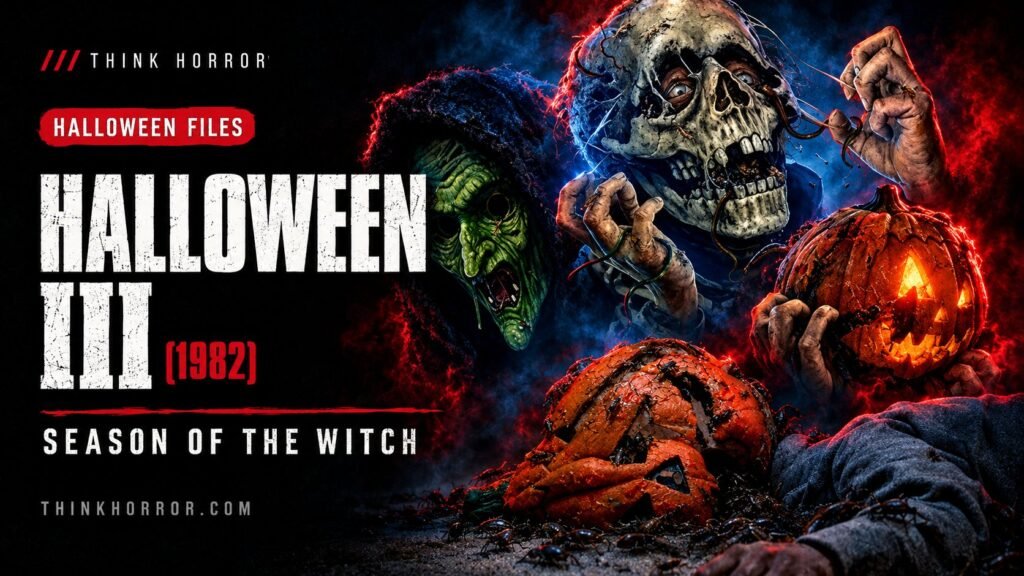
Custom featured art. Film imagery © Universal Pictures
It’s 9 p.m. on Halloween night, 1982. You’re eight years old. You’re wearing the mask — the one every kid on your block is wearing — and you’re parked in front of the television, because the commercial has been promising you all month that something special happens at nine. On the screen, a pumpkin melts. The jingle starts up one more time. And somewhere across town, a man is screaming into a telephone, begging somebody, anybody, to make it stop.
Welcome in, fiends. Turn the lights down, bundle up, and check the back of your mask for loose chips — tonight we open the file on the strangest sequel ever made: the Halloween movie with no Michael Myers in it.
Halloween III: Season of the Witch is the franchise’s great broken promise and its most argued-over oddity: panned in its day, rescued by a cult, and still, more than forty years on, the only entry that asks what Halloween night itself can do to you. So. Does the oddball deserve its second life? Honesty hour, as always.
Watch the Trailer
Quick Specs
Director: Tommy Lee Wallace
Written by: Tommy Lee Wallace, from an original screenplay by Nigel Kneale (uncredited)
Produced by: John Carpenter and Debra Hill
Starring: Tom Atkins, Stacey Nelkin, Dan O’Herlihy
Music: John Carpenter and Alan Howarth
Release date: October 22, 1982
Runtime: 98 minutes
Distributor: Universal Pictures
Box office: $14.4 million (US)
Michael Myers: Does not appear
The Review
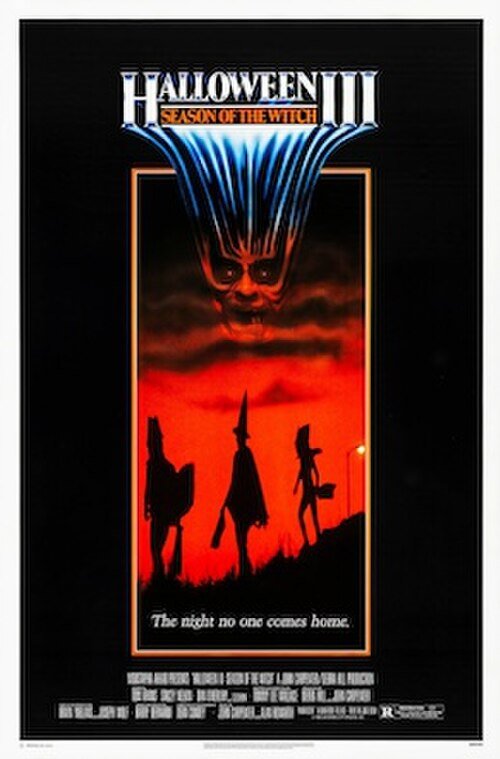
The setup is pure pulp mystery. Dr. Dan Challis (Tom Atkins), a divorced, hard-drinking physician, has a patient murdered in his hospital — a terrified man who arrived clutching a jack-o’-lantern mask and babbling about a plot. The dead man’s daughter, Ellie Grimbridge (Stacey Nelkin), smells a rat, and the trail leads to Santa Mira, a town owned outright by Silver Shamrock Novelties and its smiling patriarch, Conal Cochran (Dan O’Herlihy). Cochran makes the three masks every child in America wants this year — a skull, a witch, a pumpkin — and all month his commercials have been counting down to a “big giveaway” on Halloween night at nine. What happens to the children wearing those masks when the commercial airs is the film’s central horror, and it is a genuinely nasty piece of work: an ancient rite of sacrifice, delivered by microchip, through the television set.
None of it was an accident, and that is what makes it fascinating. John Carpenter and Debra Hill agreed to a third Halloween on one condition: no Michael. Their plan was an anthology — a different Halloween-night story every year. As director Tommy Lee Wallace put it, the intention was “an anthology out of the series, sort of along the lines of Night Gallery, or The Twilight Zone, only on a much larger scale, of course.” 1982 audiences did not want a larger scale. They wanted the Shape. They got androids, a stolen piece of Stonehenge, and a toy commercial — and they stayed home in droves.
What Works
The score. Carpenter and Alan Howarth leave the famous piano theme behind and build a cold, pulsing synthesizer dread that never once lets the film feel safe. It is one of the great under-sung horror scores of the eighties.
The jingle. “Happy, happy Halloween” is a murder weapon disguised as a nursery rhyme, and the film plays it until repetition itself becomes the threat. By the third day of the countdown you are not hearing a song anymore. You are hearing a fuse.
Dan O’Herlihy. Cochran is the franchise’s most underrated villain: courtly, amused, soft-spoken, and utterly sincere about slaughtering children as an act of religious devotion. His late speech about the history of Halloween — the sacrifices, the blood on the soil — is delivered like a man reminiscing about harvest festivals he personally attended. Because, the film hints, he did.
The look. Dean Cundey, who shot the original Halloween, photographs Santa Mira as a sunlit trap — all clean streets and smiling company men, with the dread sitting just under the daylight.
The nerve of the ending. No Halloween film before or since has ended this bleakly: a lone man screaming into a phone as the clock runs out, and a cut to black that refuses to tell you whether it worked. Whatever else the film fumbles, it commits to that final minute completely.
Tom Atkins. Challis is a rumpled, flawed, entirely believable hero — a doctor with a drinking problem and a broken marriage, not an action man. When he panics, you panic.
What Doesn’t
The missing banana. Let us say the thing plainly, because it is still the thing: a Halloween movie without Michael Myers is banana bread without the bananas. You can bake it beautifully — and parts of this are baked beautifully — but the audience bought a ticket for the ingredient on the marquee, and the marquee lied by omission. Judged as its own film, Season of the Witch survives. Judged as Halloween III, the title it was sold under, it broke a promise.
The machinery creaks. How did Cochran move a several-ton piece of Stonehenge to California? Asked directly, he shrugs: “We had a time getting it here.” The film’s answer to its biggest logic hole is a wink, and the androids raise a dozen questions the script waves past on its way to the next scene.
The middle sags. For a film about a countdown, long stretches of motel-room sleuthing tick by with surprisingly little pressure. The dread is real, but it naps.
The romance runs on plot time. Challis and Ellie fall into bed at a speed owed entirely to the script. She has just buried her father. He has just met her. The film needs them paired, so paired they are.
The scares are rationed. This is a slow-burn conspiracy picture wearing a slasher’s coat, released at the very height of slasher fever. Audiences felt cheated twice: once by the missing Michael, once by the quiet.
Full disclosure, fiends, in this site’s own tradition: this is a desk verdict — a ruling built from the verified record: the craft, the reception, and forty years of argument. And the record is genuinely split. Critics sit at almost exactly half on Rotten Tomatoes, around 51%, with Metacritic dead-center at 50. Audiences were far colder: roughly 30% approval, and a CinemaScore of D — the lowest grade this franchise has ever carried home. Time has warmed the critics considerably. It has barely moved the audience, and the audience’s point cannot be reappraised away: the name on the ticket promised a man who never shows up.
So the skulls land where the evidence lands. The score, the jingle, O’Herlihy, and that final scream keep this thing breathing. The broken promise is why it needs the machines.
💀💀 2.5 out of 5 skulls — On life support
Trivia & Facts
- Nigel Kneale, the British writer behind Quatermass, wrote the original screenplay. When the producers ordered more graphic violence and gore, he had his name taken off the film entirely. Wallace rewrote from Kneale’s bones.
- That voice booming through the Silver Shamrock commercial is Tommy Lee Wallace himself. With no money left to license a tune, he set the jingle to the public-domain “London Bridge Is Falling Down,” sang it himself, and sped the recording up until it sounded, in his own words, like “demented dwarves in a padded cell.”
- Jamie Lee Curtis is in this movie — you just can’t see her. Uncredited, she provides the voice of Santa Mira’s curfew announcer and a telephone operator.
- Michael Myers does appear, for a few seconds: the trailer for the original Halloween plays on a television in a bar scene. It is his only presence in the film, and somehow that stings worse than total absence.
- The three masks were designed by Don Post of Post Studios, the shop behind Michael’s original mask. The skull and the witch were adapted from existing Post designs; the jack-o’-lantern was created for this film.
- The android assassin in the suit is played by Dick Warlock — who played Michael Myers himself in Halloween II. The Shape is in this movie after all. He is just wearing a tie.
- Spoiler: the film never tells you whether the last network pulled the commercial. The novelization answers the question the film wouldn’t: Challis failed.
- Dan O’Herlihy, asked later what he thought of the picture, admitted he thoroughly enjoyed the role but “didn’t think it was much of a picture.” Even the villain graded it harder than we did.
Harper’s Extras
- Invasion of the Body Snatchers (1956) — Debra Hill called Halloween III “a ‘pod’ movie, not a ‘knife’ movie,” and it even borrows Siegel’s fictional town of Santa Mira. Watch the original nightmare this one is dreaming.
- The Fog (1980) — the same core crew — Carpenter, Cundey, Atkins — doing coastal dread with atmosphere to spare. If Santa Mira worked on you, Antonio Bay will finish the job.
- Trick ‘r Treat (2007) — the anthology Halloween Carpenter wanted, finally done right: one night, interwoven stories, the holiday itself as the monster. Proof the idea was never the problem.
Where to Watch
Halloween III: Season of the Witch is streaming now on Peacock Premium, Amazon Prime Video, and AMC+ (and on Philo), and is available to rent or buy on Amazon Video, Apple TV, and Fandango at Home. Availability checked October 2026 — the services rotate their crypts without asking us first.
Frequently Asked Questions
Is Michael Myers in Halloween III?
No. Not in the story at all. His only appearance is a few seconds of the original film’s trailer playing on a television in a bar. Every other entry in the series features him; this is the lone exception.
Why did they make a Halloween movie without Michael Myers?
Carpenter and Hill wanted the series to become an anthology — a new Halloween-night story each year, with no continuing characters. Season of the Witch was to be the first. After its reception, the experiment ended, and Michael returned in Halloween 4: The Return of Michael Myers (1988). The title was the apology.
Do I need to watch Halloween and Halloween II first?
No. It shares no characters or storyline with them — though a few familiar voices and faces hide in the cast if you know where to listen. It stands entirely alone. That is rather the point, and rather the problem.
Is Halloween III actually scary?
Not in the slasher way. Its horror is slow dread, one grotesque demonstration of what the masks do, and an ending that refuses to comfort you. If you need a body count, it will feel quiet. If a cheerful jingle can get under your skin, this one will live there rent-free.
Why do people like it now?
Distance. Judged as a standalone folk-horror conspiracy film instead of a betrayed sequel, its craft — the score, the villain, that ending — finally gets graded on its own paper. This review gives the craft its full due. It just won’t pretend the marquee didn’t matter.
Sleep tight, fiends. And if the pumpkin on your television starts to melt — run.