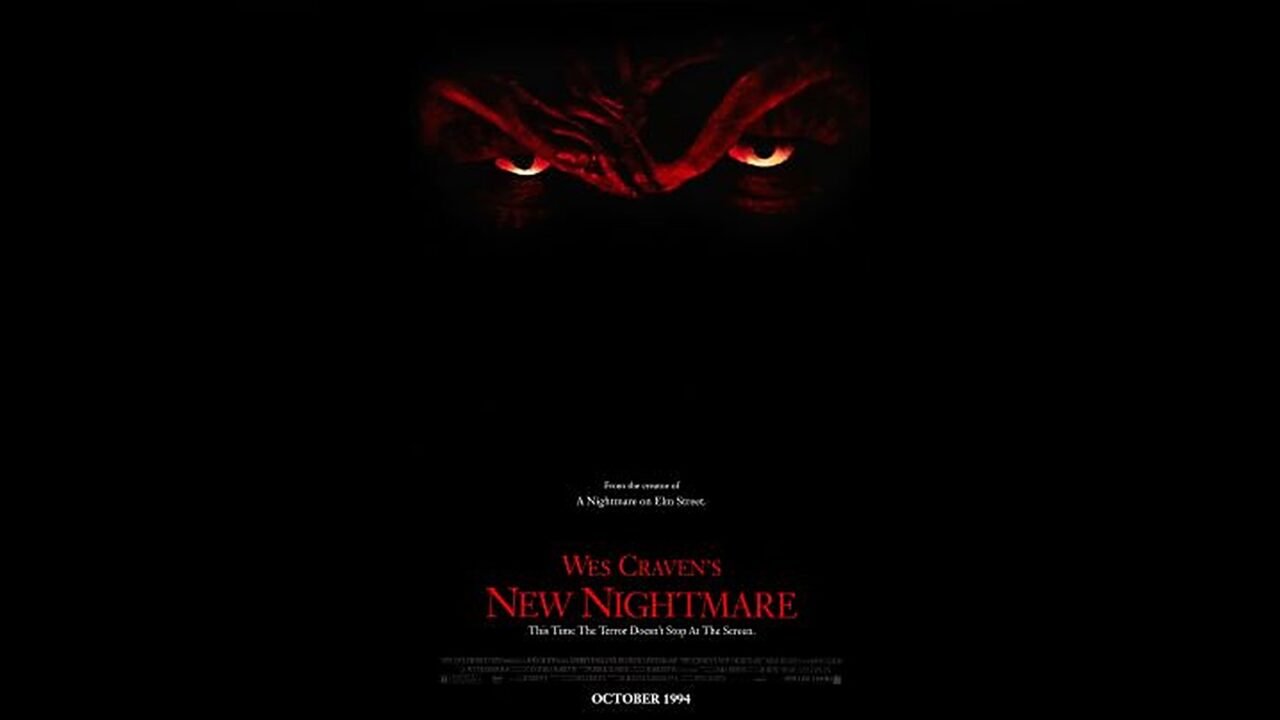
Wes Craven’s New Nightmare (1994) is the meta sequel where an ancient entity wearing Freddy Krueger’s face escapes the films into reality.
The first thing this film shows you is a glove being built. Not worn — built, on a workbench, by craftsmen: blades fitted to fingers, sinew and muscle laid over the frame like something grown rather than made. And then, while the cameras roll and the crew watches, the thing twitches. Understand that gesture and you understand the whole picture. The prop has woken up. The set is a set — Los Angeles, 1994, ten years after the original A Nightmare on Elm Street — and the man in the workroom bleeding from a throat wound is not an actor playing a victim. He is a special-effects artist, and the fiction has begun, politely and without knocking, to leak.
Heather Langenkamp is living the quiet afterlife of a scream queen: a husband who builds movie monsters for a living, a small son named Dylan, fan mail that has lately taken a turn. The phone rings and a voice she knows too well recites the jump-rope rhyme down the line. Meanwhile the studio that made her famous wants her back — one more film, Nancy Thompson one last time — and its author, Wes Craven, is up in the hills writing a script he cannot explain, dreaming dreams he does not enjoy, in which the events of her life appear on the page before she has finished living them.
The idea had been waiting a long time for its permission. When Craven came aboard to help write Dream Warriors, the third film in the series, this is what he proposed: Freddy escaping the film itself, coming for the people who made him. The studio declined, the sequels rolled on without him, and Freddy dwindled into a grin on a lunchbox. Craven got his door back only when the franchise was finally pronounced dead — and his revenge, if that is the word, was to ask what all those stories had been for.
His answer is the film’s dark little theology, delivered by Craven playing Craven, in the calm tones of a man discussing the weather. Every age, he says, keeps its evil caged in a story. The Nightmare films were this one’s cage. End the story, and the thing inside goes looking for a door — and it has chosen the face it knows best. It cannot simply walk into the world; it must be let in, through the person who defeated it first. Through Nancy. Through Heather. She must agree to play the part one final time, because the part, it turns out, was never only a part.
Craven told, in later years, of dreaming the film before he wrote it: a tenth-anniversary party for the original picture, the cast reunited — and Robert Englund’s shadow moving across the wall on its own, independent of the man. As he tells it, the shadow was casting the actor, not the other way round. That is New Nightmare in a single image, and it is genuinely frightening in a way no glove ever managed: the character has outgrown the human being, and it has come to collect the rest of the cast.
Langenkamp carries all of this, and she is magnificent in a register the series never asked of her before. Her fear here is not the teenage terror of 1984; it is adult and administrative — a mother’s fear, processed through doctors who suspect her, a husband who falls asleep at the wheel on the drive home and does not arrive, a little boy who stops sleeping and starts speaking in another voice. Watch her with John Saxon, playing himself, playing her screen father: mid-conversation, with the street outside rearranging itself into Elm Street, he stops calling her Heather and starts calling her Nancy — and she understands that reality is no longer asking her permission. It is the quietest scene in the film and the coldest.
And when Freddy comes, he is the Freddy of Craven’s first intentions: darker, trench-coated, nearly silent, the glove grown from bone and muscle rather than bolted together in a boiler room. Englund plays him at half the wattage and twice the menace, and has called this his favourite of all the Nightmare films — one sees why; it is the only sequel that lets him be frightening again. The set-pieces honour the original without merely photocopying it: the babysitter Julie dies dragged across a hospital ceiling, restaging Tina’s death from the first film as a deliberate, ghastly quotation, and the climax descends beneath Heather’s house into a storybook underworld of water and furnaces, where she follows a trail of sleeping pills the way children in fairy tales follow breadcrumbs — and finds the oven waiting, as it always is in fairy tales.
Now the debits, darlings, because there are two and they are honest ones. The first is pace: for its long middle, the film runs on portents — cracks in plaster, tremors under Los Angeles (real earthquake damage, folded in from the Northridge quake that struck during production), a monster withheld so completely that dread curdles, in stretches, into waiting. This is a film more admired than frightening for whole reels at a time, and it knows it, and does not entirely care. The second is the ending’s machinery: having built its terror out of suggestion, the finale trades it for a furnace, a fight and a fairy tale’s rules — satisfying, handsomely staged, and a degree less scary than the film promised at its start.
The public, for its part, stayed home. The picture opened the same weekend as Pulp Fiction and finished as the lowest-grossing entry in the entire series — the best-regarded sequel playing to the emptiest rooms. Two years later Craven took the same self-aware machinery, aimed it at the audience instead of the filmmakers, and called it Scream; the world has been living in that film’s house ever since. New Nightmare is the rehearsal, the stranger and braver draft — the one where the host of the nightmare is not a teenager in the audience but the woman on the screen, being asked, one last time, to go back into the boiler room so the rest of us don’t have to.
Four ravens — one for the idea, one for Heather, one for the Freddy Craven always meant to make, and one for the nerve of ending a franchise by putting the franchise itself on trial.
Where to watch: Streaming on AMC+ and Philo in the US, and available to rent or buy on the usual digital storefronts.

Quick Specs
- Title: Wes Craven’s New Nightmare
- Year: 1994
- Director: Wes Craven
- Writers: Wes Craven
- Starring: Heather Langenkamp, Robert Englund, Miko Hughes, John Saxon
- Runtime: 112 minutes
- Rating: 4 out of 5 ravens
- Box Office: $19.7M worldwide
The weekly roundup
One letter a week, from the crypt.
- New reviews, with the ravens
- New wiki entries and news
- Cool stuff worth your night
Weekly. No spam, unsubscribe in one click.