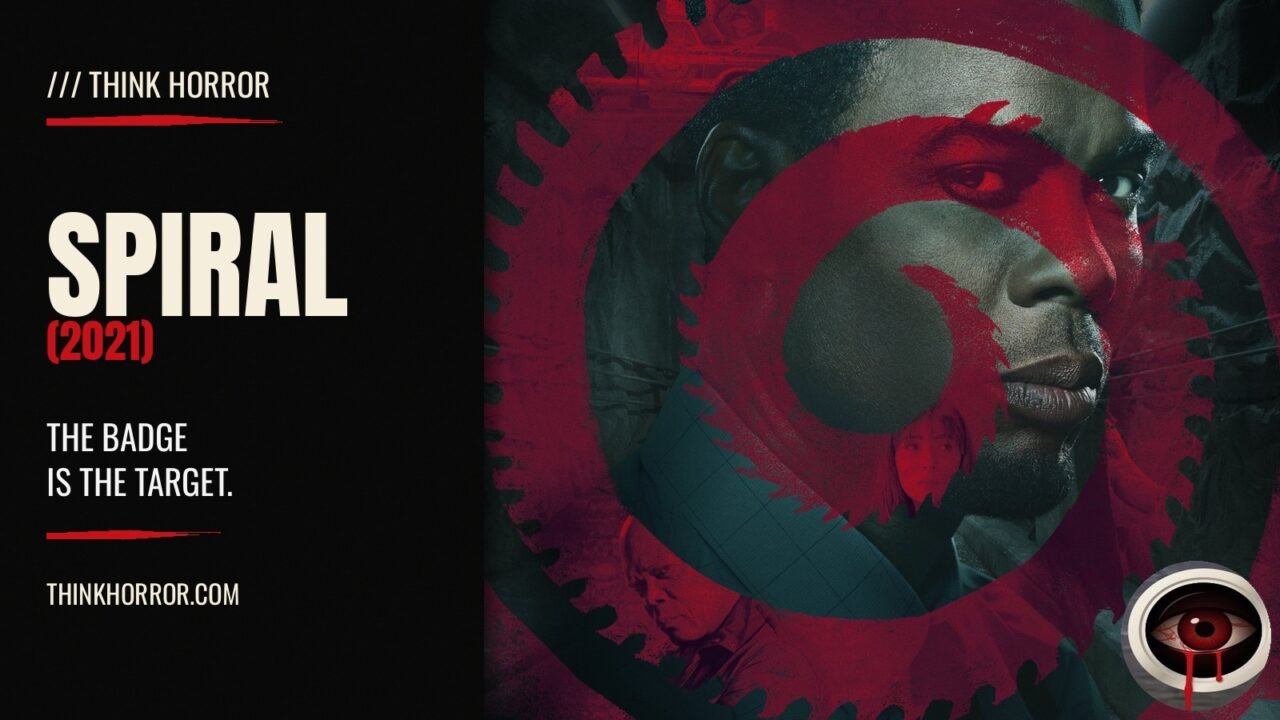
Fourth of July, and the fireworks are somebody else’s problem. You are off duty, Detective, chasing a thief down into a subway tunnel because that is what you do — and then the lights go out on you. When you wake, you are hanging by your tongue in the dark, and a voice that is not a voice is explaining the arithmetic: the tongue has lied for you your whole career. Tear it out and live. Keep it, and the next train keeps your secret forever. The tunnel is already humming. Choose quickly.
Spiral is the 2021 Saw spin-off where Chris Rock’s ostracised detective hunts a Jigsaw copycat who is skinning the badge off corrupt cops.

The Review
The most unlikely sentence in modern horror is also a true one: Spiral exists because Chris Rock pitched a Saw movie to a Lionsgate executive at a friend’s wedding in Brazil. Rock had loved the series since 2004 and wanted a door into horror; what he brought was not a joke but a reframing — the games moved out of the warehouse and into a police precinct, the victims wearing badges, the whole thing re-dressed as a cop thriller in the Seven mold. The studio shelved the John Kramer sequel its writers had been building (that film eventually surfaced as Saw X) and bet on the comedian instead. Josh Stolberg and Pete Goldfinger, the Jigsaw writers, wrote the script with Rock polishing alongside them as executive producer — note, for the record-keepers, that he has no writing credit on it, whatever the posters in your memory say. Darren Lynn Bousman, who directed Saw II through IV and had sworn off the series, came back at Rock’s insistence. What they made together is the strangest genuine artifact the franchise owns: half police procedural, half torture clockwork, entirely convinced the two halves belong together.
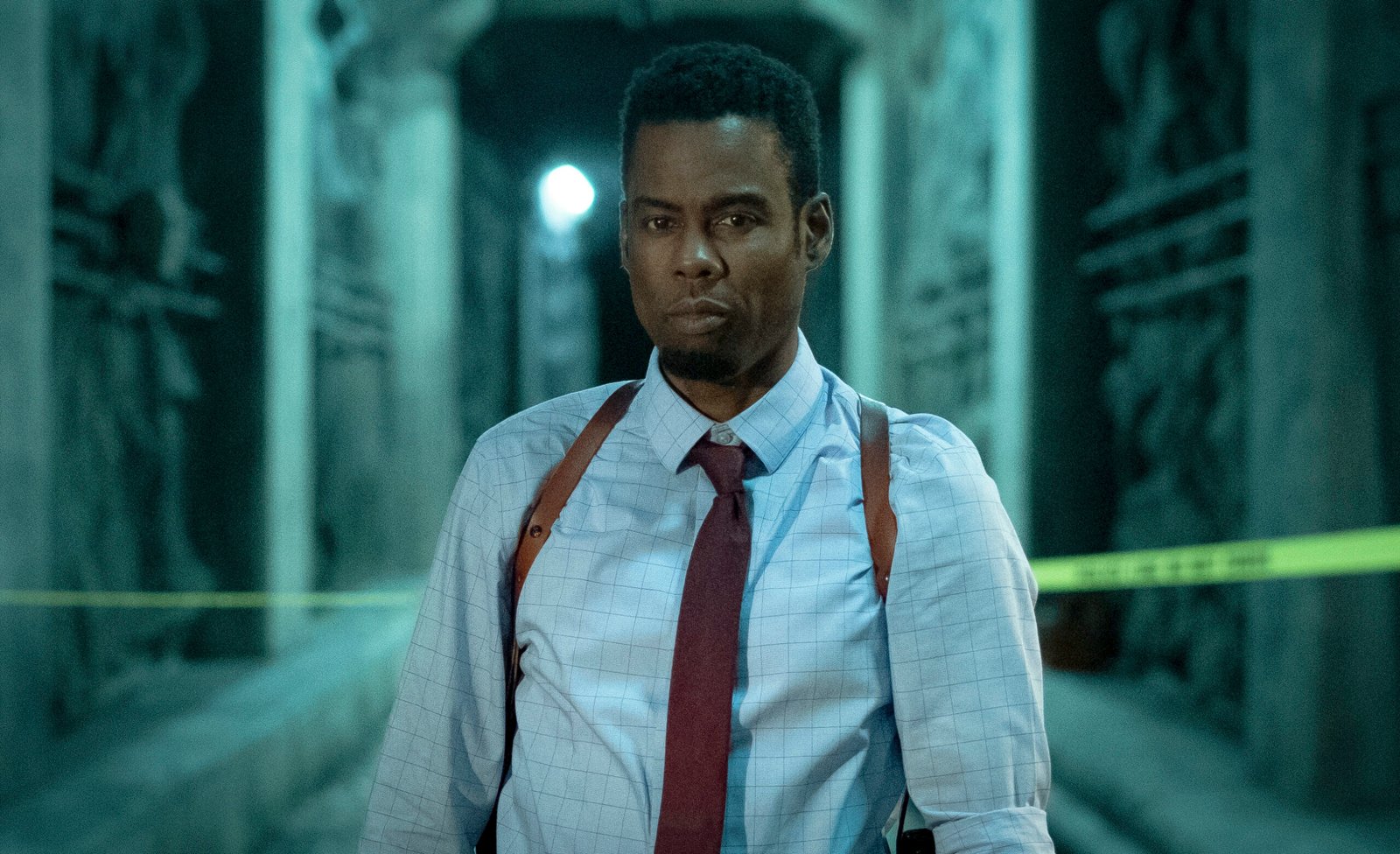
Rock plays Detective Ezekiel “Zeke” Banks, and the film is honest about what he is: the department’s rat. As a rookie, Zeke reported his own partner, Peter Dunleavy, for murdering a witness — and the precinct has never forgiven him the arithmetic of being right. He works alone, gets the backup calls nobody answers (one nearly killed him, years ago, when Detective Fitch decided not to come), and lives in the long shadow of his father Marcus, Samuel L. Jackson’s retired chief, the legend whose era the whole department still measures itself against. Rock does not play this for charm. His Zeke is wired, exhausted and angry in a way that keeps spilling out of the performance’s edges — the famous voice cracking toward a shout he keeps swallowing. It divided the critics cleanly: the Hollywood Reporter’s Lovia Gyarkye found the film “a legitimately frightening, if unevenly paced, detective thriller” and praised the acting, while others judged the material beneath both Rock and Jackson. Our seat is with the divided middle: Rock is not always in control of the register, but he is never uninteresting, and his scenes with Jackson — two men discovering the father’s legend was load-bearing — give the film a spine no trap could.
The killer, meanwhile, is pointedly not Jigsaw. Let the record be exact, because the listings keep getting it wrong: Tobin Bell does not appear in this film, in person or in voice. John Kramer survives only in photographs. The copycat works through a new puppet, Mr. Snuggles — a pig in a police uniform — speaking in a processed machine voice that was settled, astonishingly, two days before the final sound mix. The mask is a pig’s, the symbol is a red spiral, and the choice of targets is the manifesto: corrupt officers, one rigged confession at a time. It is a cleaner idea than the late sequels managed, and Bousman shoots it cleaner too — sunlit precincts and fluorescent tunnels instead of the series’ green murk, the violence rationed compared to his own earlier entries (though “rationed” is relative: the film was rated NC-17 eleven times before the cuts earned its R). The traps themselves are mid-table franchise machinery — the tongue trap that opens the film is the strongest, a thesis statement with a train in it; the wax trap in the precinct’s cold storage is the cruelest; the finger trap is mostly arithmetic — but they serve the procedural rather than pausing it, which for this series counts as reinvention.
Where it frays is in the middle distance. The mystery is solvable early by anyone watching the new partner a beat too long, and the film’s theme — police corruption, the code of silence, a chief who once protected dirty cops under an internal directive called Article 8 to clean the streets faster — is handled, as Variety’s Owen Gleiberman put it, “in a weirdly untopical, almost garishly generic way”: the material keeps gesturing at a real American wound and then retreating into franchise mechanics. The New York Times’ Lena Wilson allowed that the opening scene is the film’s best; Empire concluded that the attempt to break the mould “gets quickly overrun by the franchise’s worst habits.” Those are fair counts. What they under-credit is the ending, which is the bravest sequence Bousman ever shot for this series — a trap built not for a victim but for a witness, engineered so that whatever Zeke Banks chooses, the department itself pulls the final trigger. The last two minutes reframe everything before them, and the film cuts to black on the one image the whole series had never dared: the game still running, the player still standing, nobody saved.
The market was colder than the movie. Delayed out of 2020 by the pandemic and released as theatres reopened in May 2021, Spiral opened at number one with $8,750,034 — the lowest opening in franchise history — and finished at $23,216,862 at home against a $20 million budget, tied for the series’ highest budget to that point. Producer Mark Burg has since said plainly that it “wasn’t a box office success as they had expected,” and the studio’s answer was to go back to Kramer. Fair enough as bookkeeping. But the franchise’s own history has been kind to its orphans, and Spiral — the one where the comedian played it straight, the director of the sequels tried to make a thriller, and the copycat out-thought the original’s ghost — is better built than its opening weekend suggests.
So the ledger, plainly. The procedural frame works: Zeke’s pariah detective, the father behind him, the precinct closing ranks — real architecture, and Rock and Jackson play it for keeps. The killer’s targeting logic works; the franchise needed a reason to kill people that wasn’t a dead man’s diary. What doesn’t work is the solvable mystery, the theme forever retreating from its own nerve, and a middle act whose traps tick louder than its investigation thinks. It is the rare franchise spin-off that fails upward — pointing at the smarter series this one could have become.
Spoiler Section
Full spoilers from here. The rookie partner is the killer. William Schenk is William Emmerson, twelve years old when he watched Zeke’s partner Peter Dunleavy murder his father Charlie — a witness who had agreed to testify against a dirty cop — and be protected for it by the system Marcus Banks built under Article 8. Schenk faked his own death mid-film with the skinned corpse of the thief who lured Bozwick into the tunnel, and ran the investigation from inside it, beside the one cop he believes might understand: he is not hunting Zeke, he is recruiting him. Captain Garza dies in her own precinct’s cold storage, under flowing wax. Dunleavy dies in a machine that hurls crushed glass, while Zeke — given the choice and a key he cannot reach in time — tries honestly to save the man who ruined his career. And the finale: Marcus hangs like a marionette, bleeding out by degrees, while Schenk offers Zeke a revolver with one bullet — shoot the target and free his father but let the killer walk, or shoot the killer and watch his father drain. Zeke shoots the target. Then SWAT, summoned by Schenk’s own fake 9-1-1 call, trips the wire: Marcus is yanked upright with a gun rigged to his arm, and the officers do exactly what they were brought there to do. Schenk vanishes. The last sound of the film is Zeke screaming in an empty warehouse, the spiral’s newest student, promoted by force.
Trivia
- The film was rated NC-17 eleven times before enough was cut to earn its R, per director Darren Lynn Bousman.
- The Kramer sequel the producers shelved to make this film instead — developed by the same writers from April 2018 — later became Saw X (2023).
- The copycat’s voice was a production problem to the end: the processed voice used for Mr. Snuggles was settled only two days before the film’s sound mix was finished.
- Tobin Bell recorded a Johnny Cash cover that was considered for the ending and dropped as too gimmicky; Bell does not appear in the finished film at all.
- Bousman has said the film was designed to carry less gore than his earlier entries, with the tone modelled on Seven — and one trap scene was cut entirely after he judged it “too gnarly.”
- Chris Rock’s involvement began with a chance meeting at a friend’s wedding in Brazil, where he pitched Lionsgate’s vice chairman Michael Burns on extending the franchise.
Where to Watch
Streaming by subscription on Hulu, fuboTV, YouTube TV and FXNow; also available to rent or buy on Amazon Video, Apple TV and Fandango At Home (checked November 10, 2026).
The Verdict
The badge is the target, and for two acts the film shoots straight: a pariah detective, a legendary father, a copycat with a grievance older than the franchise’s ghost. Spiral overplays its mystery and underplays its theme, but its finale is the cruelest clean idea Saw ever built — a game the police finish for the killer. Not the rebirth the wedding pitch promised. Still, the only spin-off this series has that’s arguing about something. Rating: 3 ravens out of 5.
Quick Specs
- Director: Darren Lynn Bousman
- Screenplay: Josh Stolberg and Peter Goldfinger
- Starring: Chris Rock, Max Minghella, Samuel L. Jackson, Marisol Nichols
- Music: Charlie Clouser
- Cinematography: Jordan Oram
- Editor: Dev Singh
- Producers: Mark Burg and Oren Koules
- Production Company: Twisted Pictures
- Distributor: Lionsgate
- Released: May 14, 2021
- Runtime: 93 minutes
- Rating: R
- Budget: $20 million
- Box Office: $40.6 million worldwide per Box Office Mojo (The Numbers’ territory table sums to roughly $42.3 million)
- On This Site: Spiral, Jigsaw, Saw X
The weekly roundup
One letter a week, from the crypt.
- New reviews, with the ravens
- New wiki entries and news
- Cool stuff worth your night
Weekly. No spam, unsubscribe in one click.