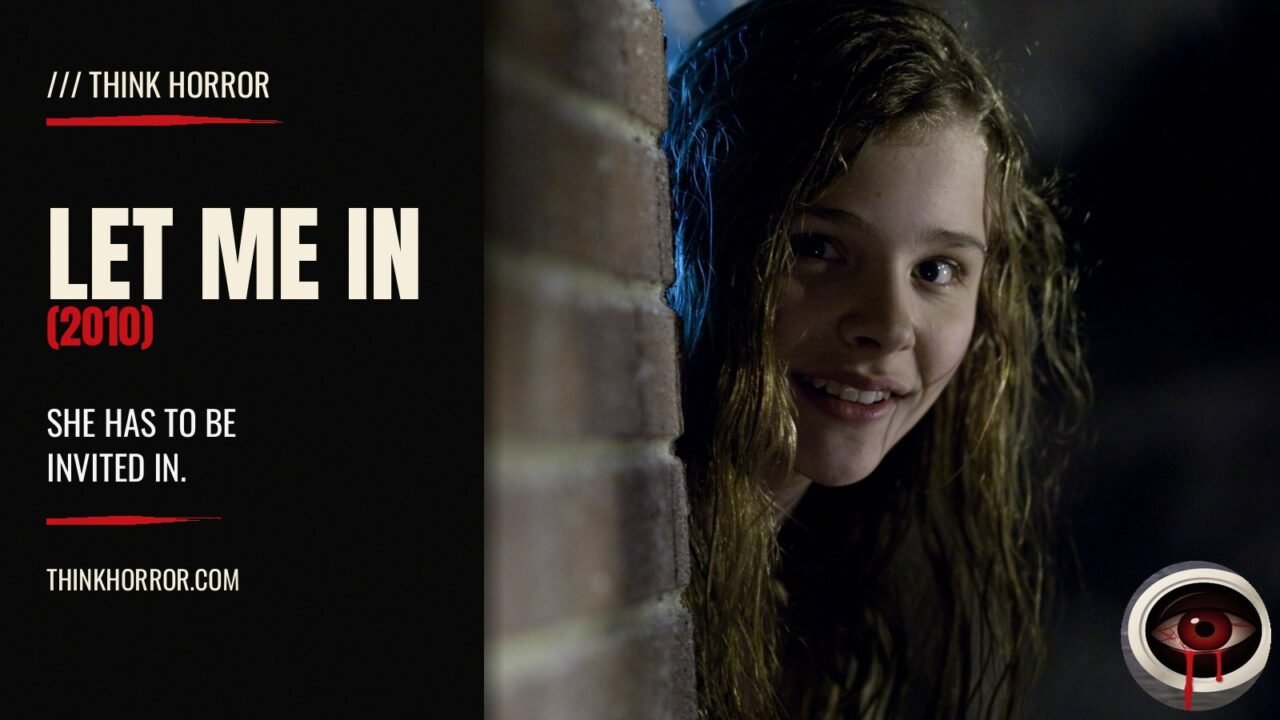
The boy with the knife is practising on a tree again, because the tree does not hit back. You are twelve, your bruises have bruises, and the courtyard of your apartment block at night is the only country where you are not somebody’s prey. The new neighbours are moving in after dark — a man, and a girl with no coat and no shoes, walking barefoot through the snow as if the cold were a rumour she had heard about other people. She looks at you once, the way weather looks at a house. Everything in your life is about to change, fiend, and almost none of it will hurt the way school does.
Let Me In (2010) is Hammer’s remake of Let the Right One In, in which a bullied boy befriends the vampire girl next door.
Los Alamos, New Mexico, March 1983: the atomic town, the town that built the bomb, where the President is on television calling an empire evil while a twelve-year-old boy practices knife work on a tree because the only evil he knows has a name, a face, and a metal antenna it hits him with. Into the apartment beside his — barefoot in the snow, no coat, a girl who only comes out after dark — moves Abby. She tells him straight away, in the courtyard, that she cannot be his friend. She is the only honest person in his life.
Harper knows the objection, because Harper made it himself, loudly, in 2010: the Swedish film was two years old, it was perfect, and Hollywood was coming for it with a bucket of American paint. So let the record of this crypt show the harder truth. This is the remake that knocked politely at the window and asked to be let in — and it is the rare one that deserved the invitation. It did not earn a fortune. It earned something better: the blessing of the man who wrote the book, and a place in this host’s cold heart next to the original it can never replace.

The Review
The film opens near the end, and that is not a cheat. A man is carried into a Los Alamos hospital with his face burned away by acid — Thomas, though the film has not named him yet — and a detective asks him about a murder. He gives the detective nothing. When the room empties, he goes out of a tenth-floor window, and leaves a note behind: I’M SORY ABBY. Then the film steps back two weeks, and spends the rest of its running time filling in the dreadful arithmetic that led him there. You are invited to watch the sum as it is worked out.
Owen is twelve, and his life is an exercise in being unseen. His parents are divorcing by telephone — his father exists in this film only as a voice on the line, his mother drifts through the apartment out of focus, a glass in her hand, a woman the camera itself cannot quite look at. At school, Kenny and his friends own Owen completely: the bruises he hides, the lies he tells about them, the knife he rehearses with against a tree in the courtyard, whispering the lines he will never say standing up. Kodi Smit-McPhee plays him as a boy holding his breath underwater, and that is not a metaphor the film intends loosely. It comes back to it, in a pool, at the end.
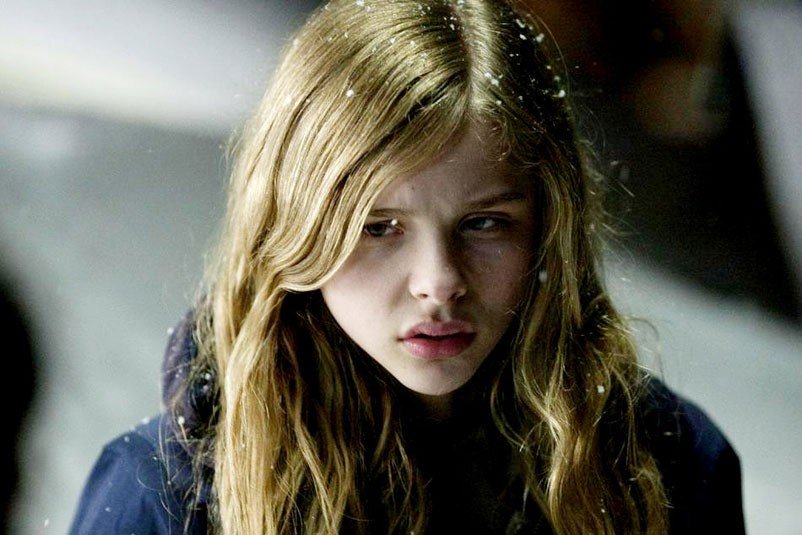
Abby arrives the way weather arrives. Barefoot on the climbing frame in the snow, solving his Rubik’s cube overnight, smelling — his word, regretted instantly — a little funny. Chloë Grace Moretz was twelve when she shot this, and what she does with stillness would shame actors three times her age: she plays a creature wearing childhood rather than living it, an old, tired thing whose patience with Owen is genuine and whose hunger is not negotiable. The film’s great tenderness and its great horror are the same scenes. She teaches him to fight back. She taps to him through the apartment wall in Morse code — two children inventing a language because the adult world has given them none. She asks him, after retching up the candy he offered her, “Would you still like me if I wasn’t a girl?” — and in this version the question means what it has always secretly meant: if I wasn’t human. If I was the thing I am.
And then there is the man she lives with. Richard Jenkins, credited only as “the Father,” gives the performance this host cannot shake: a harvester at the end of his usefulness. He bleeds a kidnapped boy into a plastic jug in the woods and, in the dark, spills the whole of it — and the sound he makes is not a monster’s sound, it is the sound of a man who has failed at the only job he has left. His second attempt ends in a wrecked car and a face full of acid so no one can trace him back to her door. Abby comes to his hospital room. He offers her the only gift he has left to give, out of his own veins, and goes out the window so the trail dies with him. It is the most quietly devastating death in modern horror, and it is a suicide staged as a love letter.
Because the film has already shown you the other side of that devotion, in a single aged photograph Owen finds among her things: the “father” as a young boy, standing beside a girl who has not aged a day since. He was Owen once. That is the remake’s own darkest addition — the Swedish film’s guardian was a different arrangement — and Matt Reeves plants it without a word of dialogue and lets it rot beautifully in the back of your mind for the rest of the picture. Every kindness Abby shows this boy is real. So is the job opening.
Around the love story, Los Alamos is dying politely. The neighbor woman Virginia survives Abby’s interrupted feeding and wakes in a hospital bed as something new — what the morning does to her there is one of the great cruel passages of the decade, and it waits below the gate. The town’s unnamed Policeman, Elias Koteas at his most dogged and human, pieces the killings together and forces Abby’s door at dawn — and being right, in this town, is the most dangerous thing a man can be. And through it all the television murmurs about evil empires on the other side of the world, while the adults of this town cannot see the evil that has been living, hungry and patient, in the apartment block for years. Reeves has said the frame was deliberate: an America certain evil lived over there, raising children who met it next door.
The pool climax you may know by reputation even if you have never seen either film: the bullies hold Owen under the water at knifepoint and the camera stays down there with him, in the muffled blue, while above the surface the rescue arrives only as edges — sounds, shadows, things drifting past. What exactly arrives waits below the gate. It is restraint raised to an art form. Greig Fraser shoots the whole picture in winter dusk and sodium light, naturalistic and unshowy, and Michael Giacchino’s score does the thing his best scores do: it aches in the places where a lesser composer would settle for scaring you.
So the ledger, plainly. What works: the two children — Smit-McPhee and Moretz carry a nearly wordless love story on Morse taps, a shared wall and a solved Rubik’s cube, and never once play it cute; Richard Jenkins, giving the finest quiet performance in any vampire film of its era, devotion curdled into failure without a single raised voice; the photograph — one prop, no dialogue, and the whole film darkens, the cycle made visible, the remake’s own contribution and its best; the restraint, the horror kept at the frame’s edges where it lives longest; and the 1983 frame, Reagan’s “evil empire” speech playing as thesis rather than decoration. What doesn’t: it cannot escape its original — beat for beat the architecture is Alfredson’s, and stretches play like a beloved song covered beautifully in another accent; the feral moments jar, the one place its patience abandons it for a digital ferocity that has aged worse than everything around it; and America shrugged — it closed at $27.1 million worldwide against its $20 million budget, among the lowest-grossing wide releases of its year. The film deserved the audience that found it later.
Spoiler Section
Spoilers settle here, fiends — the deaths and the ending are discussed plainly.
Virginia burns. Turned by the interrupted feeding, she wakes in a hospital bed as something new, and when a nurse opens the curtain the sunlight takes her, screaming, in front of the whole ward — the film’s cruellest death, dealt to its most innocent bystander. The Policeman forces Abby’s door at dawn, stake in hand, and she takes him in the dark of her own bathroom before he can finish being right. And at the pool, what drifts past Owen’s underwater camera is the bill for Kenny’s cruelty: Abby, come home, collecting it at the surface while her boy holds his breath and lives.
It ends on a train out of Los Alamos. Owen has run — from the bruises, from the telephone father, from the town that never saw him — and beside him sits a steamer trunk. From inside it, small and patient, comes a tapping in the language the two of them invented through a bedroom wall. He taps back. Whatever the job opening costs him in fifty years, the film leaves him here: chosen, answered, and going somewhere dark at speed, together.
Trivia
- Hammer bought the English-language rights at the 2008 Tribeca Film Festival, where the Swedish original had just won the festival’s top narrative prize. Producers John Nordling and Carl Molinder worked on both films.
- John Ajvide Lindqvist — who wrote the novel and the Swedish film’s screenplay — praised the remake as “a great American film” that “stands firmly on its own legs.”
- Matt Reeves refused studio pressure to age the children up, arguing it would ruin the essence of the story, and asked Smit-McPhee and Moretz not to watch the Swedish film before shooting. On Steven Spielberg’s advice, both young actors kept in-character diaries during production.
- The film was shot in and around Los Alamos and Albuquerque, New Mexico, in a real high-desert winter — and where the snow fell short, the effects team added more digitally.
- The car crash was staged as a single uncut shot using a real plate and a mechanically spun “rotisserie” model car. The scene where Abby bleeds for entering uninvited was rendered digitally, tracked to Moretz’s movements.
- The suicide note in the opening scene — “I’M SORY ABBY” — is misspelled in the film itself. It is not a typo you are catching; it is the character’s.
- Stephen King, writing in Entertainment Weekly, called Let Me In the best horror film of the decade.
- John Ajvide Lindqvist, who wrote the novel and the Swedish screenplay, blessed the remake in words worth printing whole: “‘Let The Right One In’ is a great Swedish movie. ‘Let Me In’ is a great American movie… a respectful rendering of my novel for which I am grateful.”
- A flashback showing young Abby being turned was filmed and deleted; Moretz has described it in interviews, but it is not in the released film — the picture keeps her origins, pointedly, in a photograph and a single line: she has been twelve for a very long time.
Where to Watch
As of November 15, 2026, in the US: Let Me In streams free with ads on Pluto TV. Rent or buy it on Amazon Video, Apple TV Store and Fandango at Home. Listings rotate — check before you settle in.
Quick Specs
- Director: Matt Reeves
- Screenplay: Matt Reeves, from the novel by John Ajvide Lindqvist and Lindqvist’s Swedish screenplay
- Starring: Kodi Smit-McPhee (Owen), Chloë Grace Moretz (Abby), Richard Jenkins (the Father), Elias Koteas (the Policeman), Cara Buono (Owen’s Mother), Dylan Minnette (Kenny), Jimmy ‘Jax’ Pinchak (Mark), Nicolai Dorian (Donald), Brett DelBuono (Jimmy), Sasha Barrese (Virginia), Ritchie Coster (Mr. Zoric)
- Music: Michael Giacchino
- Cinematography: Greig Fraser
- Editor: Stan Salfas
- Producers: Donna Gigliotti, Alex Brunner, Simon Oakes, Tobin Armbrust, Guy East, John Nordling and Carl Molinder
- Production Company: Hammer Films, Exclusive Media Group and EFTI
- Distributor: Overture Films with Relativity Media (US); Icon Film Distribution (UK)
- Premiered: September 13, 2010 (Toronto International Film Festival); US release October 1, 2010
- Runtime: 116 minutes
- Rating: 4 out of 5 ravens
- Budget: $20 million
- Box Office: $12.1 million domestic; $27.1 million worldwide
- On This Site: Let Me In in the wiki · Hammer Films · The Woman in Black in the wiki
The Verdict
Rating: 4 ravens out of 5.
Four ravens — it knocks politely, and earns its invitation. Let Me In is the rare remake that deserved one: the same sad story told in an American winter, carried by two children who never play it cute and by Richard Jenkins’ quiet devastation, and darkened by one photograph that turns a love story into a cycle. It can never replace the original. It does not have to. It asked, and this crypt let it in.
The weekly roundup
One letter a week, from the crypt.
- New reviews, with the ravens
- New wiki entries and news
- Cool stuff worth your night
Weekly. No spam, unsubscribe in one click.