
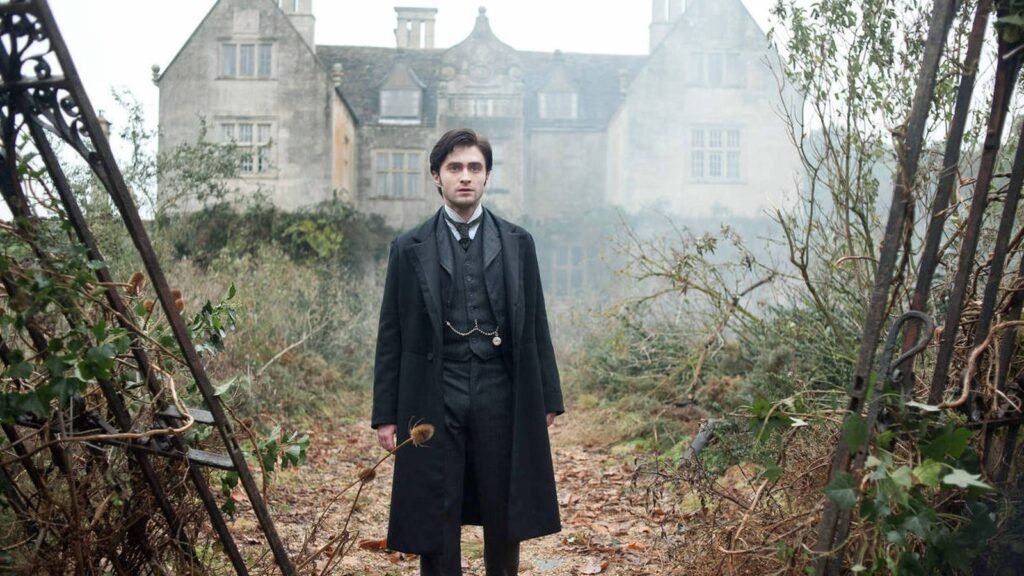
The Woman in Black (2012) is the revived Hammer’s defining ghost story, built on Daniel Radcliffe’s first post-Potter lead. It opens with three little girls playing in a nursery — who stop, rise together, walk to the window, and step out of it. No music sting does the work. No monster shows its face. Just children, a window, and the certainty that whatever looked back at them owns this film now. An old-fashioned ghost story, told straight, trusting silence and marsh fog to do what a hundred jump scares cannot — and it became the most financially successful film the revived Hammer has ever made.
Quick Specs
- Director: James Watkins
- Screenplay: Jane Goldman
- Based on: The Woman in Black (1983), the novel by Susan Hill
- Producers: Richard Jackson, Simon Oakes, Brian Oliver
- Starring: Daniel Radcliffe, Ciarán Hinds, Janet McTeer, Liz White, Sophie Stuckey, Misha Handley
- Cinematography: Tim Maurice-Jones
- Editor: Jon Harris
- Music: Marco Beltrami
- Production companies: Hammer Film Productions, Alliance Films, Cross Creek Pictures, UK Film Council
- Premiere: 24 January 2012, Royal Festival Hall, London
- Released: 3 February 2012 (North America); 10 February 2012 (UK)
- Running time: 95 minutes (the BBFC lists the classified UK version at approx. 92 minutes)
- Certificates: UK 12A (theatrical version pre-cut by the distributor); 15 uncut; US PG-13
- Distributors: Momentum Pictures (UK); CBS Films (US)
The boy who lived, sent to a house that kills children
Start with the gamble, because there were two of them, and they were the same gamble. Hammer, newly revived and still proving it was more than a logo, needed a hit that belonged to the present tense. Daniel Radcliffe needed a first grown-up lead that nobody could mistake for a boy wizard. They found each other in a ghost story about a grieving young father — and get the chronology right, because the legend usually gets it wrong. Radcliffe was announced as Arthur Kipps on 19 July 2010, while the final Harry Potter film was still almost a year from release. He was 20 years old, four days short of 21. He filmed the part at 21, and he was 22 when the film premiered and opened in early 2012. So this is his first post-Potter leading role in release order — not his first non-Potter film ever; he had made December Boys and appeared in The Tailor of Panama during the Potter years.
He holds it. His Arthur is a widower — Stella, his wife, died giving birth to their son Joseph four years before the story opens — and his grief is endangering his job at a London law firm. His employer, Mr Bentley, gives him one last chance: travel to Crythin Gifford and sort the papers of the late Alice Drablow, whose house, Eel Marsh House, is to be sold. Hold this for the versions section below: the dead wife is this film’s own invention. In Susan Hill’s novel, Stella is Arthur’s fiancée, alive and well during everything that happens to him. The film darkens its hero before he ever reaches the marsh, so the ghost is not the only thing haunting him.
A village that looks away
Crythin Gifford does not welcome him. The local solicitor, Jerome, is cold to the point of fear. The innkeeper wants him gone. Only one man treats Arthur as a guest rather than a warning: Sam Daily, the wealthy local landowner, played by Ciarán Hinds. Sam is the sceptic of this story — never make him the believer. It is his wife Elisabeth, played by Janet McTeer, who carries the couple’s grief and its strange consolation. The Dailys lost their young son Nicholas to drowning, and Elisabeth believes Nicholas speaks through her: at the Dailys’ dinner table she falls into a trance and gouges a drawing of a hanging woman into the wood with a knife. Two dead boys run under this film like two cold currents, and the story depends on keeping them separate. Nicholas Daily is the Dailys’ son. Nathaniel Drablow is somebody else’s — and he is the engine of the haunting.
Eel Marsh House stands alone on an island in the marsh, reached by a causeway the tide swallows twice a day, and the film makes the tide its clock: when the water is up, Arthur is the house’s prisoner. There he hears a carriage accident that is not happening, and he sees her for the first time — a woman in funerary black, standing among the graves. The village’s arithmetic is simple and merciless: a child dies whenever the Woman in Black is seen. It happens at once. A girl named Victoria Hardy is brought in dying — she has swallowed lye — and dies in Arthur’s arms, and the village blames the stranger who went up to the house and looked. Another child, Jerome’s daughter Lucy, locked in a basement for her own safety, is goaded by the ghost into smashing an oil lamp and burning as her father’s house catches fire.
The papers Arthur was sent to sort tell him why. Nathaniel was not Alice Drablow’s son — he was her nephew, the child of her sister Jennet Humfrye, taken from Jennet after she was judged an unfit mother and raised by the Drablows as their own. The boy drowned in a carriage accident on the marsh, in sight of the house, and Jennet — who blamed Alice for taking him and for losing him — hanged herself in the nursery, vowing never to forgive. Liz White plays her, and note the credit: in the film and its credits she is listed simply as “Jennet.” Nobody on screen calls her the Woman in Black. That name is ours, and the village’s fear, not hers. Arthur’s answer is the act of a decent man who has understood everything except the one thing that matters: he and Sam haul Nathaniel’s body out of the marsh and bury it with his mother. Her voice answers out of the dark that she will never forgive. Forgiveness was never the currency. His own son Joseph is arriving by train that night, and she has already marked him.
The house and the marsh are real
Crythin Gifford and Eel Marsh House are Susan Hill’s inventions, but the places on screen are real and specific. Eel Marsh House’s exteriors are Cotterstock Hall in Northamptonshire, all ivy and wet stone. The causeway that strands Arthur is the tidal road to Osea Island in Essex — the same causeway the 1989 television version had used, a generation earlier. The village is Halton Gill, up in the Yorkshire Dales. Watkins shoots it all in Edwardian England — damp, grey, gaslit — as a deliberate act of homage: the revived Hammer reaching back to the Gothic house style of The Curse of Frankenstein and Dracula, to the era of Terence Fisher, rebuilt with modern money and modern patience.
Four stories, four endings
Here is where most tellings go wrong, so take it slowly: there are four versions of The Woman in Black, and every one ends differently. Never let anyone merge them for you.
The film’s source is Hill’s 1983 novel — the novel, not the famous stage play, whatever loose talk you may have heard. In the novel, Arthur is engaged, not widowed. He survives Crythin Gifford, comes home, marries Stella, and they have a son, Joseph. A little over a year later, at a fair, the Woman in Black steps in front of their pony and trap: Joseph is killed outright, and Stella dies of her injuries ten months later. Arthur lives. The novel is his own telling of it, years afterwards, to the family of his second wife, Esmé, at Christmas.
Stephen Mallatratt’s stage adaptation opened in Scarborough at Christmas 1987 and reached London in 1989, where it ran in the West End for 33 years, closing only in 2023 — for most of that run the second longest-running play in West End history, behind only The Mousetrap. The play keeps the novel’s tragedy inside a rehearsal frame, then adds a final twist the novel does not have: the Actor, hired to help the elderly Kipps rehearse his story, asks about the young woman he saw in the theatre, assuming she was cast. Kipps hired no actress. “I did not see a young woman.” The telling has not exorcised her. It has summoned her.
The 1989 television film — written by Nigel Kneale — is the bleakest of the four, and it changes the names, so keep them in their own film: its hero is Arthur Kidd, its friendly landowner is Sam Toovey, and its Kidd, back in London, takes his whole family boating on a lake, sees her standing on the water, and drowns with his wife and child when a tree falls on the boat. Nobody survives to tell anything. A rights dispute then kept that film almost entirely out of circulation for decades — one repeat at Christmas 1994, then nothing until a restored Blu-ray in 2020. Its Arthur was played by Adrian Rawlins; remember that name, because he comes back below.
And the 2012 film? It ends at the station. The Woman in Black lures Joseph onto the tracks in front of a train, Arthur dives after his son, and both of them are killed. Sam Daily, watching, sees the ghosts of the village’s dead children gathered with her on the platform. Then the film does the one merciful thing any of the four versions allows its Arthur: father and son, in a bright afterlife, are met by Stella, and the family walks into the light together. The novel’s Arthur lives and loses everything slowly. This Arthur loses everything at once — and gets his family back on the other side of it. Whether that ending consoles you or lets the ghost off too easily is the argument this film wants you to have on the way home.
Cut for a 12A
British audiences did not, at first, see quite the film described above. The BBFC’s own classification record states that the distributor “chose to reduce moments of strong violence / horror in order to achieve a ’12A’ classification,” and that “a ’15’ classification without cuts was available.” The two scenes trimmed were Jennet’s hanging and the girl who smashes the oil lamp and burns — the film’s two hardest images, softened so a film about a ghost who murders children could be sold to twelve-year-olds. The uncut version is a 15: that is the classification it carries on UK home media and the one the 2014 cinema re-release carried. America rated it PG-13, under a different system entirely; the two labels are not the same statement and should never be blended. And the cuts bought peace from nobody: the 12A version still drew 134 complaints, making it the most complained-about film of 2012 in the BBFC’s own figures.
The money, with the argument left in
Even the budget of this film is an argument, and this page prints it the way the record holds it — as an argument. Variety reported the production cost at $15 million, and The Numbers lists the production budget at the same $15 million. A Daily Telegraph report from the premiere estimated $17 million. Both figures stand, attributed; nobody gets to average them into a comfortable single figure that no source ever printed.
What the film did with the money is not in dispute. It opened in North America at number two, behind Chronicle, with $20.9 million on its first weekend — the biggest US opening for a Hammer film in the studio’s history. Its North American total closed at $54,333,290, and its current worldwide total stands at $128,955,898. One caution for the number-hunters: you will see $127.7 million quoted as the film’s gross, and it is not wrong — it is simply dated. That was the worldwide total by June 2012; the gap to the current count is later reporting, not an error. The records, stated precisely and no larger than they are: the highest-grossing British horror film in 20 years, and the most financially successful film of the revived Hammer. Not the biggest Hammer film of all time — that claim gets made about it, and it is an inflation. The true claims are big enough.
What the critics made of it
The notices were generally warm, praising Radcliffe’s performance, the cinematography, Watkins’s direction and the atmosphere — with the standing reservation that the film is traditional, even old-fashioned, in its machinery. Rotten Tomatoes aggregates it at 66% from 197 reviews, its consensus calling it “traditional to a fault” while conceding it “foregoes gore for chills”; Metacritic scores it 62 from 40 critic reviews. Bruce Diones put the film’s virtues in one line: “The moody, beautifully composed production raises it above the norm.” Kate Muir caught its weather: “The set-up is chillingly effective, suffused with a nagging, damp disquiet from the marshes nearby.” Old-fashioned, in other words, was the method rather than the failure.
The sequel, and the man who bookends the whole story
Success built a sequel, as success does. The Woman in Black: Angel of Death — singular, whatever the announcement-era coverage said — arrived in January 2015, set in 1941 with evacuee children billeted at Eel Marsh House, directed by Tom Harper from Jon Croker’s screenplay. No Radcliffe, no Watkins, no Goldman. It took $48.9 million worldwide — a fraction of the first film’s haul.
But look at its cast list, because it closes this page’s strangest circle. Adrian Rawlins — the Arthur Kidd of the 1989 television film — appears in Angel of Death as Dr Rhodes, the only actor to appear in two different screen versions of this story, as two different men. And between those two appearances, Rawlins played James Potter in the Harry Potter films. Sit with the symmetry, because it is perfect and it is true: the first screen Arthur was Harry Potter’s father, and the second screen Arthur was Harry Potter. The Woman in Black has been told four times, in four ways, with four endings. The boy who lived grew up, walked out to a house on a marsh that eats children, and made the ghost story his own. She is still out there on the causeway, waiting for the tide to go down. She can wait. Waiting is what she does.