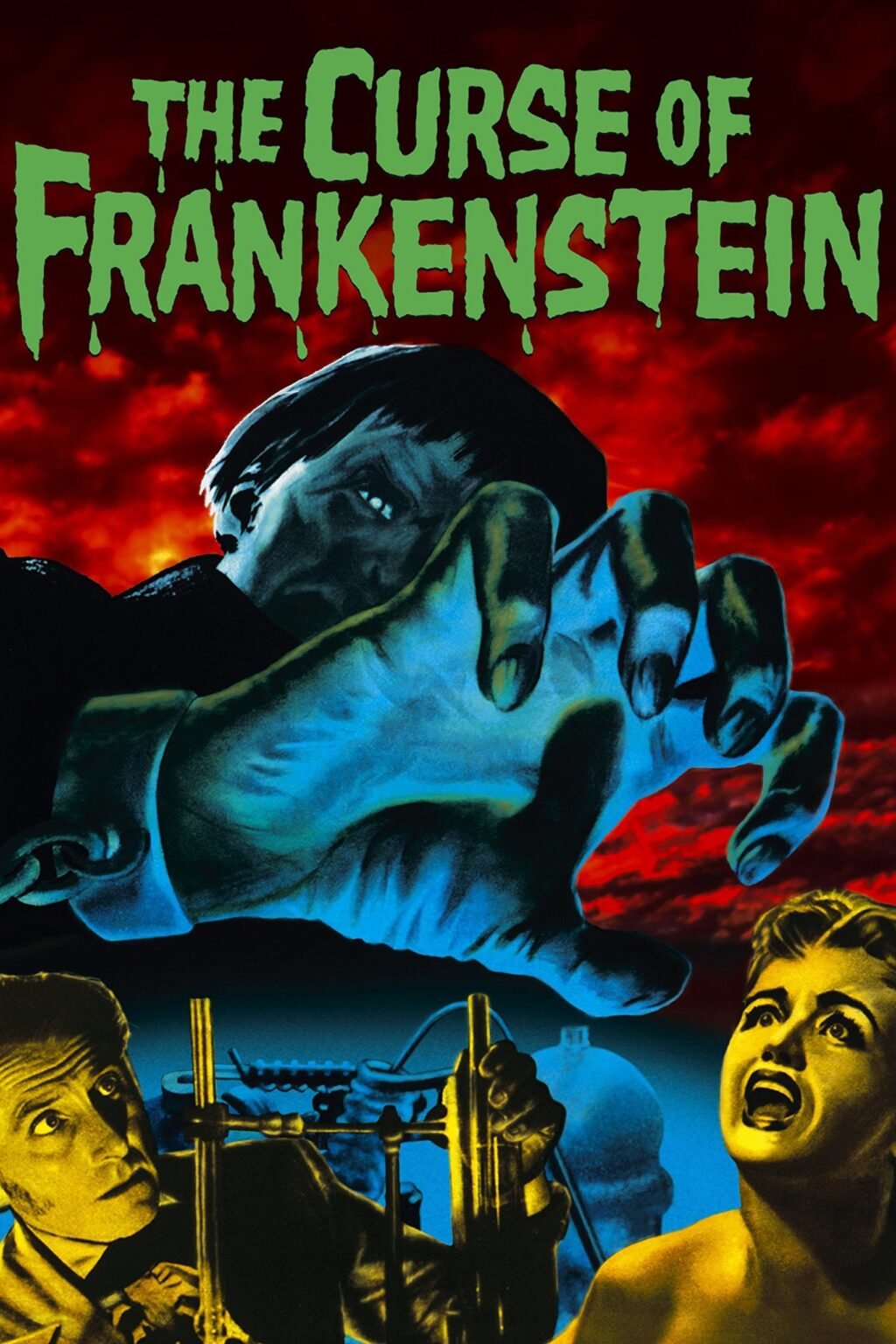
The Curse of Frankenstein (1957) is a British horror film from Hammer Film Productions, loosely based on Mary Shelley‘s 1818 novel Frankenstein. It was directed by Terence Fisher and written by Jimmy Sangster. Awaiting execution, Baron Victor Frankenstein (Peter Cushing) tells a priest how he tried to build a perfect human and created a violent creature (Christopher Lee) instead. Hazel Court and Robert Urquhart co-star. It was Hammer’s first color horror film and the first of its Frankenstein series. It was also the first screen pairing of Cushing and Lee. British critics were appalled by its blood in Eastmancolor, but audiences around the world made it a hit. It led directly to Hammer’s Dracula (1958) and is now regarded as a landmark of British horror.
At a glance
| Release date | May 2, 1957 (London premiere); May 20, 1957 (UK); July 20, 1957 (US) |
| Director | Terence Fisher |
| Writer | Jimmy Sangster |
| Based on | Frankenstein by Mary Shelley |
| Starring | Peter Cushing, Hazel Court, Robert Urquhart, Christopher Lee |
| Runtime | 83 minutes |
| Rating | UK: X certificate, with cuts |
| Budget | About £65,000 (also reported as $270,000) |
| Franchise | Frankenstein and Hammer Films: first of Hammer’s Frankenstein series; followed by The Revenge of Frankenstein (1958) |
Plot summary
In 19th-century Switzerland, Baron Victor Frankenstein awaits execution for the murder of his maid, Justine. He tells his story to a visiting priest. Left in charge of the family estate at fifteen, he hires the scientist Paul Krempe (Robert Urquhart) as his tutor, and after two years the two are working as partners. After they bring a dead puppy back to life, Victor proposes building a perfect human from body parts. Paul helps at first but pulls away in disgust, especially once Victor’s cousin and fiancée, Elizabeth (Hazel Court), comes to live with them.
Victor takes a robber’s corpse from a gibbet and buys hands and eyes from charnel-house workers. For the brain, he invites the elderly Professor Bernstein to visit, shows him Rembrandt’s The Anatomy Lesson of Dr. Nicolaes Tulp, and pushes him over a banister. In a struggle with Paul in the vault, the stolen brain is damaged. When the Creature (Christopher Lee) wakes, it is violent and has none of Bernstein’s intellect. It escapes and kills a blind old man in the woods.
Spoiler section: the ending
Paul shoots the Creature, and they bury it, but Victor digs it up and revives it. When Justine, his lover, says she is pregnant and threatens to expose him, he has the Creature kill her. On the eve of the wedding, the Creature gets onto the roof and attacks Elizabeth. Victor accidentally shoots her, then sets the Creature alight with an oil lamp, and it falls through a skylight into a vat of acid. With no evidence left, the priest doesn’t believe him. Paul refuses to confirm the story and leaves with Elizabeth, and Victor is led to the guillotine.
Production and behind the scenes
The project began as a Frankenstein adaptation from producers Max Rosenberg and Milton Subotsky, who brought it to Hammer and later founded its rival, Amicus Productions. Hammer commissioned a new script from Sangster, a former production manager at the company. He wrote with its limited resources in mind and avoided expensive set pieces like villagers storming a castle. He also said he hadn’t seen Universal’s Frankenstein films and worked from his own reading of Shelley. Cushing, then best known for British television, got his first leading film role for Hammer. Lee was cast partly for his height, with Bernard Bresslaw also considered. Hammer avoided copying Boris Karloff‘s monster from Universal’s Frankenstein (1931), so makeup artist Phil Leakey designed a new look.
Filming began at Bray Studios on November 19, 1956. One of the first scenes shot was Frankenstein cutting a highwayman’s body down from the gibbet. Nearby Oakley Court was used as a location and appeared in many later Hammer films. Jack Asher photographed it in Eastmancolor. Its blood, surgery and severed parts in color set it apart from the black-and-white, more suggestive style of earlier Universal horror. The British Board of Film Censors objected to the script before filming. After first viewing the finished film in black and white, it asked for more changes once it saw the color version. Hammer’s restoration team says the original uncensored cut is no longer known to survive. James Bernard wrote the score.
Release and reception
The film premiered at the Warner Theatre in Leicester Square on May 2, 1957, with an X certificate. Warner Bros. distributed it, and it opened in the US on July 20 with X the Unknown as the supporting feature. It was an international hit, later reported to have earned more than 70 times its cost. Its first week at Broadway’s Paramount Theatre took $72,000, which Variety called the venue’s biggest single-feature opening week in two years. One contemporary account puts its earnings at about £300,000 in Britain and £500,000 in Japan.
British critics were largely hostile. The Monthly Film Bulletin found its gore excessive, though it praised the art direction, color and music. Caroline Lejeune of The Observer called it one of the most repellent films she had seen as a critic. American reviews were more mixed: Variety praised Cushing, Fisher and Asher, while Bosley Crowther of The New York Times found it familiar. Its reputation rose from the 1970s. Reviewing the 2025 re-release, Peter Bradshaw of The Guardian gave it four stars. It holds 85% on Rotten Tomatoes.
Legacy and influence
The BFI calls it the first of Hammer’s major Gothic horrors, and says it helped revive the genre when atomic-age monsters dominated. Patricia MacCormack called it the “first really gory horror film, showing blood and guts in colour.” It made Cushing and Lee horror stars, and with Dracula (1958) and The Mummy (1959) it forms what the BFI calls Hammer’s classic early Gothic trilogy. Unlike Universal’s series, where the Monster returned and the doctors changed, Hammer’s sequels followed the Baron. Cushing played him in every film except The Horror of Frankenstein (1970), a more comic remake starring Ralph Bates.
Trivia
- A 2012 UK Blu-ray restored a close-up of a severed eyeball that had been missing from some prints.
- Warner Archive’s 2020 Blu-ray and the 2025 4K restoration present the film in several aspect ratios: 1.66:1 (UK), 1.85:1 (US) and open-matte 1.37:1.
- In 1964 it was reissued in the US on a double bill with Hammer’s Dracula.
- John Burke’s novelization appeared in The Hammer Horror Film Omnibus (1966).
- House of Hammer adapted it as a two-part comic in 1976.
Related links
- Victor Frankenstein and Frankenstein’s Monster (characters)
- Frankenstein on film and Hammer Films
- Dracula (1958)
- Frankenstein (1931)
- Peter Cushing, Christopher Lee and Terence Fisher