
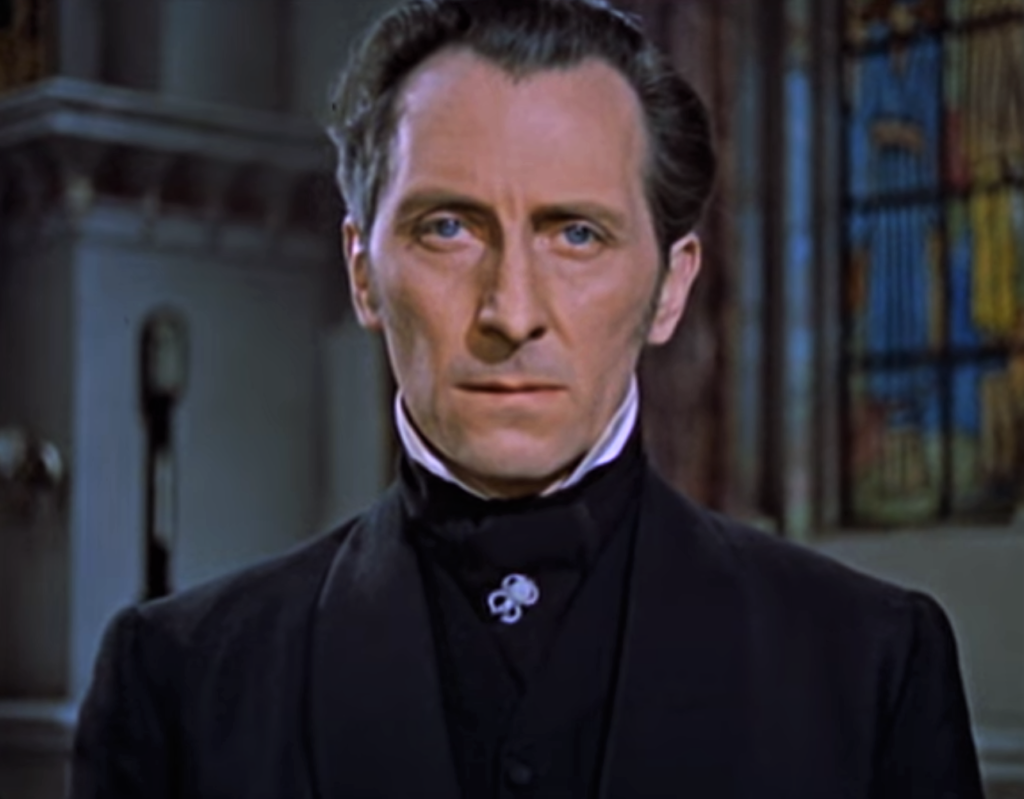
Peter Cushing (1913 to 1994) was the English actor who played Hammer’s Baron Frankenstein and Van Helsing, and Star Wars’ Grand Moff Tarkin.
Quick Specs
| Born | May 26, 1913, Kenley, Surrey, England (as Peter Wilton Cushing) |
| Died | August 11, 1994, Canterbury, Kent, England, aged 81 |
| Breakthrough in horror | The Curse of Frankenstein (1957), as Baron Victor Frankenstein, at 43 |
| Baron Frankenstein for Hammer (six films) | The Curse of Frankenstein (1957); The Revenge of Frankenstein (1958); The Evil of Frankenstein (1964); Frankenstein Created Woman (1967); Frankenstein Must Be Destroyed (1969); Frankenstein and the Monster from Hell (1974) |
| Van Helsing (five films, two characters) | Abraham Van Helsing in Horror of Dracula (1958), The Brides of Dracula (1960) and The Legend of the 7 Golden Vampires (1974); Lorimer Van Helsing in Dracula A.D. 1972 (1972) and The Satanic Rites of Dracula (1973) |
| Sherlock Holmes | The Hound of the Baskervilles (1959); the BBC series (1968); The Masks of Death (1984) |
| Star Wars | Grand Moff Tarkin in Star Wars (1977) |
| Honours | BAFTA TV Award for Best Actor (1956); OBE (1989) |
| Marriage | Helen Beck (Violet Helen Beck), from 1943 until her death in 1971 |
Who He Was
Peter Wilton Cushing was born on May 26, 1913, in Kenley, Surrey. Before the stage took him, he worked briefly as a surveyor’s assistant, which was his father’s profession.
Hammer was his third career, not his first. He had a first Hollywood spell at the end of the 1930s, and his film debut was in The Man in the Iron Mask (1939). He returned to Britain for the war years. Then, in the early 1950s, he built a major reputation on stage and in live television. He was one of British TV drama’s first stars, and he won a BAFTA TV Award for Best Actor in 1956.
In 1943 he married the actress Helen Beck, whose full name was Violet Helen Beck, professionally Helen Cushing. They had met during a production of Private Lives. In 1959 the Cushings bought a seafront house in Whitstable, Kent. Helen died in 1971, and he never remarried.
He was appointed OBE in 1989. That is the honour. The 1956 BAFTA is a television acting prize, and the two are separate.
He was diagnosed with prostate cancer in the early 1980s. The record splits between 1981 and 1982, so he was 68 or 69. He worked on in smaller roles until 1986 and then retired to the Whitstable house, where he painted, birdwatched and became a beloved local fixture. The town later named a seafront viewing point “Cushing’s View,” for the spot where he used to sit.
He died of cancer in Canterbury on August 11, 1994. He was 81.
The Work, and What He Did in It
The Curse of Frankenstein (1957) is where the Baron arrives, and where Hammer begins. Terence Fisher directed, with Cushing as Baron Victor Frankenstein and Christopher Lee as the Creature. Cushing was 43, and the film opened days before his 44th birthday. He played the Baron not as a mad cackler but as a polished, ruthless gentleman-amateur, with charm as the instrument of atrocity. In doing so he invented the Hammer tone as surely as Lee’s Creature did. The film made Hammer’s Gothic cycle possible, and it paired the two men who would carry that cycle for seventeen years.
Horror of Dracula (1958) made him Van Helsing. He reinvented the vampire hunter as an athletic, scientific crusader. In the famous finale he runs along the refectory table, tears down the curtains and improvises a cross from two candlesticks, which is physical acting of a kind the role had never had. From here, the Cushing and Lee confrontation, maker or destroyer against monster, organises the whole Hammer Dracula series.
Van Helsing is two characters across five films, and the split matters:
- Abraham Van Helsing in Horror of Dracula (1958), The Brides of Dracula (1960) and The Legend of the 7 Golden Vampires (1974).
- Lorimer Van Helsing, his descendant, with Abraham in flashback material, in Dracula A.D. 1972 (1972) and The Satanic Rites of Dracula (1973).
The Brides of Dracula is Van Helsing without Lee. Lee is not in that film.
The Hammer spine ran in this order:
- The Revenge of Frankenstein (1958).
- The Hound of the Baskervilles (1959): his Sherlock Holmes, for Hammer, opposite Lee’s Sir Henry. It is lean and precise, and in the record’s consistent judgement one of the great screen Holmes performances in miniature.
- The Mummy (1959): as the archaeologist John Banning, opposite Lee’s Kharis.
- The Brides of Dracula (1960).
- The Evil of Frankenstein (1964).
- Frankenstein Created Woman (1967).
- Frankenstein Must Be Destroyed (1969): the darkest Baron, and by wide critical consent the finest of his Frankensteins. Here the Baron is a sexual blackmailer and a murderer, played ice-calm.
- The Vampire Lovers (1970).
- The Satanic Rites of Dracula (1973).
- Frankenstein and the Monster from Hell (1974): the sixth and last Baron, and Hammer’s last Frankenstein.
Holmes went beyond Hammer. He played the detective again in the BBC series of 1968, and once more, older, in the television film The Masks of Death (1984). Holmes can fairly be called his third signature role, after the Baron and Van Helsing. Across a quarter of a century he took the detective from a Hammer colour picture, through live-era BBC television, to a late television film, from 1959 to 1984.
Dr. Who and the Daleks (1965) and Daleks’ Invasion Earth 2150 A.D. (1966) need precision. They were two Aaru and Amicus films spun off from the BBC programme’s Dalek craze. In them Cushing plays a kindly human inventor literally named Dr. Who, an elderly Earth scientist who builds a time machine in his garden. He is not the Doctor and not a Time Lord, and the films sit outside the television programme’s continuity. No regeneration, police-box lore or Time Lord mythology attaches to him. It is the single most common Cushing error in fan writing, and it is worth keeping his three doctors apart: Dr. Who, the inventor; Dr. Van Helsing, the professor; and Frankenstein, whom the films bill as Baron, a title rather than a doctorate. He played the part as a twinkling grandfather-scientist for the child audience the films were made for, a deliberate piece of casting against his Hammer image.
The Amicus years made him the anchor of the British anthology horror cycle. That cycle began with Dr. Terror’s House of Horrors (1965), where he plays the framing tarot reader, Dr. Schreck. It went on through The House That Dripped Blood (1970), Asylum (1972), And Now the Screaming Starts! (1973) and The Creeping Flesh (1973, opposite Lee), among others. Its summit is Tales from the Crypt (1972). There he is Arthur Grimsdyke, a kindly widower driven to suicide who returns to take revenge, played entirely for tears before terror. It is the single best exhibit for how far his range ran inside the genre: a horror segment built to make an audience weep for the man before it fears him.
Star Wars (1977) made him Grand Moff Tarkin, “one of his most recognised characters.” George Lucas cast him as the Death Star’s commander, the only man in the film who gives Darth Vader orders. He shot his scenes over about two weeks in May 1976, when he was 63, and he was 64 when the film opened. The boots made for him pinched his size 12 feet. So he asked Lucas whether he could wear his carpet slippers and be shot from the waist up, and Lucas agreed. His own words were, “do you think you could shoot me from the waist upwards.” He carried the film’s exposition and menace in clipped, courteous received pronunciation. Carrie Fisher later said she found it hard to act as though she hated his character, because he was so courteous and smelled so pleasant. Tarkin is why audiences who never saw a Hammer film know his face. Cushing later said he had been approached about playing Obi-Wan Kenobi before he took Tarkin. That is his own account, not documented casting fact.
His final work came in smaller roles into the mid-1980s, including Top Secret! (1984) and Biggles (1986), his last film in the standard filmography. Then he retired to Whitstable. The career closed quietly.
The digital afterlife needs the mechanism stated exactly. In Rogue One (2016), Tarkin appears again. On set the role was performed by the actor Guy Henry, in body and voice, with Cushing’s likeness recreated digitally over that performance, twenty-two years after his death, and with his estate’s involvement reported in the production record. Cushing did not simply appear in the film. Guy Henry played the part, and the face was rebuilt.
Cool Verified Facts
- He played Baron Frankenstein six times for Hammer, from 1957 to 1974.
- His Van Helsing is two men: Abraham in three films and Lorimer in two.
- He never played a monster, and he said so himself in 1964.
- He played all of Tarkin in carpet slippers, shot from the waist up, after asking George Lucas politely.
- His Dr. Who is a human inventor, not the Doctor.
- He played Sherlock Holmes for Hammer, on BBC television in 1968, and again in 1984.
- He won a BAFTA TV Award for Best Actor in 1956, the year before The Curse of Frankenstein.
- He played Holmes opposite Christopher Lee’s Sir Henry, and archaeologist John Banning opposite Lee’s Mummy, in the same year, 1959.
- His film debut came in Hollywood, in The Man in the Iron Mask (1939), almost two decades before Hammer.
- Whitstable named a seafront viewing point “Cushing’s View” after him.
Signatures, Habits and Behind the Scenes
The gentleman-horror paradox is the signature, and his own summary from 1964 is the key text: “People look at me as if I were some sort of monster, but I can’t think why. In my macabre pictures, I have either been a monster-maker or a monster-destroyer, but never a monster. Actually, I’m a gentle fellow. Never harmed a fly.” The Baron, Van Helsing, Holmes and Tarkin are makers and destroyers, every one. Even the revenant Grimsdyke is a wronged man played for pathos. The gentle fellow is confirmed from the other side of the camera by Carrie Fisher on Star Wars, and by the whole Whitstable record. Every Cushing performance runs on the gap between the courteous man and the ruthless role.
Precision was his physical style. Van Helsing’s improvised candlestick cross, Holmes’s instruments and the Baron’s laboratory business are all deliberate, rehearsed manual business. He prepared small actions, such as lighting a pipe or handling a specimen, until they read as second nature.
Helen, and the grief, is the record’s centre. After Helen’s death in 1971 he said: “Since Helen passed on I can’t find anything; the heart, quite simply, has gone out of everything. Time is interminable, the loneliness is almost unbearable and the only thing that keeps me going is the knowledge that my dear Helen and I will be reunited again some day. To join Helen is my only ambition.” He also named a rose after her, on a BBC programme. And he nonetheless worked for fifteen more years, which is the fact that gives the words their weight.
He was an artist. He painted seriously, taught by the artist Edward Seago. He drew caricatures of everyone around him, collected model soldiers and birdwatched. The auction record of his sketchbooks and paintings makes this documented fact, not colour.
He asked, and productions accommodated. The slippers are the pattern: a performer whose courtesy made productions bend gladly, and whose co-stars, Carrie Fisher among them, found him impossible to dislike.
Why He Matters
Cushing is Hammer. Lee gave the studio its monsters, but Cushing gave it its moral geometry: the Baron, whose evil is intellect without conscience, and Van Helsing, whose good is intellect with faith. He carried the studio’s Frankenstein and Dracula series at the same time for seventeen years, on both sides of the laboratory door. Add the Amicus anthologies, where his Grimsdyke proved horror could break a heart on purpose, and he stands as the most complete actor of the British Gothic cycle.
Tarkin is the proof of permanence. One two-week performance in carpet slippers became so definitive that the franchise rebuilt the man digitally rather than recast the role. There is no clearer verdict from the wider industry on what a horror actor’s craft is worth.
The afterlife is the last fact. There is “Cushing’s View” in Whitstable, and the rose named for Helen. And in 2016 there was a digital resurrection debated around the world. The quietest man of the Hammer years generated the loudest argument of any of them, about whether the dead may be made to act.