Abraham Van Helsing
Abraham Van Helsing is the elderly Dutch physician and scholar who leads the fight against Count Dracula in Bram Stoker’s 1897 novel.
Quick Specs
| Full name | Professor Abraham Van Helsing, of Amsterdam |
| Created by | Bram Stoker, in Dracula (novel, May 1897) |
| Credentials | “MD, D.Ph., D.Litt., etc., etc.,” in his own signature |
| Profession | Physician, philosopher and metaphysician; not a vampire hunter by trade |
| Former student | Dr John Seward, whom he calls “friend John” |
| Faith | Lay Catholic; never a priest |
| Family (novel) | A wife, unnamed, alive but insane; a son, unnamed, dead before the story opens |
| Age | Elderly, “old and worn” in his own words; the novel gives no birth date and no number |
| Weapons (novel) | Medicine, transfusion, garlic, crucifix, the consecrated Host, hypnotism |
| Fate (novel) | Alive at the end; he does not kill Dracula |
| Defining screen portrayals | Edward Van Sloan (1931), Peter Cushing (Hammer, 1958 to 1974), Laurence Olivier (1979), Anthony Hopkins (1992) |
| Not to be confused with | Gabriel Van Helsing, Hugh Jackman’s character in Van Helsing (2004) |
Who He Is in the Novel
Everything in this section comes from Stoker’s novel, the primary canon. The films come later, each labelled by film, and none of them gets written back into 1897.
Van Helsing is a Dutch physician and scholar from Amsterdam, and the former teacher of Dr John Seward, the asylum doctor of the novel. Seward’s devotion has a history: he once saved Van Helsing’s life by sucking the gangrene from a wound. When Seward cannot diagnose the illness wasting his friend Lucy Westenra, he sends for his old teacher, not as a vampire hunter but as a physician who “knows as much about obscure diseases as anyone in the world.”
Seward’s letter to Arthur Holmwood in chapter 9 is the novel’s own sketch of the man, and it is worth quoting in full: “He is a philosopher and a metaphysician, and one of the most advanced scientists of his day, and he has, I believe, an absolutely open mind. This, with an iron nerve, a temper of the ice-brook, and indomitable resolution, self-command, and toleration exalted from virtues to blessings, and the kindliest and truest heart that beats, these form his equipment for the noble work that he is doing for mankind.”
He is one of the few characters the novel describes in full. In Mina Harker’s journal (chapter 14) he is a man of medium height, strongly built and clean-shaven, with a hard square chin, a large resolute mouth, a broad forehead, reddish hair falling back naturally, and big dark blue eyes, “quick and tender or stern with the man’s moods.” He is old. Giving his blood for Lucy, he calls himself “old and worn.” The novel gives him no birth date and no age in numbers, and any date printed elsewhere is later invention.
He speaks English as a foreigner. Stoker writes him in broken, idiosyncratic English salted with German exclamations, “Mein Gott” among them, and his letters and great speeches are all in that voice. The films keep an accent and mostly drop the syntax. The syntax is canon; the accents belong to the performers.
His faith is specific. Van Helsing is a Catholic, and in a mostly Protestant English party he is the one who reaches, without embarrassment, for Catholic sacramental weapons while the others follow his lead. Above all he uses the Sacred Wafer, the consecrated Host, in five ways: held up to ward vampires off; crumbled into Dracula’s boxes of earth so the Count cannot rest in them; laid in a protective circle in the snow in Transylvania; placed in tombs; and touched to Mina’s forehead. He is not a priest. He is a lay Catholic physician wielding sacramentals, which is exactly the novel’s point about him standing astride science and faith.
His family is a tragedy, and the novel gives very little of it. His son is dead. Had the boy lived he would have been of Arthur Holmwood’s age and looks, and Van Helsing’s fierce tenderness toward Arthur runs on that resemblance: “mine own boy had I been so blessed that he live, and with his hair and eyes the same.” His wife went insane from grief after the boy’s death. She is alive, and as a Catholic he will not divorce her: “with my poor wife dead to me, but alive by Church’s law, though no wits, all gone, even I, who am faithful husband to this now-no-wife.” The novel names neither of them and adds nothing more.
The Kit and the Method
The novel fills his bag with medicine and folklore together.
- Blood transfusion, four times over: He performs or directs direct transfusions into Lucy from four donors, in order: Arthur Holmwood, her fiancé; Dr Seward; Van Helsing himself; and Quincey Morris. They fail, because Dracula keeps feeding and the defences keep being undone.
- Garlic: Garlic flowers sent specially from Haarlem, rubbed around Lucy’s window, door and fireplace and made into a wreath for her neck; later, garlic in the mouth of the undead Lucy.
- Crucifix: One for Lucy to wear, and a small gold one placed over the dead Lucy’s mouth, which a servant steals, one of the small failures that let her rise.
- The Host: His decisive weapon, against the boxes, in the snow circle and on Mina’s forehead.
- Hypnotism: He hypnotises Mina repeatedly, with her consent, turning Dracula’s blood link into the hunters’ intelligence on the Count’s movements and his sea voyage home.
- Documents and timetables: He works from Jonathan Harker’s journal, Mina’s collated typescript of the whole record, telegraphs, train timetables and shipping news, and from his friend “Arminius, of Buda-Pesth University,” whom he cites as his authority on the historical Dracula.
Appearance by Appearance
Dracula, the novel (1897). Van Helsing arrives by letter and telegram from Amsterdam, sees Lucy and her throat wounds, says almost nothing, and acts: four transfusions and the garlic from Haarlem. Innocents undo the defence. Lucy’s terrified mother clears away the garlic and opens the window, and a servant steals the crucifix. Lucy dies, is buried, and rises as the “bloofer lady” who preys on children. Van Helsing leads Seward, Arthur and Morris to her tomb, where Arthur drives the stake and Van Helsing beheads her and fills her mouth with garlic, freeing her soul. Then he lays out the vampire lore, confirms Jonathan’s Transylvanian journal as fact and takes command: the boxes at Carfax found and sterilised with the Host, Dracula’s London houses raided, and Mina, attacked and blood-linked in the hunters’ own headquarters, turned from victim into instrument by hypnosis.
The Host burns a red scar into Mina’s forehead when he touches it there to protect her, because she is already tainted. He did not intend the burn, and he promises it will pass. Dracula flees by sea, and the party outruns him overland. Below the castle, Van Helsing keeps Mina inside the circle of crumbled Host, which the vampire women cannot cross, then goes into the castle alone and destroys the three women in their tombs.
He does not kill Dracula. At sunset, outside Castle Dracula, Jonathan Harker shears through the Count’s throat with his kukri knife while the mortally wounded Quincey Morris plunges his bowie knife into the heart. The body crumbles to dust and Mina’s scar vanishes. Morris dies of the wounds he took fighting through the Szgany to reach the box. Van Helsing has spent the day with Mina and arrives as a witness, not the executioner.
- Status at the end, novel: Alive. In Jonathan Harker’s closing note, seven years later, he is among the surviving friends around Jonathan and Mina and their young son, Quincey.
Dracula, Universal (1931): Edward Van Sloan. Van Sloan had already played the role on Broadway in 1927, opposite Bela Lugosi’s Dracula, and came to the film with him. The film makes him the resident expert. He identifies the vampire from Renfield’s blood and the mirror test, arms the household with wolfsbane where the novel used garlic, and resists Dracula’s hypnotic attack by force of will and a crucifix. At Carfax Abbey at dawn he makes a stake from the lid of Dracula’s own coffin and impales the sleeping Count, heard but not seen, freeing Mina. This film, not the novel, is where “Van Helsing kills Dracula” enters the culture. The Spanish-language version shot on the same sets cast Eduardo Arozamena in the role.
Dracula’s Daughter, Universal (1936): Edward Van Sloan as “Von Helsing.” The sequel opens seconds after the 1931 film. Van Sloan’s professor, now credited as “Von Helsing” with no explanation, is arrested standing over Dracula’s corpse and charged with the Count’s murder. He freely admits the staking and calls his former student, the psychiatrist Dr Jeffrey Garth, to defend him. Same actor, same character; the respelling is a credits fact only.
Dracula, Hammer (1958; US title Horror of Dracula): Peter Cushing. This is the decisive rewrite. Cushing’s Van Helsing is not a baffled consultant but a scholar who is already a vampire expert and has been tracking Dracula; Jonathan Harker goes to the castle as his agent, posing as a librarian. Hammer also reshuffles the family: Lucy becomes Arthur Holmwood’s sister, and Mina becomes Arthur’s wife. The climax is a physical duel. Van Helsing runs along the table, tears down the curtains to flood the room with sunlight, and drives the crumbling Count into the beam with two candlesticks held as a cross. The candlestick cross and the leap for the curtains were Cushing’s own suggestions. Everything athletic and solitary about the popular Van Helsing starts here, and none of it is in the novel.
The Brides of Dracula, Hammer (1960): Peter Cushing. There is no Dracula and no Christopher Lee. Called to Transylvania, Van Helsing faces the vampire Baron Meinster (David Peel). Bitten in their first fight, he cauterises the wound on his own throat with a red-hot iron and purifies it with holy water. In the windmill finale he throws holy water in Meinster’s face and turns the mill’s sails until their shadow falls on the Baron as a giant cross, destroying him.
The later Hammer run (1972 to 1974): Peter Cushing. Cushing plays a Van Helsing in five Hammer Dracula films in all: Dracula (1958), The Brides of Dracula (1960) and three returns. In Dracula A.D. 1972 he plays both the 19th-century Lawrence Van Helsing, who destroys Dracula in the prologue and dies doing it, and his modern descendant, Lorrimer Van Helsing. He returns as Lorrimer in The Satanic Rites of Dracula (1973), again opposite Lee, and as the original professor once more in The Legend of the 7 Golden Vampires (1974), in which Lee does not appear. The studio’s sequence also includes Dracula: Prince of Darkness (1966), in which Lee’s Dracula returns with no Van Helsing at all.
Dracula (1979): Laurence Olivier. In John Badham’s version, based on the stage play, Olivier plays a frail old man drawn into the fight because his daughter, Mina, has become one of the undead, and the conflict costs him his life.
The Monster Squad (1987): Jack Gwillim. Abraham Van Helsing appears in an 1887 prologue, in which he and his hunters narrowly fail to banish Dracula for good. His journal, written in German and found by the modern children, is the plot’s instruction book, and at the climax he emerges to pull Dracula into limbo.
Bram Stoker’s Dracula (1992): Anthony Hopkins. Francis Ford Coppola’s film comes closest to the novel’s man, and is the strangest. Hopkins’ Van Helsing is introduced lecturing medical students on blood and venereal disease. He is extremely knowledgeable but eccentric and unpredictable, with a deep interest in the occult and earlier experience of vampires, and he becomes the younger men’s leader and spearheads the final assault on the castle. Where Cushing gave detached authority, Hopkins plays him mercurial and slightly sinister, given to strange outbursts, on the side of good but with a darker edge, and brutal in dispatching the undead Lucy and Dracula’s brides. The film’s reincarnation plot and Mina’s romance with Dracula (Gary Oldman) are its own inventions.
Van Helsing (2004): a different character. Stephen Sommers’ film stars Hugh Jackman as Gabriel Van Helsing, a young, amnesiac monster hunter working for the Vatican, armed with gadget weapons against Dracula, Mr Hyde, werewolves and Frankenstein’s monster. Sommers changed the first name because he could not take a lead called Abraham seriously. Gabriel shares a surname, an enemy and a silhouette with Abraham, and nothing else: no medicine, no Amsterdam, no Seward, no age and no faith as sacrament.
Dracula the Un-Dead (2009): the sequel novel. The estate-authorised sequel by Dacre Stoker, Bram Stoker’s great-grandnephew, and Ian Holt is set 25 years later, with Van Helsing old and dying among a company of survivors. Its climax reverses the original outright: Van Helsing is revealed as newly turned into a vampire, shoots Arthur Holmwood in the struggle, and dies with Arthur as they fall from a hotel window. That is the 2009 book’s invention. In Stoker’s novel Van Helsing is never turned, never betrays the party, and is alive at the end.
The Real-world Layer
Bram Stoker created Van Helsing for Dracula, published in London in May 1897, as the counterweight to the Count: a foreign scholar whose learning spans the laboratory and the sacristy, set against an ancient foreign aristocrat.
Stoker teased that there was a model and never named one. In an 1897 interview with The British Weekly he said Van Helsing was “founded on a real character,” and in his 1898 introduction to the Swedish and Icelandic editions he wrote, in character, that the scientist appears under a pseudonym and is too famous for his real name to stay hidden.
The most repeated candidate is Ármin (Arminius) Vámbéry, the Hungarian orientalist and traveller and professor at the University of Budapest, whom Stoker met at Sandringham in 1889 and at Henry Irving’s Beefsteak Room in 1890. Vámbéry, a Hungarian scholar Stoker knew and arguably the novel’s own “Arminius,” has often been proposed as a model. The identification is unproven and disputed. The scholar Hans Corneel de Roos points out the problem: the novel presents Arminius as Van Helsing’s friend and informant, a different person standing beside him, and a model recognised that openly is a poor candidate to be the man himself. De Roos sets aside the other names canvassed, the neurologist Jean-Martin Charcot and the degeneration theorists Max Nordau and Cesare Lombroso, on the same reasoning.
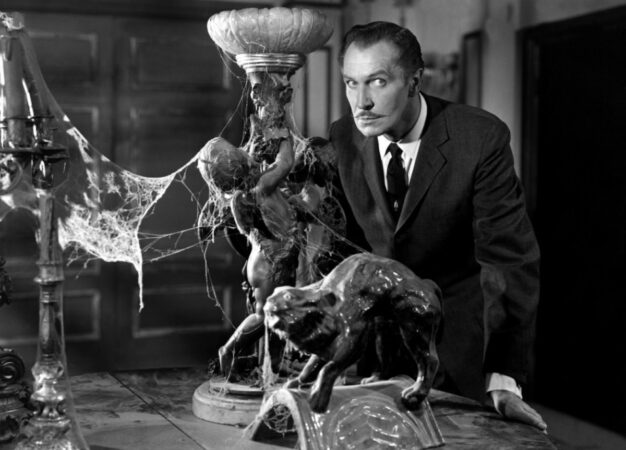
Peter Cushing’s run defined the role on screen. His lean, courteous, utterly certain professor, across five Hammer Dracula films from 1958 to 1974 and opposite Christopher Lee’s Dracula in three of them, fixed “Van Helsing” in the popular mind for a generation. Terence Fisher directed the 1958 and 1960 entries.
Stoker’s Van Helsing is in the public domain in both the United States and the United Kingdom. The American route was unusual: Stoker failed to complete the then-required deposit of two copies, so the novel never secured US copyright. The UK copyright expired in April 1962, fifty years after Stoker’s death. The limit matters as much as the freedom. What later adaptations invented, from Hammer’s family shuffle to Coppola’s reincarnation plot to Gabriel’s gadgets, belongs to those works, not to Stoker’s text. Anyone may write Abraham; the layers still belong to their makers.
Lists of Van Helsing portrayals run across film, stage and television. Beyond the actors above, they take in Christopher Plummer, David Suchet and Mel Brooks, who played him in the parody Dracula: Dead and Loving It (1995). No reliable total has been counted, so this page gives none.
Signatures and Iconography
The scholar-hunter. Before Van Helsing, the vampire’s opponent in folklore is a priest or a peasant mob. Stoker invented the figure who has defined the role ever since: the learned outsider, older, foreign and qualified in three faculties, whose authority comes from knowing the rules of both worlds, science and superstition, and refusing to choose between them.
The bag. His kit is not a weapons rack but a doctor’s bag: transfusion apparatus, surgical steel for staking and beheading, garlic flowers, a crucifix, crumbled Host in an envelope, a hypnotist’s patience and a notebook. The films are most faithful when he improvises weapons from the room, as with Cushing’s candlesticks.
“Friend John.” His constant address to Seward, avuncular, foreign and faintly imperious at once. With “Mein Gott” it is his whole voice in two phrases, and because the films drop the syntax, the sound of the novel’s Van Helsing survives mainly on the page.
The King Laugh. After Lucy’s funeral, alone in a carriage with Seward, he collapses into hysterical laughter and tears. At the graveside Arthur has said he feels truly married to Lucy because his blood went into her, and Seward knows that all four men gave her blood. Van Helsing denies he is hysterical and personifies the fit as King Laugh, who “come when and how he like. He ask no person; he choose no time of suitability.” It is grief, strain and the absurdity of the transfusions breaking through at once, not comic relief and not madness. Most adaptations drop it.
The open mind as a weapon. Seward’s sketch ends on the equipment that matters: “an absolutely open mind” joined to “indomitable resolution.” His willingness to be thought mad, by Seward, by the police of Dracula’s Daughter, by every sceptic in every adaptation, is that equipment in dramatic form. He would rather be right and ridiculous than respectable and wrong.
Why He Matters
He is the prototype of the occult detective. Critical writing on the novel reads Van Helsing as a detective-like organiser: the man who assembles the record, works out the monster’s rules and runs the campaign as an investigation. Stoker’s fusion of professor, physician, metaphysician and exorcist became the template for the pulp occult detectives, for Hammer’s professor, and for every “one expert who believes” cast since.
He is the bridge between science and faith. The novel’s England has phonographs, typewriters, telegraphs and transfusions, and it loses to Dracula until a man arrives who can use all of them and crumble a Host into a coffin without finding the two acts contradictory. Read that way, he is modernity taught humility by its own best practitioner.
He is Dracula’s true opposite, and his mirror. Critics read him as the Count’s foil: another elderly, foreign, multilingual man of immense learning and will, one hoarding life, the other spending his own blood, knowledge and sleep to give it back. That is why the role draws major actors, Olivier, Hopkins and Cushing above all, out of proportion to its time on the page. He is the only character in the book who is Dracula’s equal, and the films that understand that, 1958 above all, are built as duels.
And the name escaped the book. “Van Helsing” now works in the culture as a common noun for the vampire hunter, with the 2004 film built on his surname alone, an afterlife almost no other supporting character in Gothic fiction has had. It is also the hazard. The noun has drifted so far from the 1897 physician that the job of a page like this is to keep handing the reader back to Amsterdam, the medical bag and the King Laugh.