
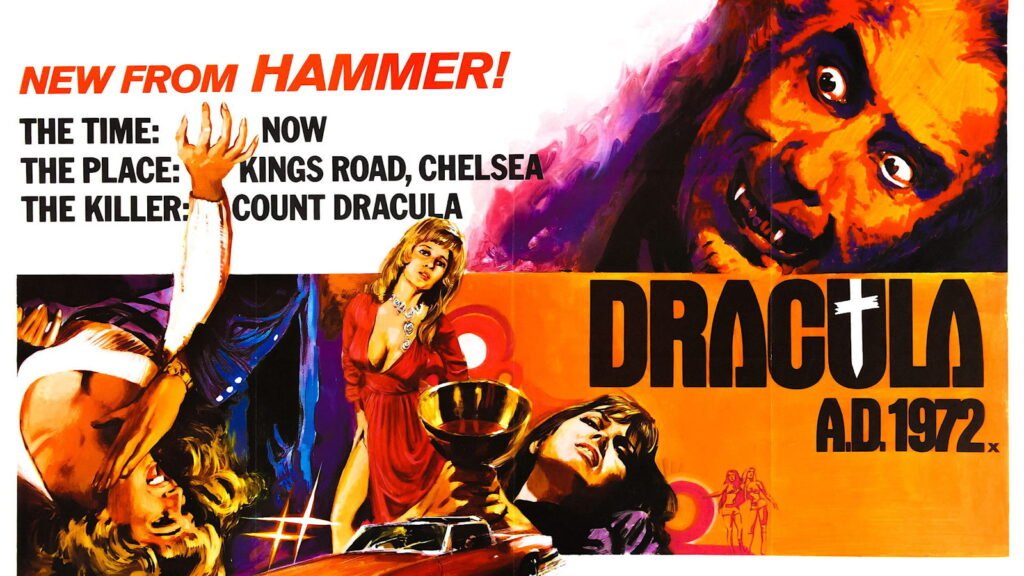
Picture the King’s Road in 1972: coffee bars, boutiques, a rock band tuning up in somebody’s front room, kids in hot pants hunting for a thrill the decade hasn’t sold them yet. Now picture the ruined church at the end of the street, and the thing buried in its graveyard — a century dead, and patient. Dracula A.D. 1972 is Hammer’s seventh Dracula film, the one that resurrects Christopher Lee’s Count in modern-day Chelsea against Peter Cushing’s Van Helsing. It is the strangest swing Hammer ever took with its crown jewel: the Gothic Count airlifted into the present tense, funk soundtrack and all, to fight the same duel he had been fighting since Victoria was on the throne.
Quick Specs
Director: Alan Gibson
Screenplay: Don Houghton
Producer: Josephine Douglas
Starring: Christopher Lee, Peter Cushing, Stephanie Beacham, Christopher Neame, Michael Coles, Caroline Munro
Studio: Hammer Film Productions
Released: 28 September 1972 (UK); 17 November 1972 (US)
Running time: about 96 minutes (the BBFC’s measured cinema version runs about 95)
Certificate: X (UK, 1972)
Music: Mike Vickers
Series place: seventh film in Hammer’s Dracula series; Lee’s sixth performance as the Count
Budget: a projected £220,000 (Kinsey; BFI Screenonline) — a projection, not an audited figure
Fourteen years between duels
Here is the headline, stated carefully because it deserves to be: this is the first film since Dracula (1958) to feature both Christopher Lee as Dracula and Peter Cushing as Van Helsing — the two roles, facing each other again after fourteen years. The men themselves had hardly been strangers in between; they had shared other films, The Mummy (1959) and The Gorgon (1964) among them. But inside this series they had been kept apart. Cushing carried The Brides of Dracula (1960) alone, a Van Helsing film with no Lee and, remarkably, no Dracula in it at all. Lee, meanwhile, played the Count four more times without him — Dracula: Prince of Darkness (1966), Dracula Has Risen from the Grave (1968), Taste the Blood of Dracula (1970) and Scars of Dracula (1970).
By 1972 Lee was fifty and Cushing fifty-nine, and neither of them treats the reunion as a lap of honour. That, in the end, is the film’s saving grace, and we will come back to it: whatever else wobbles around them, the two old duelists walk on playing it absolutely straight, as if the King’s Road were Transylvania and the stakes had never been higher. In a sense they hadn’t. This was the sixth of the seven Hammer films in which Lee would play the Count, and the series had exactly one more duel left in it after this one.
A fresh start wearing a sequel’s clothes
Do not let the series numbering fool you: under the hood, this is a reboot. The film opens with a brand-new prologue set in Hyde Park in 1872 — a coach-top fight between Dracula and Van Helsing that appears in no earlier film and cannot be squared with the series’ existing chronology, which begins in 1885 in the 1958 original. The 1872 fight ends with Dracula impaled on a broken coach wheel, Van Helsing forcing the wheel home and dying of his own wounds, and a disciple gathering the Count’s remains to bury beside his enemy’s grave at St Bartolph’s church. Treat that grave as a new foundation, not a continuation: even the Van Helsing name is freshly minted here. The 1958 film never gives its professor a first name. Lawrence is this film’s invention.
Cushing, in fact, plays two Van Helsings. In the prologue he is Lawrence Van Helsing. A century later he is Lorrimer Van Helsing — spelled with two R’s, whatever the listings tell you — Lawrence’s descendant and an occult scholar in modern London. His granddaughter Jessica, played by Stephanie Beacham, then twenty-five, runs with the young Chelsea crowd the film is about to feed to the past. Granddaughter, note: not niece, and her grandfather is nobody’s “junior” and certainly not Stoker’s Abraham. The family line is the whole plot. Dracula isn’t coming back for blood in general. He’s coming back for theirs.
A Black Mass in Chelsea
The modern story opens at a party, with the American band Stoneground playing themselves, and among Jessica’s thrill-hungry friends is Johnny Alucard — played by Christopher Neame, who also plays the unnamed 1872 disciple Johnny descends from, and is his dead ringer. Johnny talks the group into holding a Black Mass for kicks in the deconsecrated, derelict St Bartolph’s. Laura Bellows volunteers as the offering. The others flee. Dracula rises and kills her on the spot.
That is worth pausing on, because the posters lie by billing: Laura is played by Caroline Munro, and she is the Count’s first victim, dead before the film has fairly started. Hers is a small, igniting part — her drained body, found afterwards, is what starts Scotland Yard’s murder investigation — not a co-lead role, whatever her later pin-up fame did to the billing.
Inspector Murray, played by Michael Coles, is the rare screen policeman who takes the occult angle seriously, and he consults Lorrimer. It is Lorrimer who works out the film’s neatest joke, the one the film states outright: ALUCARD is DRACULA spelled backwards. Johnny, it turns out, is exactly what his name advertises — a disciple doing his master’s legwork a century on. He brings Jessica’s friend Gaynor Keating to the church, and Dracula kills her. Johnny begs for vampirism as his reward, and gets it. The vampiric Johnny turns Jessica’s boyfriend Bob, and Bob lures Jessica from the Chelsea café the group frequents. Dracula’s plan is an old man’s revenge, elegant in its cruelty: he will settle the account with the Van Helsing line by making Jessica one of his own.
What follows is Cushing’s film as much as anyone’s. Aided by Anna Bryant, one of Jessica’s friends, Lorrimer tracks Johnny to his flat and fights him — and Johnny dies by his own element, the running water of the shower. At St Bartolph’s, Lorrimer finds Bob dead by daylight and Jessica entranced, and digs a pit of stakes in the churchyard to wait for the Count. The climax is a proper duel: a silver knife, pulled from Dracula’s body by the still-commanded Jessica; holy water thrown outside the church; the Count recoiling into the pit; and Lorrimer driving him down onto the stakes with a spade until he crumbles to ash and the spell breaks. The last thing on screen is Jessica in her grandfather’s arms, under the title “Rest in Final Peace.”
Why Hammer gambled on the present tense
None of this happened by accident. The modern setting was a commission. After the success of the modern-day Count Yorga, Vampire (1970), Warner Bros. commissioned Hammer to make two Dracula films set in the present day — this one and its sequel. The logic was the studio’s modernisation gamble: Dracula among the hippies, the King’s Road and the coffee bars, sold to a youth audience Hammer could feel slipping away. Production began in September 1971 under the working title Dracula Today, filming in Chelsea and in Hertfordshire. The film was also inspired by the events surrounding the Highgate Vampire case — the 1970 North London cemetery vampire panic and its rival hunters — though inspired is the word: this is no dramatisation of that case, just a studio smelling real headlines and reaching for them.
The sound of the gamble is Mike Vickers, lately of Manfred Mann, scoring the film in a contemporary funk idiom that matches the 1972 setting stride for stride — the Count rises to wah-wah, and the film is somehow both worse and better for it. Some listings also carry Michael Carreras’s name alongside Josephine Douglas’s in the producer credit; Carreras was Hammer’s chief executive in this period, but Douglas is the producer of record. Distribution, too, wants keeping straight: Warner Bros. commissioned the film and released it in America, while in Britain it went out through Columbia-Warner Distributors. And American audiences got one extra flourish — screenings were preceded by a short clip in which Barry Atwater, the vampire of The Night Stalker, rose from a coffin and swore the entire audience in as members of the Count Dracula Society.
The Count who never leaves the church
Here is the film’s great structural secret, and its great limitation: Dracula never leaves St Bartolph’s. Not once. The resurrection, every killing he does with his own hands, and the climax all happen in the deconsecrated church and its graveyard. The modern world — the parties, the café, the police, the flat with the shower — comes to him, delivered by Johnny like room service. Whether that reads as a flaw or a strange kind of purity depends on your patience: the one thing in 1972 London that has not changed at all is the monster, and he behaves exactly as he behaved in 1872, because he is exactly what he was in 1872.
Writing in 2017, Gary A. Smith made the point that time has since proved out: the film’s swinging London “seems as much a period piece as the Victorian settings of its predecessors,” and its main problem remains that Dracula never leaves the church ruins. Both halves of that have only sharpened. The “modern day” of Dracula A.D. 1972 is now a period piece twice over — a 1972 idea of youth, haunted by an 1872 idea of evil.
What the critics made of it
At the time: not much. Roger Ebert gave the film one star out of four. Clyde Jeavons, reviewing it in November 1972, called it “an abortive and totally unimaginative attempt to update the Bram Stoker legend to present-day Chelsea,” and concluded that “the attempt to reconcile Transylvania with S.W.3 merely sends the script haywire.” Posterity has not exactly staged a rescue. Dennis Prince judged it “definitely one of the weakest installments in Hammer’s horror catalog,” another survey of the series flatly named it the low-point of the whole Hammer Dracula run, and even sympathetic champions of Lee have allowed that it could be the nadir of the series — while conceding the two stars keep the show on the rails. The film’s Tomatometer stands at 20% from 10 reviews, a figure re-checked at the building of this page.
And yet the defence has its witnesses. George R. Reis argued the film is “hardly” the low point it is reputed to be, and that “Cushing’s exceptional Van Helsing pretty much carries the film.” Watch it with that in mind and a pattern emerges from the reviews themselves: nearly everyone who damns the picture damns the script, the setting, the clothes, the music — and then exempts the two men at the centre of it. Lee and Cushing had been doing this dance for fourteen years. They were not about to be embarrassed out of it by a funk soundtrack.
One more round, then the end of the line
The second of Warner’s two modern-day commissions followed a year later: The Satanic Rites of Dracula (1973), a direct sequel — Alan Gibson directing again, Don Houghton writing again, Lee and Cushing back as Dracula and Lorrimer, Michael Coles reprising Inspector Murray, and the Count’s new headquarters built on the very churchyard where he died in this film. One change to watch for: Jessica returns, but Stephanie Beacham does not. Joanna Lumley plays her. It was the eighth film in the series and the seventh and last to star Lee; after it, his Hammer Dracula career was closed, and the series itself ended with The Legend of the 7 Golden Vampires (1974), with John Forbes-Robertson in the role.
The film itself has stayed in circulation: a DVD arrived from Warner Home Video in 2005 across the UK, US and Germany — where it travels under the glorious title Dracula jagt Mini-Mädchen — followed by a four-film Dracula set in November 2007 and a Warner Archive Collection Blu-ray in 2018. So settle in with it on its own terms. Dracula A.D. 1972 is not the crown of the series, and pretending otherwise helps nobody. But as a fossil of the exact moment Hammer tried to drag its Gothic crown jewel into the age of hot pants — and as one of the last times Lee and Cushing ever faced each other across a grave — it is absolutely worth your evening. The Count waited a hundred years in that churchyard. He can wait one more night for you.