
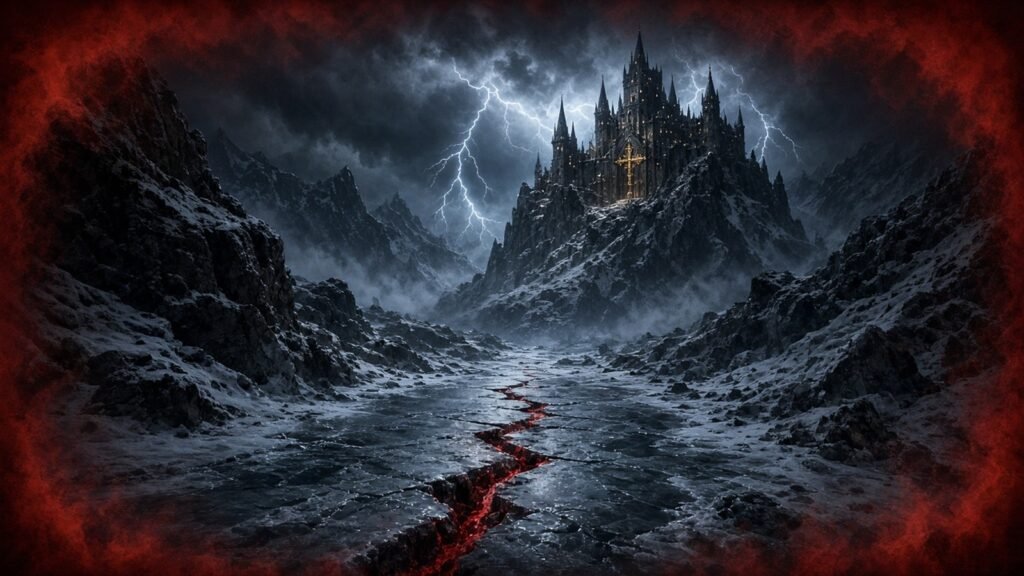
Dracula Has Risen from the Grave (1968) is Hammer’s fourth Dracula film, directed by Freddie Francis, with Christopher Lee as the Count.
Dracula comes back in this one because a priest trips. Nobody summons him, nobody performs a ritual, nobody wants him back. A frightened man falls in a storm, cuts his head on a rock, and his blood runs through a crack in the ice onto the lips of the vampire frozen underneath. Everything that follows, from a niece in danger to the Count dying on a cross he ordered thrown away, grows out of one exorcism and one accident.
Three things to settle first. This is the third time Christopher Lee plays the Count for Hammer, but the fourth film in the series, because Lee skipped The Brides of Dracula. Terence Fisher, who directed the first two Lee films, did not direct this one; Freddie Francis did. And neither Peter Cushing nor Van Helsing appears: the man of God this time is a Monsignor.
Quick Specs
- Directed by: Freddie Francis
- Screenplay by: John Elder (pseudonym of Anthony Hinds)
- Produced by: Aida Young
- Production company: Hammer Film Productions
- Starring: Christopher Lee, Rupert Davies, Veronica Carlson, Barry Andrews, Barbara Ewing, Ewan Hooper
- Cinematography: Arthur Grant
- Music: James Bernard
- Studio: Pinewood Studios
- Released: November 1968 (United Kingdom); February 6, 1969 (United States)
- Runtime: 92 minutes
- US rating: G
- Series place: Fourth Hammer Dracula film; third with Lee as the Count
The Cast
Christopher Lee plays Count Dracula. After playing the role without a single line in Dracula: Prince of Darkness (1966), he gets to speak again here, though not much. Rupert Davies plays Monsignor Mueller, a senior churchman who comes to the village on a routine visit and ends up making an enemy of the Count.
Veronica Carlson plays Maria, the Monsignor’s niece, who becomes Dracula’s target. Barry Andrews is Paul, Maria’s boyfriend, who works in a bakery under a cafe and is an atheist, which matters more than anyone expects. Barbara Ewing plays Zena, the barmaid at the cafe. Ewan Hooper is the village priest, a man who has lost his faith; all of his dialogue in the film is dubbed by another voice, and the reason has never been clear.
Marion Mathie plays Anna, the Monsignor’s widowed sister-in-law. Hammer regular Michael Ripper is Max, who runs the cafe and bakery where Paul works, and George A. Cooper plays a separate character, the village landlord. Norman Bacon is the altar boy.
The Plot
At the start of the film, an altar boy in a village below Dracula’s castle finds the body of a young woman crammed inside the church bell, another of the Count’s victims. The boy is so frightened he stops speaking.
A year after the events of Prince of Darkness, in which Dracula was destroyed in icy water, Monsignor Mueller visits the village. He finds a mute altar boy, a priest who has lost his faith and spends his time at the tavern, and an empty church: the villagers will not come to Mass because the shadow of Dracula’s castle falls across it. To end their fear, Mueller climbs to the castle to exorcise it, taking the reluctant priest with him. The priest gives up partway. Mueller goes on alone, performs the exorcism and fixes a large metal cross to the castle door.
On the way down, in a thunderstorm, the priest stumbles, strikes his head on a rock and is knocked out. His blood trickles through a crack in the ice of a frozen stream, onto the lips of Dracula beneath it, and Dracula revives.
Finding his castle barred by the cross, Dracula takes the priest under his control and forces him to name the man who sealed it. The priest finds the Count a coffin and leads him to the Monsignor’s home city, where Dracula decides to take his revenge through Mueller’s niece, Maria. The Monsignor, believing the priest got home safely, has already left.
In the city, Dracula enslaves Zena, a barmaid at the cafe above the bakery where Paul works. Paul has just made a poor impression at dinner with Maria’s family by admitting to the Monsignor that he is an atheist. Zena nearly delivers Maria to Dracula, but Paul comes looking for her and Maria gets away. Dracula punishes Zena by killing her and orders the priest to destroy her body before she can rise as a vampire. The priest burns her in the bakery oven.
Dracula reaches Maria over the rooftops and bites her. The next night the Monsignor walks in just before Dracula can bite her again and chases a fleeing figure across the roofs, where the priest knocks him down. Mueller makes it home, gives Paul a book of rites against vampires and dies of his wounds.
Paul asks the priest for help, not knowing he is still in Dracula’s power. The priest turns on him, Paul overcomes him and makes him show the way to the Count’s coffin in the cafe’s cellar. They drive a stake through Dracula’s heart. But a stake is not enough on its own: the ritual needs a prayer, and neither the faithless priest nor the atheist Paul can say it. Dracula pulls the stake out himself.
Dracula carries Maria off to his castle, with Paul and the priest behind him. At the castle door he orders Maria to take down the cross, and she throws it over the parapet into the ravine, where it lodges upright between the rocks. Paul fights Dracula on the parapet, and in the struggle the Count goes over the side and is impaled on the cross. The priest, free of Dracula at last, says the Lord’s Prayer in Latin, and Dracula dissolves into dust. Paul, with Maria safe, makes the sign of the cross.
Francis Takes Over
Terence Fisher was due to direct, but he broke his leg in a car accident while the film was in pre-production, and Freddie Francis replaced him. It made this the first Hammer Dracula film not directed by Fisher. Francis came to directing from the camera; he had won an Oscar as a cinematographer, and it shows.
Arthur Grant shot the film using coloured filters that belonged to Francis, the same ones Francis had used when he photographed The Innocents (1961). Whenever Dracula or his castle is in a scene, the edges of the frame are tinged red, amber and yellow, as if the Count stains the picture around him. The city’s rooftops, built as a set at Pinewood Studios with skewed angles and painted backdrops, pushed Hammer further toward Expressionism than it had ever gone, and reviewers often compare them to The Cabinet of Dr. Caligari.
Pinewood was itself a change. The first two Lee films had been made at Bray Studios, Hammer’s old home; by now the company had moved out and was hiring stages elsewhere. The script came from Anthony Hinds, writing under his regular pseudonym, John Elder, and James Bernard wrote the score.
Lee and the Cross
By the late 1960s Lee was tired of the Count. The widely told account is that Hammer’s James Carreras sold the film to the American distributor Warner Bros.-Seven Arts on the strength of Lee’s name before Lee had agreed to anything, and that Lee was unhappy about it and came round only after some persuasion.
He did not like everything the script asked of him either. He objected to the scene in which Dracula pulls the stake out of his own heart, though he later conceded that “the audience at the time thought it was stunning.”
Faith is the engine of this film. The plot turns on belief rather than garlic: the cross that seals the castle, the prayer that Paul cannot say, the priest who gets his faith back in time to finish the Count. The weapon that kills Dracula is the very cross he made Maria throw away.
Release and Reception
The film opened in Britain in November 1968 (accounts give both November 7 and November 24) and in the United States on February 6, 1969, rated G. In Australia, where the first two Lee Dracula films had been banned, it became the first Hammer Dracula film passed by the censors, with some cuts.
It was a major hit; accounts describe it variously as Hammer’s most successful film to that point, its biggest of the year and the biggest of its Dracula films. Critics at the time were less impressed than audiences, but the years have been kind to it, and most of the credit now goes to Francis’s direction and Grant’s colour photography. Rotten Tomatoes lists it at 76 percent from 17 reviews.
What Came Next
Dracula Has Risen from the Grave was followed by Taste the Blood of Dracula in 1970, with Lee back as the Count. Hammer’s Dracula series ran on into the 1970s, but this entry kept a reputation of its own: a Dracula film made by a cinematographer, framed in colour, set on the rooftops, and ended by a cross that its villain had thrown away.
For where it all began at Hammer, see Dracula (1958). The studio’s other Dracula films and its stars, including Peter Cushing and Terence Fisher, are covered on the Hammer Films page.