
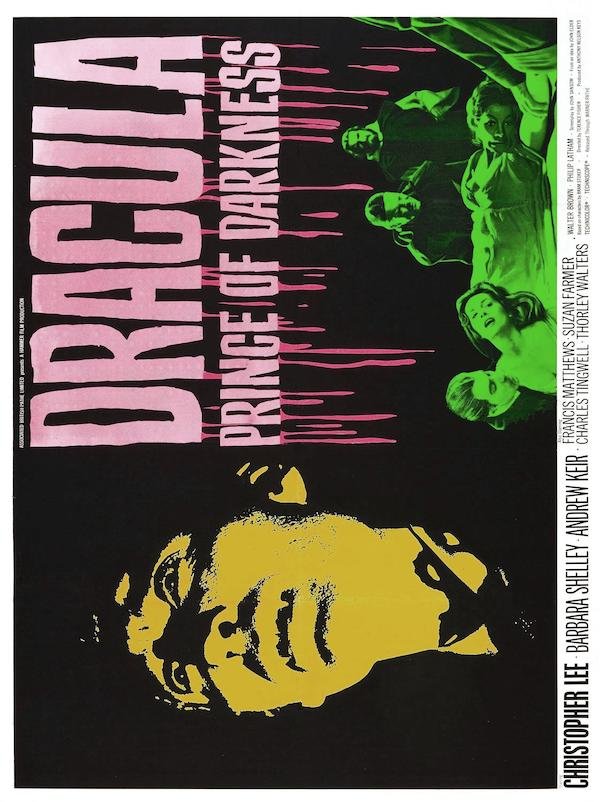
Dracula: Prince of Darkness is a 1966 Hammer horror film by Terence Fisher in which Christopher Lee’s Count is resurrected with a traveler’s blood.
At a Glance
- Director: Terence Fisher
- Writers: Jimmy Sangster (screenplay, credited as John Sansom), from a story by Anthony Hinds (credited as John Elder)
- Cast: Christopher Lee, Barbara Shelley, Andrew Keir, Francis Matthews, Suzan Farmer, Charles Tingwell, Thorley Walters, Philip Latham
- Release: January 9, 1966 (United Kingdom); January 12, 1966 (United States)
- Runtime: 90 minutes
- Studio: Hammer Film Productions, distributed by Warner-Pathé in the UK
- Music: James Bernard
- Franchise: Hammer’s Dracula series, from Hammer Films
Overview
Eight years after Dracula made him a star, Christopher Lee finally returned to the cape. Dracula: Prince of Darkness is the third film in Hammer’s series but only the second with Lee, since The Brides of Dracula (1960) had carried on without him. Peter Cushing’s Van Helsing is absent apart from the archive prologue, so the film builds its story around new characters and a slower, more atmospheric first half. It is often described as the purest example of the Hammer house style: a remote castle, a stiff-backed English party, a monk who knows better, and a vampire who never says a word.
Plot
A prologue replays the end of the 1958 film, with Van Helsing destroying Dracula in a shaft of sunlight. Ten years later, in 1895, the abbot Father Sandor warns four English travelers, brothers Charles and Alan Kent and their wives Diana and Helen, to stay away from Karlsbad. They go anyway. Their frightened coachman abandons them at dusk, and a driverless carriage takes them to a castle where the table is already set for four. The servant Klove explains that his late master ordered that guests always be welcomed.
That night Klove murders Alan in the crypt, strings his body over Dracula’s coffin and lets the blood pour onto the Count’s ashes. Dracula re-forms, and the prim, fearful Helen becomes his first victim, transformed into a sensual and savage vampire. Charles and Diana escape and take refuge at Sandor’s abbey, but Dracula has a servant there too, the bookbinder Ludwig, who invites him in.
Spoiler: The Ending
Sandor and the monks catch Helen and stake her in one of the film’s most disturbing scenes, held down on a table as the stake goes in. Dracula takes Diana and, in a scene that pushed the censors, opens a wound on his chest and tries to make her drink. Charles interrupts, and the Count flees with Diana toward the castle. Charles and Sandor overtake the wagon, Klove is shot, and Dracula’s coffin slides onto the frozen moat. When the Count rises to attack Charles, Sandor fires at the ice. It cracks beneath the vampire, and Dracula sinks into the running water and is lost.
Production
The film was shot at Bray Studios back to back with Rasputin, the Mad Monk, sharing sets and several actors, including Lee, Shelley, Matthews and Farmer. Michael Reed photographed it in widescreen Techniscope, and Bernard Robinson designed the sets. Lee famously has no dialogue, only hisses. He later said he refused to speak the lines he had been given; Jimmy Sangster wrote in his memoir Inside Hammer that he simply never wrote any, because vampires do not chat. Both accounts survive, and the truth may lie somewhere between them. Barbara Shelley recalled swallowing one of her fangs during a take and having to drink salt water to recover it, since there was no spare set.
Themes
Hammer’s vampire films often treat vampirism as liberation from Victorian repression, and Prince of Darkness makes that explicit through Helen, who moves from scolding and fussy to wild and sensual once bitten. Father Sandor, a rifle-carrying monk with a sardonic streak, offers a more practical faith than the frightened local clergy. The drowning finale was also new, giving the series a fresh way to dispatch its villain.
Release and Reception
The film played in some markets on a double bill with The Plague of the Zombies, with plastic fangs and cardboard “zombie eyes” handed to audiences as a gimmick. The Monthly Film Bulletin called it the same old hash apart from a few innovations, while Variety found it workmanlike and effective. Later commentators, including Hammer’s authorized history, have called it perhaps the quintessential Hammer horror.
Trivia
- Lee’s Dracula speaks no lines at all in the film.
- Both screenwriting credits use pseudonyms: John Sansom for Sangster and John Elder for Anthony Hinds.
- Peter Cushing appears only in archive footage from the 1958 film, uncredited.
- In France the film sold 854,197 cinema admissions.
- John Burke adapted the story in prose for The Second Hammer Horror Film Omnibus (1967).
- StudioCanal released a 2K restoration on UK Blu-ray in March 2012.