
Three notes. That is the whole trick, and it has been raising neck hairs since 1958 — a brass stamp on the syllables of a name, Dra-cu-LA, and suddenly a modest British studio picture has a sound the whole world can hum in the dark. The man who wrote those three notes never conducted them, never appears on screen, and won his Oscar for something else entirely. Pull up a chair. Let’s talk about him.
James Bernard (1925–2001) was the British composer whose scores gave Hammer horror its sound, from The Curse of Frankenstein to the three-note Dracula motif. For the better part of two decades, if a Hammer film opened with a hearse, a castle or a laboratory door creaking at midnight, the music telling you to be afraid was his — lush one minute, frenzied the next, and always, always recognisable.
Quick Specs
- Born: 20 September 1925, India
- Died: 12 July 2001, London, aged 75
- Occupation: Film composer
- Known for: Hammer Film Productions’ horror scores; the three-note Dracula motif; an Academy Award for writing — not music — on Seven Days to Noon
- Years active: 1953–2001
A schoolboy, a war, and Benjamin Britten
Bernard was born in India — in the part that is now Pakistan, by one account — and educated at Wellington College. Christopher Lee had attended Wellington before him; the two never met at school, whatever the shorthand versions say. They met through Hammer, as composer and star, the way it should be.
Bernard recalled late in life that in his mid-teens, three of his favourite books were The Devil Rides Out, She and The Hound of the Baskervilles. Hold that thought. He would score all three.
The meeting that shaped everything came at Wellington, where the schoolboy’s music reached the ears of Benjamin Britten. How the occasion went is told two ways — a visit about stage designs for Peter Grimes, or a school music competition Britten was judging — but every account agrees on the part that matters: Britten took an interest, encouraged the boy to compose, and stayed in his corner for years. During Bernard’s RAF service, from 1943 to 1946, the two kept in touch, and Bernard spent leaves travelling to London to turn pages for Britten at recitals. His war work, by his own later account as carried by his biographer, put him with the team breaking the German Enigma code, specialising in deciphering intercepted Japanese messages.
After the war came the Royal College of Music, where his composition teacher was Herbert Howells. You will sometimes read that Imogen Holst taught him there — she did not. Britten recommended Holst as a private adviser, and Bernard consulted her for years, but the RCM chair was Howells’. Then, in 1950, Britten handed him a working apprenticeship of the most literal kind: copying out the score of Billy Budd for the publishers Boosey & Hawkes. The colour around that job — the stay at Britten’s Aldeburgh home, the opening night in the company of the librettist E. M. Forster — comes down through Bernard’s own recollections, and it has the ring of a young man who knew he was living the good part.
An Oscar for writing — before he had scored a frame
In 1944 Bernard met the writer and critic Paul Dehn, then an army major doing wartime intelligence work. Whether that work sat with MI6 or with the SOE is disputed between accounts — what is not disputed is the partnership. In 1946, while Bernard was still in uniform, they moved in together on King’s Road in London, and Dehn remained his partner, in life and in work, until Dehn’s death in 1976.
Together they wrote the original story for Seven Days to Noon (1950), the Boulting brothers’ thriller about a scientist threatening to destroy London. At the 24th Academy Awards, held in 1952, Dehn and Bernard shared the Academy Award for Best Writing, Motion Picture Story. Bernard was 25 when the film came out and 26 when he collected the honour. Read the credit carefully, because it fools everyone: the Oscar is a writer’s award. The score of Seven Days to Noon is by John Addison — his first film score — and Bernard, the future sound of Hammer, wrote not one note of it.
The stand-in: Quatermass and the small string orchestra
Bernard’s first commission came in 1953, incidental music for Patric Dickinson’s radio play The Death of Hector. His BBC radio music for The Duchess of Malfi — a production boasting Richard Burton, Peggy Ashcroft and Paul Scofield — then impressed John Hollingsworth, Hammer’s music director. And when the composer originally scheduled to score Hammer’s The Quatermass Xperiment fell ill, the job came to Bernard. Accounts differ on whose hand did the hiring; they agree entirely on the illness that opened the door.
The result, in 1955, was his first film score — released in America as The Creeping Unknown — and Hollingsworth kept it on a short leash: strings and percussion only, the players drawn from the Royal Opera House. Bernard recalled years later: “I don’t think he trusted me with anything more than a small string orchestra.” Inside that restriction he was already restless, writing tone clusters and having the strings bowed on the wrong side of the bridge. His biographer David Huckvale rates it the first film score to treat strings in an unconventional, non-romantic manner — five years before Psycho made the idea famous. Some leash.
Dra-cu-LA: the Hammer years
The Curse of Frankenstein (1957) made Hammer’s name in colour gothic, and Bernard’s score — which, as his biographer notes, adapts some music he had first written for that Duchess of Malfi radio production — made its sound. Then came Dracula (1958), released in America as Horror of Dracula, and the motif. The idea to build the Count’s theme out of the sound of his name was Paul Dehn’s suggestion. Bernard took it and rendered it, in his own spelling, “Dra-cu-laaaaa” — three notes for three syllables, hammered home by the full orchestra, and a signature so strong that horror music is still living in its house.
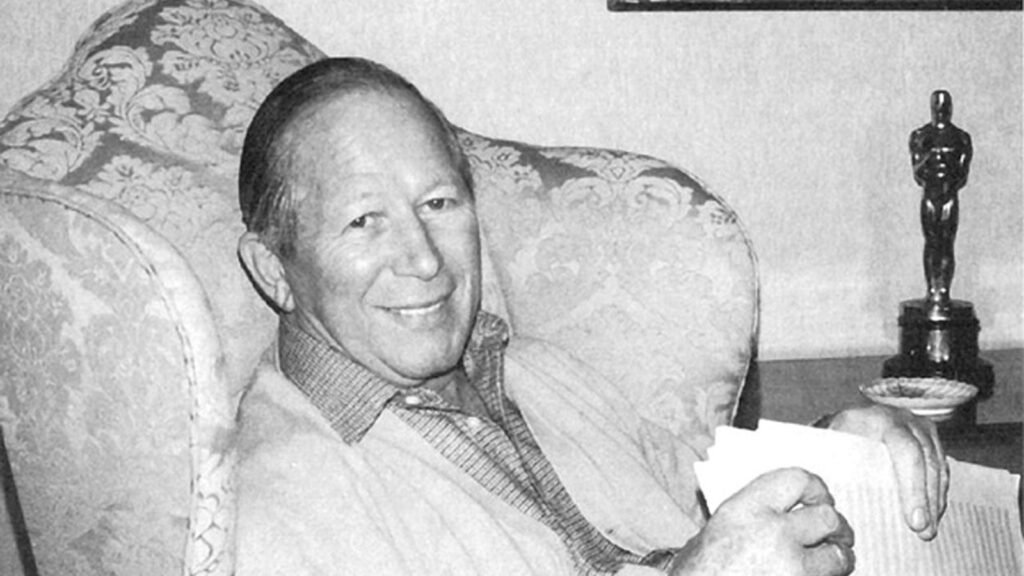
The Bernard sound, once you know it, is unmistakable: clashing harmonies, motifs doubled a tone higher for extra bite, frenzied writing driven by timpani and snare — and then, at the opposite pole, a lush romantic line, the kind he poured into Frankenstein Created Woman (1967), Taste the Blood of Dracula (1970) and Scars of Dracula (1970). One thing he did not do: conduct. Bernard orchestrated almost all of his own music, unusual among film composers, but he left the podium to others — Hollingsworth on the early scores, Philip Martell on the later ones. The man in the famous photographs is holding manuscript paper, not a baton.
The shelf fills quickly from there. X the Unknown (1956) and Quatermass 2 (1957) came before the breakthrough; after it, The Hound of the Baskervilles (1959) — yes, one of the schoolboy’s three favourite books — The Stranglers of Bombay (1959), The Damned (shot 1961, released 1963), The Kiss of the Vampire (shot in 1962, first released in America in 1963, and later recut for US television as Kiss of Evil — the same film, not a second credit), The Gorgon (1964) and She (1965) — the second of the favourite books. Dracula: Prince of Darkness followed in 1966, alongside The Plague of the Zombies. Then the run he is proudest of, on his own telling: in interviews he named The Devil Rides Out (1968) — the third favourite book, completing the set — the Dracula scores and She among his own favourites. Dracula Has Risen from the Grave (1968), Frankenstein Must Be Destroyed (1969) and the two 1970 Dracula pictures carried him into the new decade, and Frankenstein and the Monster from Hell and The Legend of the 7 Golden Vampires, both 1974, closed the Hammer feature years.
He did work away from Bray occasionally. His non-Hammer credits of the period include Windom’s Way (1957), a credit carried by the standard account of his career, and — the one that trips people up — Torture Garden (1967), which is an Amicus film, not a Hammer one, and whose score he co-composed with Don Banks. Two names on that cue sheet. Remember both.
Not his: the other Hammer composers
The assumption that Bernard scored Hammer horror entire is wrong, and some respectable references will lead you astray on it. The Mummy (1959) is Franz Reizenstein’s score. The Brides of Dracula (1960) is Malcolm Williamson’s. So is The Horror of Frankenstein (1970) — at least one major film dictionary files that one under Bernard, but the film’s own credits say Williamson, and when the dictionary and the film disagree, the film wins. Quatermass and the Pit (1967), for all that it sits in the middle of his Quatermass run, is Tristram Cary’s. Bernard scored Hammer’s first Frankenstein and Hammer’s first Dracula. That is glory enough for one man; he does not need other composers’ cues to fill out the legend.
Jamaica, and the long way back
After 1974, the features stopped. There was television: Hammer House of Horror (1980) brought Bernard back among the Hammer stalwarts to score the series, and its first episode, “Witching Time,” carries music credited to Roger Webb and Bernard. Mostly, though, the eighties were Jamaica, where he lived in semi-retirement with Ken McGregor — an actor he had met on She, in which McGregor played a tribesman. A non-Hammer feature, Murder Elite (1985), was his first film score in a decade. When McGregor died in 1994, Bernard returned to London, and London is where he stayed.
The horror world, meanwhile, had started formally saying thank you. Bernard appears as himself in the documentaries Hammer: The Studio That Dripped Blood! (1987), Peter Cushing: A One-Way Ticket to Hollywood (1989) and Flesh and Blood: The Hammer Heritage of Horror (1994). Better still, he was composing again for the genre’s memory: in 1997 he wrote a new original score for F. W. Murnau’s Nosferatu, for Kevin Brownlow’s restoration of the 1922 film — a silent vampire, scored by the man who gave Dracula his three notes, seventy-five years on. In 1998 he scored Brownlow’s Universal Horror, a documentary tribute to Universal’s classic monsters. And his final score was for a short horror film, Paul Cotgrove’s Green Fingers, starring Ingrid Pitt and Janina Faye; listings disagree on whether it arrived in 2000 or 2001. Either way, he was working almost to the end.
James Bernard died on 12 July 2001, in a London hospital, aged 75. (If you have read that he died in Jamaica, that is the residence mistaken for the place — he had been back in London for seven years.) The cause of death was not reported. He was survived by a sister. The rest is music.
Three notes, still working
The standard life is David Huckvale’s James Bernard, Composer to Count Dracula (2006) — the title alone tells you how the story came out — and Randall D. Larson’s Music from the House of Hammer (1996) carries an introduction by Bernard himself, his own voice on the years that made him. The scores themselves have never really left circulation, and every Halloween the three notes do their work on a new generation of viewers who could not pick Bernard’s face out of a lineup and know his handwriting by heart anyway.
That is the right place to leave him: seated in the armchair of the famous photograph, manuscript pages in hand, the Oscar he won for writing on the table beside him, grinning like a man who knows the joke. The cape swirls, the brass stamps out the syllables, and somewhere below the castle a small string orchestra is bowing on the wrong side of the bridge. Dra-cu-LA. His, all his — the motif, the menace, and the music. For the full studio story, start with our Hammer Films hub, and keep it locked on Think Horror.