
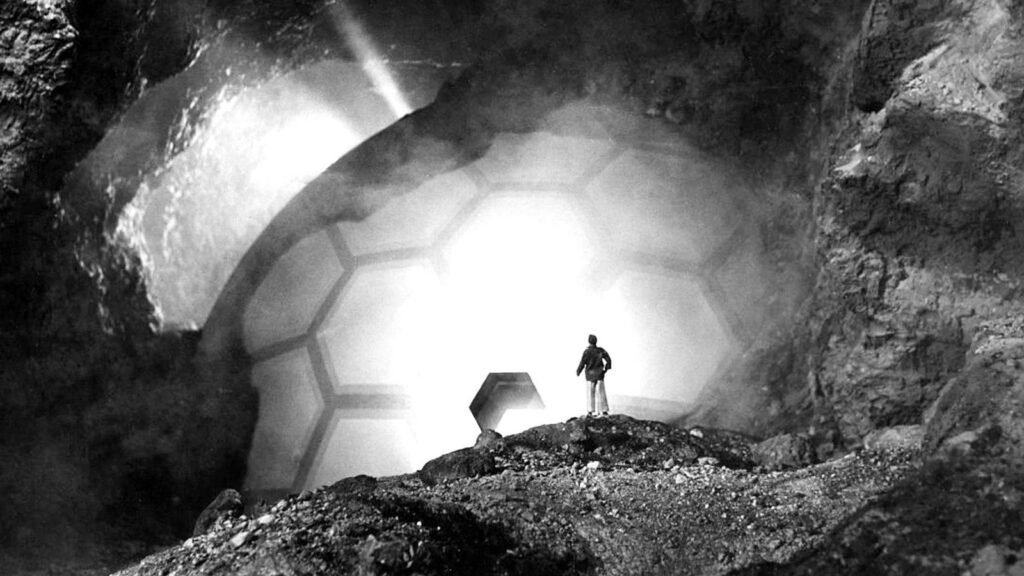
Dig deep enough under any old city and you stop finding history and start finding the things history was built to bury. London, in 1967, dug up the worst of them. Quatermass and the Pit is Hammer’s 1967 science-fiction horror film, where the Devil buried under London turns out to be a Martian. It is the third and last of Hammer’s Quatermass films, the only one in colour, and the one where Nigel Kneale finally got to adapt his own work himself — and it builds, patiently and mercilessly, to a single terrible idea: that the Devil of every legend we have ever told is not a metaphor. He is a memory. And he is ours.
Quick Specs
- Director: Roy Ward Baker
- Screenplay: Nigel Kneale, from his own BBC serial Quatermass and the Pit (1958–59)
- Producer: Anthony Nelson Keys · Executive producer: Anthony Hinds
- Cast: James Donald (Dr Matthew Roney), Andrew Keir (Professor Bernard Quatermass), Barbara Shelley (Barbara Judd), Julian Glover (Colonel Breen)
- Cinematography: Arthur Grant
- Music: Tristram Cary
- Special effects: Les Bowie / Bowie Films
- Studio: Seven Arts–Hammer
- UK release: 9 November 1967 (première), Associated British Pathé
- US release: 16 February 1968, as Five Million Years to Earth, Twentieth Century Fox
- Running time: 97 minutes
- Budget: £275,000
- Certificate: X (BBFC)
What they found under Hobbs End
Workers building an extension to the London Underground at the fictional Hobbs End station dig up a skull. Palaeontologist Dr Matthew Roney identifies it as a five-million-year-old apeman, older than any previous find — and nearby sits a large metallic object that everyone takes for an unexploded Blitz bomb. An army bomb-disposal team is called in, and Professor Bernard Quatermass arrives almost by accident: he has just learned the military is taking over his Moon-colonisation plans, and Colonel Breen has been assigned to his British Experimental Rocket Group. Quatermass accompanies Breen to the site, where a second skull, found inside a chamber of the “bomb,” dates the object itself to five million years. The hull will not mark under heat. Quatermass begins to suspect it is not a bomb at all, and not from Earth.
Roney’s assistant Barbara Judd, intrigued by the area’s name, digs up what the scientists cannot: “Hob” is an old name for the Devil. Records show hauntings and spectral disturbances around Hobbs End going back centuries, always coinciding with the ground being disturbed. A soldier sees an apparition of the apeman pass through the object’s wall. A Borazon drill cannot cut the sealed chamber — but later a hole appears in it, and widens, and inside are the corpses of insectoid creatures with horned heads. Their physiology points to Mars. Their likeness is the likeness of the Devil of legend. Quatermass puts it together: a dying Mars sent colonists who could not survive on Earth, so they preserved their line by proxy, surgically enhancing Earth’s primitive hominids and implanting Martian faculties in them — faculties whose vestiges still sit in the human subconscious. Breen insists the craft is a Nazi propaganda weapon. The Minister believes him, and orders a press unveiling.
Then the thing in the tunnel starts answering back. The drill operator Sladden is overcome by a psychic force and unleashes telekinetic havoc as he flees across London, coming to rest in a church, where he describes a vision of the insect creatures under an alien sky. Quatermass turns Roney’s machine for tapping the primeval psyche on the susceptible Barbara and records her thoughts: Martians conducting a genocidal race purge, cleansing their hives of mutations. The Minister and Breen dismiss the recording. It makes no difference. A dropped power line jolts the craft with electrical energy and its influence explodes across the district — Londoners rampage, attacking anyone perceived as different, with deadly telekinetic force. Breen is drawn to the ship and killed by its energy. Quatermass falls under the craft’s control, but Roney — one of the small immune minority — snaps him out of it. Above the city towers a spectral Martian in the image of the Devil. Roney, remembering that the Devil of folklore could be beaten with iron and water, theorises the energy can be earthed: he climbs a building crane and swings it into the image. The crane bursts into flames, discharging the energy — and killing Roney. The image vanishes. What is left is Quatermass and Barbara, standing in the devastation, saying nothing at all.
First, the serial
Before it was a film, Quatermass and the Pit was six episodes of BBC Television, broadcast in December 1958 and January 1959, written by Kneale and produced and directed by Rudolph Cartier, with André Morell as Quatermass. It was a national event: audiences averaged 9.6 million and peaked at 11 million for the final episode. In the serial, the dig is in Hobbs Lane, Knightsbridge — formerly Hob’s Lane, Hob being an antiquated name for the Devil — and the cast ran Cec Linder as Roney, Christine Finn as Barbara Judd and Anthony Bushell as Breen. The film renames the station Hobbs End and keeps Barbara as the one who unearths the “Hob” etymology.
Kneale’s film screenplay is largely faithful to his serial, with four surgical changes. The journalist James Fullalove’s subplot was cut entirely. The pit moved from a building site to the London Underground. The climax was made cinematic — in the serial, Roney throws a metal chain into the pit; the film gives him the crane. And the serial’s closing address, Quatermass pleading that Earth must not become “the second dead planet,” was dropped for a silent final shot of Quatermass and Judd amid the ruins. Nothing needs saying. The ruins say it.
Six years in limbo
This film very nearly did not exist. Kneale completed his screenplay in 1961, and the plan then was a 1963 production: Val Guest, who had directed the first two films, would direct again, and Brian Donlevy was still expected to star. Columbia Pictures passed on the script. In 1964 Kneale and Anthony Hinds submitted a revised, lower-budget version; Columbia passed again. The film stayed in limbo until 1966, when Hammer‘s deal with Seven Arts, ABPC and Twentieth Century Fox finally unlocked it — and by the time it reached the screen, everything about the plan had changed except the script.
The change that matters most is the credit: “Original Story and Screenplay by Nigel Kneale.” That had never been true before. Kneale did not write the first film at all — The Quatermass Xperiment (1955) was written by Landau and Val Guest from his teleplay, while Kneale was still a BBC staff writer with no say in the matter. By 1967 he was a freelance, adapting his own serial himself, and the difference is the whole film. After it succeeded, Hammer announced Kneale was writing a brand-new Quatermass story for them. It never got past preliminary discussions.
A new Quatermass
Read the billing carefully, because the posters have been misleading people for fifty years. Top billing went to James Donald — as Dr Matthew Roney, not as Quatermass. Andrew Keir plays the Professor and is billed second. Donald, 50 at the première, gives the film its conscience; Keir, 41, gives it its spine. Barbara Shelley, 35, plays Barbara Judd — it was her last film for Hammer — and Julian Glover, 32, plays Colonel Breen, the brass hat who would rather believe in a Nazi hoax than a Martian one. There is a quiet thread running through the cast, too: Duncan Lamont, the film’s Sladden, had played Victor Carroon, the doomed astronaut of the 1953 serial, fourteen years earlier.
Keir was there because Kneale fought for him to be. Kneale had loathed Donlevy’s Quatermass and lobbied for the recast — Donlevy belongs to the abandoned 1963 plan, and he does not appear in this film. André Morell, the serial’s Quatermass, was considered for the film and declined to revisit the role. The shoot, by the two men’s own later accounts, was not a happy one, and the record carries both sides: Keir recalled that director Roy Ward Baker had wanted Kenneth More, and called the production “seven-and-a-half weeks [of] sheer hell”; Baker denied wanting More — he would have been “too nice” for the role — and said he had no idea Keir was unhappy. Print both, believe both, and then watch Keir’s performance, which settles the argument all by itself.
Made at Elstree, certified X
The film was shot from 27 February to 25 April 1967 at MGM British Studios, Borehamwood — not at Bray, whatever you have read elsewhere. Hammer had left Bray by then; its home was the Associated British Studios, also in Elstree, and a lack of space there pushed the production onto MGM’s empty stages and backlot, which gave it the room to build Hobbs End. One location is genuine: Sladden’s terrified flight ends at St Nicholas’ church in Chiswick, and its churchyard. Val Guest was occupied on Casino Royale, so producer Anthony Nelson Keys chose Roy Ward Baker for the technical command he had shown on A Night to Remember — the effects-heavy film needed a director who could stage a disaster like a newsreel. Baker took Kneale’s script exactly as it stood: “taut, exciting… It needed no work at all.” It was Baker’s return to cinema directing and his first Hammer film, and the first film ever credited to “Roy Ward Baker” — he had been “Roy Baker” before, and the extra name ended confusion with a sound editor who shared it.
Les Bowie’s effects team built the Martian massacre — Kinsey’s Hammer history describes it as puppets mixed with live locusts — and the model work for London’s destruction and the crane climax, while production designer Bernard Robinson dressed the station set with a poster for Hammer’s The Witches (1966) as an in-joke, again per Kinsey’s account. Tristram Cary mixed orchestral and electronic music, and made the thing in the tunnel speak in what became his signature electronic effect: a violent, shaking, vibrating sound. The BBFC heard it too. The script went to John Trevelyan in December 1966 and came back with an X certificate waiting: he objected to that vibration sound, to the Martian massacre, to the scenes of destruction and panic, and to the image of the Devil himself. The released film carried the X. Nobody at Hammer can have been surprised. The Devil had been the selling point all along.
Release, reviews and the money
Quatermass and the Pit premièred in Britain on 9 November 1967 and went on general release on 19 November, as a double feature with Circus of Fear, distributed by Associated British Pathé (some listings and later reissue packaging name Warner-Pathé, the ABPC/Warner combine). In America, Twentieth Century Fox released it as Five Million Years to Earth, opening on 16 February 1968 — some Hammer histories give only “March 1968,” but a California newspaper advertisement shows it already playing in Soquel on 27 March, the tail of a February opening still rolling out. The film was made for £275,000. The American money is murkier, and it is usually quoted wrong: Fox’s records, published in Silverman’s 1988 studio history, say the film needed $1.2 million in rentals to break even and made $881,000 — rentals being the distributor’s share, not the box-office gross. Against that, Hammer counted the film a success and promptly announced another Quatermass. Both things are on the record; the film lives in the tension between them.
The reviews were just as split, and just as interesting. John Russell Taylor found that “after a slowish beginning… things really start hopping,” and called the film “genuinely gripping.” Paul Errol called it “a well-made, but wordy, blob of hokum.” William Hall settled for “entertaining hokum” with an “imaginative ending.” Penelope Mortimer delivered the famous dissent: “This nonsense makes quite a good film, well put together, competently photographed, on the whole sturdily performed. What it totally lacks is imagination.” Leslie Halliwell judged the climax — “the devil rears over London and is ‘earthed'” — “satisfactorily harrowing.” America’s trade verdict was cooler: Variety called it a “routine, somewhat distended development” that blunted the impact of “this British-made programmer.” Time has picked its side. Rotten Tomatoes, checked in October 2026, stands at 88% from 16 reviews. John Baxter found “moments of pure terror”; Bill Warren called it “a well-constructed mystery that unfolds carefully and clearly”; and Derek Winnert gives it four stars and calls Keir “arguably the best Professor Bernard Quatermass.”
The last of the line
Like its predecessors The Quatermass Xperiment and Quatermass II, the film closes a trilogy — but it closes it in colour, which neither earlier film had, and it closes Hammer’s line for good: there was no fourth Hammer Quatermass. The role’s screen line runs Reginald Tate to John Robinson to André Morell on television, Donlevy to Keir in the films, and on to John Mills in Thames Television’s Quatermass in 1979 — and Keir returned to it once more, for BBC Radio 3’s The Quatermass Memoirs in 1996, making him and Donlevy the only two actors ever to play the Professor more than once. Kneale’s verdict is the one that history kept. Kinsey’s Hammer history records him saying: “I was very happy with Andrew Keir, who they eventually chose, and very happy with the film,” before adding, in the same breath, that “the special effects in Hammer films were always diabolical.” The Guardian’s obituary of Keir put it more bluntly: he had “finally replaced the absurdly miscast Brian Donlevy.” It has even been suggested that Tobe Hooper’s Lifeforce (1985) is largely a remake of this film — Hooper himself only said he wanted “to go back to my roots and make a 70 mm Hammer film.” The film itself needs no borrowed glory. It sits in the run of Hammer landmarks that began with The Curse of Frankenstein and Dracula, and on disc it endures: the 2011 UK Blu-ray carries a commentary by Kneale and Baker together, the writer and the director, still arguing companionably over the best thing either of them ever dug up.