
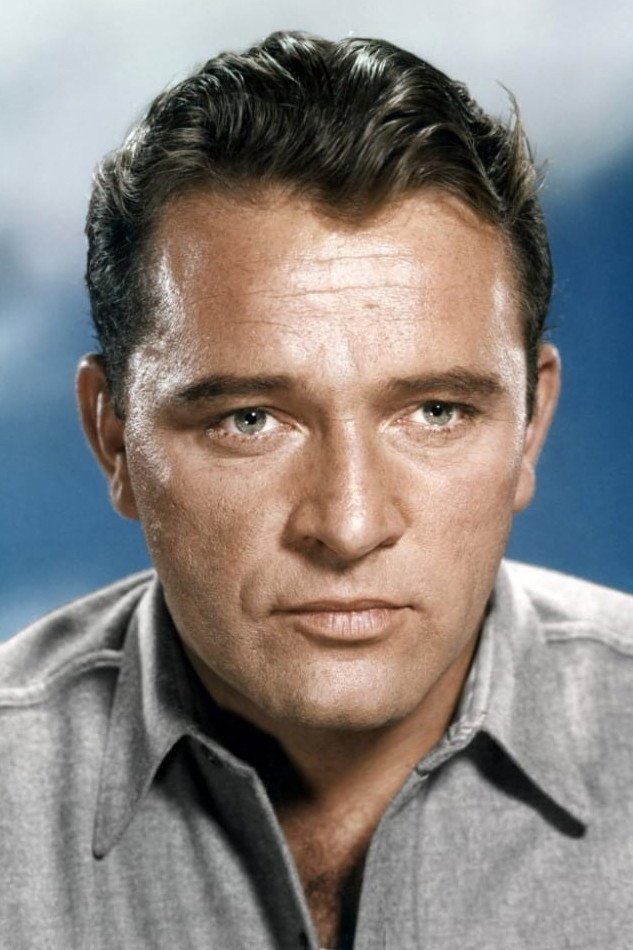
Richard Burton (1925 to 1984) was the Welsh actor who played Father Lamont in Exorcist II and John Morlar in The Medusa Touch.
Quick Specs
| Born | November 10, 1925, Pontrhydyfen, Glamorgan, Wales (as Richard Walter Jenkins Jr.) |
| Died | August 5, 1984, at home in Céligny, near Geneva, Switzerland, of a cerebral haemorrhage, aged 58 |
| Training | Mentored by the schoolmaster Philip Burton; a six-month RAF scholarship course at Exeter College, Oxford (1944) |
| Horror | Father Philip Lamont in Exorcist II: The Heretic (1977); John Morlar in The Medusa Touch (1978) |
| Signature roles | Mark Antony in Cleopatra (1963); Thomas Becket in Becket (1964); Alec Leamas in The Spy Who Came in from the Cold (1965); George in Who’s Afraid of Virginia Woolf? (1966); O’Brien in Nineteen Eighty-Four (1984) |
| Voice | First Voice in Under Milk Wood (BBC radio, 1954); the Journalist in Jeff Wayne’s Musical Version of The War of the Worlds (1978) |
| Honours | Seven Academy Award nominations, no win; Tony Award for Camelot; BAFTA Award for Best British Actor; Golden Globe for Equus; CBE (1970) |
Who He Was
Richard Walter Jenkins Jr. was born on November 10, 1925, in Pontrhydyfen, Glamorgan, the twelfth of thirteen children of Richard Walter Jenkins Sr., a coal miner, and Edith Maude Jenkins, née Thomas, in a Welsh-speaking household. His mother died in October 1927, six days after the birth of her thirteenth child, before Richard was two.
His elder sister Cecilia, “Cis,” and her husband, a miner, raised him in Taibach, Port Talbot, until he was 17. “When my mother died she, my sister, had become my mother, and more mother to me than any mother could ever have been,” he said. He later said he “would rather have played for Wales at Cardiff Arms Park than Hamlet at The Old Vic.”
He won a scholarship to Port Talbot Secondary School in 1937, the first in his family to go to secondary school, and was an eisteddfod prize-winner as a boy soprano. The schoolmaster Philip Burton changed his life, tutoring him intensively from 1939 on his accent and acting voice with outdoor voice drills, in what Richard called “the most hardworking and painful period” of his life. “I owe him everything,” he wrote. Philip brought him back to school in October 1942 after a spell as a draper’s assistant.
The name is precise. Philip could not legally adopt him, being 20 days too young to be the required 21 years older, so with his father’s consent Richard became Philip’s legal ward and on November 26, 1943, changed his surname to Burton by deed poll. Asked years later how Philip had come to adopt him, Richard cut in: “He didn’t adopt me; I adopted him.”
Philip also urged him to Oxford, where he took a six-month RAF scholarship course at Exeter College in 1944, not a degree; he played Angelo in Measure for Measure, and John Gielgud took note. The RAF disqualified him from pilot training for poor eyesight, and he was discharged in December 1947.
He married five times, to four women: Sybil Williams in 1949, with whom he had two daughters, divorced in 1963; Elizabeth Taylor in 1964 in Montreal, divorced in 1974, remarried in 1975 in Chobe National Park, Botswana, and divorced again in 1976; Suzy Miller in 1976 (divorced 1982); and Sally Hay in 1983, who survived him.
In 1957 he moved to Céligny in Switzerland for its lower tax rate and lived there for the rest of his life. “I believe that everyone should pay them, except actors,” he said of taxes. He was made a CBE in 1970.
Drink is part of the documented record. By his mid-forties he had cirrhosis of the liver, kidney disease, arthritis and a pronounced limp, and in 1974 he spent six weeks in a clinic after a period of drinking three bottles of vodka a day. He died suddenly at home in Céligny on August 5, 1984, of a cerebral haemorrhage, aged 58, and was buried there with a copy of Dylan Thomas’s poems.
The Work, and What He Did in It
His stage debut came days after the name change, in The Druid’s Rest in Liverpool in November 1943, “a nothing part” at £10 a week, “three times what the miners got.” His first film was The Last Days of Dolwyn (1949). Gielgud’s The Lady’s Not for Burning took him to Broadway in 1950, and at Stratford in 1951 his Prince Hal, Kenneth Tynan wrote, “turned interested speculation to awe.”
Hollywood followed. My Cousin Rachel (1952) brought his first Oscar nomination, the only supporting one of his seven. The Robe (1953), the first CinemaScope film, cast him as Marcellus Gallio, the tribune haunted into conversion after the Crucifixion, and brought his first Best Actor nomination at 27. Made for $4.1 million to $4.6 million, it earned $17.5 million in North American rentals and $36 million at the US box office. He then turned down a seven-picture contract to play Hamlet at the Old Vic for £150 a week, and in 1954 was First Voice in the BBC radio Under Milk Wood.
Tony Richardson’s Look Back in Anger (1959) gave him Jimmy Porter, and as King Arthur in Camelot (1960) on Broadway he won the Tony for Best Actor in a Musical.
Cleopatra (1963) was the summit of fame and the scandal. Cast as Mark Antony in 1961, he was paid $250,000 plus a $50,000 buyout of his Camelot contract; the $1 million salary was Taylor’s. He played Antony as a great man dissolving while the production collapsed and rebuilt in Rome, its production cost reaching $31 million, $44 million with distribution and advertising. The affair with Taylor began on set; Burton called it “Le Scandale.” Olivier cabled him: “Do you want to be a great actor or a household word?” Burton’s answer was “Both.” Burton and Taylor made eleven films together.
The mid-1960s were the peak. His restrained, still Becket (1964) played against Peter O’Toole’s manic Henry II. His Broadway Hamlet (1964), directed by Gielgud, ran 137 performances, a Broadway record for the play. In The Spy Who Came in from the Cold (1965) he suppressed the famous eloquence completely for le Carré’s burned-out Alec Leamas and won the BAFTA for Best British Actor. In Mike Nichols’s Who’s Afraid of Virginia Woolf? (1966) he is George to Taylor’s Martha; she won the Oscar, and he did not. Anne of the Thousand Days (1969), as Henry VIII, brought nomination number six.
Then the slide into mediocre films, driven, on the record, by extravagant spending, deepening alcoholism and his own claim that he could not find worthy material. In 1977 he had the best and worst year of the decade at once.
Exorcist II: The Heretic (1977) is his horror centrepiece. John Boorman directed, from William Peter Blatty’s characters, though Blatty had no part in the sequel. Burton plays Father Philip Lamont, a priest whose faith is failing. It opens with him botching an exorcism in Latin America, where the possessed girl burns to death, and the Church then assigns him to investigate the death of Father Merrin, now facing posthumous heresy charges. Linked to the 16-year-old Regan (Linda Blair) through Dr Gene Tuskin’s “synchronizer,” a biofeedback device that synchronises two people’s brainwaves, Lamont relives Merrin’s exorcism of the African boy Kokumo, travels to Africa to find the adult Kokumo (James Earl Jones), now a scientist studying locusts, the form the demon Pazuzu takes, and returns with Regan to the Georgetown house, where Pazuzu tempts him through a succubus double of Regan. Lamont tears out its heart, and Regan banishes the swarm. Louise Fletcher plays Tuskin, and Ennio Morricone wrote the score.
He was not the first choice. Jon Voight signed and then left in April 1976, and Burton replaced him. Boorman, who had turned down the original as “rather repulsive,” wanted the sequel to be about goodness, “a riposte to the ugliness and darkness of The Exorcist.” The production was chaos: Boorman caught San Joaquin Valley fever and production shut for more than a month, imported locusts died at a rate of 100 a day, the editor quit, and the script was rewritten again and again. “After everybody signed on they rewrote it five times,” Blair said. The final budget was $14 million. It opened on June 17, 1977, when Burton was 51, with a Warner Bros. record $6.7 million opening, before word of mouth collapsed it to a US gross of $30.7 million.
The same year he was the psychiatrist Martin Dysart in Sidney Lumet’s Equus (1977), which won him a Golden Globe and his seventh Oscar nomination. He lost to Richard Dreyfuss. Seven nominations, no win: from 1982 he shared with O’Toole the record for the most nominations without a win.
The Medusa Touch (1978) is the quieter, sharper horror film. Jack Gold directed it from Peter Van Greenaway’s novel. Burton plays John Morlar, a novelist who believes, correctly, that he can will catastrophes into being. The film investigates a man who is almost dead: bludgeoned in his flat and kept alive on machines while the French detective Brunel (Lino Ventura) reconstructs his life from his journals and from his psychiatrist, Dr Zonfeld (Lee Remick). The flashbacks show the child Morlar willing his parents’ car off a cliff and the proof he forces on Zonfeld, willing a jumbo jet into a London office block as she watches. Zonfeld, trying to stop him, had smashed his skull herself. Comatose, he still brings a cathedral down on a congregation of dignitaries, “I will bring the whole edifice down on their unworthy heads,” and the last image is his hand writing his next target: Windscale. He was 52. The same year he led The Wild Geese and narrated the Journalist on Jeff Wayne’s War of the Worlds album.
The last work recovered his standing. He played the composer in Tony Palmer’s Wagner (1983), and his final film was Michael Radford’s Nineteen Eighty-Four (1984), in which his O’Brien, calm, deliberate, the Party’s smiling torturer of John Hurt’s Winston Smith, was acclaimed. He died two months before it opened.
Cool Verified Facts
- He was born Richard Jenkins and became a Burton by deed poll, as his schoolmaster’s legal ward, not by adoption.
- He was the first in his family to attend secondary school.
- His Oxford time was a six-month wartime RAF course, not a degree.
- The Robe, his first Best Actor nomination, was the first film made in CinemaScope.
- His Cleopatra fee was $250,000 plus a $50,000 Camelot buyout; the $1 million was Elizabeth Taylor’s.
- He married Taylor twice, the second time in Chobe National Park, Botswana, and made eleven films with her.
- His Broadway Hamlet ran 137 performances, a record for the play on Broadway.
- In 1977 he had Exorcist II and his seventh Oscar nomination, for Equus, in the same year.
- A hologram of him narrated the live War of the Worlds tour from 2006 to 2010.
Signatures, Habits and Behind the Scenes
The voice was the signature, and it was built. Philip Burton’s outdoor drills turned a schoolboy voice that cracked into one his contemporaries called memorably beautiful. Robert Hardy, who saw him at Oxford, described “the voice which would sing like a violin and with a bass that could shake the floor.” The line runs from the eisteddfod boy soprano to Under Milk Wood to the War of the Worlds Journalist, whose hologram went on narrating the stage tour until 2010.
Stillness was the other half. The great performances are the quiet ones: the restrained Becket against O’Toole, the suppressed Leamas, the calm O’Brien. Where he is loud, as Antony, George or Morlar, the volume reads as rhetoric he chose.
He kept diaries for most of his life, and the historian Chris Williams edited The Richard Burton Diaries (Yale University Press, 2012), finding beneath the image of the drinker a man who “read constantly.” On Taylor, in 1968, Burton wrote that “she is an ache in the stomach when I am away from her. And I shall love her for ever.” On drink, in 1969, he hoped they would not live “the rest of our lives in an alcoholic haze,” and closed: “I’m going to have a whiskey and soda right now.”
The frictions on record are specific, not general. Martin Ritt, a non-drinker, disapproved of his drinking on The Spy Who Came in from the Cold, and Radford’s producers were concerned before Nineteen Eighty-Four. There is no documented file of him as impossible on set, and the troubles of Exorcist II were Boorman’s illness, the rewrites and the locusts.
Why He Matters
For horror, Richard Burton is a cautionary and redemptive double bill. Exorcist II is the famous wreck. Vincent Canby wrote of its “spectacular fatuousness,” Gene Siskel gave it zero stars, and readers of the Medveds’ Golden Turkey Awards voted it runner-up to Plan 9 from Outer Space as the worst film of all time. Yet it had serious defenders. Pauline Kael preferred it to the original, and Martin Scorsese argued it surpasses the first in ambition: “Does great goodness bring upon itself great evil? This goes back to the Book of Job.” The Medusa Touch is its quiet counterpart. The Monthly Film Bulletin said Burton “overacts unforgivably,” yet its idea, a man whose hatred of the world is itself a weapon of mass destruction, is genuinely frightening, and it has kept a following.
He is also the bridge between the classical stage and the modern movie star, and the bill for both. The Stratford Hal, the Old Vic Coriolanus and the record Broadway Hamlet made a miner’s son believable as Antony, Becket, Leamas and O’Brien, and the same record carries the counter-legend of a talent his contemporaries felt was wasted. Holding both is the biography.
And the last performance dignifies the arc. The final film is Nineteen Eighty-Four, the Shakespearean voice, thinned by illness, put to the coldest text of the century. The voice outlasted the career, which is why a horror audience that never saw Becket knows exactly who is speaking when Father Lamont begins to pray.