
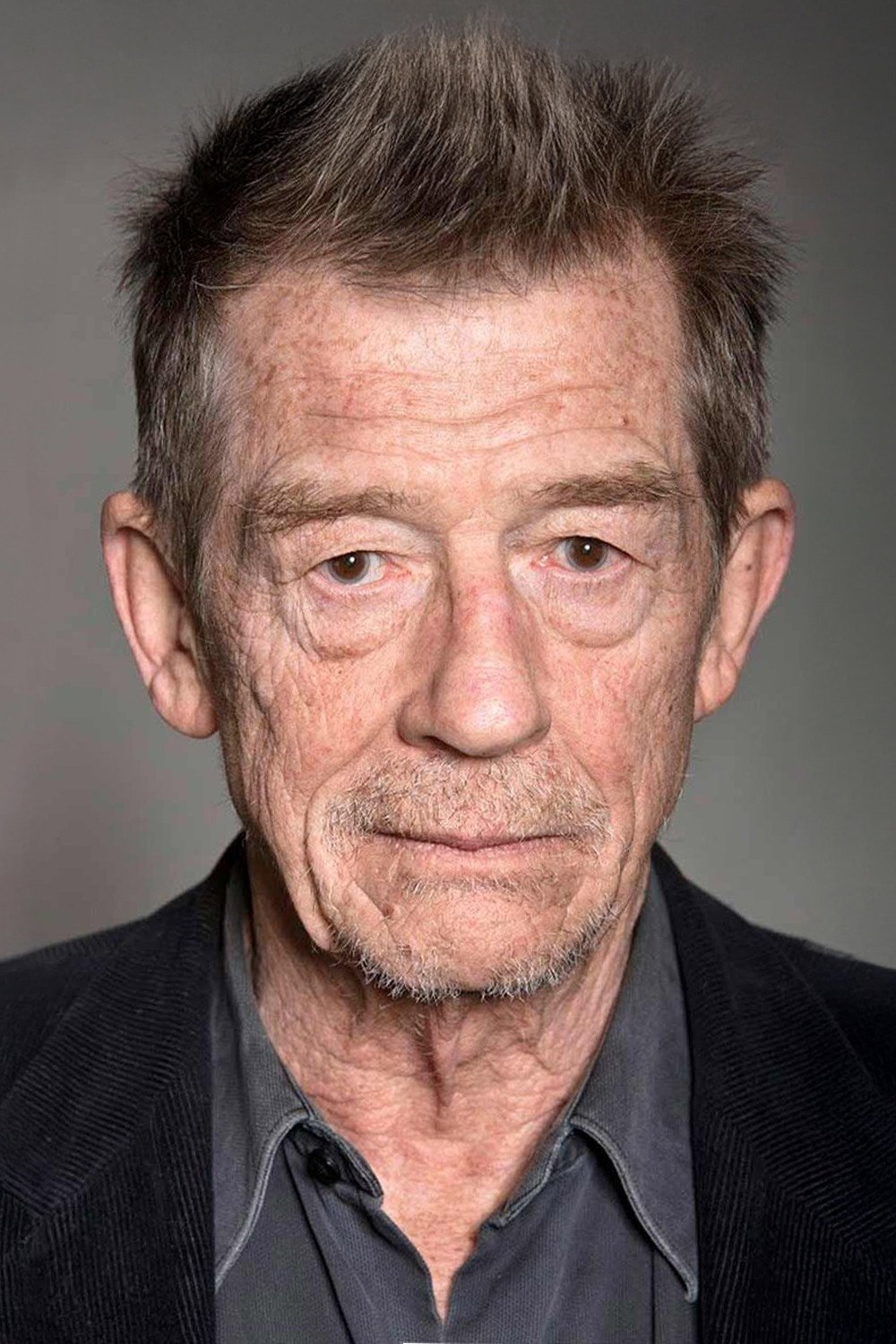
Sir John Hurt (1940 to 2017) was the English actor who played Kane in Alien and John Merrick in The Elephant Man.
Quick Specs
| Born | John Vincent Hurt, January 22, 1940, Chesterfield, Derbyshire; raised in Shirebrook |
| Died | January 25, 2017, at home in Cromer, Norfolk, aged 77 |
| Training | St Martin’s School of Art (scholarship, 1959); RADA (scholarship, 1960) |
| Horror | Kane in Alien (1979); Professor Trevor “Broom” Bruttenholm in Hellboy (2004) and Hellboy II (2008); Christopher Marlowe in Only Lovers Left Alive (2013) |
| Signature roles | Quentin Crisp in The Naked Civil Servant (1975); Caligula in I, Claudius (1976); Max in Midnight Express (1978); John Merrick in The Elephant Man (1980); Winston Smith in Nineteen Eighty-Four (1984); the War Doctor in Doctor Who (2013) |
| Honours | two Oscar nominations; BAFTAs for The Naked Civil Servant, Midnight Express and The Elephant Man; CBE (2004); knighted (2015) |
Who He Is
John Hurt was born John Vincent Hurt in Chesterfield, Derbyshire, on January 22, 1940, the youngest of three children, and grew up in the mining village of Shirebrook nearby, where his father was the vicar. Arnould Herbert Hurt was a mathematician who became an Anglican clergyman. His mother, Phyllis (née Massey), was an engineer and an amateur actress. His older brother, Michael, became a Catholic monk.
It was a strict, sheltered childhood. The family lived opposite a cinema in Shirebrook that he was not allowed to go to, and he was not permitted to mix with local children. At eight he was sent to St Michael’s preparatory school in Otford, Kent, where he played his first school roles, often girls’ parts. At twelve he moved to Christ’s Hospital School in Lincoln, where he played Lady Bracknell in The Importance of Being Earnest.
His parents wanted him to be an art teacher. He studied art at Grimsby Art School and in 1959 won a scholarship to St Martin’s School of Art in London. Unable to fund more art study, he turned to acting and in 1960 won a scholarship to the Royal Academy of Dramatic Art, where he trained for two years.
He married four times: Annette Robertson, Donna Peacock, Jo Dalton, with whom he had two sons, Alexander and Nicolas, and Anwen Rees-Myers, his wife from 2005 until his death. He was made a CBE in 2004 and knighted for services to drama in the 2015 New Year Honours, receiving the accolade at Windsor Castle on July 17, 2015, at 75. In June 2015 he announced a diagnosis of early-stage pancreatic cancer and said he would keep working; in October 2015 he said it was in remission. In the summer of 2016 he withdrew from a stage revival of The Entertainer on medical advice. He died at home in Cromer, Norfolk, on January 25, 2017, aged 77, three days after his birthday. “My husband, John Vincent Hurt, died on Wednesday 25th January 2017 at home in Norfolk,” Anwen Hurt said. The death was announced two days later.
The Work, and What He Did in It
He made his stage debut with the Royal Shakespeare Company in 1962 and his film debut the same year in The Wild and the Willing. His first major film role was Richard Rich in A Man for All Seasons (1966), the ambitious, weak young man whose perjury destroys Thomas More. At 26 he was already playing moral frailty, the register of the whole career. In 10 Rillington Place (1971) he was Timothy Evans, hanged for murders committed by his landlord John Christie (Richard Attenborough), which brought his first BAFTA nomination.
Television made him famous. In The Naked Civil Servant (1975), Thames Television’s play of Quentin Crisp’s autobiography, Hurt, at 35, played the flamboyantly defiant gay writer across decades, making Crisp’s vulnerability and steel a single quality, and won the BAFTA Television Award for Best Actor. He returned to Crisp 34 years later in An Englishman in New York (2009). In the BBC’s I, Claudius (1976), opposite Derek Jacobi’s Claudius, his Caligula was petulant, funny and sliding into madness, a deterioration episode by episode rather than a monster’s entrance.
The great run began with Midnight Express (1978), Alan Parker’s film of Billy Hayes’s Turkish-prison memoir, written by Oliver Stone. Hayes is played by Brad Davis. Hurt is Max, the wasted, self-lacerating long-termer, the prison’s ruined elder, and he played addiction and institutional decay as a physical condition. At 38 he won the Golden Globe and the BAFTA for Best Supporting Actor and received his first Oscar nomination.
Alien (1979) is his horror centrepiece. In Ridley Scott’s film, written by Dan O’Bannon, Hurt is Kane, executive officer of the Nostromo, who investigates the derelict ship, is attacked by the facehugger, recovers apparently unharmed, and dies at the crew’s meal when the creature erupts from his chest. He was 39. He played Kane as the crew’s competent, curious professional, so the film’s first death removes its most reassuring figure. He performed the chestburster sequence himself, positioned beneath a false torso fixed to the table, through which the puppet creature, real animal offal and pumped stage blood were driven.
The cast knew a creature would emerge, because it was in the screenplay, but Scott kept the mechanics and the blood from them. They were held away during the setup and brought back to a set wrapped in plastic, with four cameras rolling. The first take failed when the puppet could not break through the shirt. On the take that worked, a jet of blood struck Veronica Cartwright in the face and knocked her backwards, and her reaction on film is genuine. “If an actor is just acting terrified, you can’t get the genuine look of raw, animal fear,” Scott said. The cast were surprised by the execution, not the event.
The Elephant Man (1980) is the acclaimed centre. David Lynch directed it in black and white, and Mel Brooks executive-produced it without a credit so audiences would not expect a comedy; his company, Brooksfilms, is credited. The historical man was Joseph Merrick; the film, following Frederick Treves’s memoir, calls him John, and Hurt’s John Merrick is rescued from a freak show by Treves (Anthony Hopkins). Hurt acted from inside Christopher Tucker’s prosthetic makeup, built from casts of the real Merrick’s body, which took seven to eight hours to apply and two to remove. Under the strain, he shot only on alternate days. “It took 12 hours to apply the original makeup,” he said of the first day. From inside that apparatus he built the performance from voice and eyes, and at 40 he won the BAFTA for Best Actor and his second Oscar nomination. The film received eight Academy Award nominations and won none. The failure to honour Tucker’s work, with no makeup category then in existence, led the Academy to create the Oscar for Best Makeup the following year. From 2003 Hurt was a patron of the Proteus Syndrome Foundation; Proteus syndrome is the condition Joseph Merrick is thought to have had.
In Michael Radford’s Nineteen Eighty-Four (1984), at 44, he is Winston Smith, opposite Richard Burton, in Burton’s final film, as O’Brien. Two decades later, in V for Vendetta (2005), he played the other side of the same machinery: Adam Sutler, the dictator.
Spaceballs (1987) let him parody his own most famous death. In Brooks’s spoof, playing in effect Kane again, he suffers a second chestburster in a diner, says “Oh no, not again!”, and the creature performs “Hello! My Baby” with a straw hat and cane. Brooks had produced The Elephant Man and met Hurt there, and he cast his own Elephant Man star to redo Alien’s death as comedy, eight years later.
The voice was a second filmography: Hazel in Watership Down (1978), Aragorn in Ralph Bakshi’s The Lord of the Rings (1978), the Horned King in The Black Cauldron (1985), the narrator of Dogville (2003), and the Great Dragon, Kilgharrah, in the BBC’s Merlin (2008 to 2012).
The elder-statesman genre years made him a fixture of a new generation’s fantasy and horror. In Guillermo del Toro’s Hellboy (2004), at 64, he is Professor Trevor “Broom” Bruttenholm, founder of the Bureau for Paranormal Research and Defense and the adoptive father who raised Ron Perlman’s Hellboy: the human conscience of a monster film, a dying scholar whose love for his demonic son is the story’s moral premise. Broom is murdered in the first film, and Hurt appears in Hellboy II: The Golden Army (2008) in flashback. He played the wandmaker Garrick Ollivander in exactly three Harry Potter films: Harry Potter and the Philosopher’s Stone (2001), then, after a six-film absence, Deathly Hallows – Part 1 (2010) and Part 2 (2011), as the captive wandmaker whose knowledge of the Elder Wand the plot turns on.
In Doctor Who he was introduced at the close of “The Name of the Doctor” and then headlined the 50th-anniversary special, “The Day of the Doctor” (November 23, 2013), as the War Doctor, a previously unknown incarnation who fought the Time War, alongside Matt Smith and David Tennant. At 73 he was the oldest actor to debut as the Doctor, and he played the incarnation as a weary soldier ashamed of his own name. He reprised the role in audio dramas from 2015.
Late landmarks include Control in Tinker Tailor Soldier Spy (2011), Gilliam in Snowpiercer (2013), Christopher Marlowe, a vampire, in Only Lovers Left Alive (2013), and Father Richard McSorley in Jackie (2016), the last film released in his lifetime. His final film, completed before his death and released afterwards, is That Good Night (2017), in which he plays Ralph, a screenwriter facing terminal illness.
Cool Verified Facts
- He was born in Chesterfield and raised in Shirebrook, opposite a cinema he was forbidden to enter.
- He played Kane twice, in Alien and in Spaceballs, eight years apart.
- The Elephant Man’s makeup led directly to the creation of the Academy Award for Best Makeup.
- Ollivander appears in exactly three Harry Potter films: the first and the last two.
- He was the oldest actor to debut as the Doctor, at 73.
- Of his many screen deaths, he joked: “I think I’ve got the record.”
- The John Hurt Centre, at Cinema City in Norwich, opened in September 2016, in his lifetime.
Signatures, Habits and Behind the Scenes
He took the small roles deliberately, and the late filmography proves it: Ollivander, Control, Broom, each a handful of scenes made into a remembered character. He described his method this way: “I put everything I can into the mulberry of my mind and hope that it is going to ferment and make a decent wine.”
He died on screen constantly, in almost every register, and he knew it. But that is a theme, not a statistic: the counts disagree, and he never held any record outside his own joke.
His career rhymes with itself: Winston Smith, the victim of a totalitarian state, then Adam Sutler, its face; Kane in earnest, then Kane as a song-and-dance number. David Lynch called him “simply the greatest actor in the world.”
Why He Matters
For horror, John Hurt is the victim the genre is measured against. Kane’s death is the moment modern screen horror learned what a set-piece death could do: take a competent, liked professional in the safest room on the ship, at a meal, and remove him so violently that the film never recovers its footing. Hurt plays Kane’s ease and recovery so naturally that the eruption violates a person, not a plot function. Spaceballs is the culture’s own certificate: the scene belonged to him so completely that only he could parody it.
He also proved a performance could survive total concealment. Merrick is Kane’s counterweight, one role famous for what bursts out of him and the other for what he acts through. And across fifty years, from RADA in 1960 through Crisp, Caligula, Alien and The Elephant Man to del Toro, Harry Potter and Doctor Who, he lent his authority to everything he touched. The 2012 BAFTA for Outstanding British Contribution to Cinema and the 2015 knighthood were the same verdict, from industry and state.