
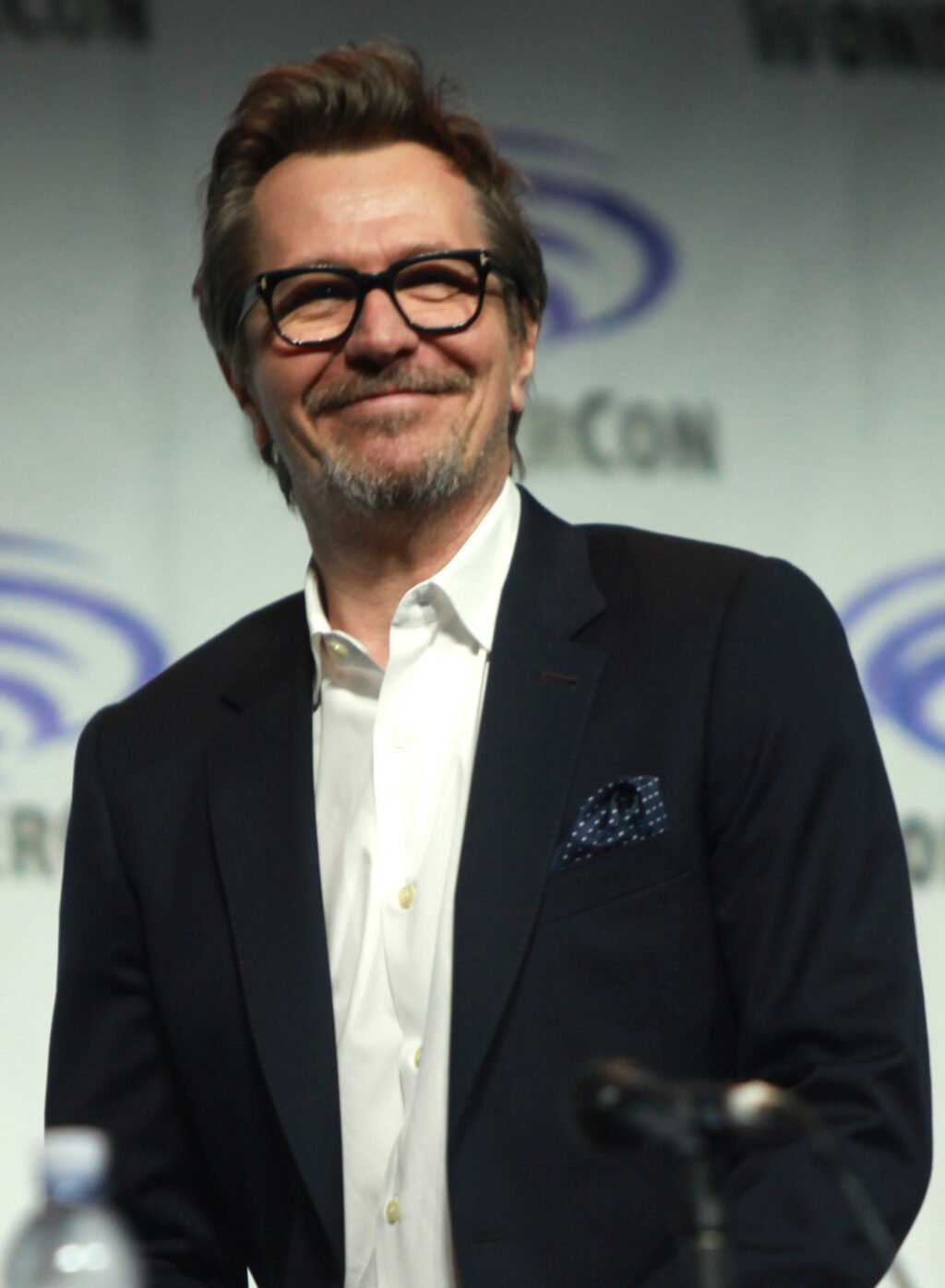
Gary Oldman (born 1958) is the London-born actor who played Count Dracula in Bram Stoker’s Dracula (1992) and won the Oscar for Darkest Hour.
One line sold Gary Oldman on Dracula. Reading James V. Hart’s script in a trailer during a long lunch break on the set of JFK, he reached “I’ve crossed oceans of time to find you” and decided: “It’s worth doing the movie just to say that line.” The line is not even in Stoker’s novel, and the voice he said it in was built half a tone at a time at a piano.
Quick Specs
| Born | March 21, 1958, New Cross, London (as Gary Leonard Oldman) |
| Title | Sir Gary Oldman, Knight Bachelor for services to drama (2025 Birthday Honours) |
| Horror centrepiece | Count Dracula in Bram Stoker’s Dracula (1992), directed by Francis Ford Coppola |
| Other horror | Mason Verger in Hannibal (2001), unbilled; The Backwoods (2006); The Unborn (2009); Red Riding Hood (2011); Mary (2019) |
| Oscar record | Three Best Actor nominations, one win, for Darkest Hour (2017) |
| BAFTA | Three wins: Best British Film and Best Original Screenplay for Nil by Mouth; Best Actor for Darkest Hour |
| Emmys | Four nominations, no wins (Friends; Slow Horses three times) |
| As director | Nil by Mouth (1997), which he also wrote and produced |
| Training | Rose Bruford College, BA in Acting, 1979 |
| Current | Jackson Lamb in Apple TV+’s Slow Horses (2022 onward) |
Who He Is
Gary Leonard Oldman was born on March 21, 1958, in New Cross, south London. In the 2025 Birthday Honours, announced on June 13, 2025, he was made a Knight Bachelor for services to drama, at 67; his reaction, to Deadline, was “gobsmacked.” Prince William invested him at Windsor Castle that autumn. In August 2025 he also put his hands and feet in cement at the TCL Chinese Theatre.
His father, Leonard Bertram Oldman, was a former sailor who also worked as a welder; by Oldman’s account he was an alcoholic who left the family when Gary was seven, and he died in 1985. In 2011 Oldman learned from his mother that his father had played for Millwall just after the Second World War. His mother, Kathleen Oldman, born Cheriton, lived from 1919 to 2018. His elder sister Maureen is the actress known as Laila Morse, Mo Harris in EastEnders; another older sister is Jackie.
He grew up in New Cross and Deptford, went to West Greenwich School, left at 16 and worked in a sports shop. What turned him toward acting was Malcolm McDowell in The Raging Moon (1971). “Something about Malcolm just arrested me, and I connected, and I said, ‘I wanna do that,'” he told Charlie Rose in 1995. RADA turned him down and advised him to find something else to do. He won a scholarship to Rose Bruford College instead and graduated with a BA in Acting in 1979.
He has been married five times. His first wife was Lesley Manville, from 1987 to 1990; their son Alfie was born in 1988, and Manville said in 2018 that they are on good terms. He was married to Uma Thurman, whom he met on State of Grace, from 1990 to 1992, and was engaged to Isabella Rossellini from 1994 to 1996. He married Donya Fiorentino in 1997; their sons Gulliver and Charlie were born in 1997 and 1999. In their 2001 divorce she alleged assault; Oldman was investigated and cleared, and he was given sole legal and physical custody of the boys. In 2018 Gulliver publicly called the allegation his mother’s “lies.” He was married to Alexandra Edenborough from 2008 until 2015, and in 2017 he married the writer and art curator Gisele Schmidt.
He was arrested for drink-driving in 1991, checked himself into rehab in 1994, and has been sober since 1997. He has described himself as a recovering alcoholic and has praised Alcoholics Anonymous publicly.
The Work, and What He Did in It
The Stage
After Rose Bruford he joined the repertory company at York Theatre Royal, then worked at the Citizens Theatre in Glasgow and in the West End opposite Glenda Jackson in Summit Conference (1982). A performance in Edward Bond’s Saved led Max Stafford-Clark to cast him as Scopey in Bond’s The Pope’s Wedding at the Royal Court in 1984. It won him the Time Out Fringe Award for best newcomer and a Drama Theatre Award for best actor, shared with Anthony Hopkins. He was with the Royal Court company from 1984 to 1986 and the Royal Shakespeare Company from 1985 to 1986, and played in The Country Wife and Serious Money in 1987.
In 2025 he went back. At York Theatre Royal, from April 14 to May 17, 2025, he directed, designed and starred in Beckett’s Krapp’s Last Tape, his first stage work in about 37 years and his first time back at that theatre in more than 45. It sold out and transferred to the Royal Court in London.
The Eighties
His film debut was Remembrance (1982), and he played a skinhead in Mike Leigh’s television film Meantime (1983). Alex Cox saw The Pope’s Wedding and offered him Sid Vicious in Sid and Nancy (1986). He turned it down twice. “I wasn’t really that interested in Sid Vicious and the punk movement,” he has said. “The script I felt was banal and ‘who cares’ and ‘why bother.'” He came round for the salary and at his agent’s urging, lost weight on steamed fish and melon, and was hospitalised for malnutrition. Roger Ebert wrote that he was “able to re-invent himself for every role… the best young British actor around.” Oldman’s own later verdict, to Playboy: “I don’t think I played Sid Vicious very well.”
He played the playwright Joe Orton in Prick Up Your Ears (1987), a BAFTA Best Actor nomination, sang and played piano live as Martin in Track 29 (1988), and was the football hooligan Clive “Bex” Bissell in Alan Clarke’s BBC film The Firm (1989), which Total Film ranked his best performance in 2011.
The Early Nineties
He was Rosencrantz opposite Tim Roth’s Guildenstern in Rosencrantz & Guildenstern Are Dead (1990), an Independent Spirit nomination, and a New York gangster in State of Grace (1990), which Ebert called the film’s highlight and Janet Maslin “phenomenal.”
For Oliver Stone’s JFK (1991) he played Lee Harvey Oswald. By his account the script held almost no Oswald material, so Stone gave him plane tickets, a contact list and “pocket money” and told him to research the role himself. He met Oswald’s widow, Marina, and their two daughters. He came away believing Oswald acted alone; Stone calls him a “Warren Commission guy,” and Oldman’s answer is: “I had to jump on the train with him.”
Bram Stoker’s Dracula (1992)
His reason for taking Bram Stoker’s Dracula was the director. “It was an opportunity to work with Coppola, who I consider one of the great American directors. That was enough, really. It was my first big American movie.” The script, and that oceans-of-time line, did the rest. He auditioned for Coppola at Napa; Gabriel Byrne also screen-tested, with Kyle MacLachlan as Harker, and neither was cast. Keanu Reeves became Jonathan Harker, Winona Ryder played Mina and Anthony Hopkins was Van Helsing.
The Count‘s voice was engineered. He worked with a singing teacher to bring it down a full octave. “I literally wanted to lower my voice an octave, and it’s doable,” he has said. “It’s an organ… you go to the piano and work half a tone, and then another half a tone down.”
The makeup was designed by Greg Cannom, who shared the film’s Academy Award for Best Makeup with Michèle Burke. With Cannom, Coppola said, it became “not just one monster but five monsters in the film.” The elderly Dracula took nearly seven hours to apply, followed by around ten hours on set and an hour and a half to remove. Coppola also kept Oldman apart from the rest of the cast, in separate housing; they first met him at rehearsals.
The film cost $40 million and took $215.9 million worldwide, and the performance won Oldman the Saturn Award for Best Actor. He was 34 when it opened. It arrived 61 years after Dracula (1931).
Villains of the Nineties
In True Romance (1993) he is Drexl Spivey, roughly ten minutes on screen, described by MSN Movies as “one of cinema’s most memorable villains.” In Luc Besson’s Léon: The Professional (1994) he is Norman Stansfield, and the famous screamed “EVERYONE!” was a gag. The line itself, “Bring me everyone,” was scripted; the delivery was Oldman joking to make Besson laugh, after warning the sound engineer to slip off his headphones, and Besson kept the take. “That was just an outtake. It was just me having fun,” Oldman has said. Léon took about $45.3 million worldwide on a $16 million budget.
He played Beethoven in Immortal Beloved (1994), doing the piano parts himself after turning the role down, he has said, “half a dozen times”; a sadistic prison warden in Murder in the First (1995); Arthur Dimmesdale in The Scarlet Letter (1995); and the art dealer Albert Milo in Basquiat (1996).
Nil by Mouth (1997)
His debut as writer and director, which he also produced, is Nil by Mouth. It has been described both as partly inspired by his own upbringing and as partly based on his memories of a child he knew at school. It stars Ray Winstone, Kathy Burke, Charlie Creed-Miles, Edna Doré and his sister Laila Morse, with a score by Eric Clapton, and was produced by Oldman, Douglas Urbanski and Luc Besson on a $9 million budget. It premiered at Cannes on May 8, 1997, in competition for the Palme d’Or, and Kathy Burke won Best Actress. At the BAFTAs it won the Alexander Korda Award for Best British Film and Best Original Screenplay. It was named to the BFI’s Top 100 British Films in 1999, and a 2017 Time Out poll ranked it the 21st-best British film. It earned $266,130 in the US.
Blockbusters
The same year he was Jean-Baptiste Emanuel Zorg in Besson’s The Fifth Element (1997), which took $263.9 million worldwide, and Egor Korshunov in Air Force One (1997), $315.2 million worldwide. He was Dr. Zachary Smith in Lost in Space (1998), voiced Lord Ruber in Quest for Camelot (1998) and played Pontius Pilate in the TV film Jesus (1999).
In The Contender (2000) he played Congressman Sheldon Runyon and was an executive producer, and what happened to it is disputed four ways. Premiere magazine reported in October 2000 that Oldman and Urbanski alleged DreamWorks had pushed director Rod Lurie to recut the film so that Runyon read as unsympathetic ahead of the election. DreamWorks’ Walter Parkes denied it “unequivocally.” Urbanski later flatly denied that either of them had made the statements, calling the story “sloppy sensationalism,” and Roger Ebert called it a “myth.” Oldman’s own on-record complaint was aimed at Lurie, not the studio: the released edit lost the character’s ambiguity, above all through the “dark, sinister music” under Runyon, “the big red flag for me.” Of Lurie he said: “deeply, deeply disappointing… I am very hurt by it.” Lurie’s reply was that Oldman had “a kind of Stockholm syndrome” with the character. The performance earned SAG and Independent Spirit nominations.
Hannibal (2001)
In Hannibal he is Mason Verger, the only surviving victim of Hannibal Lecter, and he receives no credit in the film. There are two explanations. Reporting at the time described a billing dispute: he wanted his name above the title alongside Anthony Hopkins and Julianne Moore, was refused, and removed it. Oldman’s later account is that he wanted to play the part anonymously, as “the man with no name and no face.” Greg Cannom did the makeup again; Oldman has put it at five hours a day (“It took five hours of makeup… I had no eyelids in the character”), and other accounts say six. Hannibal cost $87 million and took $351.7 million worldwide.
Sirius and Gordon
He played Richard Crosby across the two-part Friends episode “The One with Chandler and Monica’s Wedding” (2001), an Emmy nomination. In Tiptoes (2003) he played a man with dwarfism, a performance Variety’s Lisa Nesselson called “astonishingly fine.” Then came two franchises. As Sirius Black, opposite Helena Bonham Carter‘s Bellatrix, he appeared in four Harry Potter films, from Prisoner of Azkaban (2004) through a Resurrection Stone cameo in Deathly Hallows Part 2 (2011); Alfonso Cuarón cast him, and he took the part, he has said, because he needed the money after years of turning down work to raise his sons. Prisoner of Azkaban cost $130 million and took $811.6 million worldwide across all releases.
As Jim Gordon he stood beside Christian Bale‘s Batman in all three of Christopher Nolan’s films, Batman Begins (2005), The Dark Knight (2008) and The Dark Knight Rises (2012). The last two each passed $1 billion worldwide. Mark Kermode’s verdict on the middle one: “the best performance in [The Dark Knight], by a mile, is Gary Oldman.”
Horror and Mixed Years
His genre credits through these years include The Backwoods (2006) and The Unborn (2009), as Rabbi Joseph Sendak. In the motion-capture A Christmas Carol (2009) he played three roles: Bob Cratchit, Jacob Marley and Tiny Tim. He was Carnegie in The Book of Eli (2010) and Father Solomon in Red Riding Hood (2011), and voiced Lord Shen in Kung Fu Panda 2 (2011), an Annie nomination.
Tinker Tailor Soldier Spy (2011)
For Tomas Alfredson’s Tinker Tailor Soldier Spy he gained 15 lb, studied Alec Guinness’s Smiley and visited John le Carré to find George Smiley’s voice, with John Hurt as Control. When the nominations were announced on January 24, 2012, it gave him his first Oscar nomination, at 53, after three decades on screen. The film took $81.5 million worldwide.
He followed it with Floyd Banner in Lawless (2012), Dr. Dennett Norton, the scientist who builds the title character, in RoboCop (2014), Dreyfus in Dawn of the Planet of the Apes (2014), a CIA chief in Criminal (2016) and a dictator in The Hitman’s Bodyguard (2017).
Darkest Hour (2017)
For Joe Wright’s Darkest Hour, he insisted on one makeup artist, Kazuhiro Tsuji, who had retired from film into fine art. “He’s the only man on Earth who could do it,” Oldman said, and “I was lucky enough to lure him back and drag him out of retirement.” Tsuji confirmed backstage at the Oscars that he had left the industry six years earlier and came back because “Gary asked me to design this.” After six months of testing, the Churchill makeup took about three and a half hours a day to apply, 200 hours in the chair in all, worn 61 times over 48 consecutive working days. Gaining the weight instead was never on the table: “I would have to gain 80 lbs… De Niro did it once definitively, thank you very much. So it was going to be makeup!” He smoked around $20,000 worth of cigars on the production and got nicotine poisoning.
He won the Oscar for Best Actor on March 4, 2018, at 59, seventeen days before his 60th birthday, along with the BAFTA, Golden Globe, SAG and Critics’ Choice awards. Tsuji, David Malinowski and Lucy Sibbick won the makeup Oscar. The film took $150.8 million worldwide.
After the Oscar
His first horror lead after the win was Michael Goi’s Mary (2019), released on October 11, 2019, in which he plays David, a charter-boat captain who buys an abandoned, haunted ship at auction and sails his family toward Bermuda, with Emily Mortimer as Sarah. He played Jürgen Mossack in The Laundromat (2019), and Herman J. Mankiewicz in David Fincher‘s Mank (2020) for Netflix, his third Oscar nomination. He was Alistair Russell in Wright’s The Woman in the Window (2021), Harry S. Truman in a single scene of Oppenheimer (2023), and John Cheever in Paolo Sorrentino’s Parthenope (2024).
Slow Horses
Apple TV+’s Slow Horses, from Mick Herron’s Slough House novels, gave him his first lead role in a television series, as Jackson Lamb. Series 6 premiered on September 16, 2026, and Series 8, adapting Herron’s Clown Town, was announced the day before. Lamb has brought him three straight Emmy nominations, in 2024, 2025 and 2026, without a win, plus a Satellite Award and a 2026 AACTA award. The show’s own three Emmy wins went to its writer and directors. On November 20, 2022, he said the series would likely be his last role and that he intended to retire when it ends. That remains his stated intention.
Cool Verified Facts
- He won his Oscar at 59, not 60.
- The Dracula makeup was by Greg Cannom, who also made Mason Verger.
- “I’ve crossed oceans of time to find you” is James V. Hart’s line, not Bram Stoker’s.
- He is not in Sin City; his 2003 film is called Sin.
- He sang on the Sid and Nancy soundtrack with Glen Matlock, recorded a duet with David Bowie, “You’ve Been Around,” on a Reeves Gabrels album, and accepted Bowie’s Brits Icon Award for the family in 2016.
- He sat on the Cannes jury in 1993.
- Anne Beverley, Sid Vicious’s mother, gave him her son’s real chain and padlock to wear in Sid and Nancy.
Signatures, Habits and Behind the Scenes
Much of his work is built from the outside in. The Dracula voice was a piano exercise. Churchill was makeup by choice, because, as he put it, De Niro had done the weight gain “once definitively.” Mason Verger was five or six hours in the chair with no eyelids, and the elderly Count nearly seven.
He also lets the jokes stay in. Stansfield’s “EVERYONE!” was a take meant only to make Besson laugh, and Besson kept it in the film.
Why He Matters
For horror, Oldman’s Dracula is the Count as lover, monster and old man in one film, with a voice he built on purpose and a line he took the job to say. Mason Verger then gave the Lecter films their most grotesque victim, played by an actor who refused even to put his name on it.
Around that horror sits a career with almost no ceiling: Sid Vicious, Oswald, Beethoven, Smiley, Churchill and Jackson Lamb, a BAFTA-winning film he wrote and directed, an Oscar, and a knighthood. He took thirty years to get his first Oscar nomination and has spent the years since collecting the rest.