
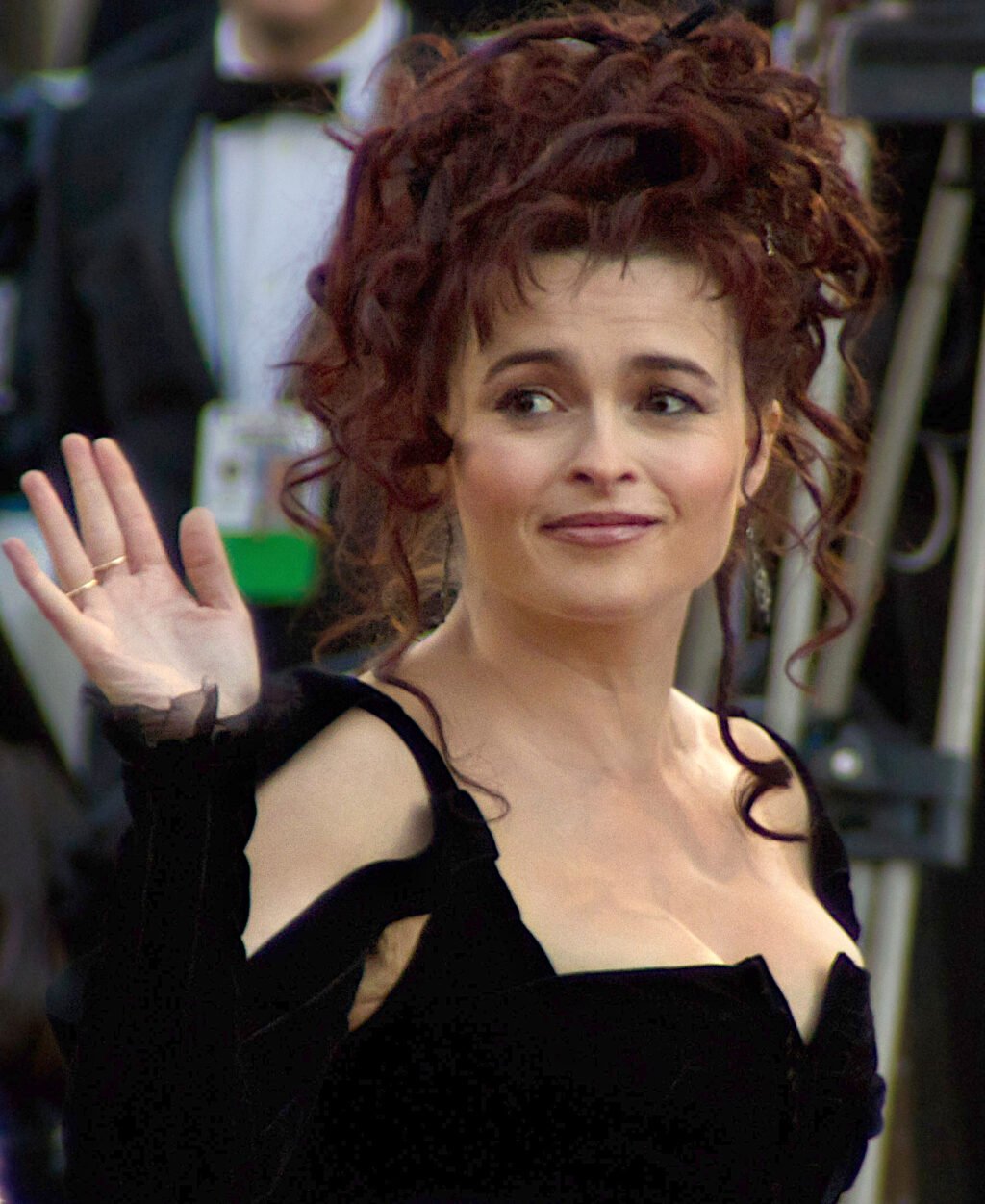
Helena Bonham Carter (born 1966) is the English actress who played Elizabeth in Mary Shelley’s Frankenstein, Mrs. Lovett in Sweeney Todd and Bellatrix Lestrange.
Quick Specs
| Born | May 26, 1966, Islington, London; raised in Golders Green |
| Training | none formal; South Hampstead High School, then A-levels at Westminster School |
| Breakthrough | Lucy Honeychurch in A Room with a View (1985) |
| Horror and Gothic | Elizabeth Lavenza in Mary Shelley’s Frankenstein (1994); voice of Emily in Corpse Bride (2005); Mrs. Lovett in Sweeney Todd: The Demon Barber of Fleet Street (2007); Bellatrix Lestrange in four Harry Potter films (2007 to 2011); Dr. Julia Hoffman in Dark Shadows (2012) |
| Also | Marla Singer in Fight Club (1999); Queen Elizabeth in The King’s Speech (2010); Princess Margaret in The Crown (2019 to 2020) |
| Oscar nominations | two, The Wings of the Dove (Best Actress) and The King’s Speech (Best Supporting Actress) |
| Wins | BAFTA for The King’s Speech; International Emmy for Enid; Genie for Margaret’s Museum |
| Honours | CBE (2012, for services to drama); first female President of the London Library (2022) |
| Family | great-granddaughter of Prime Minister H. H. Asquith; partner of Tim Burton from 2001 to 2014, with two children |
Who She Is
Helena Bonham Carter was born on May 26, 1966, in Islington, London, and grew up in Golders Green, the youngest of three children, after her brothers Edward and Thomas. Her father, Raymond Bonham Carter, was a merchant banker who represented the Bank of England at the IMF in Washington in the 1960s. Her mother, Elena (née Propper de Callejón), is a psychotherapist.
The family tree is precise. Her father’s mother was the politician and feminist Violet Bonham Carter, later Baroness Asquith of Yarnbury, and Violet’s father was H. H. Asquith, Prime Minister from 1908 to 1916. That makes Asquith her great-grandfather, and the film director Anthony Asquith, his son, her great-uncle. On her mother’s side, her grandfather Eduardo Propper de Callejón was a Spanish diplomat honoured by Israel as Righteous Among the Nations for helping save Jews during the Second World War, and her grandmother was the painter Baroness Hélène Fould-Springer.
Two family crises shaped her. When she was five, her mother had a serious breakdown and took about three years to recover; her mother’s own therapy led her to become a psychotherapist. Later her father was diagnosed with an acoustic neuroma, and complications from the operation to remove it caused a stroke that left him half-paralysed and in a wheelchair. She drew on his movements for The Theory of Flight (1998). He died in January 2004.
She went to South Hampstead High School and took her A-levels at Westminster School. King’s College, Cambridge turned her down, by the standard account because it feared she would leave to act. She has no formal acting training. She made her own start: at 13 she came second in a national poetry competition and spent the prize money on a photograph in the Spotlight casting directory. That got her an agent, and at 16 her first job, a television commercial in which she played Juliet to sell a stereo. Her first major role was the TV film A Pattern of Roses (1983).
She was with Kenneth Branagh in the second half of the 1990s. From 2001 to 2014 her partner was Tim Burton, whom she met around Planet of the Apes; they never wed, famously lived in adjoining houses in Belsize Park, and have two children, Billy (born 2003) and Nell (born 2007). They announced an amicable separation in December 2014. Since about 2019 her partner has been the art historian Rye Dag Holmboe.
The Work, and What She Did in It
Her film debut was her breakthrough: Lucy Honeychurch in James Ivory’s E. M. Forster adaptation A Room with a View (1985), released when she was 19. Trevor Nunn then cast her as Lady Jane Grey in Lady Jane (1986), her first title role, persuading her to take it over university. Ophelia to Mel Gibson’s Hamlet (1990) and Helen Schlegel in Merchant Ivory’s Howards End (1992), which earned a BAFTA supporting nomination, fixed a type: the virginal English rose of the corset films. She was uncomfortable with the label and has said so.
Her first horror lead came at 28. Mary Shelley’s Frankenstein (1994) was directed by Kenneth Branagh, who also plays Victor, with Robert De Niro as the Creature, and produced through Francis Ford Coppola’s American Zoetrope. Bonham Carter plays Elizabeth Lavenza in the full Shelley construction: taken into the Frankenstein family, raised beside Victor, then his fiancée and his bride. On the wedding night the Creature tears out her heart. Then the film gives her something no previous Elizabeth had. Victor, refusing the loss, grafts her head onto the body of the executed Justine and brings her back. The revived Elizabeth, fought over by Victor and the Creature, understands what she has been made into, sets herself alight and dies by her own hand. That reanimation is Branagh’s invention, not Shelley’s. In the novel Victor destroys the unfinished female creature and Elizabeth stays dead. The film consciously borrows the idea of Bride of Frankenstein (1935) and makes Elizabeth herself the Bride, and Bonham Carter delivers its most harrowing beat.
The reinvention followed. She won the Genie Award for Best Actress as the title character in the Canadian coal-mining drama Margaret’s Museum (1995), made Woody Allen’s Mighty Aphrodite (1995), and then played Kate Croy in the Henry James adaptation The Wings of the Dove (1997), which brought her first Oscar nomination, for Best Actress, and a run of critics’ awards from London, Los Angeles, Boston and the National Board of Review. That performance got her Fight Club (1999): David Fincher cast her as Marla Singer on the strength of it. Marla, the support-group tourist in black and the film’s one honest fraud, chain-smoking, caustic and American, is the Narrator’s (Edward Norton’s) mirror, and the performance publicly ended the English rose years. She was 33.
The Burton partnership produced seven films he directed. She was Ari, the chimpanzee advocate, under full prosthetics in Planet of the Apes (2001); Jenny and the Witch in Big Fish (2003); Mrs. Bucket in Charlie and the Chocolate Factory (2005); the voice of Emily in Corpse Bride (2005), co-directed with Mike Johnson; Mrs. Lovett in Sweeney Todd (2007); the Red Queen, Iracebeth, in Alice in Wonderland (2010), a blend of Carroll’s Red Queen and Queen of Hearts; and Dr. Julia Hoffman in Dark Shadows (2012). She reprised the Red Queen in Alice Through the Looking Glass (2016), but James Bobin directed that one, with Burton producing.
Sweeney Todd: The Demon Barber of Fleet Street (2007), Burton’s film of Stephen Sondheim’s musical with Johnny Depp as Todd, is her second horror centrepiece. Mrs. Nellie Lovett is Todd’s landlady and accomplice, the pie-shop owner who bakes his victims into her pies, and Bonham Carter played her as a lovelorn fantasist rather than a grotesque. Her tragedy, as Bonham Carter put it at the time, is that “she’s in love with somebody who doesn’t even notice her.” It was her first musical, and she had wanted to play Lovett since childhood. Being the director’s partner did not get her the part (see below). The performance earned a Golden Globe nomination and the Evening Standard British Film Award for Best Actress, shared with her work in Conversations with Other Women. She was 41.
The same year she became Bellatrix Lestrange, in Harry Potter and the Order of the Phoenix (2007), and played her through Half-Blood Prince (2009) and both parts of Deathly Hallows (2010 and 2011). The role was not originally hers. Helen McCrory was cast first and withdrew when she became pregnant; McCrory later joined the series as Bellatrix’s sister, Narcissa Malfoy. Bonham Carter made the late arrival the franchise’s most feral presence: Voldemort’s (Ralph Fiennes) most devoted Death Eater, the killer of her cousin Sirius Black (Gary Oldman), Hermione’s torturer. In the Gringotts sequence of Part 2 she also plays Hermione disguised as Bellatrix, to Emma Watson’s voice. Molly Weasley kills her in the final battle. Reviews of her first appearance called her a “shining but underused talent,” and the series kept enlarging the part around her.
The second prestige run began with Enid (2009), the BBC Four film about Enid Blyton, which won her the 2010 International Emmy for Best Actress. As Queen Elizabeth, the future Queen Mother, in The King’s Speech (2010), she won the BAFTA for Best Supporting Actress and received her second Oscar nomination. After that came Madame Thénardier in Les Misérables (2012), Miss Havisham in Great Expectations (2012), the Fairy Godmother in Cinderella (2015), Rose Weil in Ocean’s 8 (2018) and Eudoria Holmes in Enola Holmes (2020). She succeeded Vanessa Kirby as Princess Margaret in seasons three and four of The Crown (2019 to 2020), earning two Primetime Emmy nominations for playing the daughter of the queen she had already played. Her voice work includes Lady Tottington in Wallace & Gromit: The Curse of the Were-Rabbit (2005) and the narration of the documentary Three Minutes: A Lengthening (2021). She has acted in a short film, Roman Polanski’s Prada short A Therapy (2012), but she has never directed.
Cool Verified Facts
- Marla exists because of Kate Croy: Fincher cast the grime of Fight Club off a Henry James performance.
- Her mother, the psychotherapist, is a paid script reader. Bonham Carter has her read scripts and report on the characters’ psychology. She has recalled her mother leaving that script outside her bedroom door “because it was a pollutant.”
- By her own telling, she accidentally ruptured Matthew Lewis’s eardrum while filming as Bellatrix, by putting her wand in his ear.
- She played Queen Elizabeth in The King’s Speech and, nine years later, that queen’s daughter, Princess Margaret, in The Crown.
- She was appointed CBE in the 2012 New Year Honours for services to drama and dedicated it to her father’s memory. In 2022, a member since 1986, she became the first female President of the London Library, succeeding Sir Tim Rice. She was appointed to the UK’s national Holocaust Commission in 2014.
Signatures, Habits and Behind the Scenes
The Sweeney Todd audition is her signature story, because it refutes the easy assumption. As she told it in 2007, Burton said she was right for it but would be considered like anyone else. She went to a singing teacher for months, auditioned on video, then waited five weeks while Burton auditioned others and said nothing about it (“it was like the elephant in the room”). She understood she had to get it “in spite of, instead of because of” being his partner, and Sondheim held a veto.
The psychological reading comes first. The habit of having her mother read for character connects her childhood to her method, and it shows in performances built from the inside out, even under prosthetics or a fright wig.
Her range is the signature. Within roughly a decade she was a reanimated Elizabeth Lavenza, Marla Singer, an ape under latex, a corpse bride’s voice and a singing pie-maker. The press calls it eccentric. The record underneath is classical technique applied to grotesques, with Lady Jane and Lucy Honeychurch as the foundation rather than the contradiction. There is no verified diva record: the behind-the-scenes material runs the other way, from auditioning for her own partner to taking over a role another actress had to give up.
Why She Matters
For horror, Helena Bonham Carter has been the genre’s prestige anchor across three decades. In 1994 she was the female lead of the most lavish Frankenstein film made to that date and cinema’s only Elizabeth-as-Bride. In 2007 she headlined a Sondheim horror musical as Mrs. Lovett and debuted as Bellatrix: Gothic villainy in two registers in one year. Add Emily the Corpse Bride and Dr. Julia Hoffman, and her filmography is a working map of mainstream Gothic from Branagh to Burton.
The reinvention is the other argument. Few actors have made a documented escape from type as complete as English rose to Marla Singer to Bellatrix, and every step is on the record: the James performance, Fincher casting Marla off it, McCrory’s withdrawal handing her a part she then defined. With two Oscar nominations, a BAFTA, an International Emmy and a CBE behind her, directors borrow her legitimacy for grotesque material, and she spends it gladly.