
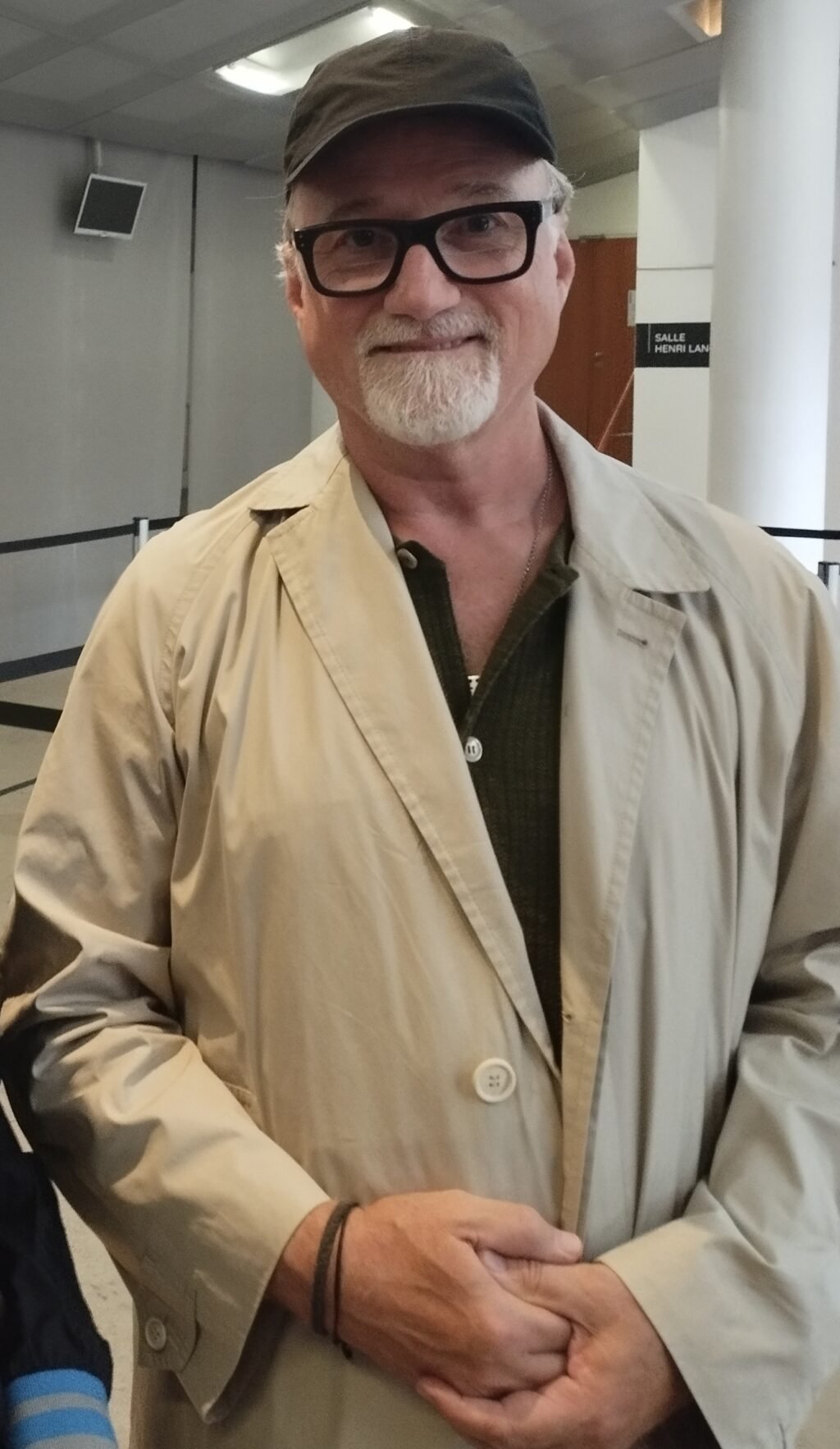
David Fincher is the American director who turned precision into dread — the music-video perfectionist behind Se7en, Zodiac and Fight Club.
Quick Specs
- Born: 28 August 1962, Denver, Colorado
- Full name: David Andrew Leo Fincher
- Known for: Se7en, Fight Club, Zodiac, The Social Network, Gone Girl
- Formation: ILM matte department, then commercials and music videos — his self-described “film school”
- Debut: Alien³ (1992) — a film he has publicly disowned
- Years active: 1983–present
Overview
Every David Fincher film feels like a machine built by a man who does not trust machines — or people, or luck, or first takes. He came up through ILM’s matte department and the music-video assembly line, learned to work fast and cheap and exact, and then spent thirty years making the most controlled films in Hollywood about the failure of control: a killer who plans better than the police, a case that cannot be closed, a social network built out of betrayal. He has never won an Academy Award — three Director nominations, zero wins, and we will unpack that properly below, because his record is the most misreported in modern directing. He shot one of the first major features mainly on digital, built Netflix’s first prestige drama, and directed the serial-killer procedural against which all others are measured. Start with the debut he hates. He would insist.
The Life
David Andrew Leo Fincher was born on 28 August 1962 in Denver, Colorado — not 10 May, whatever one reference book in circulation says. His mother Claire was a mental-health nurse who worked in drug-addiction programmes; his father, Howard Kelly “Jack” Fincher, was a reporter and Life magazine bureau chief — and, decades later, the author of the Mank screenplay, which matters when we get there. When David was two the family moved to San Anselmo, California, where George Lucas was among the neighbours — proximity, not mentorship; no source shows Lucas mentoring the kid, so this page won’t either. At eight, a documentary on the making of Butch Cassidy and the Sundance Kid detonated in his head: it had never occurred to him, he has said, that movies didn’t take place in real time — the ultimate magic trick. As a teenager in Ashland, Oregon, he directed plays, designed sets and lighting, worked as a projectionist and a TV-news production assistant, and kept himself in busboy, dishwasher and fry-cook shifts. Then he deliberately skipped film school and went to learn on sets instead.
His first marriage, to Donya Fiorentino (1990–95), produced his daughter Phelix. His wife and producing partner is Ceán Chaffin, producer on essentially all of his features from The Game onward — and that is all this page will say about dates, because the sources conflict on the marriage year and the record doesn’t get to be tidier than the truth.
The Work
The formation runs through other people’s movies: loading cameras at John Korty’s studio, then Industrial Light & Magic as an assistant cameraman and matte photographer on Return of the Jedi (1983) and Indiana Jones and the Temple of Doom (1984) — craft work, around age 20; he directed nothing at ILM. Leaving ILM, he directed a notorious American Cancer Society commercial — a smoking foetus — that got producers calling, co-founded Propaganda Films in 1986, and built the career that made him: commercials for Nike, Levi’s, Pepsi and Chanel, and 53 credited music videos between 1984 and 1993, including Madonna’s “Express Yourself” and “Vogue,” both of which won him MTV’s Best Direction award. His own framing, multiply carried: the videos were his film school.
Then Alien³ (1992). Both halves of this fact must travel together: it is his feature directorial debut, and he has publicly disowned it. Hired in 1990 to replace Vincent Ward, he directed the third film in the line that runs Ridley Scott‘s Alien (1979) → Cameron’s Aliens (1986) → his — Sigourney Weaver‘s Ripley stranded on a prison planet with Charles Dance as Clemens and Charles S. Dutton as Dillon, facing the xenomorph one more time — through studio intervention and abandoned scripts. It earned one Oscar nomination, for Visual Effects. His verdict, to The Guardian in 2009, is not “mixed feelings”: “No one hated it more than me; to this day, no one hates it more than me.” The 2003 Assembly Cut was assembled without his involvement — never call it his director’s cut. The franchise kept it; its director walked away and built a career out of never being in that position again. (His formation among the effects generation puts him in the company of craftsmen like Rob Bottin — men who learned movies by building them.)
Se7en (1995) is the breakthrough, and he saved it before he shot it. Andrew Kevin Walker wrote it; an earlier director had the famous ending rewritten out; Fincher was mistakenly sent Walker’s original draft, told New Line the head-in-the-box ending was why he wanted the film, was sent the revised draft — and refused it. Brad Pitt’s condition for signing, in Pitt’s own later account: “I will do it on one condition: the head stays in the box.” It stayed. Freeman, Pitt, Paltrow, and Spacey uncredited in the marketing as John Doe: the film re-established him completely and took one Oscar nomination, for Film Editing. The Game (1997) followed — Michael Douglas pulled into an elaborate conspiracy, and the start of Chaffin’s producer run. Fight Club (1999) — Edward Norton, Pitt, Helena Bonham Carter as Marla, from Chuck Palahniuk’s novel — disappointed at the box office on release, roughly $100 million worldwide against a budget in the mid-$60 millions, polarised critics, and then became the defining cult classic of the DVD era. Get that order right; reversing it falsifies the film’s most famous fact. Panic Room (2002), a single-location home-invasion chamber piece with Jodie Foster, restored his commercial standing.
Zodiac (2007) is the precision landmark: James Vanderbilt’s screenplay from Robert Graysmith’s books, Gyllenhaal as Graysmith, Ruffalo as Inspector Toschi, Downey Jr. as Paul Avery — and an 18-month production investigation cross-referencing police files and interviewing surviving witnesses. Fincher grew up in the Bay Area during the murders and called the Zodiac the “ultimate boogeyman.” It was shot primarily on the digital Thomson Viper FilmStream camera — among the first major Hollywood features shot mainly digitally, but not entirely: the slow-motion murder sequences were shot on film. It grossed about $84.7 million worldwide against a $65 million budget — modest, not a flop. The case remains officially unsolved; the film points where Graysmith pointed, at Arthur Leigh Allen, a suspect — never state more than that. It received no Academy Award nominations, which the record supports and history keeps arguing with.
The Curious Case of Benjamin Button (2008) was the awards pivot: 13 Oscar nominations including Picture and Director — his first Director nomination — and three wins (Art Direction, Makeup, Visual Effects), $335.8 million worldwide against a budget the sources give as a $150–167 million range. The Social Network (2010) is the trap film of his record, so here it is name by name: eight nominations, three wins — Adapted Screenplay (Aaron Sorkin), Original Score (Trent Reznor and Atticus Ross), Film Editing — and Picture and Director lost to The King’s Speech and Tom Hooper. Fincher won the Golden Globe and the BAFTA for directing it, which is precisely why the Oscar error is so common: he did not win the Oscar. Globes and BAFTAs are not Oscars. The Girl with the Dragon Tattoo (2011) — his English-language adaptation, Daniel Craig and an Oscar-nominated Rooney Mara, distinct from the 2009 Swedish film — won Film Editing from five nominations. Gone Girl (2014), Gillian Flynn adapting her own novel, Rosamund Pike nominated, joined Button as one of his two biggest commercial successes, both over $300 million worldwide. Mank (2020) he directed and produced — but the screenplay is his father’s, written by Jack Fincher, who died in 2003; it led its year with ten nominations and won two (Production Design, Cinematography), and Fincher’s third Director nomination lost to Chloé Zhao. The Killer (2023), with Michael Fassbender as the hitman, was his deliberate pulp return — his own line: “I will never be a more mature film-maker. I will carry the 12-year-old me with me wherever I go.” A Cliff Booth film, directed by Fincher from Quentin Tarantino’s screenplay with Pitt returning, has been announced for Netflix; that is announcement, not record, and this page treats it as such.
Television is no sideline: he executive-produced House of Cards and directed its first two episodes, winning the Emmy for directing the pilot; he executive-produces and directs episodes of Mindhunter — which sits on an indefinite hold after two seasons, whatever the internet announces this week — and co-created Love, Death & Robots.
The Fincher Touch
Takes. The reporting clusters around 25 to 65 takes as his working range, with famous peaks — the opening scene of The Social Network ran 99 takes — and he rejects “perfectionism” as the word for it: the point is eliminating whatever distracts. Amanda Seyfried’s account of Mank is the defence from inside: “David asks you to work your ass off to the tenth power… I’d do it again.” His own summary of shooting, from a 2023 Tribeca conversation: “Shooting for me is a lot of indigestion and reality.” The camera moves locked to the character’s behaviour; handheld is near-nonexistent, so its rare appearance lands like a shout. And the effects are the ones you don’t see — where Cameron builds the effect you notice, Fincher builds the effect you never clock: a rebuilt 1970s San Francisco, seamless twins, a man aging backwards. Research is the pre-production: eighteen months of police files before Zodiac rolled. After Alien³, control became the career’s organising principle — he fought for Se7en‘s ending before shooting a frame, directed the template episodes of his own series, and took his late features to the place that would leave him alone.
Why He Matters
For horror and the thriller, he owns two load-bearing texts: Se7en reset the serial-killer film — procedural patience, dread over gore, an ending the killer designed and won — and Zodiac reset true crime around obsession and non-resolution. His horror is control systems failing. For cinema entire, he is the music-video generation’s most durable graduate, and the man who carried feature-film precision into streaming without surrendering it. The reception record — Fight Club‘s DVD afterlife, The Social Network‘s standing in decade retrospectives, Zodiac‘s rise in best-of-the-century polling, three Oscar Director nominations making him awards criticism’s most cited “overdue” director — is stated here as reception, which is what it is. The craft underneath it is fact.
Trivia & Facts
- David Fincher has never won an Academy Award. Three Director nominations — Benjamin Button, The Social Network, Mank — zero wins. His Social Network directing prizes are the Golden Globe and the BAFTA.
- Mank‘s screenplay was written by his father, Jack Fincher, who died in 2003 — seventeen years before his son directed it.
- Brad Pitt agreed to Se7en on one condition: “the head stays in the box.”
- Zodiac was shot mainly on digital — but the slow-motion murder sequences were shot on film.
- Fight Club was a box-office disappointment on release; the cult classic came later, on DVD. Order matters.
- He never went to film school. The music videos — 53 of them, including Madonna’s “Vogue” — were, in his words, his film school.
- One reference book prints his birth date as 10 May 1962. It is wrong. He was born 28 August 1962.
FAQ
Has David Fincher ever won an Oscar?
No. He has three Academy Award nominations for Best Director — The Curious Case of Benjamin Button, The Social Network and Mank — and no wins. Films he directed have won nine Oscars in other categories; those belong to the films and their artists.
Why does David Fincher hate Alien³?
He was hired to replace another director and made the film through constant studio intervention and abandoned scripts, and has said the producers never trusted him with it. His 2009 verdict: “No one hated it more than me; to this day, no one hates it more than me.” The 2003 Assembly Cut was made without him and is not his director’s cut.
Who wrote Mank?
His father. Jack Fincher — the former Life bureau chief — wrote the screenplay and died in 2003. David Fincher directed and produced the film in 2020; he did not write it.
Is Mindhunter cancelled?
Neither cancelled nor renewed in the verified record — it sits on an indefinite hold after two seasons. Anyone selling you a settled third season or a settled cancellation is ahead of the facts.