
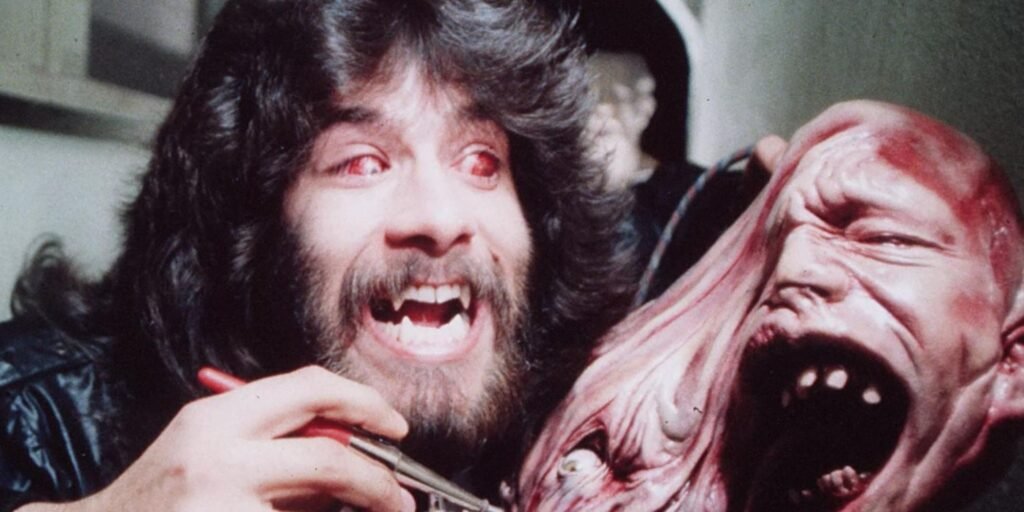
Rob Bottin (born 1959) is an American special make-up effects artist best known for the shape-shifting creatures of John Carpenter’s The Thing.
Quick Specs
| Born | Robin R. Bottin, April 1, 1959, El Monte, California |
| Trade | special make-up effects and creature design |
| Mentor | Rick Baker, whose apprentice he became at 14 |
| Signature work | The Thing (1982) |
| Also | The Fog (1980), The Howling (1981), Legend (1985), RoboCop (1987), Total Recall (1990), Se7en (1995) |
| Honors | Special Achievement Academy Award for Visual Effects, Total Recall (shared, 1991); Academy Award nomination, Best Makeup, Legend; two BAFTA nominations; two Saturn Awards |
| Years active | 1976-2002, plus a brief return in 2014 |
Who He Is
Rob Bottin grew up in El Monte, California, on a steady diet of old horror movies and Famous Monsters of Filmland. At 14 he mailed Rick Baker an autograph request with one of his intricate drawings. Baker invited him over to talk monsters, and the boy became his apprentice. Bottin earned his first film credit at 17 on Baker’s King Kong (1976), and he helped build the Cantina creatures for Star Wars (1977). He is also in that scene, as the tallest player in the Cantina band. He grew up to be 6 feet 5.
Then came the Roger Corman years: Piranha (1978), Rock ’n’ Roll High School (1979), Humanoids from the Deep (1980) and Tanya’s Island (1980). By Bottin’s own account he was “working for no pay, just to get a credit.” On those sets he met cinematographer Dean Cundey, and he asked Cundey to introduce him to John Carpenter.
The Work, and What He Built
The Fog (1980): Carpenter hired him to make the drowned, rotting sailors who come back for revenge, and Bottin played their leader, Captain Blake, himself. Another actor supplied Blake’s voice. When Carpenter asked for a ghost to attack Stevie Wayne on the radio-station tower, Bottin “came back with a model of the ghost’s head, unbelievably elaborate,” Carpenter recalled. “He brought the worms with him!”
The Howling (1981): Baker was meant to do Joe Dante’s werewolf film, but his schedule filled up with An American Werewolf in London, so his protege took over. Bottin also got an associate producer credit, and Baker stayed on as a consultant. The centerpiece is the on-camera transformation of Eddie Quist. Instead of dissolving between makeup stages, Bottin did it in camera, with air bladders under latex skin so the flesh seemed to bubble and stretch, and mechanized heads for the snout pushing out. In Make-Up Artist Magazine, Bottin listed what he sculpted: Eddie’s burned face, the bullet he pulls from his own head, the bladder face, every transformation head and the final werewolf. He rigged the skulls with brass and solder so the face could stretch from half-human to snout, sculpting for what he called “mega-expressiveness.” Partway through, much of the crew left to join Baker on American Werewolf, and Dante gave Bottin’s skeleton crew extra time on a smaller stage for the close-ups. The Howling reached theaters about five months before Baker’s film, which went on to win the first-ever Academy Award for makeup. There was no feud. A decade later, Bottin saluted Baker from the Oscar stage.
The Thing (1982): this is the one. Carpenter did not want “a guy in a suit,” and he gave Bottin creative control over the monster. Bottin’s idea changed the film: the Thing would have no single form at all. “It doesn’t look like one monster, it looks like anything,” Carpenter said. Bottin’s reason was candid: “I don’t want to do this thing if I have to compete with Alien. I’m too insecure to come up with one definitive thing.” The script kept the creature in shadow, and Bottin pushed back on that too. “Rob Bottin was the guy who said, ‘No, you’ve got to put him in the light,'” Carpenter recalled. He later gave half the credit for the effects to Bottin and half to Cundey’s lighting.
Bottin was 22 for most of the shoot. He led a crew of about 35 and worked seven days a week, often late into the night, for a year and five weeks, living on the Universal lot and sleeping on sets and in locker rooms. His materials ran from foam latex, fiberglass and gelatin to creamed corn, mayonnaise, microwaved bubble gum, strawberry jam and K-Y Jelly.
- The chest chomp: when the doctor tries to shock Norris back to life, Norris’s chest opens into jaws and bites off his arms. Bottin’s team built a fiberglass dummy of actor Charles Hallahan with a hydraulic jaw rig inside, and one shot took about ten hours to set up. For the wide shot, Bottin hired a man who had lost both arms below the elbow in an industrial accident. He wore a mask molded from Richard Dysart’s face and fake forearms of wax bones, rubber veins and Jell-O, which the jaws then sheared off.
- The spider-head: Norris’s head tears itself loose, drags itself along by its tongue, sprouts eyestalks and spider legs, and scuttles for the door. The melted plastic in the rig gave off flammable fumes, and when the flame effect hit it, the puppet burst into a fireball. It survived with minimal damage, and the scene was finished.
- The kennel: the one major creature Bottin did not build. Overloaded, he brought in Stan Winston, who made the transformed dog as a hand puppet worked from below the set. Winston refused screen credit because it was “Rob’s film.” The slithering tendrils in that scene are Bottin’s, and so are the arms the creature grows to climb the kennel ceiling. Jim Kagel built them, and Bottin wore them himself for the inserts. Bottin called the flower of dog tongues and teeth the “pissed-off cabbage.”
- The Blair-Thing: the full-size finale creature stood about five feet high and eight around, worked by dozens of operators on cables and rods. Bottin crawled inside to work the dog that bursts from its belly. A stop-motion version animated by Randall William Cook’s team was cut almost entirely by Carpenter and survives on home-video extras.
At the end, Bottin was hospitalized with exhaustion, double pneumonia and a bleeding ulcer. Some critics at first called the effects gruesome excess. They have long since been recognized as the film’s beating heart.
After The Thing he did Dante’s “It’s a Good Life” segment of Twilight Zone: The Movie (1983) and the aliens Wak and Neek for Explorers (1985). Legend (1985) earned him his Oscar nomination for Best Makeup. Tim Curry’s Darkness was a full-body red prosthetic with three-foot fiberglass horns on a harness. It took five and a half hours to apply, up to eight early in the shoot, and an hour in a bath to remove. Once, Curry pulled it off too fast and tore his skin, and Ridley Scott shot around him for about a week. Bottin said he had been asked to build “the Vegas show from hell.” The Witches of Eastwick and Dante’s Innerspace followed in 1987.
RoboCop (1987): Bottin designed and built the RoboCop suit. After long design debates with Paul Verhoeven, it was not ready until the day shooting with it began, and Peter Weller’s first fitting took nearly 11 hours. Weller had trained for months with mime coach Moni Yakim on fluid movement. In the real suit he could barely move, so they threw that out and built the slow, deliberate walk the character is known for. In the Dallas heat he sweated off several pounds a day. Bottin also built the animatronic Murphy that is shot to pieces. He did Emil, the thug who drives through toxic waste, too, with a foam-latex head and gloves that melt “off his bones like marshmallow sauce,” a nod to Baker’s The Incredible Melting Man. He returned for RoboCop 2 (1990) with a fiberglass suit that had the polished “show car” look he had wanted the first time and parts that came off fast. He is credited on RoboCop 3 (1993).
Total Recall (1990): Verhoeven and Arnold Schwarzenegger gave him free rein on the Mars mutants, though Bottin said he kept some realism so the is-it-a-dream question stayed open. He built Kuato, the tiny rebel leader growing out of Marshall Bell’s belly, worked by a team of puppeteers. He built the “two weeks” disguise, where Priscilla Allen’s head splits open to reveal Schwarzenegger. For that shot both actors were swapped for Bottin puppets. He built the Johnny Cab driver, modeled on Robert Picardo, and four full-size heads that swell in Mars’s thin air. Mary, the three-breasted mutant played by Lycia Naff, began as a four-breasted design. Four looked bovine, Bottin argued for three, and Verhoeven later admitted, “He was right.” At the Academy Awards on March 25, 1991, Total Recall received a Special Achievement Award for Visual Effects, shared by Eric Brevig, Bottin, Tim McGovern and Alex Funke. There were no regular nominees that year. Bottin used his moment to thank “my big brother and mentor, Rick Baker: I salute you.”
Later credits include Bugsy (1991), Basic Instinct (1992), his third film with Verhoeven, Se7en (1995), his first film with David Fincher, Mission: Impossible (1996), Mimic (1997), Deep Rising (1998), Fear and Loathing in Las Vegas (1998) and some gags for Fight Club (1999). His last features were Charlie’s Angels (2000), Mr. Deeds (2002) and Serving Sara (2002).
Cool Verified Facts
- He is not the man behind ED-209 in RoboCop. Craig Davies designed it, and Phil Tippett animated it.
- He had wanted to direct since Star Wars, and he once considered USC film school. John Landis told him he would learn more working on sets.
- In 2014 he briefly came back for Game of Thrones season 4. Director Alex Graves said Bottin worked with the visual-effects team on Joffrey’s poisoning death.
Signatures, Habits and Behind the Scenes
- He hoarded the work. On The Thing he chose to handle many of the hardest jobs himself, and he has said that is part of why he ended up in hospital. When he finally stopped, Carpenter looked at him and said, “You don’t look well.”
- He wanted his effects in the light. Bottin argued that an audience “really goes nuts” when the creature is right there in front of them. His builds were made to hold up under bright, close, sustained looks.
- Air bladders were a house tool, from Eddie Quist’s face to the Total Recall heads.
- “Rob’s like a mad genius,” a Howling crew member said. “Whatever he touched, he gave it his own signature.”
- He is famously private. His credits stop in 2002, and he has never said on the record why.
Why He Matters
A 22-year-old with a crew of 35, working 57 weeks without a day off, made every creature in The Thing except Winston’s dog. Bottin did more than improve the technique. He changed what a movie monster could be: something with no true shape, only imitation, which is why the effects and the paranoia in The Thing can’t be pulled apart. With The Howling a year earlier, he had two landmark transformations in a row. Then he showed his range in fantasy and science fiction with Darkness, RoboCop and the mutants of Mars, all of it practical and all of it before CGI took over. Stan Winston would not take credit for a single dog because the picture belonged to Bottin, and that may be the best review he ever got.