
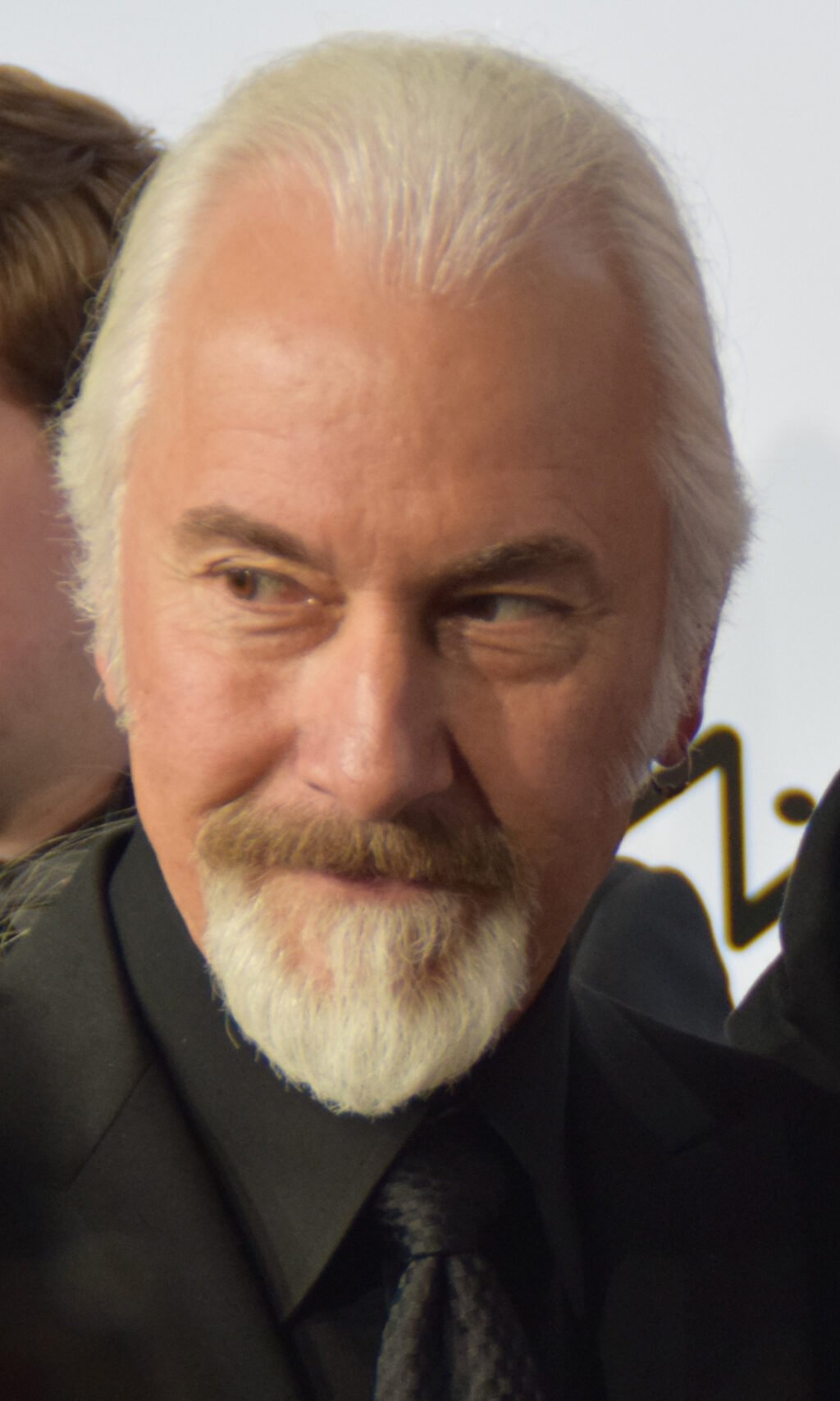
Rick Baker (born 1950) is the American special makeup effects artist behind An American Werewolf in London and Men in Black, and the record holder for Academy Awards in makeup.
When Rick Baker was very small, he told people he wanted to be a doctor. He meant Dr. Frankenstein. The plan lasted until he worked out that doctors did not make movie monsters and makeup artists did, and from then on the boy in Covina, California, was building them in his parents’ kitchen. He went on to win seven Oscars for it, more than any other makeup artist.
Quick Specs
| Born | December 8, 1950, Binghamton, New York (as Richard Alan Baker); raised in Covina, California |
| Known for | The transformation in An American Werewolf in London (1981), the Kong suit in King Kong (1976), Harry and the Hendersons, Ed Wood, Men in Black, The Wolfman (2010) |
| Academy Awards | 7 wins from 11 Best Makeup nominations (both category records), plus 1 Best Visual Effects nomination: 12 nominations in all |
| First Oscar | The first competitive Academy Award for Best Makeup, for An American Werewolf in London, presented March 29, 1982 |
| Mentor | Dick Smith, makeup artist of The Exorcist |
| Protégé | Rob Bottin |
| Emmy | The Autobiography of Miss Jane Pittman (1974), shared with Stan Winston |
| Studio | Cinovation Studios, his own effects company, latterly a 60,000-square-foot facility in Glendale |
| Walk of Fame | Star unveiled November 30, 2012, at 6764 Hollywood Boulevard |
| Last film | Maleficent (2014); retired from studio work in May 2015 |
| Book | Rick Baker: Metamorphosis (2019), a two-volume record of his career |
| Family | Married Elaine in 1974 (divorced 1984); married hairstylist Silvia Abascal in November 1987; two daughters |
Who He Is
Richard Alan Baker was born on December 8, 1950, in Binghamton, New York, the son of Ralph B. Baker, a professional artist, and Doris Baker (née Hamlin), a bank teller. The family moved to Covina, California, before he was a year old, so he is a Californian who happens to have been born in New York. “My parents left when I was, like, not even one,” he has said. “[I] lived in California my whole life.”
He grew up on the classic monster movies on television, then on Famous Monsters of Filmland, where Dick Smith’s articles and Monster Makeup Handbook showed him the craft existed and could be done with materials found at home. He made masks and fake body parts in the kitchen and set up his first makeup lab in his bedroom. He has described himself as a painfully shy kid who used disguises to become someone else.
As a teenager he found Dick Smith’s address and kept it in a cigar box of treasures. In 1969 he finally wrote, enclosing photographs of his own copies of Smith’s makeups. Smith wrote back, sent a rejected foam casting, and invited him to come and watch him work. The correspondence became a mentorship. Baker studied art at Mt. San Antonio College from 1969 to 1971; the college later gave him its George H. Bell Award for Outstanding Alumnus, in 1997.
His first professional job came while he was still a teenager: puppet designer at Art Clokey Productions, on the stop-motion series Davey and Goliath.
He married Elaine in 1974; they divorced in 1984. He met the hairstylist Silvia Abascal when both worked on Into the Night (1985), and they married in November 1987. They have two daughters, born in 1989 and 1993.
The Work, and What He Did in It
Clay, Latex and Schlock
His early feature credit is Octaman (1971), whose title costume he co-created with Doug Beswick. Then John Landis, making his first film, needed an ape. Schlock was shot in 1971 and released in 1973, a prehistoric-apeman comedy, and Baker designed and built the Schlockthropus suit that Landis wore himself. During the production Landis told him about a werewolf script he had and said he wanted Baker for it. The promise took ten years to come due.
Assistant to Dick Smith
The Exorcist (1973) is Dick Smith’s film. Baker’s role was uncredited special effects assistant. “It’s really a Dick’s movie,” Baker has said. “I just was an assistant to Dick.” His work was laboratory work in Smith’s operation: running foam rubber, making moulds, and a lot of work on the dummy used for the head-turning scene. The possession makeup on Linda Blair, the old-age makeup on Max von Sydow and the vomit rig are Smith’s designs. While at Smith’s home he took the call from Larry Cohen that led to his next job.
It’s Alive and an Emmy
For Cohen’s It’s Alive (1974) Baker designed and created the killer infant, his first creature of his own. It was a dummy baby on an aluminium-wire armature with articulated limbs and adjustable eyeballs, plus a mask, gloves and partial body suit for close-ups. He came back for It Lives Again (1978) and It’s Alive III (1987).
On The Autobiography of Miss Jane Pittman he aged Cicely Tyson to 110, and the work won the Emmy, shared with Stan Winston. Baker was not yet in the makeup union, which is why he was paired with Winston, and by his own account their techniques clashed.
The union rep had told him, as Baker remembers it, “You’re never gonna get in. You have to be born into this. You’re not a Westmore.” His answer, to himself: “You know what? I’m going to show these guys.”
He Was Kong
King Kong (1976) was sold on a forty-foot mechanical gorilla credited to Carlo Rambaldi. The robot proved usable only briefly. For most of the film, the Kong on screen is Rick Baker, in an ape suit largely of his own making, with Rambaldi’s animatronic mechanisms working the mask. The AFI Catalog, citing Variety’s review, records Kong as “portrayed by an uncredited costumed actor, Rick Baker, as well as the forty-foot robotic gorilla.” He shared the suit work with William Shepard, also uncredited. His only screen credit was “special contributions.”
The Cantina and the Melting Man
Star Wars (1977) was not his film either. The cantina creatures came from Stuart Freeborn’s department, and Freeborn made Chewbacca and the first wave of aliens. When George Lucas wanted the cantina filled out for a Los Angeles pickup shoot and Freeborn was unavailable, Baker was brought in, credited as makeup artist on the second unit. He supplied the extra aliens in days, many of them masks he already owned. He also sketched the design for the Bith musicians of the cantina band, and Doug Beswick sculpted the head and cast the copies.
The Incredible Melting Man (1977) gave him decay as a process. He built facial appliances to show the astronaut Steve West deteriorating in stages and made the gelatin head, with a wax skull and fake blood inside, that bursts on the rocks. He designed four stages of melting; the edit cut them down.
Around them came Squirm (1976), The Fury (1978), The Funhouse (1981) and The Incredible Shrinking Woman (1981). By the time the public learned his name, the business already knew it.
The Howling Hand-Off
Baker was the original hire on Joe Dante’s The Howling (1981). Then Landis’s long-delayed werewolf film was finally financed, and Landis called in the promise. Dante has recalled it: “Initially, Rick Baker was going to do the picture. Then John Landis… called him up and lowered the boom: ‘You can’t do his picture! You’ve got to do my picture!'” Baker left, put his second-in-command Rob Bottin in charge, and stayed on as special makeup effects consultant only. The Howling’s transformations are Bottin’s work.
An American Werewolf in London
On An American Werewolf in London (1981) Baker designed and created the special makeup effects, and the centrepiece was David Kessler’s change from man to wolf. Every earlier werewolf film had hidden the change in optical dissolves and cutaways. Landis staged this one in full view, in bright light, and Baker built it with no opticals at all. The method was mechanical: “change-o” parts and change-o-heads, puppet replicas of the actor whose shapes altered on camera, intercut with the actor in successive prosthetic stages. He also made the rotting makeups for Griffin Dunne’s undead Jack.
The result was the first competitive Academy Award for Best Makeup, at the 54th Academy Awards on March 29, 1982. The category was not created for him. The Academy introduced it after the outcry over Christopher Tucker’s unrecognised work on The Elephant Man (1980). Earlier makeup Oscars, to William J. Tuttle and John Chambers, were honorary.
Thriller and Videodrome
Michael Jackson loved An American Werewolf in London and hired Landis and Baker so he could transform on screen. Rather than repeat the wolf, Baker turned Jackson into a cat-like “werecat” using the same techniques. With the dancers hired three days before the shoot, the close-up zombies were Baker and his crew, in makeups built from life casts they already had. Thriller (1983) became the first music video inducted into the National Film Registry.
For David Cronenberg‘s Videodrome (1983), credited as special makeup effects designer, Baker’s company built the New Flesh, with gags divided among his top artists, including Tom Hester and Doug Beswick. The shop made Max Renn’s abdominal slit, the wound that swallows a gun and a Betamax cassette; the gun fused to his hand by cable-driven tendrils; and the breathing, fleshy television.
Apes, Bigfoot and a Lion
Greystoke: The Legend of Tarzan, Lord of the Apes (1984) asked for a whole ape society in prosthetic makeup. Baker’s work, shared with Paul Engelen, earned his second Oscar nomination and lost to Amadeus, which meant losing to Dick Smith. At the BAFTAs it won Best Make-Up Artist, shared with Engelen, Peter Frampton and Joan Hills.
Harry and the Hendersons (1987) brought the second Oscar and the work he has repeatedly named among his proudest. He designed Harry, a gentle Bigfoot built as a full suit and animatronic head for Kevin Peter Hall, who stood 7 feet 2 inches. Hall’s own eyes and performance survived inside the head while puppeteers worked brow and lips, and Harry carries grief and joy without dialogue.
On television he designed and created Vincent, Ron Perlman‘s lion-man in the series Beauty and the Beast. The brief, in his words, was a beast “attractive to women.”
On Gorillas in the Mist (1988), Michael Apted asked him to fix the oldest flaw of ape suits: recognisably human eyes. His eye-mask solution hid the human eye line, so Sigourney Weaver could play opposite gorillas whose gaze read as animal.
Ed Wood
Ed Wood (1994) won his third Oscar, shared with Ve Neill and Yolanda Toussieng. He played nobody in it. He designed Martin Landau’s prosthetic makeup as Bela Lugosi, and Landau won Best Supporting Actor for the performance it made possible. The boy who grew up on the Universal monsters won an Oscar rebuilding one of their stars, on another actor’s face.
Many Murphys
Back in 1988, Coming to America had let Eddie Murphy and Arsenio Hall each play several people: Clarence the barber, the singer Randy Watson and, most famously, Saul, the elderly Jewish customer, played by Murphy. Visiting Paramount executives did not recognise their own star. It earned a Best Makeup nomination and lost to Beetlejuice.
The Nutty Professor (1996) took the idea to its limit. Baker’s prosthetic system turned Murphy into Sherman Klump and the whole Klump family, a cast played by one man, and won his fourth Oscar, shared with David LeRoy Anderson, plus a BAFTA.
Men in Black
For Men in Black (1997) Baker designed and built a headquarters full of practical aliens, each with a distinct design. Barry Sonnenfeld told NPR: “Rick thinks like a filmmaker… He creates back stories for these aliens so that they’re not just arbitrary.” The centrepiece was Edgar, the giant bug wearing Vincent D’Onofrio’s skin. D’Onofrio has described up to eight hours in the chair, with threads on his cheeks pulling his face into wrong positions. It won his fifth Oscar, again shared with David LeRoy Anderson. He returned for Men in Black II (2002), where he cameos at the alien registration counter, and Men in Black 3 (2012).
His twelfth Academy nomination came from outside makeup. For Mighty Joe Young (1998) his shop built the animatronic and suit Joe that worked alongside the digital one, and Baker shared a Best Visual Effects nomination with Hoyt Yeatman, Allen Hall and Jim Mitchell. What Dreams May Come won.
The Grinch and the Apes
How the Grinch Stole Christmas (2000) put Jim Carrey in a foam prosthetic suit covered in dyed-green yak hair sewn into spandex, with facial appliances, and gave the Whos their noses, lips, dentures, ears and wigs. The first day in the chair was brutal; the routine was streamlined to roughly two to three hours, and Carrey endured it for 92 days of shooting. It won Baker’s sixth Oscar, shared with Gail Ryan, and a BAFTA.
Tim Burton insisted on prosthetic apes rather than CGI for Planet of the Apes (2001). After Stan Winston left over creative differences, the job went to Baker, who had already designed test makeups for two earlier remake attempts that never got made. He rebuilt the ape face around the actor: oversized false teeth pushed the lips out into a muzzle nearly level with the nose, under a very thin prosthetic face, so the lips could move over the teeth. The film brought a BAFTA nomination and the guild award for Best Special Makeup Effects. It did not bring an Oscar nomination.
The Ring, Hellboy and Tropic Thunder
On The Ring (2002) his special makeup effects included the closet reveal of Katie’s corpse, a full dummy he built from photographs of Amber Tamblyn taken from many angles, rather than the actor in makeup.
On Hellboy (2004), directed by Guillermo del Toro, his credit is makeup consultant for the Hellboy character. Cinovation was one of the prosthetic and animatronic shops, alongside Spectral Motion, and the Hellboy makeup itself was designed and created by Matt Rose.
Norbit (2007) brought his eleventh makeup nomination, shared with Kazuhiro Tsuji, a former Cinovation artist. On Tropic Thunder (2008) he made Robert Downey Jr. into Kirk Lazarus playing Lincoln Osiris, and Tom Cruise into the bald, hairy Les Grossman. Downey was Oscar-nominated for the performance; the makeup was shortlisted but not nominated.
The Wolfman
Universal’s The Wolfman (2010) brought him back to the monster he had reinvented. Baker, a devotee of Jack Pierce’s design for Lon Chaney Jr. in 1941, built the new Wolf Man to honour it: fresh latex pieces and loose hair applied every day to Benicio del Toro, spare dentures and wigs in reserve, three hours to apply and one to remove. On February 27, 2011, the makeup won his seventh Oscar, shared with Dave Elsey.
What the Oscar does not cover is the transformations. His team had built most of a practical transformation, and the sequences were taken digital against his wishes; on the day the change was shot as a CGI performance, they were not even on the call sheet. Elsey recalls the moment in Rick Baker: Metamorphosis: “We said, ‘But we have all this stuff. It’s all ready to go. Don’t you want to even try it?’… Rick was so gutted.” The man who invented the on-camera transformation won his last Oscar for a film that would not use his.
Maleficent, and Retirement
His last film credit was Maleficent (2014). Angelina Jolie wanted appliances that changed her bone structure, and Baker designed subtle silicone-gel prosthetics: cheeks less than a quarter of an inch thick at their crest, a nose piece, pointed ears and teeth, and light, removable horns held on magnets. Arjen Tuiten and Toni G applied it some 70 times on set. “People probably wouldn’t think it took three hours a day to achieve because it looks pretty simple,” Baker said, “but smooth, beautiful skin is the hardest thing to do.”
He had closed his 60,000-square-foot studio and sold the building in 2014. On May 28, 2015, he announced his retirement from active film work, and he explained it to KPCC: “The CG stuff definitely took away the animatronics part of what I do. It’s also starting to take away the makeup part. The time is right, I am 64 years old, and the business is crazy right now. I like to do things right, and they wanted cheap and fast.” He left design and consulting open.
The next day, May 29, 2015, Prop Store’s “Rick Baker: Monster Maker” auction in Los Angeles offered 417 lots from 50 productions, straight from Cinovation, with no reserve and a pre-sale estimate of around $750,000. “I had to face reality,” he told NPR. “I no longer was going to have this 60,000 square-foot building to keep stuff in.”
Retirement did not mean stopping. By 2019 he was working from a house turned studio in Toluca Lake and had published Metamorphosis. “This is how I have fun,” he told NPR. “That’s one of the reasons I retired. I have things I want to make for myself.”
Cool Verified Facts
- His seven wins: An American Werewolf in London, Harry and the Hendersons, Ed Wood, The Nutty Professor, Men in Black, How the Grinch Stole Christmas and The Wolfman.
- His Greystoke nomination lost to Amadeus, made up by his mentor Dick Smith.
- On November 12, 2011, he presented Dick Smith with Smith’s Honorary Academy Award, calling him “my idol, my mentor and my friend.”
- His Hollywood Walk of Fame star, unveiled on November 30, 2012, was the 2,485th. At the ceremony Guinness World Records entered him twice, for most Oscar wins and most Oscar nominations in makeup.
- He received the Jack Pierce Lifetime Achievement Award at the Chiller-Eyegore Awards on October 3, 2009, and an honorary Doctorate of Humane Letters from the Academy of Art University in 2008.
Signatures, Habits and Behind the Scenes
The Ape Man
His filmography is a history of the movie ape: the Schlock suit, Kong himself, the apes of Greystoke, Harry, the gorillas of Gorillas in the Mist, Mighty Joe Young and Planet of the Apes. For forty years, when a Hollywood ape performance mattered, the hands were usually his.
Change-o-mation
His defining technique was the transformation shown rather than dissolved. For An American Werewolf in London, and again for Thriller, he used mechanical puppet parts and heads whose shapes change on camera, intercut with the actor in successive makeup stages. He deliberately avoided the air-bladder appliances Bottin was using on The Howling, so the two rival transformations of 1981 were different machines. He traces his nerve with cable-operated masks to watching Rambaldi on King Kong: “I had always been hesitant about mechanics, because I thought the parts would have to be perfectly machined… Then I saw how crude and sloppy Carlo’s cable mechanisms looked. But they worked!”
From Smith to Bottin
Baker has said, “I wanted to be Dick Smith when I grew up… Because he gave so much, I wanted to give back.” Rob Bottin came to him as a young teenager who could draw. “Rob came to me as a 13-year-old kid,” Baker has said. “I kind of took him under my wing.” Bottin became his second-in-command and was handed The Howling as his first lead job. Baker’s rueful verdict is that he taught Bottin too well, “because he showed me up in The Thing,” the film Bottin made for John Carpenter in 1982. Cinovation worked as a school too: Kazuhiro Tsuji went from Baker’s shop to his own Oscar-winning career.
Inside His Own Monsters
The shy kid who used disguises never stopped climbing into the creatures. He is Kong for most of King Kong, a zombie rising from the tomb in Thriller, the alien-registration clerk in Men in Black II and the Wolf Man’s first victim in The Wolfman.
Why He Matters
For horror, Baker is the hinge between two eras of makeup. Behind him stood Jack Pierce’s Universal monsters and Dick Smith’s foam latex. In 1981 his orbit produced both of the definitive werewolf transformations, his own in An American Werewolf in London and his protégé’s in The Howling, and after that a transformation could no longer be a dissolve with hair glued on between cuts.
For the Oscars, he defined what the makeup category was for. He was its first competitive winner, and over the next three decades he took seven of its awards from eleven nominations. From the first Werewolf to The Wolfman, the category’s history and his filmography are nearly the same list. He also closed a circle: the uncredited assistant on The Exorcist, a film whose makeup had no category to win, handed Dick Smith his Honorary Oscar.
For cinema as a whole, his is the practical era’s fullest career. He learned foam latex from Dick Smith, built cantina aliens on a pickup shoot, put Murphy, Carrey, Landau, del Toro and Jolie inside makeups that extended their performances instead of replacing them, and ran a shop that trained the next generation. When he retired, he said the business wanted “cheap and fast,” and that computer effects had taken first the animatronics and then the makeup.