
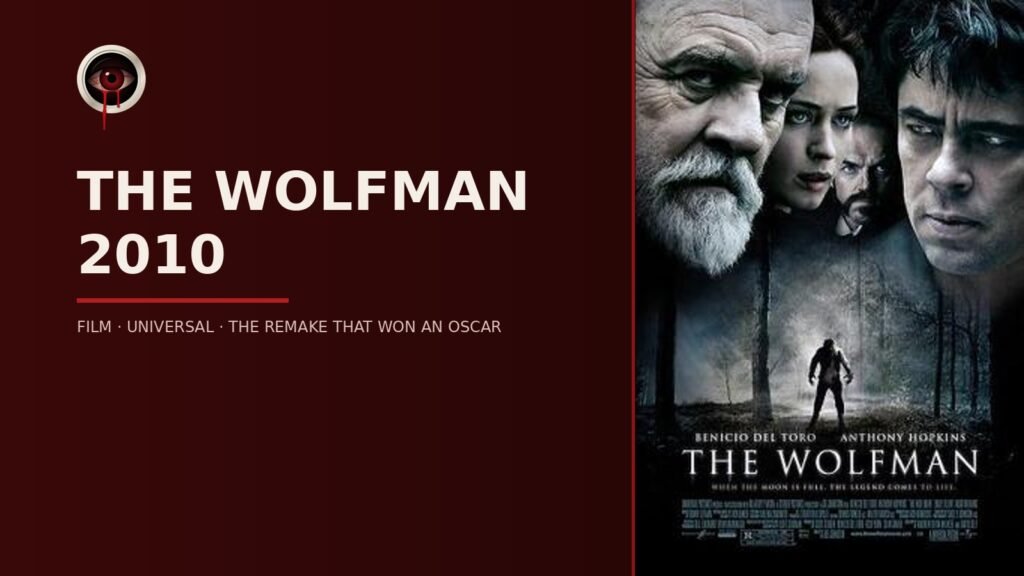
The Wolfman (2010) is Joe Johnston’s Gothic horror remake of the 1941 classic, starring Benicio del Toro as the cursed Lawrence Talbot.
Start with the name, because the name is a trap: this film is The Wolfman, one word. The 1941 original it remakes is The Wolf Man, two words, and the 2025 film is Wolf Man again — three different titles for three different films, and this one is a remake of the first, not a sequel to anything. It was championed by its star: del Toro, a lifelong fan of the original and a collector of Wolf Man memorabilia, produced as well as played Lawrence, and drew on Werewolf of London and The Curse of the Werewolf alongside the 1941 film for his reading of the part. What he shepherded to the screen was the most troubled production in the modern Universal Monsters line — a film that lost its director weeks before shooting, its composer during editing, and its release date five times — and then won an Academy Award for its makeup.
Quick Specs
Director: Joe Johnston
Screenplay: Andrew Kevin Walker and David Self, remaking Curt Siodmak’s 1941 story and characters
Producers: Scott Stuber, Benicio del Toro, Rick Yorn and Sean Daniel
Starring: Benicio del Toro, Anthony Hopkins, Emily Blunt, Hugo Weaving, Geraldine Chaplin, Art Malik, Antony Sher
Music: Danny Elfman (see the score history below)
Cinematography: Shelly Johnson
Editing: Dennis Virkler and Walter Murch
Makeup: Rick Baker (makeup effects creator) and Dave Elsey (makeup effects supervisor)
Production: Universal Pictures, Relativity Media and Stuber Pictures; distributed by Universal Pictures
Release: 12 February 2010 (US, wide) — the fifth date after November 2008, February 2009, April 2009 and November 2009 all slipped; most European markets opened 10–11 February 2010
Rating: R
Runtime: 103 minutes per Wikipedia’s listing, 102 minutes (1h 42m) per Rotten Tomatoes; the extended director’s cut adds about 17 minutes (some Blu-ray reviews count 16)
A Production That Shed Everything Except Its Star
Universal announced the remake in March 2006 with del Toro attached and Andrew Kevin Walker developing the screenplay. Mark Romanek signed on in February 2007 — and left in January 2008, weeks before filming. The shorthand is “creative differences,” and this page does not print it as an explanation, because the accounts do not agree on one: Romanek’s own later version is that he wanted “a balance of cinema in a popcorn movie scenario” and the two sides never agreed on that balance once money was involved; another account adds disputes over budget, tone and script, compounded by the Writers Guild strike, which froze on-page fixes; a contemporary account frames the dispute as the shooting schedule. Brett Ratner emerged as frontrunner, Frank Darabont, James Mangold and Bill Condon were met or considered, and Joe Johnston was hired on 3 February 2008 — about a month before cameras rolled, which Johnston himself describes as “three weeks of prep, a ridiculously inadequate amount of time.” He brought in David Self to rewrite, and shot from 3 March to 23 June 2008 in Britain: Pinewood, Chatsworth House dressed down with weeds, dead grass and ivy to play Talbot Hall, Castle Combe, the National Trust village of Lacock — where Universal donated £5,000 for filming a frozen-corpses scene in the tithe barn — Stowe, and Dartmoor’s Foggintor Quarry.
Remade in Post
The film was then substantially rebuilt. In May 2009 the production returned for pick-ups at Pinewood and two weekends of location work at Greenwich, for two agreed reasons: a werewolf that had walked upright was reshot moving on all fours, because the upright shots “didn’t look quite right,” and two sequences originally cut from the script for budget — a full London rampage and a less ambiguous ending — were restored after the assembled film proved to need them. In the edit suite, Walter Murch replaced Dennis Virkler mid-post (the final credit is shared), Johnston saying he “sort of rediscovered what the movie was about with Walter.” The score went through the same revolving door: Danny Elfman composed it; during the post-production delays Paul Haslinger was brought in with a contemporary electronic score; the released film uses Elfman’s score, adapted to the final cut by Conrad Pope, Edward Shearmur and Thomas Lindgren. Why Elfman’s score was set aside is told three ways — rejected after the film was cut down by over half an hour, lost to his Alice in Wonderland schedule, or judged tonally out of step — and this page attributes the reasons rather than merging them.
The makeup never changed hands, and it is the film’s glory. Rick Baker — for whom the 1941 film and Frankenstein were childhood inspirations — designed to Jack Pierce’s original as closely as possible: three hours to apply, an hour to remove, fresh latex and loose hair daily. His own verdict on the transformation, given to Entertainment Weekly: “Going from Benicio to Benicio as the Wolf Man isn’t a really extreme difference… Here we have Benicio del Toro, who’s practically the Wolf Man already, to Benicio del Toro with more hair and bigger teeth.” The one honest tension was method: Baker expected the transformation to be digital and was disappointed, believing it would look unrealistic; Johnston, arriving three weeks out, chose to shoot the change plainly and decide in post, because CGI “gave me so much more flexibility.” Both positions are in the record, and this page keeps both.
The Plot
Blackmoor, England, 1891. Ben Talbot is found mutilated in a slaughterhouse, killed by something humanoid in the woods. His brother Lawrence — a stage actor, long estranged from their father — returns to Talbot Hall at the urging of Ben’s fiancée, Gwen Conliffe, and reunites coldly with Sir John. Lawrence carries his own wound: as a boy he saw his mother Solana dead with Sir John standing over her, a trauma that put him in Lambeth Hospital for a year. At the Romani camp outside Blackmoor, during a full moon and a townspeople’s raid, a werewolf kills Constable Nye and others and bites Lawrence; Maleva sutures him, over another Romani’s insistence that the cursed man should be killed before he kills. Lawrence heals unnaturally fast, sends Gwen to London for her safety, and follows Sir John to Solana’s crypt — where Sir John locks himself away with a warning. Lawrence transforms, kills hunters in the woods, and wakes under arrest: Inspector Francis Aberline (the film’s spelling, and a character only loosely based on the real Frederick Abberline) returns him to Lambeth, where Dr. Hoenneger’s “treatments” are brutal.
Spoilers, from here. Sir John visits and confesses everything: bitten twenty-five years earlier by an infected boy in the Hindu Kush, he is the werewolf — Solana’s killer, Ben’s killer, and the one who bit Lawrence. Singh has locked him up every full-moon night for years; now, insane, he means to let the beast run free, and he leaves Lawrence a razor in case his son prefers the other exit. That night Lawrence is exhibited in Hoenneger’s lecture theatre as a case study; he warns the room, transforms anyway, kills Hoenneger, and rampages through London. He reaches Gwen’s antique shop — an antique shop; the apothecary belongs to earlier drafts, not this film — and they admit their love. Gwen asks Maleva for a cure and is told there is none: only a loved one can release him, by killing him. At Talbot Hall, Lawrence finds Singh’s body, loads Singh’s silver bullets, and discovers Sir John sabotaged the cartridges years ago. Father and son transform together and fight through the burning hall, and Lawrence kills Sir John there — the summaries conflict on the blow itself, so this page stops at the hall. Gwen disrupts Aberline’s shot, flees with his revolver, and at the gorge, with the Wolfman’s human mind faintly recognising her, shoots Lawrence through the heart with a silver bullet. He dies human, thanking her for setting him free. The last beat is an implication, not a transformation shown: Aberline, bitten in the fight, stares at his wound and then at the full moon, and a howl sounds over the burning hall.
Money
Budgeted at $85 million when shooting began in March 2008, the film’s reported production budget rose to $150 million after reshoots and delays — one retrospective account puts the post-reshoot figure at $120 million, and a separate retrospective speaks of $80 million “initially allocated,” close to but not the same as the $85 million start-of-shoot figure; the $150 million is the figure most trackers carry. Marketing is in none of these numbers. The grosses split by tracker: The Numbers reports $142.6 million worldwide ($62.2 million domestic, $80.4 million international); Box Office Mojo reports $139.8 million ($62.0 million domestic, $77.8 million international), the gap sitting almost entirely in the international line. The opening was the same on both: $31.5 million, second place behind Valentine’s Day. On either tracker the worldwide gross fell short of the reported production budget before marketing, which is why accounts then and since call it a financial failure — and this page computes no loss figure, because none is reliably sourced.
Reception and the Oscar
Rotten Tomatoes stands at 32% from 220 reviews — checked for this page in October 2026 — with the consensus “Suitably grand and special effects-laden, The Wolfman suffers from a suspense-deficient script and a surprising lack of genuine chills”; Metacritic is 43 of 100 from 36 critics, and CinemaScore audiences gave it a C+. The named verdicts refuse to line up neatly: Roger Ebert gave it two and a half stars, praising the atmospheric locations and melodramatic scope while faulting the CGI; Peter Travers gave it one and a half — “The Wolfman bites, but not — I think — in the way the filmmakers intended”; Owen Gleiberman praised del Toro’s Lawrence, comparing him favourably to Lon Chaney Jr.‘s in the 1941 original. The studio’s own verdict arrived a year later and belongs to 2011, not release week: Universal president Ron Meyer, at the Savannah Film Festival, called the film “crappy” and “one of the worst movies we ever made.” In 2014 the Los Angeles Times placed it on a retrospective list of the costliest box-office flops of all time.
And then there is the award the film actually won. At the 83rd Academy Awards, Rick Baker and Dave Elsey won Best Makeup — the category was called Best Makeup then, not by its modern name — beating Barney’s Version and The Way Back; the film also won Best Make-Up at the 37th Saturn Awards. The extended cut, released on DVD and Blu-ray on 1 June 2010, restores about 17 minutes (some reviews count 16), including a whole performance the theatrical audience never saw: Max von Sydow as the stranger on the train who gives Lawrence the wolf-head cane — cut theatrically, though a credit for his assistant survived in the theatrical credits as a leftover. The longer cut is not seamless, reviewers note: it shows Gwen visiting Lawrence in person while later dialogue still refers to her letter. A 4K restoration of both cuts followed from Shout! Factory in October 2024.
What Followed — and What Didn’t
No sequel was made, the Aberline sting notwithstanding. Universal’s 2012 direct-to-video Werewolf: The Beast Among Us began life planned as a spin-off from this film and was ultimately unrelated — it is not a sequel, whatever the shelf says. The Dark Universe’s own Wolf Man (Aaron Guzikowski’s script, then David Callaham’s rewrite, Dwayne Johnson rumoured) was never made at all; the shared universe died with 2017’s The Mummy. The next Wolf Man on screen is 2025’s Wolf Man — a separate reboot in which Christopher Abbott, not Ryan Gosling (who stayed on as executive producer), plays the lead. Later reassessments — Awards Radar in 2021, We Got This Covered in 2023, JoBlo’s retrospective — have been kinder to the 2010 film than its opening was, praising the atmosphere, the Gothic craft and Baker’s practical makeup. A flop with an Oscar and a cult growing around it: that is the strange, accurate shape of this one.