
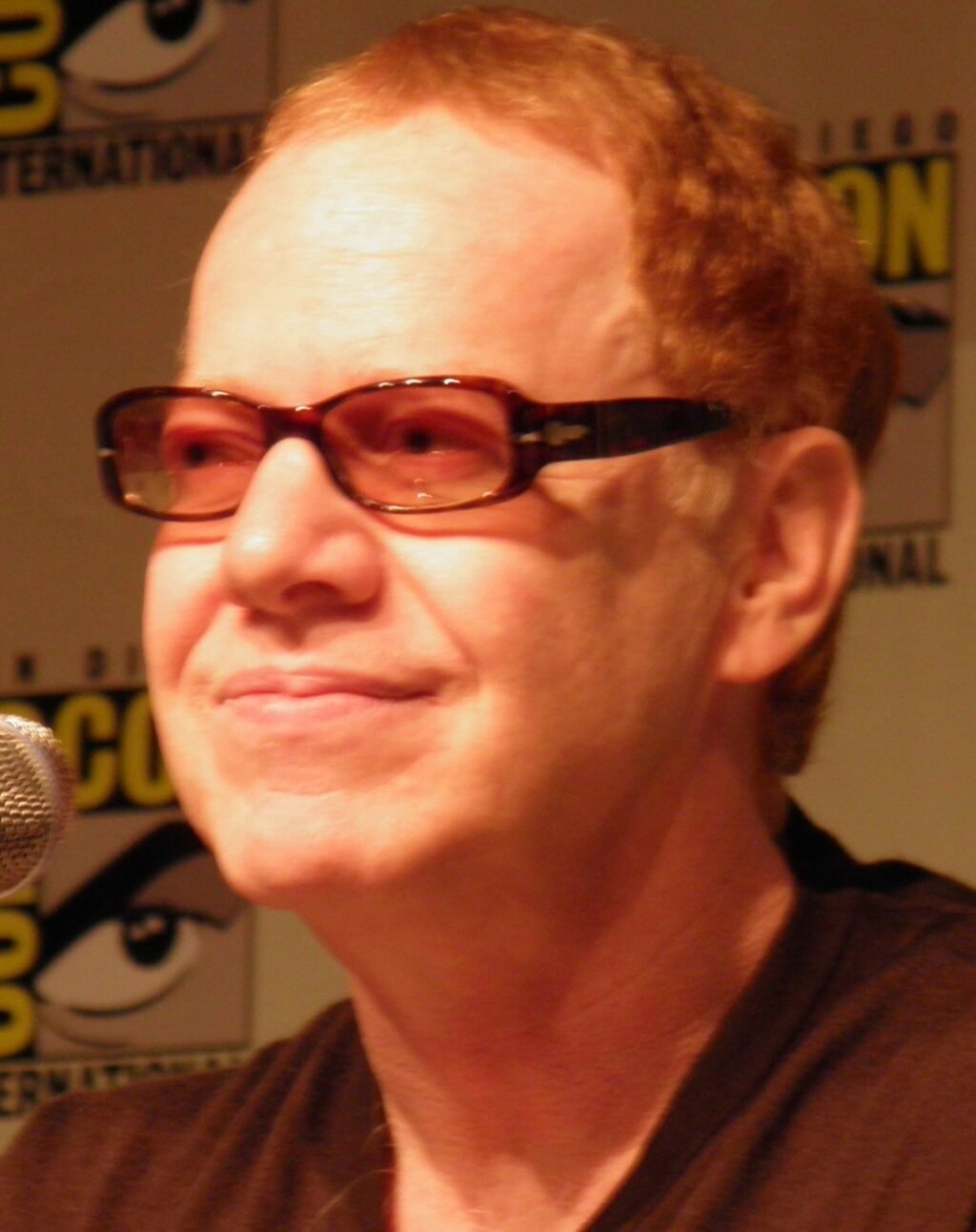
Danny Elfman is the rock frontman who became the sound of Tim Burton’s gothic imagination — a self-taught high-school dropout with a new-wave band, hired to write orchestral film music he wasn’t sure he could write, who then proceeded to define how mainstream gothic sounds for three generations. If you grew up humming the Batman theme, singing along with Jack Skellington, or hearing The Simpsons theme roughly ten thousand times, you grew up inside Elfman’s head. The classical establishment doubted him precisely because of where he came from. He answered with the scores themselves — more than a hundred of them.
The Mystic Knights and the Dropout
Daniel Robert Elfman was born on 29 May 1953 in Los Angeles, California. His father, Milton Elfman, was a teacher; his mother, Blossom Elfman, a children’s author and screenwriter; his older brother is the filmmaker Richard Elfman. He was raised in Baldwin Hills, Los Angeles, then Brentwood, and attended University High School in West LA — which he dropped out of, moving to Paris, where Richard was living and performing street theatre. He is essentially self-taught as a composer, never classically trained. Remember that when the establishment scepticism arrives later in this story, because the scepticism is the point: everything Elfman became, he became without the credentials that were supposed to be required.
In 1972 Richard founded the Mystic Knights of the Oingo Boingo, a surreal street-theatre troupe. Danny joined, took a leading role, and when Richard left for filmmaking, Danny led the group as it mutated into a band — the name shortened to Oingo Boingo around 1979. Fronted by Elfman, the band became a Los Angeles new-wave institution: “Dead Man’s Party,” the title song for the 1985 film Weird Science, albums through the early nineties, a final album — Boingo (1994) — and farewell shows at Halloween 1995. The band years cost him, too: he has spoken publicly about the significant hearing damage and tinnitus that years of touring left him with, one reason he stopped full-time band touring, though he later returned to selective live performance, including singing Jack Skellington live-to-picture.
Forbidden Zone and the Burton Partnership
Elfman’s first film-music work came inside the family business. Forbidden Zone — filmed in 1980, released in 1982 — was directed by his brother Richard, with young Danny appearing on screen as Satan and providing early score material with the Mystic Knights. His first studio score is a different milestone, and the two should never be collapsed: in 1985, Paul Reubens and Tim Burton, both fans of Oingo Boingo, chose Elfman to score Burton’s first feature, Pee-wee’s Big Adventure. He has said he nearly declined, doubting he could write orchestral music at all. He wrote it. The Burton partnership — one of the defining composer-director relationships in modern film — had begun.
Beetlejuice (1988) made the pairing famous: frantic, gothic-carnival music that became the template for the Burton sound, all careening strings and wicked delight, the world of Winona Ryder‘s Lydia Deetz given a musical pulse. Then Batman (1989) made Elfman undeniable. His main theme and score won the Grammy Award for Best Instrumental Composition — and by his own oft-told account, the theme arrived as Elfman humming into a recorder on a flight home from a set visit. The same year, quietly, he wrote the main title theme for The Simpsons (1989), which earned an Emmy nomination in 1990 and remains, for sheer hours of human listening, possibly his most-heard music.
Edward Scissorhands (1990) is the choral, music-box score Elfman has repeatedly called among his most personal Burton works — the waltzing, wordless-choir sound that became his gothic signature. Batman Returns (1992) darkened the superhero template, in the era of Michael Gough‘s Alfred. Then came the film that generates more credit errors than any other in his career, so let’s state it exactly.
The Nightmare Before Christmas — Stated Exactly
The Nightmare Before Christmas (1993) was directed by Henry Selick. Not Burton. Burton produced it and originated the story and characters, and the confusion is understandable — but the director is Selick, and accuracy is the whole game. Elfman’s contribution was triple: he wrote the songs, he wrote the score, and he was Jack Skellington’s singing voice. Jack’s speaking voice is Chris Sarandon. The songs came first and are the score’s DNA — Elfman composed them, sang the demos, and built the underscore from the same material, which is why the film feels composed rather than accompanied. The score earned a Golden Globe nomination. When you hear Jack Skellington sing, that is the composer himself, performing his own songs, in a film he did not direct, for a character he half-voices. Every clause of that sentence corrects a real error somebody has printed.
The Rift, the Return, and the Raimi Thread
Elfman did not score every Burton film, and the famous gap has a name: Ed Wood (1994), scored by Howard Shore during a falling-out between Elfman and Burton. The partnership reconciled and resumed — Mars Attacks! (1996), and then in full flower Sleepy Hollow (1999), the waltzing gothic-horror score that proved the reunion was no nostalgia act. Another credit discipline, since it comes up constantly: Sweeney Todd is Stephen Sondheim’s music, not an Elfman score. The later Burton era runs on through Helena Bonham Carter‘s years in Burton’s company and into streaming, where Elfman — with Chris Bacon — provided the theme and score for Wednesday (2022), the Burton-directed Netflix series, nearly four decades after Pee-wee.
The second great thread is Sam Raimi. Elfman scored Darkman (1990), A Simple Plan (1998), Spider-Man (2002) and Spider-Man 2 (2004), his themes anchoring the films. There’s a handoff worth recording on a horror wiki: Christopher Young supplied additional music on Spider-Man 2 and then scored Spider-Man 3 using Elfman’s themes — two of horror’s great composers sharing one superhero. The Raimi reunion continued with Oz the Great and Powerful (2013) and Doctor Strange in the Multiverse of Madness (2022).
The Oscar Ledger and the Later Career
Now the fact that gets upgraded in sloppy biographies, stated flat: Danny Elfman has four Academy Award nominations and zero Oscar wins. The nominations are real honours and worth listing properly. In 1997 he was nominated twice in the same year — Men in Black and Good Will Hunting. Big Fish (2003) brought the third nomination, and Milk (2008) the fourth. Four nominations, no wins, as of this writing — and anyone who calls him an “Academy Award winner” is wrong in a way that insults the actual record, which needs no decoration.
The honours that are wins form a long spine: the Grammy for the Batman theme; seven Saturn Awards for Best Music; the BMI Richard Kirk Career Achievement Award in 2002; induction as a Disney Legend in 2015; the Max Steiner Film Music Achievement Award in 2017; and the Society of Composers & Lyricists Lifetime Achievement award in 2022. His television themes — The Simpsons, Desperate Housewives (2004) — brought Emmy recognition alongside the scores. In 2021 he released Big Mess, his first solo pop/rock album in roughly four decades, a lockdown-era double album distinct from any Oingo Boingo record. He married actress Bridget Fonda in 2003; they have three children. The filmography runs past a hundred feature scores. The dropout from University High School has a lifetime-achievement shelf.
Signatures and Habits
The waltz and the choir: that is the Burton-gothic signature — 3/4-time waltzes, wordless boys’ and mixed choirs, celesta and music-box colours, from Edward Scissorhands through Sleepy Hollow to the song score of Nightmare. It is gothic romanticism rather than jump-scare horror: longing and melancholy in a crooked house, not a knife in the dark. He writes the songs too, and on Nightmare the songs aren’t decoration on the score — they are the score, composed first and unfolded into the underscore.
Elfman composes the themes and the full dramatic architecture himself, working with orchestrators — long-time collaborator Steve Bartek, the Oingo Boingo guitarist, among them — the way most large-scale film composers do. The 1990s whisper that a rock singer couldn’t really be writing this music, that someone else must be doing it for him, was answered the only way that matters: with volume, a hundred-plus scores in an unmistakably personal voice. He is also a composer’s composer with a clear lineage — Bernard Herrmann was the composer he most admired, and Elfman has said Herrmann’s scores made him want the job. The Herrmann inheritance runs through this whole corner of the wiki: the tradition passes from Herrmann to the men who scored your childhood.
Why Danny Elfman Matters
To a horror wiki, Elfman matters because, with Burton, he defined the sound of mainstream gothic whimsy-horror for a generation — Beetlejuice, Sleepy Hollow, The Nightmare Before Christmas, the Wednesday theme. This is the friendly-faced dark carnival, horror aesthetics carried to audiences who would never watch a slasher, and it moved the genre’s centre of gravity: after Elfman, gothic could be wistful, funny and melancholy at blockbuster scale. His superhero themes — Batman, Spider-Man, Darkman — shaped the genre scores a generation of readers grew up on. And his story remains the great outsider composer story of his era: no conservatory, no credentials, a street-theatre troupe and a rock band — and the establishment answered, in the end, with a shelf of lifetime-achievement awards. Browse the horror directors index and count how many of those filmmakers’ worlds Elfman’s music helped build.
Trivia
- Elfman plays Satan in Forbidden Zone (1982), his brother Richard’s film — also his first film-music credit, years before his first studio score.
- By his own oft-told account, the Batman theme was sketched by humming into a recorder on a flight home from visiting the set.
- He was Oscar-nominated twice in a single year — 1997, for Men in Black and Good Will Hunting — and has four nominations in total, with no wins.
- Jack Skellington has two voices: Elfman sings him, Chris Sarandon speaks him.
- The gap in the Burton filmography is Ed Wood (1994) — Howard Shore scored it during the Elfman–Burton falling-out.
- Oingo Boingo’s farewell shows were at Halloween 1995 — the most on-brand exit a band like that could choose.
FAQ
Did Tim Burton direct The Nightmare Before Christmas?
No. Henry Selick directed it. Burton produced it and originated the story and characters; Elfman wrote the songs and score and sang Jack Skellington’s parts.
Has Danny Elfman won an Oscar?
No. He has four Academy Award nominations — Men in Black and Good Will Hunting (both 1997), Big Fish (2003) and Milk (2008) — and no wins. His wins include a Grammy for the Batman theme and seven Saturn Awards for Best Music.
Did Danny Elfman score Ed Wood or Sweeney Todd?
Neither. Ed Wood (1994) was scored by Howard Shore during a falling-out between Elfman and Burton. Sweeney Todd uses Stephen Sondheim’s music.
Who voices Jack Skellington?
Two performers: Danny Elfman is Jack’s singing voice, and Chris Sarandon is his speaking voice.
Was Danny Elfman classically trained?
No — that’s the famous part of the story. He dropped out of high school, came up through street theatre and Oingo Boingo, and is essentially self-taught as a composer.