
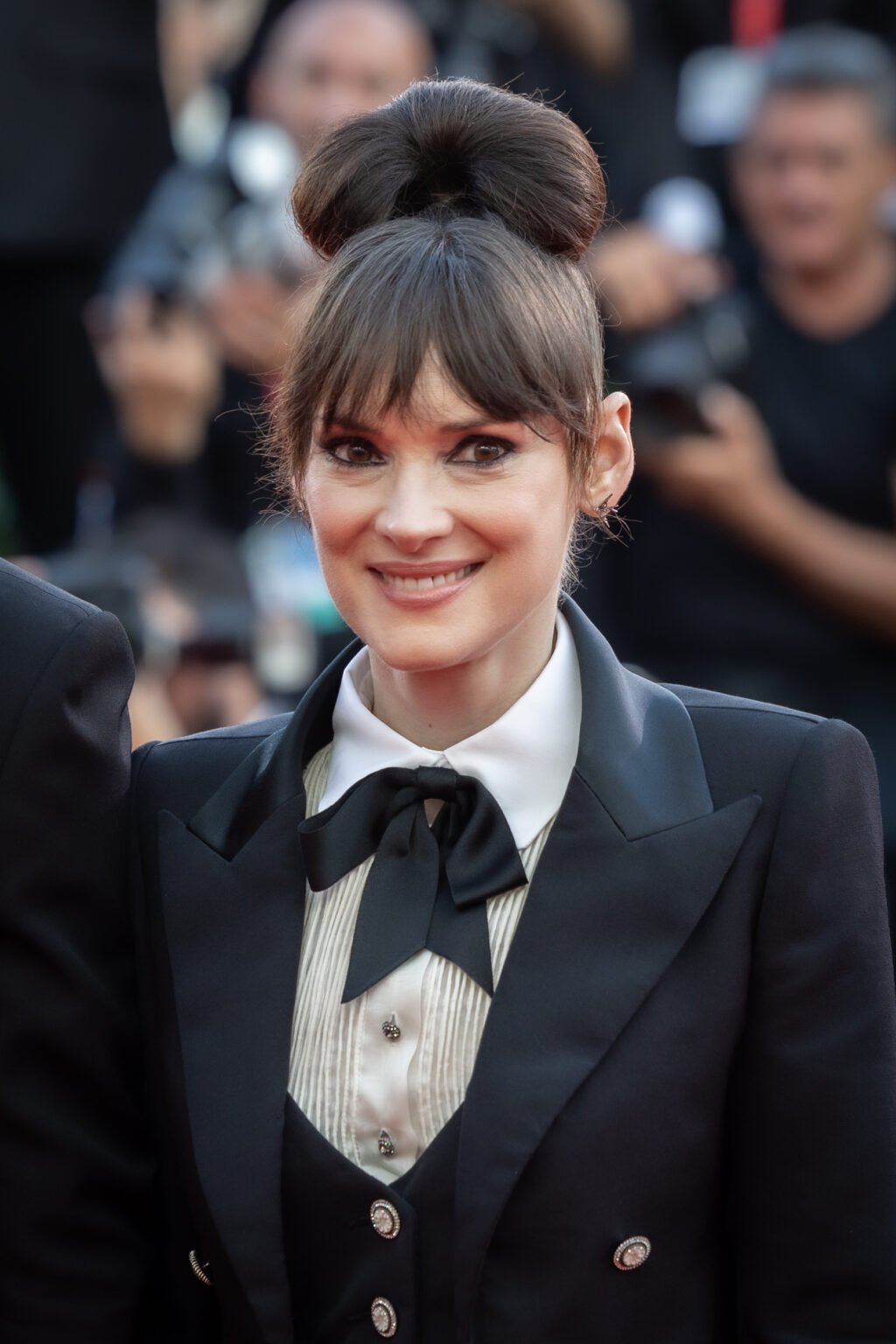
Winona Ryder (born 1971) is the American actress who played Lydia Deetz in Beetlejuice and Joyce Byers in Stranger Things.
Quick Specs
| Born | October 29, 1971, Winona County, Minnesota (as Winona Laura Horowitz) |
| Raised | The Rainbow commune near Elk, Mendocino County, California, then Petaluma, California |
| Training | Acting classes as a child in San Francisco |
| Horror | Lydia Deetz in Beetlejuice (1988) and Beetlejuice Beetlejuice (2024); Mina Harker and Elisabeta in Bram Stoker’s Dracula (1992); Annalee Call in Alien Resurrection (1997); voice of Elsa Van Helsing in Frankenweenie (2012); Joyce Byers in Stranger Things (2016 to 2025) |
| Signature roles | Veronica Sawyer in Heathers (1988; US release 1989); Kim Boggs in Edward Scissorhands (1990); May Welland in The Age of Innocence (1993); Jo March in Little Women (1994); Susanna Kaysen in Girl, Interrupted (1999) |
| Honours | Golden Globe for Best Supporting Actress (The Age of Innocence); Academy Award nominations for The Age of Innocence and Little Women; SAG ensemble award for Stranger Things (2017); star on the Hollywood Walk of Fame (2000) |
Who She Is
Winona Laura Horowitz was born on October 29, 1971, in a farmhouse in Winona County, Minnesota, near the city of Winona, which she was named for. Her middle name honours Laura Huxley, the wife of Aldous Huxley and a friend of her parents. Her father, Michael D. Horowitz, is an author, editor, publisher and antiquarian bookseller who also worked as Timothy Leary’s archivist; her mother, Cynthia Palmer (born Istas), is an author, video producer and editor. Timothy Leary was her godfather. She has a younger brother, Urie, named for Yuri Gagarin, and two older half-siblings from her mother’s first marriage, Jubal and Sunyata. Her stage name comes from the singer Mitch Ryder, a favourite of her father’s.
Minnesota was her birthplace, not her childhood. In 1978, when she was seven, the family moved to the Rainbow commune near Elk, in Mendocino County, California, about 300 acres shared with seven other families, with no electricity and no television. She became a devoted reader, above all of The Catcher in the Rye. The family later settled in Petaluma, California, the town she calls home. She took acting classes as a child and had to persuade her parents to let her take her first film role.
In her own telling, she was beaten up at school by classmates who mistook her for a boy, needed stitches, and was the one the school expelled. Years later, she has said, she ran into one of the attackers in a café and said, “That was me. Go f--- yourself.”
On December 12, 2001, at 30, she was arrested at the Saks Fifth Avenue store in Beverly Hills, accused of taking more than $5,500 in designer clothing and accessories. At trial in the fall of 2002 she was convicted of grand theft and vandalism and acquitted of burglary; a drug-possession count was dropped once a doctor’s prescription was proved. In December 2002 she was sentenced to three years’ probation, 480 hours of community service, $3,700 in fines and $6,355 in restitution to Saks, with psychological and drug counselling. She served no jail time. In June 2004 the felonies were reduced to misdemeanours, and her probation ended in December 2005.
She has been with the fashion designer Scott Mackinlay Hahn since about 2011. She received a star on the Hollywood Walk of Fame in 2000.
The Work, and What She Did in It
Her debut was a small part as Rina, a friend of Corey Haim’s title character, in David Seltzer’s coming-of-age drama Lucas (1986); she was 14 when it came out. Seltzer described her as “this little frail bird… whatever message was being said by her mouth was being contradicted by the eyes.”
Beetlejuice (1988) was the breakthrough. In Tim Burton’s comedy-horror, Ryder, 16, plays Lydia Deetz, the goth teenager who is “strange and unusual” enough to see the ghosts of the Maitlands when her own family cannot. Lydia is the film’s emotional centre and its final image, dancing and levitating to “Jump in the Line.” The role made her the defining teenage face of Burton’s world.
Heathers was shot in 1988 and premiered in Milan that fall, but its American life began in 1989, at Sundance on January 21 and in theatres on March 31. Michael Lehmann directed Daniel Waters’s script. Ryder plays Veronica Sawyer, the clique’s only member not named Heather and its conscience. Drawn into the murders that J.D. (Christian Slater) disguises as suicides, she ends the film by taking the red scrunchie, and the power, for herself. It took about $1.1 million in theatres, a flop, and became the landmark teen film of its generation on video.
In Great Balls of Fire! (1989) she was Myra Gale Lewis, Jerry Lee Lewis’s 13-year-old bride. Then she rejoined Burton for Edward Scissorhands (1990). At 19 she plays Kim Boggs, the suburban girl who sees past Edward’s blades and dances in his ice shavings, and who frames the whole film as the story she tells her granddaughter. In Mermaids (1990) she was Charlotte Flax, the religion-obsessed older daughter opposite Cher, and was nominated for a Golden Globe.
Bram Stoker’s Dracula (1992) is the horror centrepiece, and it exists partly because of her. Francis Ford Coppola directed. Ryder, 21, plays two women: Elisabeta, Dracula’s 15th-century wife, and Mina Murray, later Mina Harker, the Victorian fiancée in whom Elisabeta is reborn and whom the Count crosses oceans of time to reclaim. Gary Oldman is Dracula, across both of her lives. It is Mina who ends him: as the curse lifts, she drives the knife and decapitates him. How she brought the script to Coppola is below.
Her prestige run came next. In Martin Scorsese’s Edith Wharton adaptation The Age of Innocence (1993) she played May Welland, won the Golden Globe for Best Supporting Actress, and was nominated for the Academy Award for Best Supporting Actress at 22. In Little Women (1994) she was Jo March and earned a second consecutive Oscar nomination, this time for Best Actress. In Reality Bites (1994) she was Lelaina Pierce, the valedictorian with a camcorder, a defining Generation X role. In The Crucible (1996) she played Abigail Williams, the accuser at the centre of the Salem trials, horror-adjacent in the truest sense: the monster is the lie, and she is its author.
In Alien Resurrection (1997) she is Annalee Call, the mechanic on the Betty, revealed partway through as an auton, a second-generation android, and the film’s moral core opposite Sigourney Weaver’s Ripley 8. In Girl, Interrupted (1999) she played Susanna Kaysen and also executive-produced, having championed Kaysen’s memoir of her stay in a 1960s psychiatric hospital; Angelina Jolie won an Oscar in the supporting role opposite her. In Mr. Deeds (2002) she was Babe Bennett, also known as Pam Dawson, a tabloid reporter, her last big studio lead before the years after the trial.
From 2006 to 2015 she worked in independent films and sharp supporting roles. She was Amanda Grayson, Spock’s human mother, in Star Trek (2009); Beth Macintyre, the discarded prima ballerina whose fate shows Nina where obsession ends, in Black Swan (2010); and the voice of Elsa Van Helsing in Burton’s Frankenweenie (2012).
Stranger Things (2016 to 2025) was the comeback. In the Duffer Brothers’ Netflix series she plays Joyce Byers, the Hawkins mother who refuses every sane explanation for her son Will’s disappearance and turns out to be right, stringing Christmas lights across her walls to talk to him through them. She was 44 when the first season premiered in July 2016. The role brought her a Golden Globe nomination for Best Actress in a TV drama and a Screen Actors Guild Award with the ensemble in 2017. The series ran five seasons and ended in 2025. Along the way she was Evelyn Finkel in HBO’s Philip Roth adaptation The Plot Against America (2020).
In Beetlejuice Beetlejuice (2024), 36 years after the original, she plays Lydia Deetz again. Lydia is now a TV psychic and a mother, dragged back to Winter River, and Jenna Ortega plays her daughter, Astrid. The film’s final worldwide gross was $452.0 million.
Cool Verified Facts
- She was named after the city of Winona, Minnesota, near the farmhouse where she was born.
- Her stage surname comes from the singer Mitch Ryder.
- Timothy Leary was her godfather; her father was his archivist.
- She grew up partly on a commune with no electricity and no television.
- She handed Francis Ford Coppola the Dracula script herself.
- She played Lydia Deetz 36 years apart, in 1988 and 2024.
- She has made four films with Tim Burton: Beetlejuice, Edward Scissorhands, Frankenweenie and Beetlejuice Beetlejuice.
- Her younger brother, Urie, is named after the cosmonaut Yuri Gagarin.
- She was 22 when she received her first Oscar nomination, for The Age of Innocence.
- In Bram Stoker’s Dracula she plays two women, Elisabeta and Mina, one reborn as the other.
- Her reward offer for Polly Klaas was $200,000.
- Heathers premiered in Milan in 1988 but did not reach American theatres until March 31, 1989.
- She was 16 when Beetlejuice came out and 52 when its sequel did.
Signatures, Habits and Behind the Scenes
She is the reason Coppola’s Dracula exists. Cast as Mary Corleone in The Godfather Part III, she withdrew because of illness and exhaustion, and feared that Coppola held it against her. At a meeting to clear the air she left him James V. Hart’s Dracula script, which she had read at 19 and wanted as her move into adult roles. Hart has said, “She gave it to Francis to see if he felt it was a role she should do.” Ryder’s memory of the moment: “when he saw the word Dracula, his eyes lit up. It was one of his favorite stories from camp.” Coppola directed it, and she played Mina.
The most important story off screen is Polly Klaas. In October 1993, 12-year-old Polly Klaas was kidnapped in Petaluma, Ryder’s hometown. Ryder offered a $200,000 reward for her safe return, saying at the time, “This case has really hit home for me because I grew up here in Petaluma.” Klaas was found murdered. Ryder then played Jo in Little Women, one of Klaas’s favourite books, and dedicated her performance to Klaas’s memory. Decades later she linked it to Joyce Byers. She said she knew the Klaas family, that “a lot of my performance in that first season was connected to him,” meaning Polly’s father, Marc Klaas, and that she had to be sure the show would treat a missing child with respect before she signed on.
Critics keep returning to her eyes. From Seltzer on Lucas onward, the through-line of her acting is the split between the waif on the outside and what her eyes are doing, the quality Burton built both Lydia and Kim around.
The Depp chapter is brief. She met Johnny Depp at the Great Balls of Fire! premiere in June 1989, when she was 17. They were engaged in 1990 and split in 1993, and his “WINONA FOREVER” tattoo, altered after the split to “WINO FOREVER,” is the era’s most famous souvenir.
Burton keeps coming back to her, and the music of that world, by the composer Danny Elfman, has surrounded her since she was 16. Their four films together span 36 years, from Beetlejuice in 1988 to Beetlejuice Beetlejuice in 2024, so no other actor anchors his career at both ends the way she does.
On Stranger Things she protected the young cast. Having been her own generation’s teen star, she became the children’s counsellor on sudden fame; the Duffer Brothers have said she “specifically helped Millie [Bobby Brown] a lot.”
Why She Matters
For horror, Winona Ryder is the bridge between the genre’s gothic past and its streaming present. Lydia Deetz defined the horror-comedy heroine for a generation. Mina and Elisabeta put her at the centre of the great gothic revival of the 1990s, in a film she set in motion herself. Call carried the android conscience of Alien Resurrection. Joyce Byers made her the face of television’s biggest horror phenomenon, a mother as final girl. The same ghost story bookends it all, in 1988 and in 2024.
Beyond the genre she earned two consecutive Oscar nominations, at 22 and 23, and won a Golden Globe. She gave two generations of teenagers their defining performances, from Veronica to every Lydia who followed. Beetlejuice Beetlejuice finished at $452.0 million worldwide with her back in the role that made her. And she built one of the most complete second acts in modern Hollywood without ever disowning the first.