
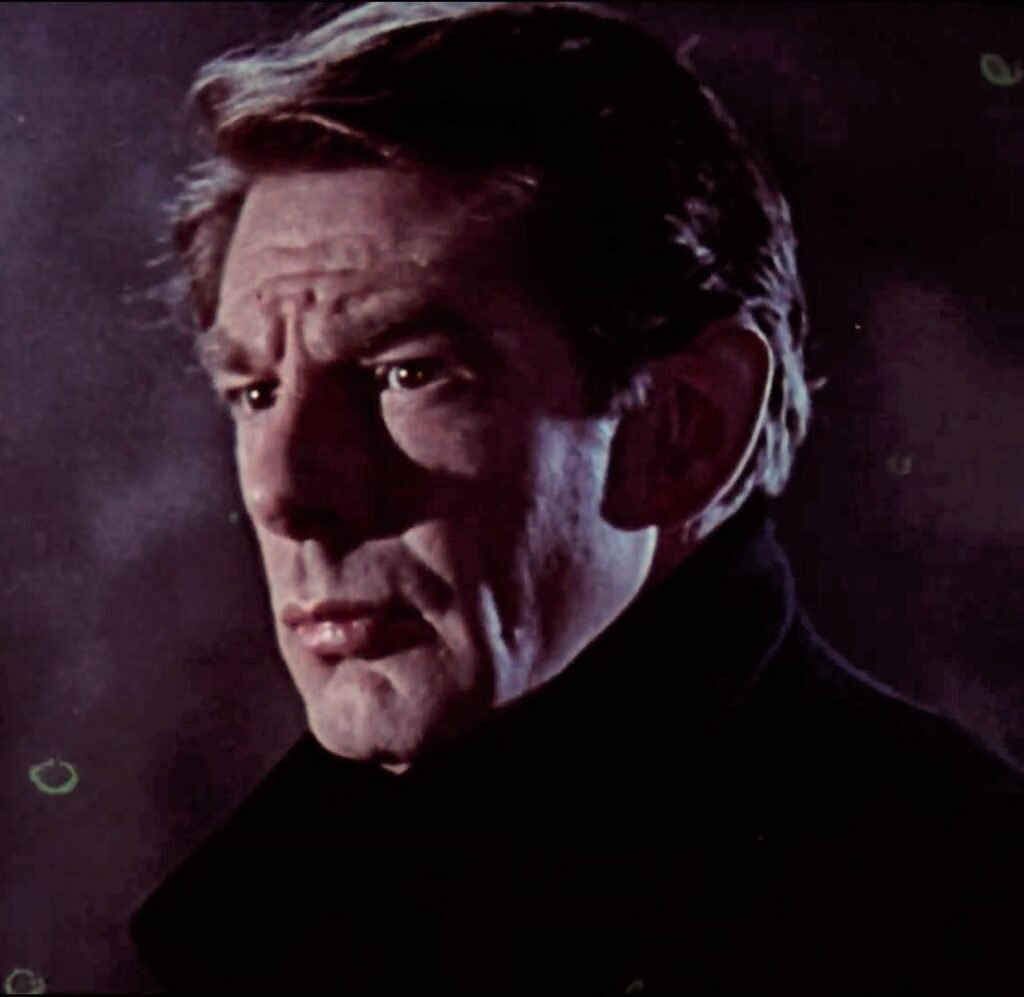
Michael Gough (1916 to 2011) was the British actor who played Arthur Holmwood in Hammer’s Dracula and Alfred in four Batman films.
Quick Specs
| Born | November 23, 1916, Kuala Lumpur, Federated Malay States (now Malaysia), to English parents (as Francis Michael Gough) |
| Died | March 17, 2011, at home in Ashmore, Dorset, England, aged 94 |
| Training | The Old Vic |
| Horror | Arthur Holmwood in Dracula (1958); Edmond Bancroft in Horrors of the Black Museum (1959); Dr Charles Decker in Konga (1961); Lord Ambrose D’Arcy in The Phantom of the Opera (1962); Eric Landor in Dr. Terror’s House of Horrors (1965); Dr Christian Storm in Horror Hospital (1973); Schoonbacher in The Serpent and the Rainbow (1988); Notary James Hardenbrook in Sleepy Hollow (1999) |
| Signature roles | Alfred Pennyworth in Batman (1989), Batman Returns (1992), Batman Forever (1995) and Batman & Robin (1997); the Celestial Toymaker in Doctor Who (1966) |
| Voice | Elder Gutknecht in Corpse Bride (2005); the Dodo in Alice in Wonderland (2010), his final film role |
| Honours | British Academy Television Award for Best Actor (1956); Tony Award for Best Featured Actor in a Play, Bedroom Farce (1979); BAFTA Film Award nomination, The Go-Between (1971) |
Who He Was
Francis Michael Gough was born on November 23, 1916, in Kuala Lumpur, in what was then the Federated Malay States, to English parents: Francis Berkeley Gough, a rubber planter, and Frances Atkins (née Bailie). He was British, and the birthplace surprises nearly everyone who knows him only as Alfred. He was educated at Rose Hill School in Tunbridge Wells and at Durham School, went on to Wye Agricultural College, and left it to train at the Old Vic.
During the Second World War he was a conscientious objector who nevertheless served, as required, in the Non-Combatant Corps, with 6 Northern Company in Liverpool. It is a quietly principled early fact about a man who would spend much of his screen career playing murderers, mad scientists and satanists.
He married four times: to the actress Diana Graves (1937 to 1948), to Anne Leon (1950 to 1962), to Anneke Wills (1965 to 1979), the Doctor Who companion actress, whom he met on Candidate for Murder, and in 1981 to Henrietta Lawrence, who survived him. He had four children. His career ran from a television debut in 1946 to a final voice role in 2010, more than 150 film and television appearances across more than six decades.
He died at his home in Ashmore, Dorset, on March 17, 2011, aged 94, surrounded by his family, after about a year of ill health. No cause was announced at the time, and the family spoke of old age; the Oxford Dictionary of National Biography later recorded the cause as pneumonia and prostate cancer. He was cremated, and his ashes were scattered in the English Channel. Michael Keaton’s farewell said it in one line: “To Mick, my butler, my confidant, my friend, my Alfred. I love you. God bless. Michael (Mr. Wayne) Keaton.”
The Work, and What He Did in It
He started on stage and television. His television debut was Androcles and the Lion in 1946, the year of his West End break, and his first film came two years later, at 31. For Blanche Fury (1948), in which he played Laurence Fury, the director Marc Allégret is said to have “scoured all the theatres of London” and “unearthed a minor obscure actor, Michael Gough, who had never appeared in a film.” The same year he played Nicholai opposite Vivien Leigh in Anna Karenina, the film in which, as The Guardian’s obituary put it, he “first made his cinematic mark.” Through the 1950s he became an established classical character actor: Michael Corland opposite Alec Guinness in Ealing’s The Man in the White Suit (1951), Dighton, the first murderer, in Laurence Olivier’s Richard III (1955), one of the two killers of Clarence and the Princes in the Tower, and the British Academy Television Award for Best Actor in 1956.
So when Hammer called, he was no hopeful. In Terence Fisher’s Dracula (1958), released in the United States as Horror of Dracula, Peter Cushing is Van Helsing and Christopher Lee is the Count, and Gough, 41, is third-billed as Arthur Holmwood. When his wife, Lucy, is taken by Dracula, dies and rises, Holmwood becomes Van Helsing’s ally and has to face what she has become. It is the one heroic lead of his horror career, in the film that founded Hammer’s Gothic cycle, and everything he did in the genre afterwards played against it.
A year later he was the killer. Horrors of the Black Museum (1959) was an Anglo-Amalgamated film, not a Hammer one, and in it Gough is Edmond Bancroft, a bestselling crime writer whose private museum of murder weapons is not a collection but a toolkit: he hypnotises his young assistant into committing the killings he then writes about. At 42 it made him a horror lead in his own right, and set the pattern for the next fifteen years.
In Hammer’s The Phantom of the Opera (1962) he is Lord Ambrose D’Arcy, the grasping aristocrat who steals Professor Petrie’s music, drives him into the acid accident that creates the Phantom, and profits from the opera house while the Phantom, played by Herbert Lom, haunts it. Lom is the monster; Gough is the story’s human villain. Around these sat a run of elegant villains and cranks: Dr Charles Decker, growing a chimpanzee into a giant ape in Konga (1961); Michael Conrad, the zoo owner who kills with his animals, in Black Zoo (1963); Eric Landor, the artist of the “Disembodied Hand” story in Amicus’s Dr. Terror’s House of Horrors (1965); the auctioneer in The Skull (1965); Berserk! (1967); Curse of the Crimson Altar (1968); Sam Murdock opposite Joan Crawford, in her final film, in Trog (1970); Walter Eastwood in The Corpse (1971); the mad surgeon Dr Christian Storm in Horror Hospital (1973); and Uncle Alexander Yorke, the family satanist, in Satan’s Slave (1976). In The Legend of Hell House (1973) he is the dead Emeric Belasco, uncredited.
He was clear-eyed about some of it. He called a few of those films “GTMAR films: Get The Money And Run.” The Guardian’s verdict supplies the counterweight: good film or bad, he “was never less than committed, and always eerily memorable.”
Television gave him one of science fiction’s great villains. In the Doctor Who serial The Celestial Toymaker, broadcast in 1966, when he was 49, he plays a bored, eternal games-player who traps William Hartnell’s First Doctor and his companions in lethal parlour games. It was a single appearance that became one of the programme’s most remembered villains. He was cast to return in The Nightmare Fair, but that story was cancelled in the programme’s mid-1980s upheaval and never made. He came back to the series anyway, as Councillor Hedin, an old friend of the Doctor turned conspirator, in Arc of Infinity (1983). In The Avengers he was Dr Armstrong, the automation-obsessed, wheelchair-using robot-maker of “The Cybernauts” (1965).
A prestige thread ran under the horror. He worked for Ken Russell on Women in Love (1969), was Mr Maudsley in Joseph Losey’s The Go-Between (1971), which brought a BAFTA Film Award nomination, and appeared in The Boys from Brazil (1978), Out of Africa (1985) as Lord Delamere, Derek Jarman’s Caravaggio (1986) as Cardinal Del Monte, and Martin Scorsese’s The Age of Innocence (1993) as Henry van der Luyden. The stage summit was Alan Ayckbourn’s Bedroom Farce, in which he played Ernest, the resigned father, at the National Theatre in 1977 and then on Broadway, winning the 1979 Tony Award for Best Featured Actor in a Play at 62. He was nominated for a second Tony for Breaking the Code in 1988. In between he took a full comedy turn as Dr Paul Flammond in Top Secret! (1984).
He returned to horror in Wes Craven’s The Serpent and the Rainbow (1988), at 71, as Schoonbacher, a supporting part in Craven’s Haitian voodoo story, whose menace belongs to Zakes Mokae’s Dargent Peytraud. It is a small credit that matters to a horror wiki because it is Craven’s film, and because a year later Gough became famous all over again.
Batman (1989) cast him as Alfred Pennyworth, Bruce Wayne’s butler, confidant and only family. In Tim Burton’s Gotham his Alfred is the still, dry centre of a film built on Jack Nicholson’s noise and Michael Keaton’s silence. He was 72, older than Alfred is usually imagined, and the age is the performance’s authority. The film grossed about $411.6 million worldwide on a $35 million production budget, its final cost reported as high as $48 million, and a Hammer veteran suddenly had the most famous face of his life.
He played Alfred four times: Batman (1989) and Batman Returns (1992) for Burton, with Keaton, and Batman Forever (1995) and Batman & Robin (1997) for Joel Schumacher, with Val Kilmer and then George Clooney. He and Pat Hingle, the series’ Commissioner Gordon, are the only two actors in all four. The Guardian wrote that he “remained a constant, providing charm and quintessential Britishness to ground the various offbeat situations.” Batman & Robin was a critical failure that ended the series, and the BFI’s obituary judged him “the only participant to walk away with dignity.” He is not the Alfred of Christopher Nolan’s films; that was Michael Caine. Gough’s Alfred did reach beyond the four films, into two BBC radio Batman dramas, a 1989 Diet Coke advertisement and a run of OnStar commercials.
Burton cast him again in Sleepy Hollow (1999), at 82, as Notary James Hardenbrook, the town notary caught inside the conspiracy, a casting that was itself the homage: the Hammer generation inside Burton’s own Gothic. He retired after it, and came back twice, for Burton, as a voice only: Elder Gutknecht, the skeletal elder who explains the rules of the dead, in Corpse Bride (2005), and the Dodo in Alice in Wonderland (2010), his final film role, released when he was 93.
Cool Verified Facts
- He was born in Kuala Lumpur, the son of an English rubber planter.
- He was a conscientious objector who served in the Non-Combatant Corps during the Second World War.
- In Hammer’s Dracula he is Arthur Holmwood, third-billed behind Peter Cushing and Christopher Lee.
- He played a sinister butler, Fisk, in What a Carve Up! in 1961, twenty-eight years before Alfred.
- He and Pat Hingle are the only actors in all four Batman films from 1989 to 1997.
- His Doctor Who return as the Celestial Toymaker was planned and cancelled.
- He won a Tony at 62, for Bedroom Farce.
- His last two film roles, for Tim Burton, were voice roles, made after he had retired.
Signatures, Habits and Behind the Scenes
He summed up his place in the Hammer years himself: “a poor man’s Peter Cushing.” It was a joke, not a ranking, and it is the most efficient true sentence about his horror career: the same studio, the same years, the same authority, one line further down the billing.
How Burton found him exists in two versions, both anecdotes. His agent’s: “Tim Burton was a huge fan of Mick from the Hammer Horror films of the 60s, so he tried very hard to include him in everything he did.” And Gough’s own, as the BFI obituary tells it: Burton, watching him collect his Tony, exclaimed, “That’s the guy who’s in all those terrible movies! He’s our Alfred!”
He had played the butler before. As Fisk in What a Carve Up! (1961) he spoofed the sinister-servant type already, decades before he defined its gentler opposite at Wayne Manor. And his menace was always built from stillness rather than relish: the murderers and satanists are frightening because he never seems to be enjoying himself.
Why He Matters
For horror, Michael Gough is Hammer’s third man, and the only one of them whose fame peaked after the horror. Peter Cushing and Christopher Lee define Hammer’s Gothic; Gough was its indispensable accomplice, Holmwood in the founding Dracula and then a decade of elegant villains across Hammer, Amicus and Anglo-Amalgamated. Tim Burton, a director raised on those films, then carried him into the blockbuster era as Alfred and into Sleepy Hollow’s homage. He is the bridge between Bray Studios and modern franchise Gothic, the horror actor the biggest Gothic blockbusters of two eras both reached for.
He is also the definitive screen Alfred before Nolan by sheer endurance: four films, two directors, three Batmen and one Alfred. And the stage record forbids any dismissal of him as a B-movie actor. A BAFTA for television, a Tony at 62, Ayckbourn at the National, Jarman and Scorsese in the film margins: the horror and Batman fame sits on top of one of the most respectable character-actor careers of his generation.