
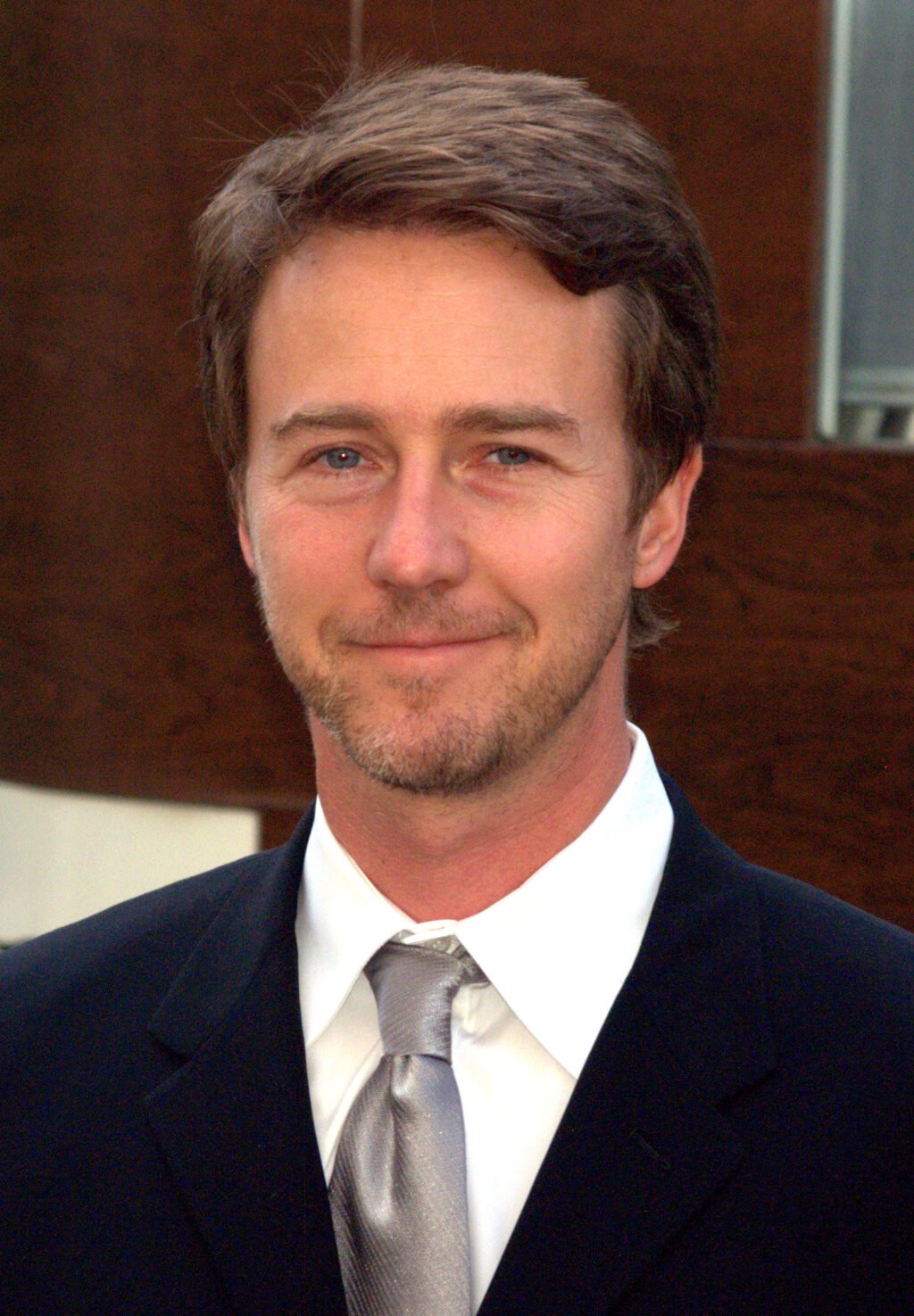
Edward Norton is the American actor and filmmaker who played Will Graham in Red Dragon and holds four Academy Award nominations.
Quick Specs
| Born | Edward Harrison Norton, August 18, 1969, Boston, Massachusetts; raised in Columbia, Maryland |
| Education | Wilde Lake High School (1987); Yale College, BA in history (1991) |
| Film debut | Aaron Stampler in Primal Fear (1996), a Golden Globe win |
| Horror centerpiece | FBI profiler Will Graham in Red Dragon (2002) |
| Oscar nominations (four) | Primal Fear, American History X, Birdman, A Complete Unknown |
| As director | Keeping the Faith (2000); Motherless Brooklyn (2019, also writer and star) |
| Company | Class 5 Films, founded 2003 |
| Off screen | trustee of Enterprise Community Partners; UN Goodwill Ambassador for Biodiversity |
Who He Is
Edward Harrison Norton was born in Boston on August 18, 1969, and grew up in Columbia, Maryland, a planned town built by his maternal grandfather, the developer James Rouse, founder of The Rouse Company and co-founder of Enterprise Community Partners. Norton has said he felt no burden from it. Rouse was “a ballpark and fishing trips kind of granddad,” and his own upbringing was “solidly upper middle class.” His father, Edward Mower Norton Jr., was a Marine lieutenant in Vietnam who became an environmental lawyer and a federal prosecutor in the Carter administration. His mother, Robin, an English teacher, died in 1997 after surgery for a brain tumor. He has two younger siblings, Molly and Jim.
At five he saw a musical at the Columbia Center for Theatrical Arts starring his babysitter, and it hooked him. He made his stage debut at eight in Annie Get Your Gun at Toby’s Dinner Theatre. He graduated from Wilde Lake High School in 1987 and from Yale in 1991 with a degree in history, having studied Japanese, acted and rowed there. He then spent about five months in Osaka working for his grandfather’s Enterprise Foundation before moving to New York.
In New York he took odd jobs and studied with the acting coach Terry Schreiber, whom he met because Schreiber needed a Japanese translator. Edward Albee cast him in the premiere of Fragments after a reading and called him a rare actor “who really knocked me out.” He is married to the Canadian producer Shauna Robertson, and they have a son.
The Work, and What He Did in It
His film debut skipped the queue. Chosen over some 2,000 other hopefuls, he played Aaron Stampler in Primal Fear (1996): a stammering Kentucky altar boy accused of murdering an archbishop and defended by Richard Gere’s Martin Vail. Norton plays the performance inside the performance, and when the second persona, “Roy,” surfaces in the closing twist, it lands because he has kept it hidden the whole time. Roger Ebert called it “completely convincing.” He won the Golden Globe for Best Supporting Actor and was nominated for the Oscar and the BAFTA. The same year he was Larry Flynt’s lawyer Alan Isaacman in The People vs. Larry Flynt and Holden Spence in Woody Allen’s Everyone Says I Love You.
In 1998 he was Worm, the ex-con card sharp, in Rounders, and Derek Vinyard in American History X: a Venice Beach neo-Nazi leader who kills two men, is changed by prison, and comes home trying to pull his younger brother out of the movement he built. He shaved his head and put on substantial muscle, and earned his second Oscar nomination, for Best Actor. The film’s post-production became a fight with two sides. Director Tony Kaye delivered a cut of about 95 minutes; New Line had Norton work on a new cut with the editor, and the released film runs about 119. Kaye tried to take his name off the film, ran trade ads against Norton and the studio, and sued; the suit was dismissed in 2000. Writer David McKenna later said that Norton “cut the film according to the script” and “rescued our child.”
In David Fincher’s Fight Club (1999), from Chuck Palahniuk’s novel, he is credited simply as the Narrator, an insomniac auto-recall coordinator who starts an underground fighting club with Brad Pitt’s Tyler Durden. To prepare, Norton and Pitt took lessons in boxing, grappling, taekwondo and soap-making. The film underperformed in theaters and became a defining cult film at home, and the whole thing is told in Norton’s voice.
He directed his first film, Keeping the Faith (2000), and starred as a priest in love with the same woman as his best friend, a rabbi played by Ben Stiller. He played the ambitious young thief working a heist with Robert De Niro in The Score (2001), Nelson Rockefeller in Frida (2002), and Monty Brogan, a drug dealer spending his last free day in post-9/11 New York before a seven-year sentence, in Spike Lee’s 25th Hour (2002).
His horror centerpiece is Red Dragon (2002), directed by Brett Ratner from a script by Ted Tally, who had written The Silence of the Lambs, for producer Dino De Laurentiis. Norton is Will Graham, the FBI profiler who caught Hannibal Lecter and was nearly killed doing it. Retired to Florida, he is pulled back by Jack Crawford (Harvey Keitel) to hunt Francis Dolarhyde, the “Tooth Fairy” (Ralph Fiennes), and has to consult the imprisoned Lecter (Anthony Hopkins), the man who tried to gut him. Norton plays Graham quiet, inward and damaged against Hopkins’s theatrical Lecter: a man whose gift for thinking like killers is also his wound. Red Dragon is not a remake. It is the second film of Thomas Harris’s 1981 novel, which Michael Mann first adapted as Manhunter (1986), with William Petersen as Graham, and the same cinematographer, Dante Spinotti, shot both. Released on October 4, 2002, it took about $209 million worldwide on a $78 million budget, and critics ranked it above Hannibal (2001) and below The Silence of the Lambs.
He was Steve, the crew member who betrays the team, in The Italian Job (2003), and Baldwin IV, the leper king of Jerusalem, masked throughout, in Kingdom of Heaven (2005). In 2006 he played the magician Eisenheim in The Illusionist and the bacteriologist Walter Fane opposite Naomi Watts in The Painted Veil, which he also produced through Class 5 Films, the company he founded in 2003 with his brother Jim, Stuart Blumberg and Bill Migliore.
He was Bruce Banner in The Incredible Hulk (2008), directed by Louis Leterrier and released weeks after Iron Man. He signed on understanding he would rewrite Zak Penn’s script, and he kept revising pages daily during the shoot. In his own words, he saw the Hulk as “literally the Promethean myth” and pitched a two-film arc in the “long, dark and serious” mode of Christopher Nolan’s Batman. Marvel cut the film to a 112-minute action picture over his objections, and he did little promotion. Writers Guild arbitration gave Penn sole screenplay credit. On July 10, 2010, Kevin Feige announced that Marvel would not bring him back for The Avengers, saying the decision was “definitely not one based on monetary factors, but instead rooted in the need for an actor who embodies the creativity and collaborative spirit of our other talented cast members.” Norton’s agent called the statement “a purposefully misleading, inappropriate attempt to paint our client in a negative light.” Norton’s own public reply was gracious, and Mark Ruffalo took the role. In 2019 Norton called the statement “cheap,” but he also said, “I got on great with Kevin Feige,” and admitted, “I honestly would’ve wanted more money than they’d have wanted to pay me.”
The second act brought ensembles and a fourth nomination. He was Scout Master Ward in Wes Anderson’s Moonrise Kingdom and Eric Byer in The Bourne Legacy (both 2012), and Inspector Henckels in The Grand Budapest Hotel (2014), sharing the SAG ensemble award. In Birdman (2014) he is Mike Shiner, a brilliant, volatile Broadway method actor hired into Michael Keaton’s play; some critics read the part as a comment on his own reputation, and it brought his third Oscar nomination. He wrote, directed and starred in Motherless Brooklyn (2019) as Lionel Essrog, a detective with Tourette syndrome, moving Jonathan Lethem’s novel to 1950s New York with a Robert Moses-like villain, which he framed as an homage to the things his grandfather cared about. After Glass Onion (2022) as the tech billionaire Miles Bron, he played Pete Seeger in James Mangold’s A Complete Unknown (2024), performing Seeger’s music himself, banjo included. It brought his fourth Academy Award nomination, for Best Supporting Actor.
Cool Verified Facts
- He won the acting cup at Camp Pasquaney in New Hampshire in 1984 and later went back there as a theater director.
- He won an Obie Award for Burn This Off-Broadway in 2003.
- His four Oscar nominations came for an altar boy, a neo-Nazi, a Broadway egotist and a folk hero.
- He is a trustee of Enterprise Community Partners, his grandfather’s affordable-housing nonprofit, and president of the American branch of the Maasai Wilderness Conservation Trust.
Signatures, Habits and Behind the Scenes
His hands-on streak shows up in the credits and the disputes rather than in gossip: uncredited rewriting on The Incredible Hulk, extensive enough to go to arbitration; an edit of American History X that provoked a lawsuit; producing The Painted Veil; writing and directing Motherless Brooklyn.
He rebuilds himself for parts, including skills the camera barely shows: the fight and soap-making lessons for Fight Club, the shaved head and muscle for Derek Vinyard, Seeger’s banjo style for A Complete Unknown.
His own joke about the Hulk years, borrowed from a Bruce Willis roast line: “I thought we should try to make one Marvel movie that was as good as the worst Chris Nolan movie.”
Why He Matters
For horror, one role is enough, because it holds a lot of weight. Edward Norton’s Will Graham sits between William Petersen’s cool original in Manhunter and the television Graham who came later. Red Dragon was Hopkins’s farewell to Lecter in the film series, and it only works if Graham can hold the frame against him quietly. Norton does it by underplaying, the profiler as casualty.
His debut is still a benchmark: a first film performance that won a Golden Globe and earned an Oscar nomination. Four nominations for films released in 1996, 1998, 2014 and 2024 sum up his range.
And the fights are part of the history. American History X and The Incredible Hulk are two of the best-documented star-versus-system battles in modern Hollywood. Told with every side quoted, Kaye, Marvel and Norton alike, they make a truer story than either the “genius wronged” version or the “difficult actor” one.