
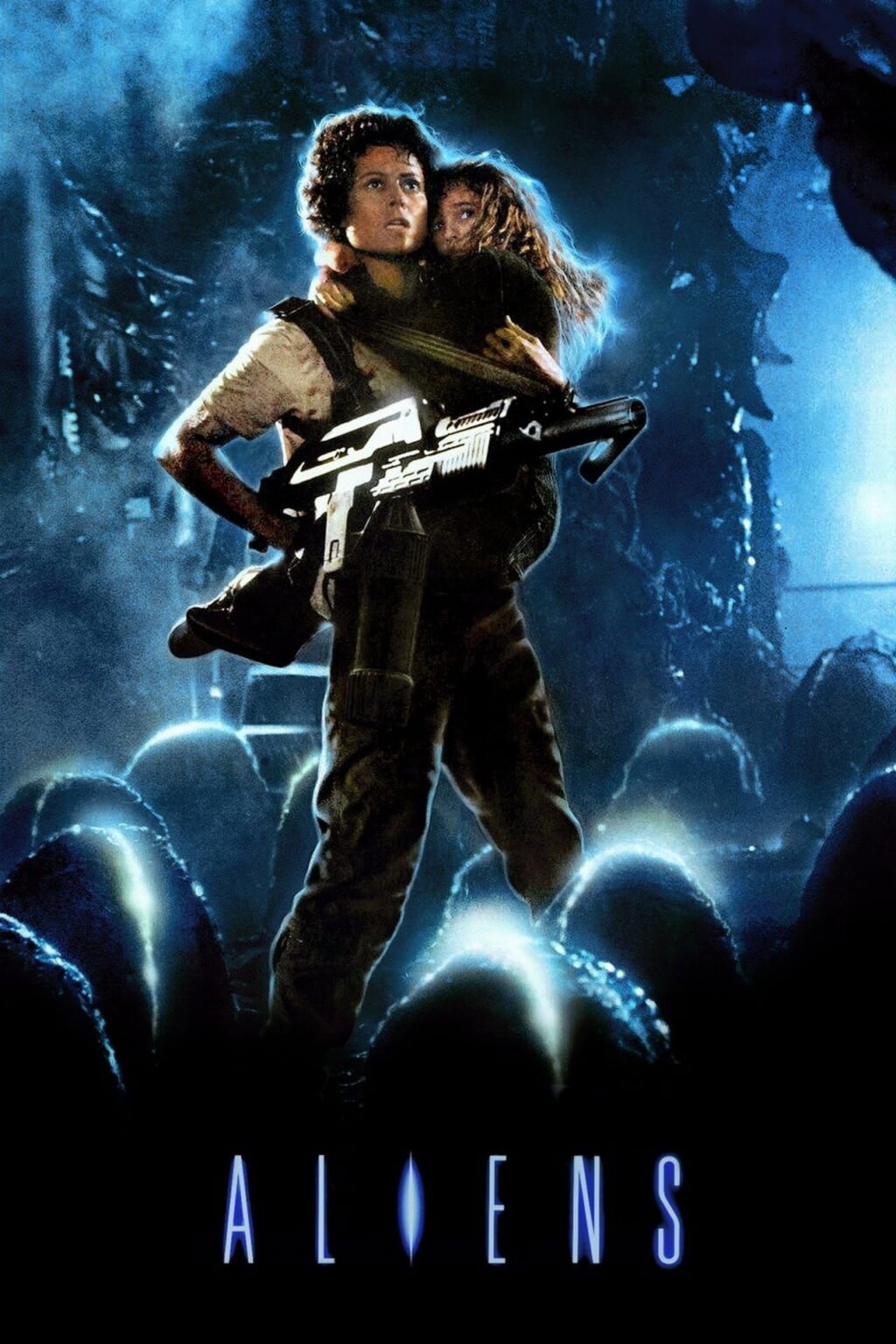
Aliens (1986) is the science-fiction action-horror sequel to Alien (1979), written and directed by James Cameron. Sigourney Weaver returns as Ellen Ripley, found adrift 57 years after she destroyed the Nostromo. When contact is lost with a colony on the moon where her crew found the alien eggs, Ripley goes back with a unit of Colonial Marines. They face a whole hive of Xenomorphs and the creature that lays the eggs: the alien queen. Where Ridley Scott’s original was a slow-burning haunted-house film, Cameron made a relentless war movie. It won two Academy Awards, and Weaver received a Best Actress nomination.
At a glance
| Release date | July 18, 1986 (US) |
| Director | James Cameron |
| Writers | James Cameron (screenplay); story by James Cameron, David Giler and Walter Hill |
| Based on | Characters created by Dan O’Bannon and Ronald Shusett |
| Starring | Sigourney Weaver, Michael Biehn, Paul Reiser, Lance Henriksen, Carrie Henn, Bill Paxton, Jenette Goldstein |
| Runtime | 137 minutes |
| Rating | R (US) |
| Budget | $18.5 million |
| Box office | About $85.1 million (US and Canada); worldwide estimates range from $131.1 million to $183.3 million |
| Franchise | Alien franchise: sequel to Alien (1979); followed by Alien 3 (1992) |
Plot summary
A salvage crew finds Ripley’s escape shuttle. She has been in stasis for 57 years since she blew up the Nostromo to kill the alien that slaughtered her crew. Her employers at the Weyland-Yutani Corporation don’t believe her story about the alien eggs on the moon LV-426, which has since been settled by a colony of terraformers. When contact with the colony is lost, company man Carter Burke (Paul Reiser) and Lieutenant Gorman persuade a traumatized Ripley to go back with a squad of Colonial Marines. She agrees only on the condition that they wipe out the creatures.
The marines, led by Corporal Hicks (Michael Biehn), find the colony torn apart and only one survivor: a young girl nicknamed Newt (Carrie Henn). Beneath the atmosphere processing station, they discover the colonists cocooned as hosts for alien embryos. An ambush wipes out most of the squad, and the survivors barricade themselves in, with the station’s damaged reactor counting down to an explosion. Ripley also has to deal with a betrayal from within.
Spoiler section: the ending
Ripley discovers that Burke sent the colonists to the derelict ship, hoping to bring the aliens back for weapons research. He also tried to have her and Newt impregnated so they could be smuggled through quarantine. In the final attack, Burke, Hudson, Gorman and Vasquez are killed, and Newt is taken. Ripley arms herself and goes into the hive alone. She rescues Newt, burns the queen’s eggs and escapes just before the station explodes. But the queen has stowed away on the dropship, tears the android Bishop (Lance Henriksen) in half and goes for Newt. Shouting “Get away from her, you bitch!”, Ripley fights her in a power loader and blows her out of an airlock.
Production and behind the scenes
A sequel was discussed right after Alien‘s success, but it was held up for years by management changes at 20th Century Fox and by a lawsuit from Brandywine producers over unpaid profits. Despite having little directing experience, Cameron was hired to write a story in 1983 on the strength of his scripts for The Terminator and Rambo: First Blood Part II. New Fox executive Lawrence Gordon later revived the project. Weaver was paid $1 million plus a share of the profits, the highest salary of her career at the time. Cameron cast Carrie Henn, who had no acting experience, after she was scouted at school in Lakenheath, England. James Remar was originally cast as Hicks but left early in filming. He later admitted he was fired after an arrest for drug possession, and Biehn replaced him.
Filming began in September 1985 at Pinewood Studios near London on a 75-day schedule. The actors playing the marines trained with the British Special Air Service. Stan Winston’s studio redesigned the alien warriors and built the enormous queen puppet, partly operated with hydraulics. H. R. Giger was unavailable because he was under contract for Poltergeist II. Syd Mead designed the Sulaco, and the armored personnel carrier was a disguised aircraft tug for a Boeing 747. James Horner had just three weeks to write the score, recorded with the London Symphony Orchestra. Cameron disliked parts of it and cut it up, adding cues from Jerry Goldsmith’s Alien score.
Release and reception
Aliens opened on July 18, 1986, at No. 1 with $10.1 million and stayed among the top-grossing films for 11 weeks. It earned about $85.1 million in the US and Canada, the seventh-highest total of the year. International figures for 1986 are inconsistent, so estimates of the worldwide gross range from $131.1 million to $183.3 million. Time put it on its cover as “The Summer’s Scariest Movie,” and audiences gave it an “A” CinemaScore. Many critics called it a rare sequel that matched or surpassed the original. Roger Ebert found the last hour “painfully, unremittingly intense.” The film holds a 93% approval rating on Rotten Tomatoes and a Metacritic score of 84.
At the Academy Awards it won Best Sound Effects Editing and Best Visual Effects. It received five other nominations, including Best Original Score and Best Actress for Weaver, the first Best Actress nomination for a science-fiction film. Weaver was also nominated for a Golden Globe, and the film won the BAFTA for Best Special Visual Effects.
Legacy and influence
Aliens is widely ranked among the greatest science-fiction and action films and among the best sequels ever made. The BFI named it one of the 10 greatest action films. Its squad of soldiers being picked off one by one has been repeated to the point of cliché, and Horner’s score was used in action trailers for a decade. Critics have read it as a story about motherhood, with Ripley and the queen as opposing single mothers, and as an allegory of the Vietnam War. Ripley became a model for the female action hero, and Weaver jokingly called herself “Rambolina.” Alien 3 (1992) killed off Hicks and Newt off-screen. Cameron called that decision “a huge slap in the face to the fans.” The later Alien: Romulus (2024) is set between the first two films.
Trivia
- Bill Paxton’s line “Game over, man; game over!” grew out of a backstory he invented for Hudson, in which the marine had trained only on simulators.
- Weaver had to film “Get away from her, you bitch!” in a single take, and she thought she had botched it.
- Before he was fired, James Remar accidentally shot a hole in the set of Little Shop of Horrors, which was filming on a neighboring stage.
- Scenes cut from the theatrical version include Ripley learning that her daughter died while she was in stasis. The scene helps explain her bond with Newt.
Related links
- Ellen Ripley and the Xenomorph (characters)
- Alien franchise
- Alien (1979), Alien 3 (1992) and Alien: Romulus (2024)
- James Cameron (writer and director)
- Sigourney Weaver, Michael Biehn, Bill Paxton and Lance Henriksen (cast)
- H. R. Giger, designer of the original creature
Trailer
Go Behind the Screams
Check out these behind-the-scenes looks at how Aliens (1986) was made: