
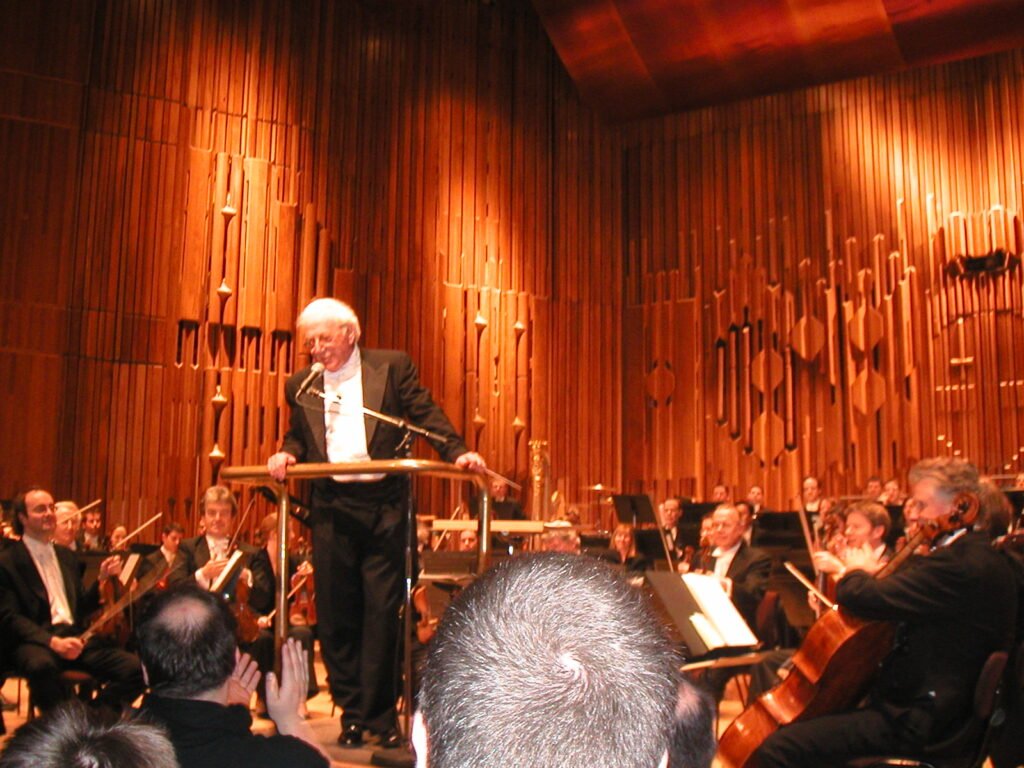
Jerry Goldsmith (1929–2004) was the American composer who treated every film as a new language to invent — a black Mass for The Omen, twelve-tone apes for Planet of the Apes, a lullaby curdling into atonal terror for Poltergeist. Most great film composers have a sound; Goldsmith had a refusal — no house style, only rebuilding from the film in front of him. Horror got some of his best rebuilding — and, in Alien, the genre’s most famous case of a great score taken apart by other hands.
A Clerk-Typist at CBS
Jerrald King Goldsmith was born on 10 February 1929 in Los Angeles, California. He began piano at age six, and as a teenager studied piano with Jakob Gimpel and composition, theory and counterpoint with Mario Castelnuovo-Tedesco — the teacher to name, who also taught Henry Mancini and John Williams. His conversion story is his own, told consistently: seeing Spellbound (1945), scored by Miklós Rózsa, made him want to write film music. He attended classes taught by Rózsa at the University of Southern California — attended, note; no source in the record supports a completed degree — and also studied at Los Angeles City College.
In 1950 he joined CBS as a clerk-typist in the music department. That is really how it started: a staff job, then composing assignments from inside it — radio first, then live television, writing at punishing speed, up to a score a week in the radio period. The early credits run through Climax!, Playhouse 90, Perry Mason and Gunsmoke, but two anthology jobs matter most here. He composed seven original scores for the original The Twilight Zone in 1960–61 — seven, exactly; the series’ famous title music is Bernard Herrmann’s and Marius Constant’s, never his — and in 1960 Revue Studios hired him to score Thriller, the horror anthology hosted by Boris Karloff, sharing the scoring substantially with Morton Stevens.
His first credited feature score was the western Black Patch (1957); the first major break came with Lonely Are the Brave (1962), on Alfred Newman’s recommendation — Newman had been impressed by the Thriller work. Goldsmith worked for more than 200 film and television productions across roughly five decades, and died at his home in Beverly Hills on 21 July 2004, aged 75, after a battle with cancer. He was married to Sharon Hennagin (1950–70), then to Carol Heather, who remained his wife until his death; of his five children, the eldest son, Joel, became a film and TV composer in his own right — a separate credit, not a pseudonym, as the First Contact credit below shows.
The Sixties: Freud to the Planet of the Apes
His first Oscar nomination came for Freud (1962), a modernist, serial-influenced score for John Huston’s film. Remember Freud — it comes back seventeen years later in the strangest possible way. A Patch of Blue (1965) and The Sand Pebbles (1966) brought nominations two and three.
Then Planet of the Apes (1968), nomination four and the experimental landmark. Goldsmith wrote an avant-garde, substantially twelve-tone score performed by deliberately misused instruments: horns blown without mouthpieces, woodwind players fingering keys without blowing, Echoplex-looped drums, stainless-steel mixing bowls as percussion, the orchestra imitating ape sounds. The score ranks No. 18 on the AFI’s list of the 25 greatest American film scores; his Chinatown ranks No. 9, making him one of the few composers with two scores on that list. Patton (1970), nomination five, built its martial score on Echoplexed trumpet triplets — a ghostly call-and-response for a general haunted by reincarnation. And Papillon (1973) was nomination six.
Chinatown in Ten Days, and the Black Mass
Chinatown (1974) is the signature anecdote of his career. Phillip Lambro’s original score was rejected, and Goldsmith was hired to write a replacement — in ten days. What he produced was a sparse noir score anchored by a solo trumpet love theme over four pianos, four harps, strings and percussion, deliberately refusing period pastiche. His reasoning: the visuals already establish the 1930s; “emotions are timeless.” It was nomination seven. It lost to The Godfather Part II — a loss.
After The Wind and the Lion (1975, nomination eight) came the win. For Richard Donner’s The Omen (1976), Goldsmith built the score as a black inversion of a Catholic Mass — a chorus chanting Latin in a “satanic mass” design, his own framing being that Damien, the anti-Christ figure, needed the opposite of a Mass. The chant piece is “Ave Satani” — “Hail Satan.” At the 1977 ceremony, Goldsmith won Best Original Score for The Omen, while “Ave Satani” was nominated for Best Original Song at the same ceremony — and lost, to “Evergreen.” The win is the score; the song was nominated and lost. Anyone who merges those two facts into “he won for Ave Satani” has it backwards. He returned to score both sequels, Damien: Omen II (1978) and Omen III: The Final Conflict (1981); neither was Oscar-nominated. And The Boys from Brazil (1978) brought score nomination number ten, closing the decade at full sprint.
1979: The Theme That Lived, and the Score That Was Taken Apart
For Robert Wise’s Star Trek: The Motion Picture (1979), Goldsmith wrote the heroic main theme — score nomination eleven — and that theme, as arranged by Dennis McCarthy, was reused as the main title theme of Star Trek: The Next Generation. He scored five Star Trek features in total, and his Voyager theme won him an Emmy.
Alien (1979) is the other story, and it has to be told with the filmmakers named, because “the score was altered” on its own is a flattened half-fact. As Goldsmith wrote it, the score opened with a deliberately romantic, lyrical main title — space as wonder before horror — using unusual colour including serpent and didgeridoo. Director Ridley Scott rejected that conception and had him rewrite the main title as, in Goldsmith’s own quoted words, “the obvious thing: weird and strange.” He was called back to rescore multiple cues — seven in the Movie Music UK account — and some rejected cues were replaced not with new writing but with music from his own 1962 score for Freud, tracked in by Scott and editor Terry Rawlings from the temp track, covering the acid-blood scene and Dallas’s air-shaft search among other moments. His end title was replaced by an excerpt from Howard Hanson’s Symphony No. 2, which also covers the finale. Goldsmith was publicly aggrieved; the two sides, he said, were “going at opposite ends of the pole.” Two disciplines for the record: Alien received no Oscar nomination for its score — his 1979 nomination was Star Trek — and he never scored a sequel. Aliens (1986) is James Horner’s score, in the Alien franchise‘s full telling, though its editors tracked excerpts of Goldsmith’s Alien music into the climax — a reuse, not a Goldsmith sequel score.
The Eighties Horror Run
Poltergeist (1982), for director Tobe Hooper and producer Steven Spielberg, was score nomination twelve — a three-register score: a gentle lullaby theme for Carol Anne and the family’s suburban life, a semi-religious theme for the souls trapped between worlds, and atonal horror bursts for the attacks. It lost to John Williams’s E.T. He also scored Poltergeist II: The Other Side (1986), in a more synthesiser-led idiom.
Psycho II (1983) posed the hardest succession problem in horror music: writing the first new Psycho score after Bernard Herrmann. Goldsmith’s solution, per the Intrada session documentation, was honourable and exact — an otherwise all-new score that opens by using Herrmann’s shower-murder set-piece from the original film, then grounds Norman in a wistful, sympathetic main theme for electronics and strings: innocence and madness in one theme, against every stabbing-string expectation. The relay then passed on: Psycho III (1986) was scored by Carter Burwell.
The same year, Twilight Zone: The Movie (1983) made him the natural hire twice over — a veteran of the original series scoring its film descendant, alone, in four styles for four directors: astringent and percussive for Landis’s “Time Out,” warm and magical for Spielberg’s “Kick the Can,” melancholy theme plus shrieking horror for Dante’s “It’s a Good Life,” psychological symphonic writing for Miller’s “Nightmare at 20,000 Feet.” And Gremlins (1984), for Dante, split the film’s double nature musically — warm orchestral writing for Gizmo, against synthesiser-led chaos centred on the “Gremlin Rag.” The Dante partnership ran on through Gremlins 2, Innerspace, The ‘Burbs and Small Soldiers, to his final feature. Under Fire, Hoosiers and Basic Instinct (1992) added score nominations thirteen, fourteen and fifteen — the last a nomination, not a win.
The Ledger, Stated Properly
Here is the awards total in the only form this page prints it — both numbers you will see elsewhere are real; they count different things. Goldsmith won one Academy Award — Best Original Score, The Omen. He received 17 Academy Award nominations in score categories in total, including that win — the last of them L.A. Confidential (1997) and Mulan (1998), the Mulan nomination shared with Matthew Wilder and David Zippel, not a solo nomination, and not a win. Plus one Best Original Song nomination, for “Ave Satani” — 18 Academy nominations in total. Television is a separate ledger: five Primetime Emmy wins, including for Masada and the Voyager theme; nine Golden Globe nominations, no wins.
The later run — Total Recall (1990), The Mummy (1999), the later Star Trek films — ends with Looney Tunes: Back in Action (2003) for Dante, his final released feature score. A planned Timeline score that year was replaced (by Brian Tyler) — an unused score, stated as such. Two closing credits tie the generations together: on Star Trek: First Contact (1996), his son Joel collaborated with him, composing roughly 22 minutes of a score that is primarily Jerry’s. And he composed the Universal Pictures logo fanfare in the form debuting with The Lost World: Jurassic Park (1997) — audiences who never learned his name heard him for years.
How He Worked
The chameleon doctrine first: the absence of a fixed style was the style. Twelve-tone modernism for the apes, a black Mass for the Antichrist, sparse noir for Chinatown — rebuilt per film, every time. His unifying principle, in his own words from a DVD commentary: all of a film’s music should be unified — “part of the same architecture, everything comes out of [that]” — built from short leitmotifs.
Then the experiment habit: unusual instruments played unusually, always with a normal orchestra as the base — mixing bowls, Echoplex, horns without mouthpieces — because, as the soundtrack documentation quotes him, he did not want Apes to be “an electronic score, not gimmicky.” The specialist biography record names Runaway (1984) as his first all-electronic score; the 1990s fusion scores grow from there. Speed was trained, not improvised: the CBS years — a score a week, five years of live television in his own account — are the documented root of the Chinatown feat. And restraint: explaining why he left the final Statue of Liberty scene in Planet of the Apes unscored, he said Charlton Heston “was a bit over the top by himself, and didn’t need any score to accompany him.” A signature that includes knowing when silence wins — the honest contrast with Alien, where others made those decisions for him. Directors returned to him across decades for a reason: Schaffner, Donner, Dante, Verhoeven — partnerships measured in films plural, never one-offs.
Why Goldsmith Matters to Horror
He owns two of horror’s defining score-moments in two opposite idioms: The Omen‘s choral black Mass, which made liturgical chanting a horror language, and Alien‘s dissonant deep-space dread, a landmark even in the altered form audiences first heard. Add Poltergeist‘s lullaby-versus-atonality and horror has three of its permanent templates from one composer in six years. He is also a direct link in horror television’s founding generation — seven Twilight Zone scores and the Karloff Thriller work, decades before the 1983 film closed the loop. And the Alien alterations are the case study every later replaced-or-edited score in the genre gets measured against — Horner’s Aliens treatment included, on the same franchise, three years later.
Trivia
- He reportedly wore an ape mask while conducting the Planet of the Apes sessions — the story survives only in that hedged form, even from its friendliest sources.
- His wife Carol wrote and performed The Omen‘s love-theme song, “The Piper Dreams,” per the score coverage of record.
FAQ
How many Oscar nominations did Jerry Goldsmith have — 17 or 18?
Both — they count different things. 17 in score categories, including the Omen win, plus one song nomination (“Ave Satani”): 18 in total.
Did Goldsmith score Aliens?
No. Aliens (1986) is James Horner’s. Goldsmith’s only Alien-franchise feature score is the 1979 film — though its editors tracked excerpts of his Alien music into the climax: a reuse, not a sequel score.
Did he write the Twilight Zone theme?
No. He composed seven original episode scores in 1960–61. The title themes are Herrmann’s and Constant’s.