
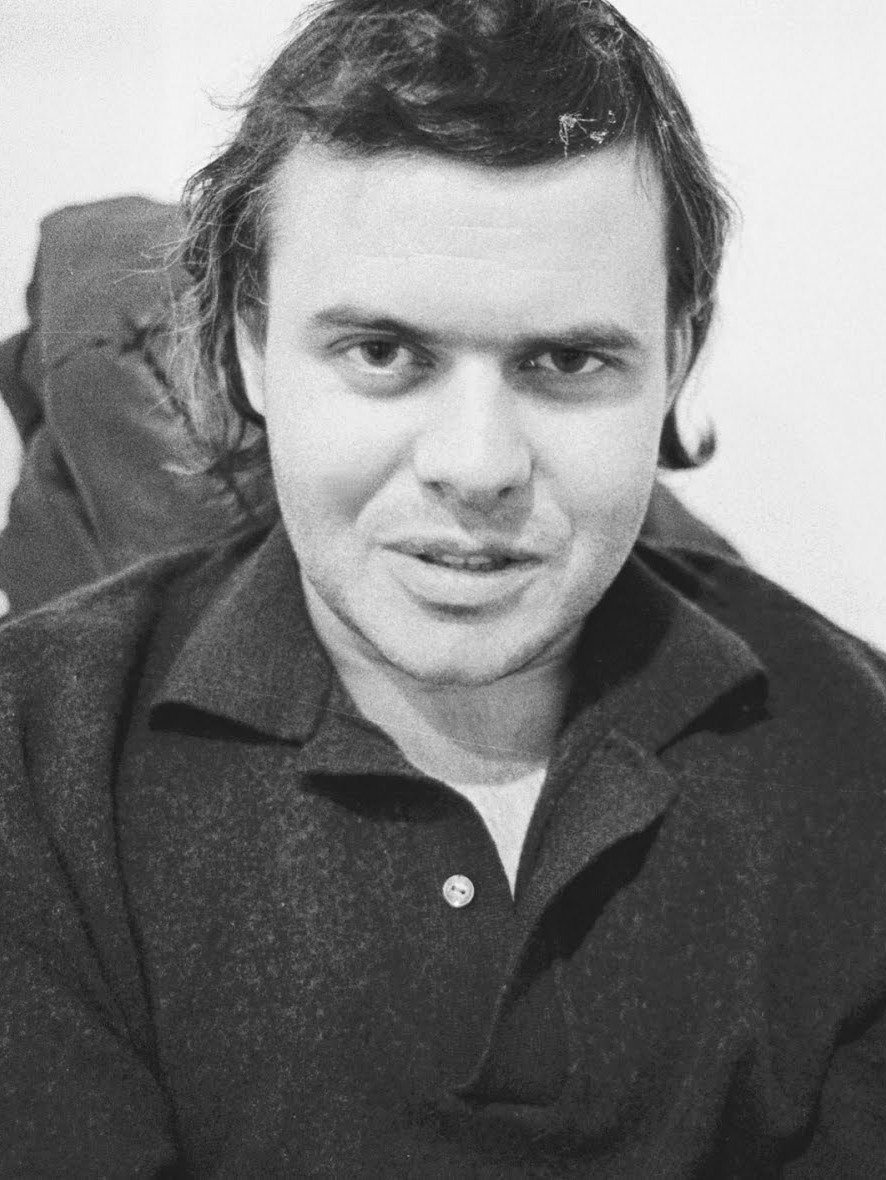
H. R. Giger (1940 to 2014) was the Swiss painter, sculptor and designer who created the biomechanical style and the creature, egg and derelict spacecraft of Alien (1979).
H. R. Giger never set out to design a movie monster. By the time a film director saw his work he had spent more than a decade painting a world of his own, bodies fused with machines, bone that looked like architecture, tubes that looked like flesh. The creature that made him famous was already there, nearly complete, in a painting called Necronom IV, before anyone in Hollywood knew his name. The film simply came and found it.
Quick Specs
| Born | February 5, 1940, Chur, Switzerland (as Hans Rudolf “Ruedi” Giger) |
| Died | May 12, 2014, in hospital in Zürich, from injuries suffered in a fall at his home |
| Known for | The creature, egg, derelict ship, Space Jockey and planet of Alien (1979); the biomechanical style |
| Academy Award | Best Visual Effects for Alien, at the 52nd Academy Awards, shared with Carlo Rambaldi, Brian Johnson, Nick Allder and Denys Ayling |
| Other film designs | The unmade Dune of Alejandro Jodorowsky; Poltergeist II: The Other Side (1986); Tokyo: The Last Megalopolis (1988); Alien 3 (1992, unused); Sil for Species (1995); murals for Prometheus (2012) |
| Key book | Necronomicon (1977, Sphinx Verlag, Basel) |
| Album covers | Brain Salad Surgery (Emerson, Lake & Palmer, 1973); Koo Koo (Debbie Harry, 1981) |
| Training | Architecture and industrial design, School of Applied Arts, Zürich |
| Museum | H.R. Giger Museum, Château St. Germain, Gruyères (opened 1998) |
| Giger Bars | Chur (1992) and Gruyères (2003) |
| Honours | Science Fiction and Fantasy Hall of Fame (2013) |
| Family | Married Mia Bonzanigo (1979) and Carmen Maria Scheifele Giger (2006) |
Who He Was
Hans Rudolf Giger was born on February 5, 1940, in Chur, the capital of the Swiss canton of Graubünden. The name is also given as Hans Ruedi, the Swiss short form of Rudolf, and he signed himself H.R. His father, a chemist who ran the family pharmacy, saw art as a “breadless profession” and pushed his son toward a proper trade.
In 1962 Giger moved to Zürich and studied architecture and industrial design at the School of Applied Arts. That training is not a footnote. A designer of objects and buildings is what later let him think about a creature, its ship and its planet as one engineered system.
By 1964 he was making his first artworks, mostly ink drawings and oil paintings. His first solo exhibition followed in 1966, and in 1969 his first poster edition was printed and distributed by H. H. Kunz, co-owner of Switzerland’s first poster publishing company. It was his first real success.
From 1966 his partner was the Swiss actress Li Tobler, whose features appear in many of his paintings of the period. She died by suicide in 1975. He married Mia Bonzanigo in 1979; they divorced a year and a half later. In 2006 he married Carmen Maria Scheifele Giger, who became director of the H.R. Giger Museum, and he lived and worked with her in Zürich for the rest of his life.
He suffered from night terrors from childhood, and the biographical record ties much of his imagery to them. He acknowledged the sleep disorder as an influence on what he painted.
The Work, and What He Did in It
The Airbrush and the Biomechanoids
After the ink and oil years came the discovery that defined him: the airbrush, used freehand. Painting by painting he built a figure type, the Biomechanoid, a human form fused with machine parts, tubes and bone, and landscapes to match. All of it existed years before a film studio hired him. His film career was this ready-made world being commissioned, not a style invented for Hollywood.
Brain Salad Surgery
In 1973 Emerson, Lake & Palmer put his image of a human skull encased in a machine on the cover of Brain Salad Surgery. The Associated Press noted that it and his Koo Koo cover later made Rolling Stone’s 1991 list of the top 100 album covers. Music was a second career for him, not a sideline.
Necronom IV and Necronomicon
The painting Necronom IV (1976) shows an elongated-headed biomechanoid that became the Alien with very little redesign. It was reproduced in his book Necronomicon, named after H. P. Lovecraft’s fictional book of dark magic and first published in 1977 by Sphinx Verlag in Basel. He later said his friend, the Swiss writer Sergius Golowin, introduced him to Lovecraft and suggested presenting his pictures as illustrations for Lovecraft’s imaginary book. The book was not made for cinema, but it worked as a portfolio.
Jodorowsky’s Dune
In the mid-1970s Alejandro Jodorowsky assembled Moebius, Chris Foss, Dan O’Bannon and Giger for a film of Dune. Some $2 million went into pre-production before the money collapsed, and the film was never shot. Giger designed the world of the Harkonnens: Castle Harkonnen, conceived as a stronghold in the shape of the Baron himself, and the Harkonnen chairs, including the triple-skulled “Capo” throne meant for the Baron. When David Lynch later made Dune (1984), he used none of Giger’s designs. “I was asked to do it two times,” Giger said in 2009, “once with Jodorowsky and then another time with Ridley Scott.”
The unmade film left two lasting things. The chairs became real furniture, and they furnish the Swiss Giger Bars. And on the production he met Dan O’Bannon.
Alien: The Hiring
O’Bannon, who had worked with Giger on Dune, put Necronomicon into the hands of the director Ridley Scott. Producer Gordon Carroll recalled that the moment Scott saw the work, he knew “the biggest single design problem, maybe the biggest problem in the film, had been solved.” Scott’s own verdict: “I’d never been so certain about anything in all my life.”
Scott divided the design into three worlds, under production designer Michael Seymour: the planet, everything to do with the alien, and the Earth ship. Giger worked mainly on the alien and the planet. Ron Cobb designed the Nostromo and its interiors, and also gave the Alien its acid blood. Chris Foss produced early spacecraft exteriors. Jean “Moebius” Giraud designed the spacesuits, which costume designer John Mollo realised.
Alien: What Giger Did
His share is precise, and the precision is the point. He designed the adult Alien, adapting it from Necronom IV, removing the painted figure’s eyes and developing it for the screen. He designed the egg. He designed the derelict spacecraft inside and out, the masked Space Jockey, and the surface of the planetoid. He also painted designs for the facehugger and the chestburster, but the versions on screen were built by others. His chestburster model was a large figure with arms, which the crew nicknamed a “degenerate plucked turkey,” and it was far too big to fit inside a ribcage. Ridley Scott redesigned the chestburster, working back from the adult, and the effects artist Roger Dicken built it. Dicken also built the screen facehugger; Giger designed how it worked, including the spring-like tail and the hand-like grip, and began a translucent version he had no time to finish. The life cycle itself starts in the script by Dan O’Bannon and Ronald Shusett.
Then he built. At Shepperton Studios he sculpted the adult Alien himself, in his own words: “I started out with kind of a statue of Bolaji, and directly over that I modeled the shape of the Alien in plasticine, with bones and tubes and lots of mechanical things. The head I built up from a real human skull using plasticine and flexible piping.” Production accounts agree on the materials: snake vertebrae, plasticine and cooling tubes from a Rolls-Royce, cast in latex for the suit worn by the 6-foot-10 Bolaji Badejo. Carlo Rambaldi built the separate mechanical head for close-ups. A plan to cast the suit translucent, so the skeleton would show through, was tried and dropped for lack of time and suitable materials. For the derelict interior he built a bone-and-plaster environment and, by production accounts, painted the Space Jockey set by hand.
Alien won the Academy Award for Best Visual Effects at the 52nd Academy Awards on April 14, 1980, shared five ways: H.R. Giger, Carlo Rambaldi, Brian Johnson, Nick Allder and Denys Ayling. The film was also nominated for Best Art Direction and did not win it.
Frozen Out of the Sequels
He was not invited to work on Aliens (1986). James Cameron later wrote him a letter explaining that he had wanted his own stamp on the film and feared being overwhelmed by Giger’s style, and asking his forgiveness.
For Alien 3 (1992), David Fincher brought him back. Giger produced a new four-legged Alien, sleeker, with the dorsal tubes removed, and with Fincher a version with full, human-like lips for the close encounter with Ripley. He built it as a full sculpture in Zürich. The creature actually filmed was designed and built by Amalgamated Dynamics, Alec Gillis and Tom Woodruff Jr., derived from his original. When Giger invited them to Switzerland to see his sculpture, Woodruff has recalled, “Fox told us we had to say no.” The theatrical release also failed to give him the new-work credit he was owed. Home-video releases corrected it to a full creature-design credit.
On Alien Resurrection (1997) he did no work and was at first left out of the credits entirely. He wrote an open letter to Fox: “The designs and my credit have been stolen from me, since I alone have designed the Alien.” Fox revised the credits for video. The pattern is plain in the record: the franchise ran on his designs while repeatedly failing to credit the designer, and the corrections came only after he protested.
Poltergeist II: The Other Side
For Poltergeist II: The Other Side (1986), the sequel to Poltergeist (1982), he worked from Zürich, not on set. From Michael Grais and Mark Victor’s screenplay he designed a ghost’s transformation, from a worm-like spirit through a grotesque dwarf stage into a huge, Gorgon-like creature called the Great Beast, and sent the airbrushed designs to Los Angeles. The production realised them cheaply. “I was horrified by Poltergeist II,” he said in 1988. Same designer as Alien, no hands on the build, opposite result: it is the clearest case in his record of why his physical presence mattered.
Tokyo: The Last Megalopolis
Akio Jissoji’s occult epic Tokyo: The Last Megalopolis (1988) was among the most expensive Japanese live-action films of the 1980s. The producer Takashige Ichise recruited Giger while he was in Japan for an exhibition, and he supplied creature design, concept art for the gohō dōji creature, though his schedule kept him off the set.
Species and the Ghost Train
For Species (1995) he designed Sil, the human-alien hybrid. In his designs she is a tall, translucent-skinned figure with tentacle-like hair gathered like an Egyptian headdress and dagger-like ridges down the spine, and the production brief was explicit: “we want to avoid anything metallic… She should look very organic.” Steve Johnson’s effects company built the physical creature, and Giger quarrelled publicly over how his designs were used.
He also invented a nightmare for the young Sil, a Ghost Train with skull carriages, accordion bellows and vacuum arms. “That was entirely my idea,” he said. “The script had nothing about the train.” It was built in Zürich and then cut down to a fragment in the finished film. His verdict was that “the dream lost its spectacular quality.”
A Batmobile That Wasn’t
In early pre-production on Batman Forever (1995), the filmmakers talked to Giger about the Batmobile, and he drew an X-shaped design with articulated front legs, retractable fins and spines around a central pod. It went no further. Production designer Barbara Ling told The Hollywood Reporter in 2015: “He had these insane, fabulous, weird scribbles that were very like ‘Alien.’ It was exciting that this strange mind briefly touched upon us, but it didn’t work out.” The sketches survive in his book H.R. Giger’s Film Design (1996).
Koo Koo
For Debbie Harry’s Koo Koo (1981) he worked from a photograph of her by Brian Aris and set four acupuncture needles through her face. He had just had acupuncture treatment himself, he said, and “the idea of the four needles came to me, in which I saw symbols of the four elements.” Harry called the result “a combination of punk, acupuncture and sci-fi.” He also suggested the album’s title. He was commissioned for promo videos for “Backfired” and “Now I Know You Know,” and when the director failed to turn up on the day, Giger directed and produced them himself at his studio in Switzerland.
Frankenchrist
In 1985 the Dead Kennedys included a poster of his 1973 painting Work 219: Landscape XX, an explicit painting better known by a blunter title, inside their album Frankenchrist. In 1986 members of the band and others in the distribution chain were charged with distributing harmful matter to minors over the poster. The case ended without a conviction, though the legal costs nearly bankrupted the label, Alternative Tentacles. Giger was not charged and was not a defendant. His painting was the exhibit, not the accused.
Prometheus
His last film credit came on Prometheus (2012). In Ridley Scott’s words, “he’s doing a little bit of work for me. He’s been doing some murals, big murals, which we’ll see in almost one of the first chambers we encounter.” The film also reuses his Derelict and Space Jockey from Alien and a temple design that started on Jodorowsky’s Dune, and it credited him for the original designs. He was not its creature or production designer, but he was not absent from it either.
The Museum, the Bars and the Last Years
In 1998 the H.R. Giger Museum opened in the Château St. Germain in Gruyères. It holds the largest permanent collection of his paintings, sculptures, furniture and film designs. Two Giger Bars, complete biomechanical rooms designed by him, survive in Switzerland: one in Chur, his birthplace, opened in 1992, and the Museum HR Giger Bar at Gruyères, opened on April 12, 2003. An earlier bar in Tokyo (1988) came first, though by several accounts he later disowned it. In 2013 he was inducted into the Science Fiction and Fantasy Hall of Fame.
H. R. Giger died on May 12, 2014, in hospital in Zürich, from injuries suffered when he fell down the stairs at his home.
Cool Verified Facts
- Late in his career he gave up the airbrush for pastels, markers and ink.
- The painted Necronom IV figure has an eye. Giger removed the eyes for the film creature, and the design gained its second, inner jaw.
- The Harkonnen chairs, handmade in fibreglass or aluminium to look like a human skeleton, were sold as furniture. People can sit in a piece of a film that was never made.
- His Alien Oscar was a five-way team award; the Academy records the fifth winner as Denys Ayling.
- Ridley Scott has said Giger spent eleven months at Shepperton on Alien, staying over a pub and never going into town.
Signatures, Habits and Behind the Scenes
The Biomechanical
His own word for the fusion at the centre of everything: human and animal bodies continuous with machines, flesh that is also tubing, bone that is also architecture, painted with a cold realism. The key point for horror is that the biomechanical is a whole world, not just a monster style. In Giger the creature, its ship, its planet and its furniture are one organism, which is why Scott could hand him “everything to do with the alien” as a single job.
Freehand
His signature technique was airbrush used freehand, without the masks and templates airbrush artists normally depend on. “Using an airbrush freehand has become as familiar as steering a car,” he said. He worked images up directly, without the usual preliminary sketches.
The Locked Studio
Scott’s tribute fixes how he worked on Alien: “all the security we built up around his ‘lock up’ studios at Shepperton. I was the only one allowed the honour of going in, and I absolutely enjoyed every hour I spent with him there.”
The Painter Who Built
He did not hand over drawings and go home. On Alien he sculpted the creature and painted the set himself, and the results show it. On Poltergeist II, Alien 3 and Species, the industry wanted the Giger look without the Giger method, and in each case the gap shows on screen.
Why He Matters
For horror, before Giger the movie monster was something that visited the human world. His Alien brought its own world with it, ship, egg, planet and body grown from the same biomechanical tissue, and horror gained an ecology. The life cycle of egg, facehugger, chestburster and adult is body horror as biology, parasitism and birth turned into weapons, and he gave it the look of a single living system. Every organic spaceship, every hive interior and every sleek, eyeless predator since works in a visual language one Swiss artist had fully formed in his paintings before a film existed to use it.
For film design, he is the clearest modern case of a film’s look having one nameable author who was not its director. Scott’s three-worlds plan admitted it: the human technology could be designed by a team, but the alien had to come from one imagination and be built by the same hands. The Academy honoured the result, shared, correctly, with the builders and effects supervisors who realised it. His museum and bars in Gruyères and Chur are his answer to everything that followed: rooms where his authorship is total and permanent.
The wider record follows. Two of his album covers made Rolling Stone’s top 100. The words “biomechanical” and “Gigeresque” passed into the language of art and tattooing, and his Necronomicon is a documented influence on the hell imagery of the video game Doom. More than four decades on, his Alien is still the creature the franchise is built around.