
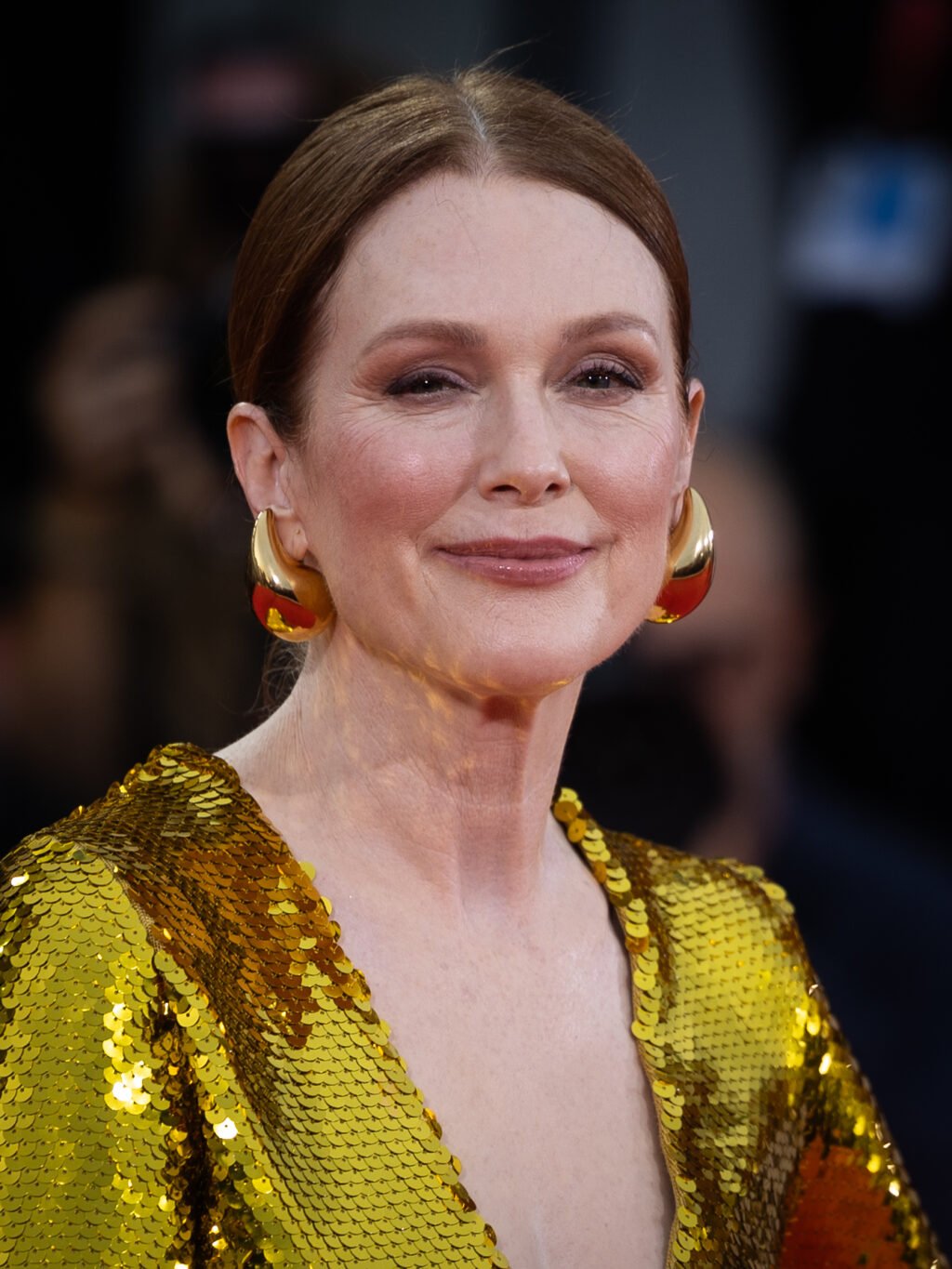
Julianne Moore (born 1960) is the American actress who played Clarice Starling in Hannibal and Margaret White in Carrie, and won an Oscar.
Quick Specs
| Born | Julie Anne Smith, December 3, 1960, at Fort Bragg, North Carolina |
| Training | Boston University, BFA in Theatre, 1983 |
| Horror | Carol White in Safe (1995); Lila Crane in Psycho (1998); Clarice Starling in Hannibal (2001); Telly Paretta in The Forgotten (2004); Margaret White in Carrie (2013); Lisey Landon in Lisey’s Story (2021) |
| Also | Amber Waves in Boogie Nights (1997); Cathy Whitaker in Far from Heaven (2002); Laura Brown in The Hours (2002); Alice Howland in Still Alice (2014) |
| Oscars | Best Actress, Still Alice (won, on her fifth nomination) |
| Emmys | Daytime Emmy (As the World Turns, 1988); Primetime Emmy (Game Change, 2012) |
Who She Is
Julianne Moore was born Julie Anne Smith on December 3, 1960, at the Fort Bragg Army installation in North Carolina, the eldest of three children. Her father, Peter Moore Smith, was a US Army paratrooper who rose to colonel and became a military judge. Her mother, Anne (née Love) Smith (1940 to 2009), emigrated from Greenock, Scotland, with her family in 1951 and worked as a psychologist and social worker. Her younger brother, Peter Moore Smith, is a novelist, and her younger sister is Valerie.
She was an Army child in the fullest sense. The family moved with her father’s postings through Alabama, Georgia, Texas, Panama, Nebraska, Alaska, New York and Virginia, among other places, and she attended nine different schools. At 16 she moved to Frankfurt, West Germany, and at Frankfurt American High School, after planning to become a doctor, she began acting in school plays. She draws the line herself: moving constantly, she has said, “teaches you to watch, to reinvent, that character can change.”
Her parents backed the acting on the condition that she earn a degree, and she graduated from Boston University with a BFA in Theatre in 1983. In New York every variation of her own name was already registered with the Actors’ Equity Association, so she built a new one: Julie, her own first name, plus Anne, her middle name and her mother’s, plus Moore, her father’s middle name. In 2011, after her mother’s death, she claimed British citizenship in her mother’s honour.
She has been married to the director Bart Freundlich since 2003. They met on his film The Myth of Fingerprints (1997), and they have two children. She also writes for children: Freckleface Strawberry (2007), drawn from being teased as a girl for her red hair and freckles, led to sequels and a 2010 stage musical, and My Mom Is a Foreigner, but Not to Me (2013) came from being Anne Love Smith’s daughter.
The Work, and What She Did in It
Television came first. On As the World Turns (1985 to 1988) she played dual roles, the half-sisters Frannie and Sabrina Hughes, and won the 1988 Daytime Emmy for Outstanding Ingenue at 27. On the New York stage she appeared in Caryl Churchill’s Serious Money at the Public Theater (1987), played Ophelia in Hamlet at the Guthrie Theater in Minneapolis (1988), and was in the Churchill one-acts staged as Ice Cream with Hot Fudge (1990).
Her film debut was in horror: a small role in the anthology Tales from the Darkside: The Movie (1990). A supporting part in The Hand That Rocks the Cradle (1992) brought wider attention. Robert Altman cast her in Short Cuts (1993) after seeing her in the long-running New York workshop production of Uncle Vanya, which Louis Malle filmed as Vanya on 42nd Street (1994).
Safe (1995), written and directed by Todd Haynes, was her first starring role and is the foundation stone of her horror record. She plays Carol White, a wealthy San Fernando Valley housewife who becomes convinced she is allergic to the modern world itself, its fumes, fabrics, food and air, while doctors find nothing and her life narrows room by room. In the end she retreats to a New Age desert community that may be a refuge or a cult. Moore plays Carol at a near-whisper, polite, vacant, apologetic and slowly disappearing, a performance built almost entirely from subtraction. It premiered at Sundance on January 25, 1995, when she was 34, brought her an Independent Spirit Award nomination. Film institutions now programme it as psychological horror.
She alternated the mainstream with the independent from the start: Nine Months (1995) and The Lost World: Jurassic Park (1997), as the palaeontologist Dr. Sarah Harding, sat beside Haynes and Altman. In Paul Thomas Anderson’s Boogie Nights (1997) she is Amber Waves, the veteran performer who mothers the young cast while fighting to regain custody of her own child, and at 36 she earned her first Oscar nomination, for Best Supporting Actress.
In Gus Van Sant’s near shot-for-shot colour remake of Psycho (1998), from Joseph Stefano’s original screenplay, Vince Vaughn is Norman Bates and Anne Heche plays Marion Crane. Moore is Lila, Marion’s sister, the role Vera Miles originated in 1960. Where Miles played Lila determined and frightened, Moore deliberately played her harder and more aggressive, the one principal who chose confrontation over replication, a choice the reviews noted whether they were sympathetic or hostile. The remake failed critically and commercially, and she was among its least blamed elements. She was 38 at its release. Lila is the character who goes down into the fruit cellar and finds Mrs. Bates, so she stepped into the most scrutinised remake in horror history in the role that survives it. The Big Lebowski (1998), as Maude Lebowski, and Magnolia (1999) completed the decade. In Neil Jordan’s The End of the Affair (1999), opposite Ralph Fiennes, she received her second Oscar nomination and her first for Best Actress.
Hannibal (2001) is the horror centrepiece by profile. Ridley Scott directed, David Mamet and Steven Zaillian wrote from Thomas Harris’s novel, and Anthony Hopkins returned as Lecter, with Gary Oldman as Mason Verger and Ray Liotta as Paul Krendler. Jodie Foster, who had won the Oscar as Clarice in The Silence of the Lambs (1991), declined to return, as did Jonathan Demme, and Moore took the role. Her Clarice is ten years on: no longer a trainee but a senior agent whose career has curdled into disgrace after a botched drug raid, suspended and framed by Krendler, who still walks alone onto Verger’s estate to cut Lecter down from the boar pen and is shot doing it.
The finale dinner at Krendler’s house is hers as much as Hopkins’s. Wounded, drugged and in an evening dress Lecter chose, Clarice calls the police, then watches Lecter open Krendler’s skull and sauté a slice of his brain. She refuses every offered complicity (“Not in a thousand years”) and finally handcuffs Lecter’s wrist to her own as the police close in. Lecter escapes by cutting off his own hand rather than hers. The film turns the novel’s ending, in which Clarice joins Lecter, into her refusal, and Moore’s whole performance is built to earn it. She was 40 at release.
The 2002 films brought a double nomination: Best Actress for Haynes’s Far from Heaven, as Cathy Whitaker, a 1950s housewife inside a Sirk-style melodrama that exposes the era’s racism and homophobia, and Best Supporting Actress for Stephen Daldry’s The Hours, as Laura Brown, at the same ceremony. That puts her among a small number of performers ever nominated twice in one year. She also won the Volpi Cup at Venice for Far from Heaven.
In Joseph Ruben’s The Forgotten (2004) she is Telly Paretta, a Brooklyn mother fourteen months after losing her nine-year-old son Sam in a plane crash, who is told by her husband (Anthony Edwards) and her psychiatrist (Gary Sinise) that Sam never existed, and who refuses to stop remembering as photographs empty and records vanish. Reviews disliked the film’s eventual science-fiction explanation and respected the performance carrying it. It is her paranoid-thriller lead, a gaslit-mother film a decade before the term was common.
The working centre ran through Alfonso Cuarón’s Children of Men (2006), as Julian, the activist leader and former partner of Clive Owen’s Theo, a supporting role of outsized importance, killed early, whose death drives the plot. It continued through Savage Grace (2007), A Single Man (2009), The Kids Are All Right (2010) and Crazy, Stupid, Love. (2011). As Sarah Palin in HBO’s Game Change (2012) she won the Primetime Emmy for Outstanding Lead Actress in a Limited Series or Movie.
In Kimberly Peirce’s Carrie (2013), from Stephen King’s novel, Chloë Grace Moretz is Carrie White and Moore is her mother, Margaret. Piper Laurie had made the role operatic at 44 in the 1976 film and was Oscar-nominated for it. Moore, at 52, rebuilt Margaret as something quieter and more damaged: a self-harming, whispering fundamentalist whose fanaticism reads as untreated illness and twisted love rather than camp villainy. Peirce re-centred the film on the mother and daughter, which makes Margaret, not the prom, the horror engine. The film drew mixed reviews, and her performance was the part of it they singled out.
Still Alice (2014) brought the win. As Dr. Alice Howland, a Columbia linguistics professor diagnosed with early-onset Alzheimer’s, she won the Oscar for Best Actress on her fifth nomination, at 54. The same year she won Best Actress at Cannes for David Cronenberg’s Maps to the Stars and joined the Hunger Games films as President Alma Coin. In Kingsman: The Golden Circle (2017) she played an outright villain, Poppy Adams, a cartel queen in a 1950s-Americana hideout.
Lisey’s Story (2021) is the horror centrepiece by recency. Stephen King adapted his own 2006 novel into the eight-episode Apple TV+ limited series, writing every episode himself. Pablo Larraín directed them all, and Moore starred and executive-produced. Lisey Landon is a novelist’s widow two years after the death of her husband Scott (Clive Owen, her Children of Men co-star), following the “bool hunt” of clues he left her back through her own deliberately buried memories of their marriage, while a deranged fan (Dane DeHaan) stalks her for Scott’s unpublished manuscripts. The monster is memory itself, and Moore anchors all eight episodes. It premiered on June 4, 2021, when she was 60: a Stephen King horror lead, written by King.
Cool Verified Facts
- Her first film credit is in horror, Tales from the Darkside: The Movie (1990), thirty years before Lisey’s Story.
- Her stage name is built from her own name, her mother’s name and her father’s middle name.
- She is not Marion in Psycho. She is Lila, Marion’s sister.
- She holds a Daytime Emmy, a Primetime Emmy and an Oscar.
- She played Julian opposite Clive Owen in Children of Men, then his wife fifteen years later in Lisey’s Story.
- She played doubles throughout her career: Frannie and Sabrina on As the World Turns, the two 1950s wives of the 2002 double nomination, and a wife and her twin sister in Suburbicon (2017).
Signatures, Habits and Behind the Scenes
Faced with an inherited role, she changes the temperature instead of copying the performance. Her Lila is harder than Vera Miles’s. Her Clarice is rebuilt for a decade of damage, not an imitation of Foster. Her Margaret turns inward against Laurie’s outward fury. The Carrie casting inverts 1976: then an established star menaced a newcomer, and in 2013 the Oscar-track star is the menace around Moretz.
Todd Haynes is her defining director: Safe, Far from Heaven, Wonderstruck (2017) and May December (2023), including her first starring role and half of her double-nomination year. Add Altman, Paul Thomas Anderson twice, the Coens, Cuarón, Cronenberg and Peirce, and American independent film cast her as its centre.
Why She Matters
For horror, Julianne Moore’s record runs across three decades: a horror film debut, the defining slow-dread performance of the 1990s in Safe, the sister in horror’s most famous remake, the lead of a Lecter film, a gaslit-grief thriller, Margaret White, and a Stephen King series King wrote himself. Safe and Hannibal are not detours from the prestige career but load-bearing parts of it.
She inherited two of horror’s most guarded roles, Clarice Starling after Foster’s Oscar and Margaret White after Laurie’s Oscar-nominated original, and was measured against the originators both times. Both times she refused imitation and rebuilt the character. The win, when it came, was for playing a woman losing language itself, the inverse of the watchful, verbal women who made her name.