
Clarice M. Starling is a fictional character created by novelist Thomas Harris and the protagonist of his novels The Silence of the Lambs (1988) and Hannibal (1999) — the FBI agent who hunts the serial killer Buffalo Bill with the counsel of the imprisoned Dr. Hannibal Lecter. Three performers have played her: Jodie Foster in The Silence of the Lambs (1991), Julianne Moore in Hannibal (2001), and Rebecca Breeds in the CBS series Clarice (2021). Foster won the Academy Award for Best Actress for the role, and the American Film Institute ranks Starling the sixth greatest screen hero of all time — the highest-ranked heroine on its list.
At a glance
- Full name: Clarice M. Starling — the middle initial is never expanded in any work.
- Creator: Thomas Harris
- First appearance: The Silence of the Lambs (novel, 1988)
- Portrayed by: Jodie Foster (1991); Julianne Moore (2001); Rebecca Breeds (Clarice, 2021)
- Occupation: FBI trainee turned full agent
- Home: a small West Virginia town; a Montana sheep-and-horse ranch (childhood); Quantico, Virginia
- Honors: Academy Award, Best Actress (Foster, 1992); AFI’s No. 6 hero
Canon profile
Clarice M. Starling is the fictional protagonist of Thomas Harris’s The Silence of the Lambs and its sequel Hannibal: the FBI’s investigator-protagonist of the Buffalo Bill case and, in Hannibal, the disgraced agent drawn back into the hunt for the fugitive Lecter. Where the novels and the films disagree, both versions are given and labelled.
Raised in a small West Virginia town, she loses her marshal father — a night marshal in the novel, a town marshal in the film — shot by burglars when she is about ten; he survives more than a month. The layers split on her mother. In the novel her mother lives, working as a motel maid by day and café cook by night for over two years before sending ten-year-old Clarice to her mother’s cousin on a Montana sheep-and-horse ranch. In the film: “My mother died when I was very young. My father had become the whole world to me.”
On the ranch she wakes to the screaming of the spring lambs being slaughtered, opens the pen, and tries to carry one away — she cannot save it. In the novel she also flees with a mare named Hannah; both end up in a Lutheran orphanage, where she spends the rest of her childhood. In the film she stays with the cousin and her husband for two months before running away. The lambs are the engine of the character: Lecter’s closing question — whether saving Catherine Martin will make “the lambs stop screaming” — is the works’ own framing of her motive.
Her schooling is novel-led canon: the University of Virginia, a double major in psychology and criminology, two summers as a counsellor in a mental health centre. She met Jack Crawford when he guest-lectured at UVA. The film gives her psychology background and Academy standing without the full UVA apparatus. At Quantico, trainee Starling is recruited by Crawford, chief of the Behavioral Science Unit, to interview Lecter; the novel calls her “top quarter of her class.” She graduates with honours and becomes a full agent at the novel’s end; the film ends on her graduation and Lecter’s farewell phone call. Her closest colleague is Ardelia Mapp, her Academy roommate and fellow agent, who returns in Clarice.
At the end of The Silence of the Lambs she is alive, a hero in the press, and a graduated full agent: Buffalo Bill dead at her hand, Catherine Martin rescued alive, Lecter escaped and at liberty. At the end of Hannibal the layers split. In the novel she is gone from the FBI and the United States: drugged and conditioned by Lecter, she eats Paul Krendler’s brain at his table and becomes Lecter’s lover; the two vanish, last sighted three years later at the Teatro Colón in Buenos Aires. In the film there is no conditioning and no elopement: she refuses him, handcuffs herself to him, and he cuts off his own hand to escape. The Clarice series adds a series-only layer: alive and serving in Washington, D.C. in 1993.
Work by work
Spoilers follow throughout this section.
Red Dragon (1981) / Manhunter (1986) / Red Dragon (2002) — absent. Starling does not appear and has no role in any version; the investigator is Will Graham, the killer Francis Dolarhyde. The 2002 film’s closing beat — Chilton telling Lecter of a visitor, “a young woman from the FBI” — is an unnamed, unseen, retrospective allusion to the interview that will open The Silence of the Lambs. Never credit her with the Dolarhyde case.
The Silence of the Lambs (1988 / 1991) — her debut and defining case. Crawford sends trainee Starling to interview the imprisoned Dr. Hannibal Lecter at the Baltimore State Hospital for the Criminally Insane for insight into the active killer Buffalo Bill: Jame Gumb, who kidnaps women, starves and kills them, and skins them to make a garment. Lecter trades clues for personal revelation — quid pro quo. His hints (“we covet what we see every day”) lead her to the first victim’s home town, where she unknowingly calls on Gumb himself, living as “Jack Gordon”; a death’s-head moth confirms him. In his basement, in total darkness, Gumb stalks her in night-vision goggles — she hears his revolver cock, fires toward the sound, and kills him, pulling Senator Martin’s daughter Catherine alive from his pit. Lecter escapes custody during the Memphis transfer, killing his guards. In the novel she graduates with honours and receives his letter from St. Louis; in the film, a graduated agent, she takes his farewell call — “I have no plans to call on you… I’m having an old friend for dinner” — and is left holding the line.
Hannibal (1999 / 2001) — disgrace, Verger, and the split ending. Years later (seven in the novel), her career collapses after a botched drug raid: her mentor John Brigham is killed and she shoots the dealer Evelda Drumgo, who is holding a baby. The corrupt Justice official Paul Krendler uses the scandal against her. Lecter, living in Florence as “Dr. Fell,” writes her a condolence letter, and the FBI sets her to catch him. Mason Verger — the sadist Lecter once drugged into mutilating his own face — plots revenge: feed Lecter to specially bred wild boars, using Starling as bait; the bounty-hunting Florentine detective Rinaldo Pazzi is disembowelled and hanged by Lecter. At Verger’s farm Starling rescues the captured Lecter and is wounded. Verger dies differently by layer — in the novel his sister Margot kills him; in the film his physician Cordell pushes him to the boars. Krendler is killed at Lecter’s dinner, where the endings diverge absolutely. In the novel Lecter drugs and conditions Starling; she eats Krendler’s brain and becomes Lecter’s lover, and the two vanish — sighted three years later at the Teatro Colón, Buenos Aires. In the film there is no conditioning: she refuses him, watches in horror as he feeds Krendler his own brain, handcuffs herself to Lecter, and he severs his own hand to escape; she remains with the Bureau. Scott’s stated reason: “I couldn’t take that quantum leap emotionally on behalf of Starling… one of the attractions about Starling to Hannibal is what a straight arrow she is” — with Harris’s blessing, Scott has said.
Clarice (CBS, 2021) — series-only continuity. Set in 1993, a year after the Buffalo Bill case, it returns a traumatised Starling to the field in Washington, D.C. with the FBI’s ViCAP unit, at the urging of now–Attorney General Ruth Martin — the mother of the woman she rescued — with Krendler above her, Mapp beside her, and Catherine Martin as a damaged mirror. Procedural cases, a season-long conspiracy, therapy and family secrets: all series inventions, in neither novel nor film. The doctor she once consulted cannot be named or shown — a rights restriction — so he is only obliquely referenced; Buffalo Bill survives only as aftermath. One thirteen-episode season (Feb 11 – Jun 24, 2021); CBS cancelled it, and a Paramount+ move became “unlikely.”
Also absent — Hannibal Rising (2006 / 2007) and Hannibal (NBC, 2013–15). Hannibal Rising is a Lecter origin prequel in wartime and post-war Europe — his childhood, his sister Mischa, his first killings — decades before her storyline; she is not a character in the work. She never appears in Bryan Fuller’s NBC series: a rights absence (the De Laurentiis side held the non-Silence characters; MGM held Starling), not a canon statement.
Real-world layer
Starling was created by Thomas Harris. The Lecter novels run Red Dragon (1981), The Silence of the Lambs (1988), Hannibal (1999), Hannibal Rising (2006); Silence is her first appearance of any kind.
Jonathan Demme, fresh from Married to the Mob (1988), wanted its star Michelle Pfeiffer; she turned the role down — “I was trepidatious. There was such evil in that film… It was that evil won in the end… I was uncomfortable with that ending. I didn’t want to put that out into the world” (New Yorker, 2021). Foster campaigned: she had tried to buy the novel’s rights herself and, finding Orion already developing it, pitched herself to Demme as “one strong woman saving another.” Demme — “I wouldn’t believe Jodie Foster in that part” — was pressed by the studio to reconsider; Foster’s passion won it. Never the first choice: the insistent second choice who talked her way in.
Foster won Best Actress at the 64th Academy Awards (March 30, 1992) — her second, after The Accused. Her speech called Starling “an incredibly strong and beautiful feminist hero that I am so proud of.” The film took the “Big Five” — Picture, Director, Actor, Actress, Adapted Screenplay — only the third film ever to do so.
Producers sought Foster for Hannibal; by 1999 she had backed out and Julianne Moore was cast, Ridley Scott replacing the departed Demme. The strands, none the sole settled cause: Foster’s later account gave scheduling — directing her long-cherished Flora Plum — as the official reason (“Clarice meant so much to Jonathan and I… there was no way that either of us could really trample on her”); reporting stressed her objections to the material, above all the novel’s ending; and De Laurentiis’s salary-demand claim was single-sourced, flagged as possible “sour grapes.”
The Harris rights are split between MGM and the Dino De Laurentiis Company, following the book of first introduction: CBS/MGM’s Clarice could use Silence-introduced characters but not name Lecter, introduced in Red Dragon. Kurtzman told EW he was “still trying to understand how the rights are divided,” calling the limit “quite liberating.” The mirrored split is why Fuller’s Hannibal never had Starling.
Silence: $272.7 million worldwide on $19 million. Hannibal: $351.6 million on $87 million (released February 9, 2001) — then the tenth-highest-grossing film of 2001. Clarice is television: no box office. These are the films’ grosses, never any performer’s earnings. Direction and writing: Demme and Ted Tally (Silence); Scott, David Mamet and Steven Zaillian (Hannibal); Alex Kurtzman and Jenny Lumet created Clarice.
Signatures & iconography
The lambs confession is her defining scene: the quid pro quo’s price is her worst memory — the slaughter of the spring lambs, her failed rescue, the screaming that, Lecter proposes, still wakes her — so she must save Catherine Martin, “one lamb,” in its place. “Well, Clarice — have the lambs stopped screaming?” is her signature line.
Quid pro quo is her method: personal truth traded point for point for a killer’s insight, standing at a cell’s glass, refusing to lie — because Lecter will know.
Criticism singles out the visual grammar of a small woman among large men: Starling in grey sweats dwarfed by tall trainees in red in the Quantico elevator; men addressing the camera — the viewer-as-Clarice — in direct close-up. Attributed critical framing, not plot fact.
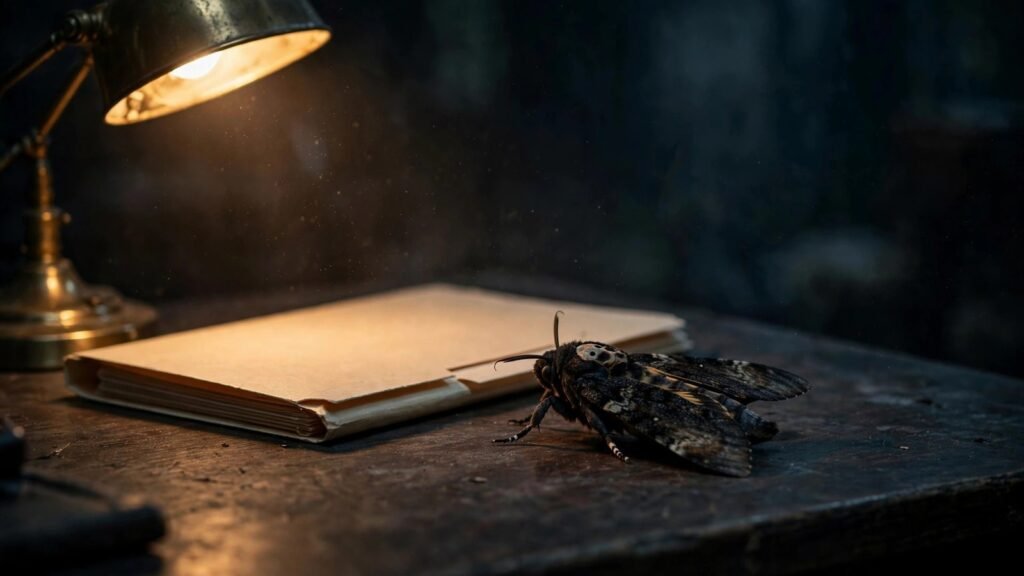
The death’s-head moth, placed in victims’ throats: “the significance of the moth is change: caterpillar into chrysalis, or pupa, and from thence into beauty. Our Billy wants to change, too.” Criticism links the moth’s transformation to her arc — trainee into agent, haunted child into rescuer.
The dark basement: alone, blind, stalked by a man who can see her, she wins by hearing his revolver’s hammer cock and firing first — competence by ear, terrified and accurate. “I have no plans to call on you”: the closing call — Lecter’s courteous guarantee against her plain refusal to stop hunting him — fixes their iconography: mutual respect between hunter and monster. The novel gives a letter from St. Louis, not a call.
Why she matters
AFI’s No. 6 hero — and its highest-ranked heroine. On AFI’s 100 Years…100 Heroes & Villains (June 3, 2003), Clarice Starling (Jodie Foster) ranks No. 6 of the fifty heroes — behind Atticus Finch, Indiana Jones, James Bond, Rick Blaine and Will Kane; ahead of Rocky Balboa and, at No. 8, Ellen Ripley — while Lecter is the list’s No. 1 villain.
The prototype female FBI agent — attributed criticism. An OhioLink-hosted thesis on the female FBI agent in Hollywood thrillers (1991–2008) heads a chapter “Clarice Starling: The Prototype”: she set the template later women agents were written against. The same scholarship resists the “final girl” label as “difficult” — she hunts and kills Bill at the FBI’s behest, an agent of the state; her competence is professional, not the slasher survivor’s improvisation.
Feminist hero — contested, on the record both ways. Foster claimed it at the podium (“an incredibly strong and beautiful feminist hero”). AWFJ’s 30th-anniversary piece credits Demme and Tally with putting “viewers in Clarice’s shoes,” reading her as surpassing the surrounding men “in both intelligence/perception and dedication” yet recognisably human and flawed. The counter-case: the quid pro quo trades intimate exposure for a man’s superior insight, and questions whether a heroine who never defeats Lecter can be a feminist heroine. A live argument — both positions attributed, neither settled.
A heroine who wins as a woman, not an honorary man — attributed criticism. Surveys contrast her with the masculinised action heroine: Foster’s Starling prevails through intuition, empathy and endurance — “vulnerable” and “impressively subtle” — the model for a feminised line of heroines against the Ripley/Connor line. Three performers across thirty years, an Oscar for the first: she is the element every rights-holder needed.
Trivia
- Her middle initial is “M.” — no work expands it; never invent one.
- It is “Clarice Starling,” not “Clarise”; the killer’s given name is Jame Gumb (“James” is an error); his alias is Jack Gordon; “Buffalo Bill” is the press/FBI nickname, not a second killer.
- No novel or film states her birth date; fan sources print three contradictory ones (December 23, 1958; December 23, 1961; December 20, 1961).
- The novel calls her “top quarter of her class” at Quantico — never “first in her class.”
Related links
- The Silence of the Lambs
- Hannibal (2001)
- Buffalo Bill
- Hannibal Lecter
- Hannibal Lecter Series
- Jodie Foster
- Julianne Moore
- Thomas Harris
- Jonathan Demme
- Anthony Hopkins
- Ted Levine
- Red Dragon
- Hannibal Rising (2007)
- Manhunter
- Horror Characters
- Horror Actors
- Horror Directors
- Horror Movies
- Horror Franchises