
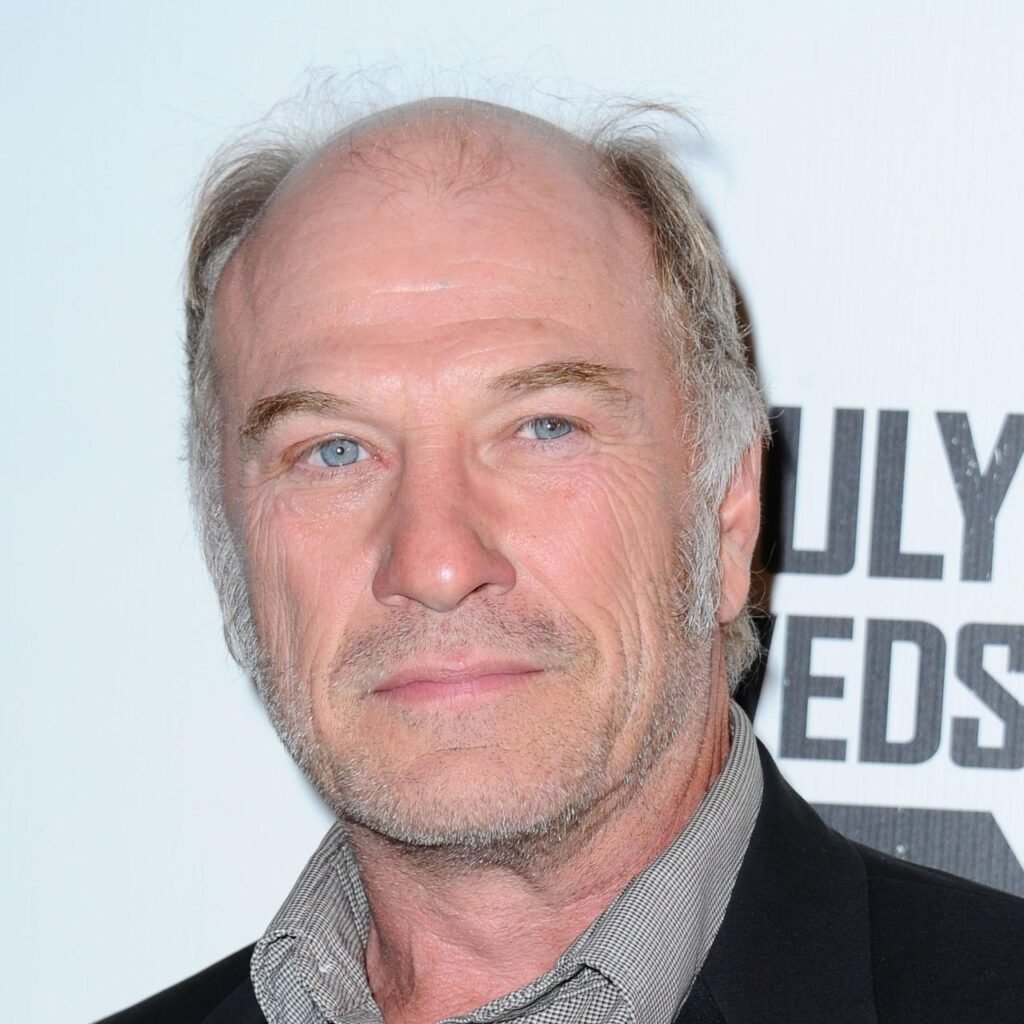
Ted Levine (born 1957) is the American actor who played Buffalo Bill in The Silence of the Lambs and Captain Stottlemeyer on Monk.
Quick Specs
| Born | May 29, 1957, Bellaire, Ohio (as Frank Theodore Levine) |
| Raised | Oak Park, Illinois |
| Training | Marlboro College (enrolled 1975, left to act); the Chicago stage, including Remains Theatre and Steppenwolf |
| Horror | Jame “Buffalo Bill” Gumb in The Silence of the Lambs (1991); Officer John Hunton in The Mangler (1995); voice of Rusty Nail in Joy Ride (2001, uncredited); Big Bob Carter in The Hills Have Eyes (2006); Thomas Blackburn in Banshee Chapter (2013); Julien Mayfair in Mayfair Witches (2025) |
| Signature roles | Frank Holman in Crime Story (1986 to 1988); Detective Mike Bosko in Heat (1995); Captain Leland Stottlemeyer in Monk (2002 to 2009) and Mr. Monk’s Last Case (2023); Ken Wheatley in Jurassic World: Fallen Kingdom (2018); John Brennan in The Report (2019) |
| Voice | Sinestro in the DC animated series, from Superman: The Animated Series to Justice League Unlimited |
| Honours | Screen Actors Guild ensemble nomination for American Gangster (2007); Best Actor, Beaufort International Film Festival, for Dig Two Graves (2015) |
Who He Is
Frank Theodore Levine was born on May 29, 1957, in Bellaire, Ohio, the son of Charlotte Virginia (Clark) Levine and Milton Dmitri Levine, both doctors. His father was of Russian-Jewish descent and his mother of Welsh and Native American ancestry, and Levine calls himself a “hillbilly Jew.” He grew up in Oak Park, Illinois. “I wasn’t smart enough to be a doctor. None of us were,” he has said. His brother David, “a junkie and a writer” in Levine’s description, has been a source for more than one of his performances.
He enrolled at Marlboro College in Vermont in 1975 and dropped out to act. The moment he was hooked came at the University of Illinois, where, planning to go back to school, “I thought I’d be a zoologist or an ornithologist,” he walked into the campus theatre, went out on the stage, made some noises, and that was that.
His real education was the stage. He toured nationally as Sergeant Toomey in Biloxi Blues and settled in Chicago, where he joined the Remains Theatre ensemble, co-founded in 1979 by William Petersen with a group of fellow actors that included Gary Cole and Amy Morton. He worked at the Goodman and Steppenwolf. The lesson has stayed his credo: “the best things I’ve been involved with have been when everyone was pulling their weight and telling the story.”
He has two children, a son and a daughter, with Kim Phillips, and he lives out in the country and rides horses.
The Work, and What He Did in It
His first screen role was a patrolman in Through Naked Eyes (1983), and he kept getting uniforms. The first real role came through a party he was not invited to. Touring in Miami, he bet a castmate he could get them into the wrap party for Michael Mann’s Manhunter, and had the bouncer announce “a friend of Billy Petersen is here.” It worked, and Mann remembered him. Mann’s office later called him in for Crime Story (NBC, 1986 to 1988), where he played the mob enforcer Frank Holman. Holman “was a liar,” Levine said; “every situation he was in, he was basically lying.” Small film parts followed, among them Ironweed (1987) and Betrayed (1988).
The Silence of the Lambs (1991) changed everything. Jonathan Demme directed Ted Tally’s adaptation of Thomas Harris’s novel, with Jodie Foster as Clarice Starling and Anthony Hopkins as Hannibal Lecter, and Levine, 33 at the US opening on February 14, 1991, plays the killer the film hunts: Jame Gumb, called Buffalo Bill, a former tailor sewing a suit of women’s skin, who keeps a senator’s daughter, Catherine (Brooke Smith), in a dry well in his basement and leaves death’s-head moth cocoons in his victims’ throats. The name is Jame.
He got the part as one of three finalists, reading with Smith, who was already cast and read Foster’s lines opposite him. “When Ted walked in, it was so crazily obvious,” Smith said. Levine’s memory: “I just pulled something out. It was scary. It felt kind of magical.” Hitting it off with Smith at the audition, he said, made it easier “to make a separation between that insane misogyny and the actual person.”
He built Gumb in layers. His instrument is a deep baritone, and for Gumb he throttled it into something softer, strained and childlike: a man audibly trying on a voice that is not his, to match a man trying on a skin that is not his. The body is heavy, slouching and unglamorous, the opposite pole from Lecter’s stillness, because he built Gumb as pathetic before powerful. The pit scenes, the lotion and the basket, are delivered downward into the well in that flattened register, and the delivery, not the line alone, is what audiences took away. At the end Gumb stalks Clarice in darkness through night-vision goggles and gives himself away by cocking his revolver; she turns and kills him. The killer defined by sound dies because of a sound he makes.
The most famous scene was his idea. Alone while Catherine is below, Gumb makes himself up before a video camera, lipstick, a nipple ring, a victim’s scalp as a wig, and asks his reflection, “Would you f--- me? I’d f--- me. I’d f--- me so hard,” then dances, tucked, to “Goodbye Horses.” The dance comes from chapter 20 of Harris’s novel and was not in the original script; Levine, who had “read the book a whole lot,” asked for it to be put in. He rehearsed it to Bob Seger’s “Her Strut,” and songs by Bowie and Jagger were considered. The song Demme used was “Goodbye Horses,” written by William Garvey and performed by Q Lazzarus, his bandmate, whose demo Demme first heard in 1985 when she played it for him in the New York taxi she was driving. Against “Her Strut,” Levine said, the scene became “a little gentler,” “stranger” and “more feminine.” He called the dancing Gumb “a would-be glitter rocker,” and said it made “this psychotic monster accessible, in a strange sort of way. But in a weirdly gentle sort of way.” Q Lazzarus died in 2022, aged 61. Family Guy, Clerks II and Jay and Silent Bob Reboot have all parodied the scene.
Harris built Gumb from three real killers: Ed Gein for the skin, Gary Heidnik for the women in a basement pit, which directly inspired the film’s design, and Ted Bundy for the feigned-injury ruse, Gumb’s arm in a cast, asking Catherine to help with a sofa. The film made $272.7 million worldwide on a $19 million budget and swept the five major Oscars, Picture, Director, Actor, Actress and Adapted Screenplay, the third film ever to do so and still the only horror film to win Best Picture. It entered the National Film Registry in 2011. Levine was not nominated.
The character has been argued over from the start. In the film, Lecter’s profile says Gumb is not a genuine transsexual but believes he is, having been rejected by clinics, and Demme defended him as “a tormented man.” Levine has been consistent about his reading: “I didn’t play him as being gay or trans. I think he was just a f---ed-up heterosexual man.” In February 2026, at 68, for the film’s 35th anniversary, he told The Hollywood Reporter the other half: “There are certain aspects of the movie that don’t hold up too well. I’m a lot wiser about transgender issues. It’s unfortunate that the film vilified that, and it’s f---ing wrong. And you can quote me on that.” He did not disown the performance.
Then came the typecasting. “I was just getting offered rapists and killers and all that sh--,” he said. The decade’s answer was three films. In Tobe Hooper’s The Mangler (1995), from Stephen King’s story, he led a horror film as its investigator, not its monster: Officer John Hunton, looking into deaths around a possessed laundry press, opposite Robert Englund as its owner. It finished with $1.78 million domestic, a flop and Hooper’s last wide US release. In Georgia (1995) he played the supportive husband of Mare Winningham’s Georgia, because Jennifer Jason Leigh fought for him: “She grabbed ahold of the wheels of the bus and helped me turn it.” And for Mann’s Heat (1995), offered the unhinged crew member, he said no: “I’d rather play Bosko.” Mann agreed, and Levine played Detective Mike Bosko.
The voice became a career of its own. In John Dahl’s Joy Ride (2001) he is “Rusty Nail,” the CB-radio trucker who terrorises Paul Walker and Steve Zahn and is never properly seen. The performance is voice only, uncredited, recorded entirely in post-production; the body glimpsed on camera is Matthew Kimbrough’s. “I didn’t even meet him on Joy Ride,” he said of Walker. The same year he was Walker’s police superior on camera in The Fast and the Furious. For DC animation he was Sinestro, from Superman: The Animated Series to Justice League Unlimited.
Monk (USA, 2002 to 2009) was the second defining role. In Andy Breckman’s series, with Tony Shalhoub as the detective, Levine played Captain Leland Stottlemeyer for eight seasons and 125 episodes, from the premiere on July 12, 2002, when he was 45. “At first, he was a bit of a sh--, and it kind of evolved to where he became more compassionate toward Monk and enabled him,” he said. It was, he said, a show “a kid could watch with their grandma and enjoy it. I was really proud of that show, and, ultimately, of Stottlemeyer.” He played him again in Mr. Monk’s Last Case (2023). For eight years horror’s most famous basement face belonged to television’s most decent boss.
Around Monk he went back to horror as a father, “Big Bob” Carter, the patriarch in Alexandre Aja’s remake of The Hills Have Eyes (2006), which made $70 million on $15 million. He was in American Gangster (2007), whose cast was nominated by the Screen Actors Guild, and was the Warden in Martin Scorsese’s Shutter Island (2010).
The later work keeps widening. He led the indie horror film Banshee Chapter (2013) as Thomas Blackburn, a Hunter S. Thompson-like writer he built on his brother instead: “You can say ‘David Levine-esque’.” In Jurassic World: Fallen Kingdom (2018), at 61, he is Ken Wheatley, the mercenary hunter who pulls teeth from his kills; he reaches into the caged Indoraptor for a tooth, and the animal, feigning unconsciousness, takes his arm and kills him. The film made $1.31 billion worldwide. In The Report (2019) he played the CIA director John Brennan, and in Big Sky (2021) Horst Kleinsasser; Brooke Smith is in that series too, but they share no episodes. In 2025 he joined Mayfair Witches as Julien Mayfair.
Cool Verified Facts
- His character’s name is Jame Gumb, not James or Jamie.
- The “Goodbye Horses” dance was his request, restored from chapter 20 of the novel.
- He rehearsed the dance to Bob Seger’s “Her Strut.”
- He is the uncredited voice of Rusty Nail in Joy Ride and never met Paul Walker on that film.
- He crashed the Manhunter wrap party, and it led to his first real television role, for Michael Mann.
- He turned down the Waingro part in Heat to play Detective Bosko.
- The Silence of the Lambs won all five major Oscars, and he was not nominated.
Signatures, Habits and Behind the Scenes
His Buffalo Bill preparation is documented in his own words, without the folklore. He read profiles of real serial killers, and “to this day I find myself having unpleasant dreams about the things I found out.” He went to transvestite and transgender bars and talked with regulars about transformation as performance. He studied a tape of Gary Heidnik, and built part of Gumb’s self-image on David Bowie: “I think Gumb at one point thought that he might be a rock star in the mode of a David Bowie.” For the dance he shaved his body, “I did a little Brazilian on myself. That wasn’t fun.”
He improvises inside an ensemble, and says so. On Crime Story, “I did a lot of improvising, and the writers picked up on that.” On Banshee Chapter, “Some of it stayed. A lot of it didn’t.” On Monk, eight seasons became “a file cabinet full of choices, which sort of define the character.” The other side of the Remains lesson: “the sh--tiest things I’ve been involved with have been with people who were stars.”
The baritone has three settings: suppressed and strained for Gumb, unleashed and faceless for Rusty Nail, aristocratic for Sinestro.
He tells the best story about his other horror lead himself. In South Africa he and Hooper inspected the built Mangler: “it looked like the 4-H had built a f---ing float,” and Hooper said he could not use it, because it was funny and it was not supposed to be funny. A primitive computer-generated effect replaced it. His verdict: “The Mangler has some merit, for those who appreciate a schlocky kind of grade-D horror movie. I know I do!” There is no record of him as difficult; by his account the Silence set was “very cool.”
Why He Matters
Ted Levine played the killer the prestige era could not absorb. The Silence of the Lambs is still the only horror film to win Best Picture, and its engine is not Lecter, who advises, but Gumb, who acts. Hopkins became the quoted icon; Levine became the imitated one, the lotion, the basket, the dance. Buffalo Bill is where the screen serial killer stopped being a mastermind in a cell and became a working man with a sewing room, pathetic, methodical and permanently frightening.
He is also the test case for escaping a horror performance. Typecast into rapists and killers, he refused Waingro and took the husband, the detective, the astronaut and eight seasons as Monk’s captain, and in his sixties still died memorably in a billion-dollar dinosaur film and played a real CIA director. The voice has its own filmography, an uncredited radio killer and a DC arch-villain, in a career whose defining role was built by withholding that same voice.
And at 35 years he has publicly re-read his own legend, keeping his reading of the character while condemning the vilification in the same breath. That is the right closing note for a living page.