
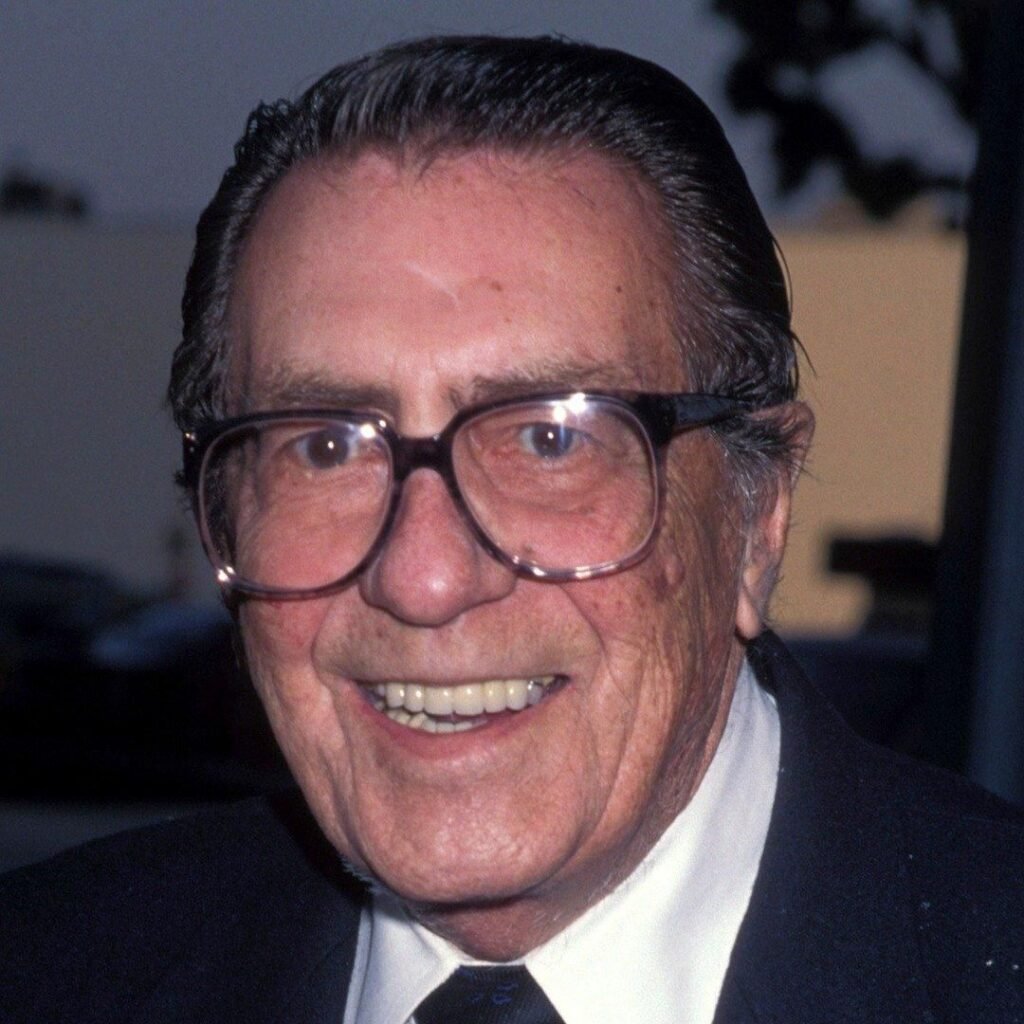
Joseph Stefano (1922–2006) was the screenwriter who rebuilt Psycho from the inside — moving Marion Crane to the front of the story, the theft into the audience’s own hands, and Norman Bates, impossibly, into the audience’s heart. Alfred Hitchcock directed Psycho and Robert Bloch originated it, but the film you actually experience — the girl you get to know, the murder that lands like a theft of your own, the boyish killer you catch yourself protecting — is Stefano’s architecture. Then he walked away from a second Hitchcock film to run a television anthology, and built another classic there. His contribution is often neglected. Not here.
South Philadelphia to the Song Trade
Joseph William Stefano was born on 5 May 1922 in Philadelphia, Pennsylvania — Philadelphia, full stop; the Camden, New Jersey version that floats around has no source behind it in the serious record. He graduated from South Philadelphia High School (for Boys) in 1940, aged eighteen, and went to New York as an aspiring entertainer: he played piano, sang, danced, and wrote music and lyrics. He toured with a modern dance troupe and worked temporary jobs as a typist while pursuing performing work. There is no conservatory or film school in this story. His formation was the entertainment trade itself.
Through the 1940s he worked as a composer of pop music — the career he expected to have. Screenwriting came late to it. In 1953, in a Manhattan bar, he met Marilyn Epstein; the Associated Press obituary, quoting her account, tells it as a jukebox story — the stranger in the black jacket told her, “Play that one, I wrote it.” They married soon after, and she is attested as his wife throughout the Hitchcock-scholarship record. Stefano died on 25 August 2006 in Thousand Oaks, California, aged 84, survived by Marilyn and their son Dominic. The cause of his death was not disclosed, and this page states nothing beyond that.
One Feature Credit, Then Hitchcock Called
His big break was television: hired as a writer for the Ted Mack Family Hour in the 1950s. His first feature screenplay was The Black Orchid (1958) — Martin Ritt directing, Sophia Loren and Anthony Quinn starring — a melodrama rooted in his Italian-American material. (It is The Black Orchid. At least one sloppy lineage renames it “The Black Dahlia,” which is a different film and a different decade’s scandal.) One feature credit was the whole of his film résumé when Hitchcock hired him — because the first attempt at adapting Bloch’s novel, by Alfred Hitchcock Presents writer James P. Cavanagh, had been rejected by Hitchcock as dull and dragging. Stefano got the meeting, and won the job with his reshaping of the material.
What He Did to Psycho
First, the credit discipline, because everything else hangs on it: Robert Bloch wrote the 1959 novel Psycho; Stefano wrote the 1960 screenplay adapting it. He never wrote a Psycho novel. Bloch never wrote the film’s screenplay. And Stefano received no Oscar nomination for the work — the film’s four Academy Award nominations went to Hitchcock, Janet Leigh, the cinematography and the art direction. Now, the documented changes, which are the heart of his career:
He moved Marion Crane to the front of the story. Bloch’s novel opens at the motel, with Norman. Stefano and Hitchcock open with Marion’s life and do not introduce Bates until roughly twenty minutes in — expanding Marion’s material from two of the novel’s seventeen chapters to nearly half the film’s narrative.
He invented the opening situation. The lunchtime hotel tryst between Marion Crane and Sam, and Marion’s theft as the film stages them, are not in the novel. Stefano’s stated logic: audiences would be “sucked into a character who did something wrong but was really a good person… They would feel as if they, not Marion, had stolen the money. When she dies, the audience would be the victim.” That is not plotting. That is engineering complicity.
He made Marion sympathetic before killing her — because his pitch to Alfred Hitchcock was that he could not care about “a horrendous murder of a stranger I didn’t care about either.” His summary of the whole method, given to the Los Angeles Times: Bloch’s novel “started with Marion Crane arriving at the motel and immediately being killed. My feeling was that, since I did not know anything about this girl, I wasn’t going to care about her when she was killed. So we backed the story up a bit.”
He rebuilt Norman Bates. Bloch’s Norman — as Robert Bloch wrote him — is middle-aged, around forty, plump, balding, bespectacled, a drinker, overtly unstable. Stefano could not get involved with that man — “I really could not get involved with a man in his 40s who is drunk and peeps through holes” — and became intrigued by the character when Hitchcock suggested casting Anthony Perkins. So Stefano eliminated Norman’s drinking, and with it the novel’s mechanism of drunken “becoming Mother,” and removed Norman’s interests in spiritualism, the occult and pornography. What remained was boyish, shy, and fatally easy to forgive.
He engineered the sympathy transfer. For Stefano, the parlour conversation — Marion showing maternal sympathy toward Norman — is what makes it possible for the audience to switch its sympathies to Norman after her murder. Complicity, bereavement, adoption: one move in three beats, and the most influential piece of horror screenwriting ever done. His next feature was The Naked Edge (1961), a thriller starring Gary Cooper. Then came the hinge decision of his life.
The Road Not Taken: The Outer Limits
Stefano turned down an offer to write another Hitchcock film in order to do The Outer Limits. Which film did he decline? The sources in this record disagree — the Hitchcock Wiki lineage says Marnie; the PopMatters account says The Birds — so this page states the decline and names the disagreement rather than printing one title as settled fact. What is certain: he wrote no second Hitchcock film, and any source listing The Birds among his screenplays is in error.
And the role he chose instead needs stating exactly, because the common version inflates it in one place and shrinks it in another. The Outer Limits was created by Leslie Stevens, who wrote and directed the pilot, “The Galaxy Being.” Stefano did not write the pilot — not the outline, not a draft, none of it. What happened is that Stevens, busy with Stoney Burke, recruited Stefano in a late-night phone call — pitching the series to him together with composer and producer Dominic Frontiere — to come on as a writer and producer. Stefano had never produced before. As Season 1’s producer he became the show’s creative guiding force and wrote more episodes than any other writer on the series, “The Zanti Misfits” among them.
What he did to the format is the television form of his Psycho belief. He insisted every Season 1 episode carry a monster or creature as a critical part of the storyline — the device he called “the bear” — believing it necessary to provide fear, suspense, or at least a centre for plot development. Season 1 consequently combined science fiction and horror; after he left, Season 2 dropped the bear and turned to harder science fiction. Bright Lights Film Journal adds the tonal layer: as hands-on producer he overlaid the season with the same Gothic, noir, Freudian feeling that had saturated his Psycho screenplay, hiring veteran film directors and shooting in Conrad Hall’s black-and-white — Stefano, a Val Lewton admirer by his own statement, making television the way Lewton made films. He left after Season 1; the standard accounts cite network interference and exhaustion, and the reasons are printed here as attributed, because that is what they are.
The Long Middle and the Return
After Eye of the Cat (1969) and Futz! (1969), the latter co-written with Rochelle Owens, came the long middle: television movies, including Home for the Holidays (1972) and Snowbeast (1977) — working television, not features, for the better part of two decades. A late feature credit, The Kindred (1987), returned him to horror on the big screen, and he served as a writer and executive producer on the Swamp Thing television series in the early 1990s.
Then the return that closes the circle. Psycho IV: The Beginning (1990), directed by Mick Garris and premiered on Showtime on 10 November 1990, is both the third sequel and a prequel: Anthony Perkins’ final appearance as Norman Bates, flashbacks to Norman’s youth and his mother Norma, and a present-day Norman fearing his unborn child will inherit his illness. Stefano, the original film’s screenwriter, wrote Norman’s ending as well as his beginning — thirty years apart. Discipline, one more time: he had no involvement in Psycho II (1983) or Psycho III (1986). His name is on no credit for either. The return is Psycho IV only.
His last personal film was Two Bits (1995) — written and executive-produced by Stefano, directed by James Foley, with Al Pacino as the grandfather and young Jerry Barone as Gennaro, the boy who needs a quarter for the new movie palace in 1930s South Philadelphia. It is a semi-autobiographical return to his own childhood material — the same Italian-American vein as The Black Orchid, nearly four decades earlier. And its reception must be stated as honestly as its intentions: it fared poorly at the box office and with critics on release. Leonard Maltin’s verdict is the fair summary of its mixed notices: “written with feeling… but too slow and delicate to realize its full potential.” A personal late work with admirers — never an acclaimed comeback, and this page won’t dress it as one. In 1998, Gus Van Sant’s near shot-for-shot remake of Psycho was made from Stefano’s 1960 script — a reuse of his screenplay, produced a second time by a second director, not new 1998 writing by him. Between the remake and Two Bits‘ reception, the record shows him less than enthusiastic about continuing to write for modern Hollywood.
How He Wrote: Sympathy as a Weapon
His whole method is one move repeated at different scales. Make the audience complicit — the theft they feel they committed. Make them bereaved — the murder that makes the audience the victim. Make them adopt the murderer — the parlour scene that hands their loyalty to Norman. On The Outer Limits, the same belief wore a different costume: the monster is the centre, not the garnish — the frightening thing carries the story’s weight.
Two attributed pieces of colour belong with the method. Stefano wrote Psycho while in therapy, working on his relationship with his own mother, and multiple accounts report that this fed his handling of Norman and Mother — his own oft-retold account, printed here as his account, not as clinical fact about the writing process. And like Bernard Herrmann, he did defining work while the credit culture looked elsewhere. The Italian-American vein bookends it all: first feature and last personal film, thirty-seven years apart, both drawn from the South Philadelphia families he came from.
Why Stefano Matters to Horror
He is the un-credited-in-the-public-mind author of Psycho‘s structure — the version of the story audiences actually carry in their bones. He wrote Norman Bates twice, thirty years apart, the only writer to open and close the original Psycho cycle. He imported film horror into television, running an anthology on Gothic atmosphere, Freudian psychology and a compulsory monster — Psycho‘s sensibility rebuilt for weekly TV by Psycho‘s own writer, in 1963. And his script has already outlived its film once: the 1998 remake’s shot-for-shot method meant his 1960 screenplay was, in effect, produced twice. No other horror screenwriter of his generation quite shares that distinction.
Trivia
- He met his wife Marilyn in a Manhattan bar in 1953 — by her account, quoted in his Associated Press obituary, the stranger in the black jacket told her “Play that one, I wrote it,” about a song on the jukebox.
- He had never produced anything before Leslie Stevens’ late-night phone call made him The Outer Limits‘ Season 1 producer.
- His monster-in-every-episode doctrine on The Outer Limits had a name inside the production: “the bear.”
FAQ
Did Joseph Stefano write the Psycho novel?
No. Robert Bloch wrote the 1959 novel. Stefano wrote the 1960 screenplay that adapts it — the two credits are distinct, and so are the two men’s contributions.
Did Stefano write The Outer Limits pilot, “The Galaxy Being”?
No. Series creator Leslie Stevens wrote and directed the pilot. Stefano joined as Season 1 producer and chief writer — the show’s creative guiding force who wrote more episodes than anyone — from the series proper onward.
Was Stefano involved in Psycho II or Psycho III?
No — no credit on either sequel. His return was Psycho IV: The Beginning (1990), written as both prequel and third sequel.
Was Stefano Oscar-nominated for Psycho?
No. The screenplay received no nomination; the film’s four nominations were for direction, supporting actress, cinematography and art direction.