
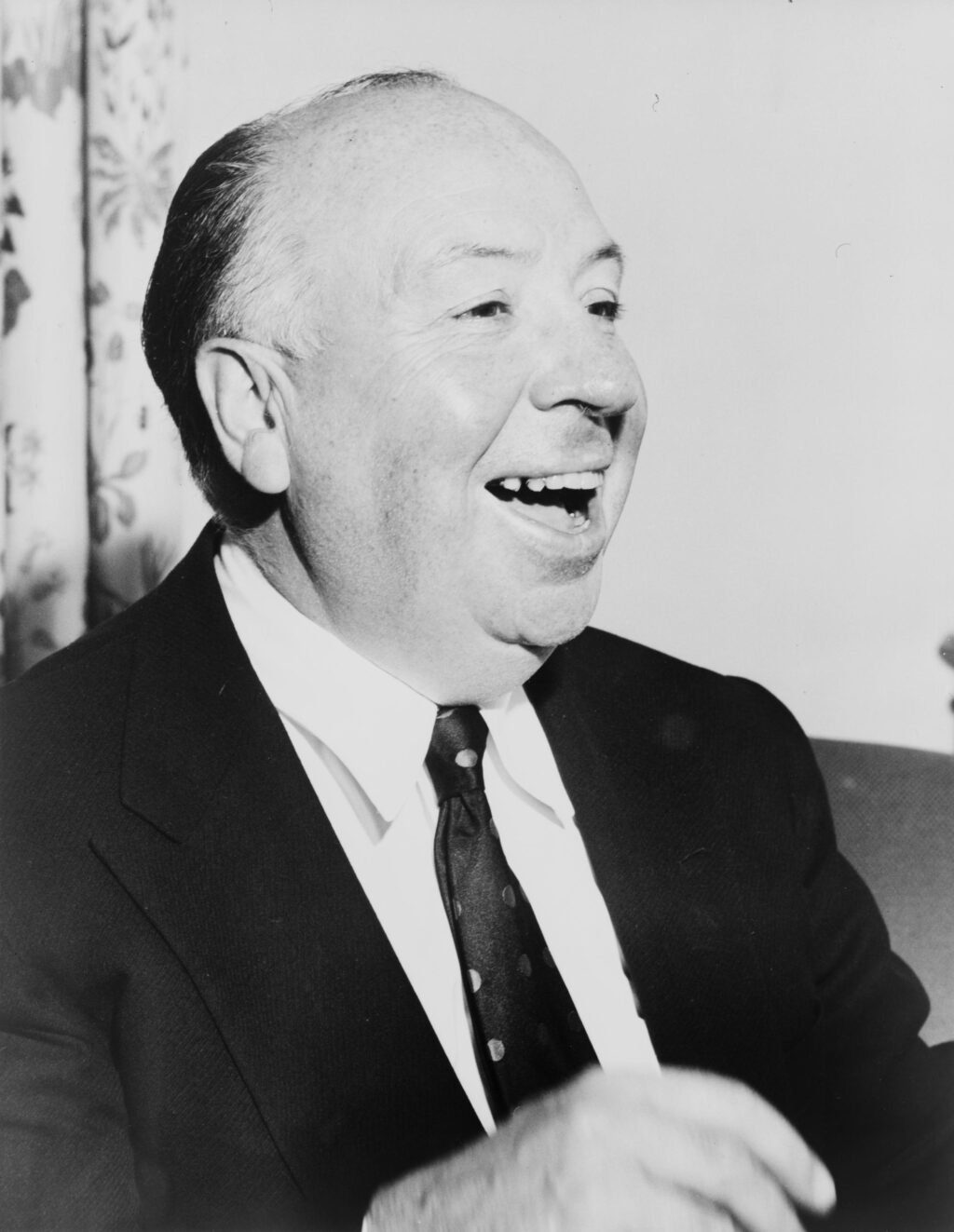
Alfred Hitchcock (1899 to 1980) was the English director and producer who made Psycho and turned suspense into a system.
Quick Specs
| Born | August 13, 1899, Leytonstone, London, England (as Alfred Joseph Hitchcock) |
| Died | April 29, 1980, at his home in Los Angeles, California, aged 80 |
| Schooling | Educated by Jesuits at St Ignatius College |
| First film job | Title-card designer at Famous Players-Lasky, London (1919 to 1920) |
| First completed feature | The Pleasure Garden (1925) |
| Directed | More than 50 features, 1925 to 1976 (commonly cited as 53) |
| Horror | Psycho (1960); The Birds (1963) |
| Key films | The Lodger (1927); Blackmail (1929); The 39 Steps (1935); The Lady Vanishes (1938); Rebecca (1940); Shadow of a Doubt (1943); Notorious (1946); Strangers on a Train (1951); Rear Window (1954); Vertigo (1958); North by Northwest (1959); Frenzy (1972) |
| Television | Alfred Hitchcock Presents (1955 to 1962), then The Alfred Hitchcock Hour |
| Academy Awards | Five Best Director nominations, no competitive win; Irving G. Thalberg Memorial Award (1968 ceremony) |
| Other honours | First BAFTA Fellowship (1971); AFI Life Achievement Award (1979); KBE (1980 New Year Honours) |
| Family | Married Alma Reville (December 1926); daughter Patricia Hitchcock (born July 7, 1928) |
Who He Was
Alfred Joseph Hitchcock was born on August 13, 1899, in Leytonstone, London, in the flat above his parents’ greengrocer’s shop at 517 High Road. His father, William Hitchcock, was a greengrocer, and his mother was Emma. He was raised a strict Catholic and educated by Jesuits at St Ignatius College. The world knew him later simply as “Hitch.”
He liked to tell the story that his father once sent him to the local police station with a note, and that the young Alfred was locked in a cell for several minutes “to learn.” It is his own anecdote, told with variations over the years, and it is the explanation he and others offered for a lifelong fear of the police.
In 1915 he went to work as an estimator for the Henley Telegraph and Cable Company. Those engineering and draughtsman years taught him to plan on paper before anything was built, and he never lost the habit. By 1919 to 1920 he was at the London studio of Famous Players-Lasky, illustrating title cards for silent films. There he learned scripting, editing and art direction, and by 1922 he had risen to assistant director.
He married Alma Reville in December 1926. She had worked beside him since the Famous Players-Lasky and Gainsborough years and remained his closest collaborator for the rest of his life. Their daughter, Patricia Hitchcock, was born on July 7, 1928, and she appears in three of her father’s films: Stage Fright (1950), Strangers on a Train (1951) and Psycho (1960), where she plays Marion Crane’s co-worker Caroline.
In 1939 he signed with David O. Selznick and moved to Hollywood. He became a US citizen in 1955, the year Alfred Hitchcock Presents went on the air.
The honours came late, and in an order worth stating exactly. In 1971 he received the first BAFTA Fellowship ever given. In 1979 the American Film Institute gave him its Life Achievement Award. In the 1980 New Year Honours he was appointed a Knight Commander of the Order of the British Empire for his contributions to the film industry.
He died at his home in Los Angeles on April 29, 1980, aged 80. The cause is reported two ways. Obituaries at the time said his doctors attributed the death to liver failure and heart problems; some later references say renal failure. Nine of his films stood in the US National Film Registry as of 2021: Rebecca, Shadow of a Doubt, Notorious, Strangers on a Train, Rear Window, Vertigo, North by Northwest, Psycho and The Birds.
The Work, and What He Did in It
His “first film” has three separate answers, and they should not be merged. His first job in film was designing title cards at Famous Players-Lasky, and the credits for that work run from 1920 to 1922 across a dozen productions. His first attempt at directing, Number 13 (1922), was abandoned unfinished when the money ran out, and it never counts as a completed film. He also finished Always Tell Your Wife (1923), standing in for its director, who had fallen ill. His first completed feature as director is The Pleasure Garden (1925).
Before that came the apprentice years, from 1920 to 1925, and he did nearly every job on the floor. He was title designer, then screenwriter, art director and assistant director, mostly for the director Graham Cutts at Gainsborough, on Woman to Woman, The White Shadow, The Prude’s Fall, The Passionate Adventure and The Blackguard. By the time he directed, he had personally done almost every craft job on a silent production. That technical completeness is what lay behind the total control of his later career.
The films that built the system:
- The Pleasure Garden (1925): his first completed feature, an Anglo-German production shot in Munich. It was followed by The Mountain Eagle (1926), which is now lost.
- The Lodger: A Story of the London Fog (1927): the breakthrough, a story of suspicion set in Jack the Ripper’s London. It is the prototype of the classic Hitchcock plot, an innocent man falsely accused. It has the wrong-man engine, the subjective camera and his first cameo. It is the template for the next fifty years in one silent film.
- Blackmail (1929): his last silent and his first sound film. Begun as a silent and partly reshot with dialogue, it is the standard citation for Britain’s first talkie feature. He used sound as a weapon at once. In the famous breakfast scene the word “knife” swells out of a wash of chatter, the first great sound-design set-piece in British cinema.
- The Man Who Knew Too Much (1934): the film that established a favorite pattern, an investigation of family relationships inside a suspense story.
- The 39 Steps (1935): a stylish and efficiently told chase, the wrong-man chase in its mature form. Secret Agent and Sabotage followed in 1936.
- The Lady Vanishes (1938): sleek, exemplary Hitchcock: fast-paced, witty and magnificently entertaining.
Across that decade he fixed the grammar. Ordinary people are dropped into a conspiracy. Set-pieces are staged at famous landmarks. The audience is given information before the characters have it.
The American years began with a Best Picture. Rebecca (1940) was his first film under the Selznick contract, and it won the Academy Award for Best Picture. That award goes to the producer, Selznick, and it was not a directing Oscar. Hitchcock earned his first Best Director nomination for it and lost to John Ford for The Grapes of Wrath. The wartime run followed: Foreign Correspondent (1940), Suspicion (1941) and Saboteur (1942).
Shadow of a Doubt (1943) was shot in Santa Rosa, California, and is the story of a beloved uncle who turns out to be a murderer. He repeatedly named it as his own favorite of his films. Lifeboat (1944) set an entire film in one boat and brought his second Best Director nomination. With nine people in a boat, he solved the cameo problem by appearing in a photograph in a newspaper weight-loss ad. Spellbound (1945), with its Salvador Dalí dream sequence, was his third nomination.
Notorious (1946) has the famous crane-to-kiss shot. Rope (1948) was his first Technicolor film and the first from his own company, Transatlantic Pictures, built to look like a single continuous take playing out in real time. The entertainer was also a formal experimenter, and these two films show both sides.
Then came the great 1950s run:
- Strangers on a Train (1951), from Patricia Highsmith’s novel: two strangers and a criss-cross murder bargain.
- Dial M for Murder (1954), shot in 3D.
- Rear Window (1954), his fourth Best Director nomination and the purest statement of his theme of voyeurism. A photographer with a broken leg watches his neighbors, and the audience is locked in the chair beside him.
- To Catch a Thief (1955).
- The Wrong Man (1956), deliberately unglamorous, with Henry Fonda as a real-life wrongly accused man, shot in a documentary manner.
- The Man Who Knew Too Much (1956): he remade his own 1934 film, bigger and in VistaVision, with an Albert Hall climax built around Arthur Benjamin’s Storm Clouds Cantata. The cantata is Benjamin’s, not Bernard Herrmann’s.
Vertigo (1958) is the slow coronation. James Stewart plays an acrophobic detective hired to follow a friend’s wife, played by Kim Novak. Hitchcock rendered the fear of heights with the dolly-zoom, now called the “Vertigo effect,” and played a recognition scene on Herrmann’s music with no dialogue at all. It drew mixed notices and modest returns on release. In the 2012 BFI Sight and Sound critics’ poll it was voted No. 1, displacing Citizen Kane after fifty years at the top. In the 2022 poll it ranked second, behind Jeanne Dielman.
North by Northwest (1959) is the wrong-man chase perfected as entertainment: Cary Grant, the crop-duster and Mount Rushmore. Herrmann’s score famously withholds music from the crop-duster attack until the crash.
Psycho (1960) is the horror centrepiece. When Paramount balked at the material, he financed the film cheaply himself, through his own Shamley Productions, and shot it at Revue Studios with his television crew. Specifically, he:
- bought the rights to Robert Bloch’s novel anonymously, so the price stayed low and the ending stayed secret;
- shot in black and white, fast and cheaply, on a budget of $806,947, against an eventual worldwide box office of about $50 million;
- enforced the no-late-admission policy, so that audiences could not enter after the film had started, a piece of showmanship that became part of the event;
- built the shower murder, 45 seconds that rewired horror;
- took an ownership stake in the film in place of his usual fee, which in the standard account made Psycho the most profitable film of his career.
The TV unit’s efficiency is why Psycho looks expensive and cost almost nothing. It brought his fifth and last Best Director nomination. Norman Bates is Robert Bloch’s creation before he is Hitchcock’s, and Joseph Stefano wrote the screenplay.
The Birds (1963), from Daphne du Maurier, has no conventional score. Herrmann served as sound consultant on its electronic bird sounds. Marnie (1964) was the last Herrmann score for a Hitchcock film.
Torn Curtain (1966) is the rupture. Under studio pressure for a saleable sound, Hitchcock rejected the score Herrmann delivered after hearing the prelude, and John Addison replaced him. The partnership was over: seven scores, a sound consultancy and one rejected score, the greatest director and composer partnership in film. That break is the seam between his classic period and his late one.
The late films are Topaz (1969); Frenzy (1972), a return to London and to form, a necktie-murder story shot in Covent Garden and widely received as his late comeback; and Family Plot (1976), his final film, a light thriller that closes the filmography on comedy rather than dread.
In all he directed more than 50 feature films. The commonly cited total is 53 directed features, a count that shifts by one or two depending on whether co-directed and unfinished work is included. Number 13, unfinished, never counts.
Cool Verified Facts
- He never won a competitive Academy Award. He was nominated for Best Director five times, for Rebecca, Lifeboat, Spellbound, Rear Window and Psycho, and lost every time. His Academy honour was the Irving G. Thalberg Memorial Award, presented at the 1968 ceremony.
- Rebecca won Best Picture, but that Oscar went to its producer, David O. Selznick. Best Director for 1940 went to John Ford.
- He was the first person to receive the BAFTA Fellowship, in 1971.
- His first completed feature, The Pleasure Garden, was shot in Munich.
- Blackmail began life as a silent and is the standard citation for Britain’s first talkie feature.
- Rope was his first Technicolor film.
- His daughter Patricia plays Caroline, Marion Crane’s co-worker, in Psycho.
- He did not coin the word “MacGuffin.” The screenwriter Angus MacPhail did. Hitchcock popularised it, and explained it endlessly, including with his lion-trap story for François Truffaut.
Signatures, Habits and Behind the Scenes
Suspense over surprise was his doctrine, and he explained it with a bomb. Suspense is developed by giving the audience information that the endangered characters do not have. If the audience knows a bomb is under the table, that is suspense. If the bomb simply explodes, that is surprise. He laid the theory out for François Truffaut, and every set-piece in his filmography runs on it.
The cameos began with The Lodger, where he is credited as an actor as well as director, and continued through most of his films. He misses a train, carries a cello case, and turns up in a newspaper ad when the whole set is a lifeboat. The appearances became so expected that he started placing them early in the film, so audiences would stop watching for him and start watching the movie. Published counts vary widely depending on what is counted, so the habit matters more than any total.
He storyboarded everything. The draughtsman from Henley’s and the title-card artist planned his films in drawings, to the point where he claimed the creative work was finished before shooting began and that filming itself bored him. The precision of the shower scene is the most famous product of that habit.
The Psycho gambles worked as a set. An anonymous rights purchase, his own money, a television crew, black and white, no late admissions and the star killed a third of the way in: the story behind Psycho is a producer’s masterclass, and it is production record, not lore.
His relationship with actors is summed up by a line he was teased with for decades. The famous version is that actors are cattle. In his own softened retelling, what he had said was that actors should be treated like cattle, meaning directed firmly, and his own stars never let him forget it.
The Herrmann partnership is the sound of the signature. Hitchcock’s images are inseparable from Bernard Herrmann’s ostinatos, and Hitchcock is quoted as estimating that “33% of the effect of Psycho was due to the music.” It is his attributed remark, not a measurement, but it says how much he knew he owed.
The television show made the man himself the brand. Alfred Hitchcock Presents ran from 1955 to 1962 and then became The Alfred Hitchcock Hour. His droll “Good evening” introductions, built around his own silhouette profile, made his face and voice known in every household. For a generation of viewers he was more recognizable than any of his actors.
Why He Matters
For horror, Psycho is the hinge of the whole genre. Before it, horror lived in castles, laboratories and other centuries. Hitchcock put it in a motel bathroom off a highway, killed his leading lady a third of the way in, and aimed the camera at the audience’s own voyeurism. The Birds then removed the explanation altogether and made horror a pure, unmotivated event. Every slasher, every motel and every shower scene since 1960 stands downstream of one cheap, fast, black-and-white production he financed himself.
For cinema as a whole, he is the director who made suspense a system: the audience knowing more than the characters, the wrong man, the set-piece at the landmark and the camera as Peeping Tom. Then he spent fifty years demonstrating it in public, cameo by cameo, until the director himself became the brand. The institutional record follows the same arc, from five nominations without a win to the first BAFTA Fellowship, the AFI Life Achievement Award, a knighthood and nine films in the National Film Registry.
The posthumous proof is Vertigo. A 1958 disappointment rose to the top of the 2012 Sight and Sound poll, and that rise is now part of his record. The culture eventually caught up with a film he had made more than half a century before.