
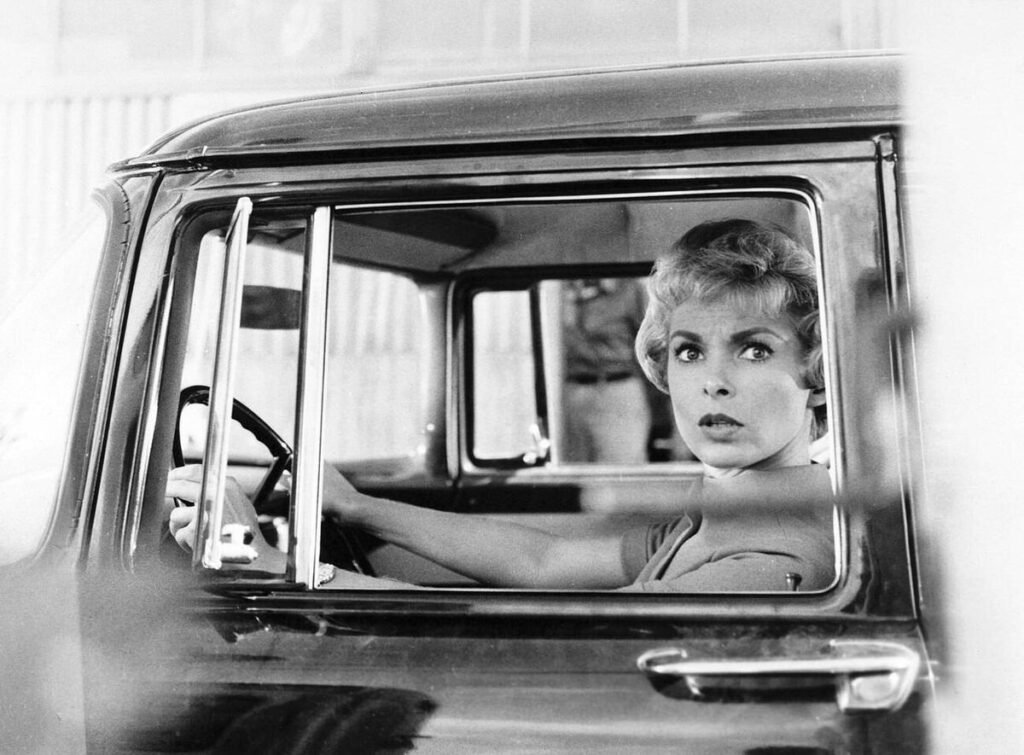
Marion Crane is Psycho’s false protagonist — the secretary whose shower murder, 45 minutes in, rewired what a film could do to its audience.
She is a fictional character, and this page treats her as one: her life exists in four separate versions — Robert Bloch’s 1959 novel, Hitchcock’s 1960 film, Gus Van Sant’s 1998 remake and the Bates Motel television series — which this page never merges, because they disagree about her name, her city, the money, and whether she lives or dies. In the film that made her immortal she steals, runs, repents, and is killed before she can make it right — a penitent, not a fugitive — and that uncompleted decision is the whole character.
Quick Specs
- Creator: Robert Bloch (novel); developed for the screen by Joseph Stefano
- First appearance: Psycho (novel, 1959) — as Mary Crane
- Played by: Janet Leigh (1960), Anne Heche (1998), Rihanna (Bates Motel, 2017)
- Home (1960 film): Phoenix, Arizona
- Status: Murdered in the films; survives in Bates Motel — by layer, below
The Character: The 1960 Film
Marion Crane is a secretary at a Phoenix real-estate office, employed for ten years by George Lowery. She is in love with Sam Loomis, a hardware-store owner in Fairvale, California, whom she meets for lunchtime trysts in a Phoenix hotel because they cannot afford to marry: Sam is a divorcé carrying his father’s debts and alimony to his ex-wife, and tells her the debts will take a couple more years to clear. On Friday, December 11 — the film dates the tryst on screen — wealthy client Tom Cassidy pays $40,000 in cash for a house, a wedding present for his daughter, and flaunts the cash at her. Told to deposit it in the bank’s safe-deposit box, she pleads a headache, takes the money home, packs, and drives for Fairvale to pay Sam’s debts and make their marriage possible. The theft is impulsive and fully hers.
The flight tightens around her. She sleeps in her car at the roadside, is woken by a California Highway Patrol officer whose suspicion her nervousness arouses, and — watched by him — trades her Arizona-plated car at a Bakersfield dealership, paying $700 for a California-plated replacement. Driving on through a heavy rainstorm, she leaves the main highway and stops, a few miles short of Fairvale, at the Bates Motel — twelve rooms, bypassed since the highway moved, overlooked by the Bates house. She registers under an alias, “Marie Samuels” — an alias, not a second character — and accepts Norman Bates’s invitation to a light supper of sandwiches and milk in the motel parlor, among his stuffed birds. The conversation is her hinge. Norman describes everyone as caught in a “private trap” they cannot claw out of; Marion recognises her own trap, suggests he might put his mother in a mental institution — which agitates him — and, back in her room, does the arithmetic of what she has spent, tears up the reckoning and flushes it. One scrap survives, and later betrays her presence to the investigator Arbogast. She decides to drive back to Phoenix in the morning and return the money. She is murdered a penitent, not a fugitive mid-escape — the most-missed fact in popular retellings of her arc.
While she showers, Norman — having watched her undress through a peephole behind a painting in his office — enters as the “Mother” figure, silhouetted through the curtain, and stabs her to death, about 45 minutes into the 109-minute film: barely two-fifths of the way through, not the “halfway” of loose criticism. Norman, horrified as himself at what “Mother” has done, methodically cleans the bathroom, wraps her body in the shower curtain, and puts her, her belongings and — unknowingly, because she had wrapped what remained of it in a newspaper — the money into her car, which he sinks in the swamp behind the motel. The money is never spent, never reaches Sam, and is never shown recovered by her employer; the film’s closing beats haul the car, containing her remains and the stolen cash, out of the swamp. The closing explanation, delivered by the psychiatrist Dr Richman, is that Norman, attracted to Marion, was overridden by the jealous “Mother” personality, who killed her. Her younger sister Lila (Vera Miles) refuses to accept the disappearance and drives the investigation that follows — and it is Lila who finds Mrs Bates’s mummified corpse in the fruit cellar. Marion herself is dead, finally and without sequel ambiguity, in this layer.
Mary in the Book, Marion on Screen
Robert Bloch created her for his 1959 novel — as Mary Crane, from Dallas, Texas. For the film, screenwriter Joseph Stefano renamed her Marion, because a real Mary Crane lived in Phoenix — the film’s opening city — at the time; accounts differ on whether one real Mary Crane or two were found there, and this page states the clearance reason without settling the count. The layers diverge further in the book: Mary is introduced in the novel’s second chapter, after an opening centred on Norman, and is dead by the third — beheaded in the shower, in two sentences, where the films stab her. Her telltale object after death is an earring, not the film’s unflushed paper scrap, and Bloch gives Sam and Lila a budding romance after her death that Stefano and Hitchcock deliberately removed from the film — Stefano thought it would make Sam seem cheap. The “false protagonist” shock, then, is substantially a film construction: Stefano extended her role from two chapters into the film’s opening movement and re-centred the picture on her, so the audience would invest before the murder. Hitchcock’s stated casting logic, via Stefano, was to use a name actress as Marion, because “the bigger the star, the more unbelievable it would be that we would kill her.” The famous no-late-admission policy for screenings existed in part for the same reason — Hitchcock did not want latecomers asking when Janet Leigh was coming on, after the leading lady had been killed off a third of the way in.
The Shower Scene: Seven Days, 45 Seconds
The murder sequence took seven days to shoot, and the murder itself runs about 45 seconds on screen, inside a broader bathroom sequence of about three minutes. Beyond those two figures, the famous numbers are lineages counting different things — Hitchcock himself told Dick Cavett there were “78 separate pieces of film in 45 seconds”; the documentary 78/52 accounts 78 setups and 52 cuts; other records give 50 angles or 76 shots. This page prints the agreed facts and the range — dozens of setups, accounts giving between 70 and 78 setups, angles or pieces of film — and no single count as settled, because none is. Janet Leigh was not nude: she wore flesh-coloured moleskin, and for shots in which Marion’s face is not visible the body is body double Marli Renfro, a model paid $500 for about a week’s work. The “blood” was Bosco chocolate syrup, chosen for black-and-white photography; the stabbing sound was a knife plunged into a casaba melon. In the standard production account, Anthony Perkins was not present for the shower filming — he was in New York for a stage commitment, and the “Mother” figure on set was played by stand-ins. Bernard Herrmann’s shrieking-strings cue scores the murder; Hitchcock had originally wanted no music over the scene and was persuaded otherwise. Leigh repeatedly said afterwards that she took baths only — “It’s not a hype, it’s not a joke, honest to gosh, it’s true” — because the finished scene made her feel how vulnerable a person is in a shower. That is her own testimony, quoted as such; her 1995 memoir Psycho: Behind the Scenes of the Classic Thriller remains the primary-source account of playing Marion.
The Performance
Janet Leigh was the first choice for the role — the long list of other names in the secondary record is introduced by its own sources as actresses “allegedly” considered, and this page keeps the hedge. Leigh took the part for $25,000, a quarter of her usual fee, under the film’s tight budget. For Psycho she won the Golden Globe Award for Best Supporting Actress and was nominated for the Academy Award for Best Supporting Actress — a nomination, in the supporting category, despite being the film’s first-act lead; she did not win an Oscar, and no draft of this page will promote her to one. A decorated horror performance in its own moment, for roughly 45 minutes of screen time, remains an early landmark in the industry’s recognition of genre acting — and the role redefined her public identity permanently: her obituaries led with Marion above five decades of other work.
Sequels, a Remake, and the Great Subversion
In the film sequels Marion exists as footage and grievance. Psycho II (1983) opens by replaying the shower scene — 1960 footage, not a new Leigh performance — and her living legacy there is Lila, now Lila Loomis, campaigning to keep Norman locked up, and Lila’s daughter Mary Loomis, Marion’s niece, whose name deliberately echoes Marion’s motel alias without being her. Psycho III (1986) returns to the shower scene in flashback when Maureen Coyle reminds Norman of Marion. Psycho IV (1990) mentions her only, as “the girl [Norman] killed in the shower.” Gus Van Sant’s Psycho (1998) is a near shot-for-shot remake in colour, reusing Stefano’s screenplay, with Anne Heche as Marion and Van Sant later describing the film as an experiment to demonstrate that a film cannot truly be copied exactly. Its layer changes the money: the theft is $400,000, the inflation update — printing that figure for 1960 is a layer error — and the shower murder is more explicit, with visible blood and wounds. The film failed commercially and critically, winning Golden Raspberry Awards for Worst Remake and Worst Director, with Heche nominated for Worst Actress — and, the other half of the record, Saturn Award nominations including Best Supporting Actress for Heche. Both halves stand.
Bates Motel (A&E, 2013–17) is a contemporary, separate continuity — not a prequel whose Marion could grow into Leigh’s — and in its fifth season it performs the great subversion. Rihanna plays Marion: a Seattle-based notary public in a long-distance relationship with Sam Loomis, who in this layer is married, to Madeleine Loomis, and cheating — a wife the 1960 film never had. Marion steals a suitcase of cash — the series’ figure is $400,000 — from her boss, learns from Norman that Sam has deceived her, smashes Sam’s car windows in rage, returns to the motel and showers while Norman watches… and then simply gets out, unharmed. Norman, fighting “Mother”’s urging, warns her and helps her leave. She drives out of town alive, with the money, throws her phone from the car, and does not return; Sam arrives, waits in her room, and takes the shower instead, where Norman kills him. The producers stated the intent at broadcast — executive producer Carlton Cuse: “We didn’t want Marion to be victimized… in 2017, Marion deserves a different outcome,” and, “There was no way to redefine Marion Crane as a modern empowered woman if we killed her in the shower.” She is the only screen Marion who survives, and that survival belongs to this layer alone — it softens nothing in 1960.
The Iconography
The shower murder itself is the centre: curtain ripped back, the silhouetted figure, Herrmann’s strings, blood spiralling into the drain, the extreme close-up of her dead eye resolving from the drain, the hand clawing the curtain down as she slides along the tiles — the most parodied and analysed single murder in cinema, with an entire documentary, 78/52, devoted to taking it apart. Around it, the film draws its moral diagram in wardrobe: in the opening hotel scene Marion wears a white bra and carries a white purse; after she takes the money she is in a black bra with a black purse — Hitchcock’s design, innocence before and guilt after, legible before a word about guilt is spoken. In the parlor, surrounded by Norman’s stuffed birds of prey, he tells her, “You eat like a bird.” Criticism has long noted the rest of the work her surname does — a crane is a bird, seated for supper among dead birds, watched by the taxidermist who will make a still exhibit of her too; that is a critical reading, stated as one. And the aftermath belongs to her iconography as much as the murder: the money wrapped in newspaper on the nightstand, the meticulous cleanup, the car sinking, pausing, sinking again in the swamp while the film transfers the audience’s allegiance to Norman by making them will it to disappear — until the winch hauls it out at the end and closes the loop.
Why She Matters
Marion Crane broke the contract between star and audience. In 1960, billing and screen time guaranteed survival; Psycho spent its biggest star at the two-fifths mark and kept going for another hour, leaving the audience, in the critical literature’s phrase, clinging to Norman — and every false-protagonist film since works in her wake, Scream (1996) most explicitly, with its opening-scene killing of its own biggest name. “A Marion Crane” is now critical shorthand for the expendable apparent lead. She matters the more because she is a protagonist defined by a moral decision rather than victimhood: she steals, lies and runs, and then — uniquely among her era’s doomed transgressors — decides on her own to go back and make it right, and is killed before she can. That is why the murder reads as tragedy rather than punishment, and why both later reworkings define themselves against her: Van Sant reproduces the decision beat for beat, and Bates Motel rewrites the ending so the decision is finally allowed to save her. Without appearing beyond flashback, she structures the sequels, the remake and the series — the franchise’s second centre, after Norman himself. The secretary from Phoenix who decided to return the money: that is Marion Crane.
Keep it locked on Think Horror — and maybe take baths for a while.