
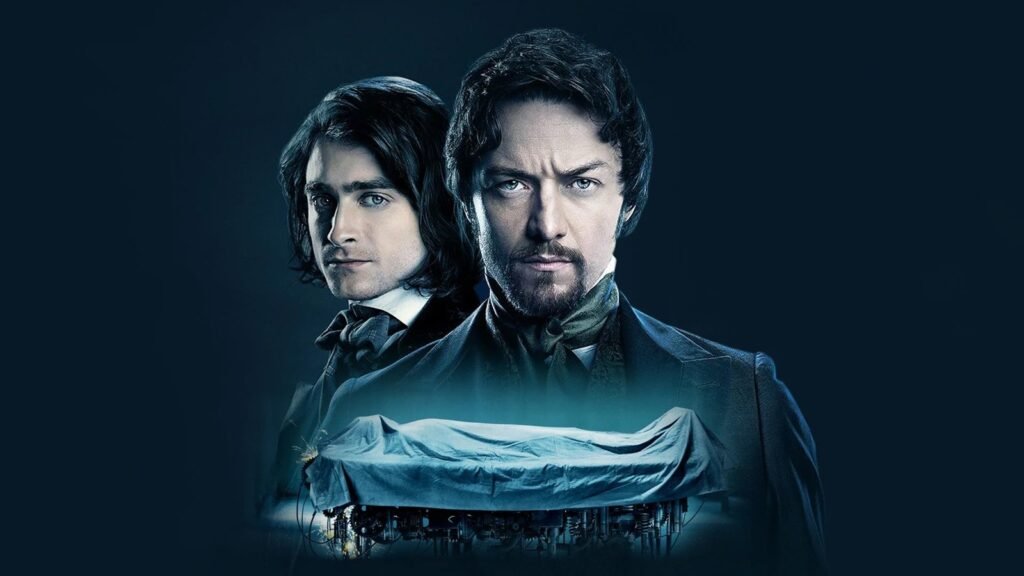
Victor Frankenstein (2015) is the Frankenstein story retold by Igor — a circus performer Victor rescues, renames, and makes his partner in creating life. The first words of the film are “You know the story,” and they are spoken by Igor — which is the whole gamble in one line. Mary Shelley never wrote an Igor. The assistant is an invention of the cinema, built up over decades of Frankenstein films until audiences simply assumed he had always been there, hunched in the corner of the lab. Max Landis took that assumption and built an entire film on it: not the master’s story with the servant in support, but the servant’s story, with the master as the dangerous, dazzling problem he has to solve.
So manage your expectations before the lightning strikes. Anyone settling in for the Monster will wait nearly the whole film for him — the creation arrives at the very end, and barely. What fills the space instead is a double act: Daniel Radcliffe, billed first, as the rescued clown who becomes the film’s conscience, and James McAvoy as the medical student whose brilliance keeps sliding into mania. This is a Frankenstein film about the friendship, and about what it costs the friend who can see the cliff edge coming.
Quick Specs
- Director: Paul McGuigan
- Screen story and screenplay: Max Landis
- Based on: Frankenstein; or, The Modern Prometheus (1818) by Mary Shelley — loosely
- Producer: John Davis
- Starring: Daniel Radcliffe, James McAvoy, Jessica Brown Findlay, Andrew Scott, Charles Dance, Freddie Fox
- Cinematography: Fabian Wagner
- Edited by: Andrew Hulme and Charlie Phillips
- Music: Craig Armstrong
- Production design: Eve Stewart
- Costume design: Jany Temime
- Production companies: Davis Entertainment Company, TSG Entertainment, Moving Picture Company
- Distributor: 20th Century Fox
- US release: 25 November 2015
- Running time: 110 minutes
- Certificate: PG-13 — macabre images, violence and a sequence of destruction
- Budget: $40 million
The assistant who was never in the book
Start with the heresy, because the film does. There is no Igor in Shelley’s 1818 novel — no assistant at all, faithful or otherwise. The character is a creature of the movies, assembled by popular memory out of the laboratory help of earlier adaptations, and by 2015 he was so completely fused with the Frankenstein story in the public mind that Fox could title a film after the master and hand the narration to the servant. Fox’s own production notes call Landis’s script a “regeneration” of the tale, and go further — the notes frame it as the first story to be told largely from Igor’s perspective. That superlative is the studio’s own billing, so take it as billing; the perspective itself, though, is real, and it shapes everything.
It also defines what the film is not. This is not an adaptation of Shelley’s plot, and it is not a remake of Frankenstein (1931). The creature’s wanderings, the murders, the Arctic — none of that happens here. Set in 1860s London, the film is an origin story: Victor and Igor before the famous creation, building toward it one terrible prototype at a time. Where the 1931 film gave horror its defining image of Frankenstein’s Monster, this one is interested in the years of obsession that would make such a creature thinkable — and in the one man close enough to watch it happen.
The reinvention begins with Igor’s body, so get it right: there is no deformity to cure. When Victor finds him, he is an unnamed, abused circus clown whose stooped back is caused by a large cyst. Victor drains the cyst in the opening act and fits him with a harness to correct his posture — a medical fix for a medical problem, delivered by a man who treats people the way he treats apparatus. Then Victor gives him a name: Igor Straussman, borrowed from his absent roommate. Hold that detail loosely, the way the film does — the roommate was simply absent when the name was handed over. What the real Straussman actually was to Victor comes out much later, and it is much worse.
Two creations
The plot runs on two creatures, and the film is careful to keep them apart even if its reputation doesn’t. The first is Gordon: a chimpanzee-like thing stitched together from the organs of dead animals, unveiled at a demonstration at Victor’s university. Gordon escapes, rampages, and has to be killed by his own makers — and the fallout gets Victor expelled. He is a medical student throughout this film, never a doctor, and after Gordon he isn’t even a student anymore.
Underneath the experiments sits a grief the film parcels out slowly. Victor’s older brother Henry is dead, and their father — Baron Frankenstein, played by Charles Dance — blames Victor for it. That blame is the engine: every escalation is a young man trying to reverse the one result he cannot accept. The money for the final escalation comes from Finnegan, Victor’s wealthy classmate, who offers to fund a humanoid creation to be named Prometheus — and who plans, once it works, to weaponize the creature and dispose of Victor. And midway through the climb, Igor learns the truth about his own name: the real Igor Straussman died of an overdose, and Victor used the dead man’s eyes in the experiments.
Against all of this stands Inspector Roderick Turpin, an original character invented for the film and built as a religious foil — a devout inspector who reads the experiments as heresy and means to burn them out. Turpin leads the police raid that destroys the lab, and pays for it with a hand and an eye. Victor and Igor escape to Finnegan’s private estate in Scotland, where Igor — increasingly unable to follow his friend — is cast out and nearly killed, and is nursed back to health by Lorelei, the circus aerialist whose fall started everything.
Which brings us, at last, to Prometheus. In a thunderstorm at the estate, Victor brings the humanoid to life; the electrical apparatus collapses, killing Finnegan and many of his workers. The creature that rises is wordless and shows no sentience at all — pointedly, it is not Henry resurrected, whatever Victor needed it to be. Turpin, now obsessed, arrives and is killed by it. Then Victor and Igor do together the thing the whole film has been bending toward: they destroy Prometheus by destroying its two hearts, the maker and the witness ending the work side by side. In the aftermath, Igor receives a letter from Victor, who has gone into hiding in the Scottish countryside. Victor apologizes, thanks Igor for his friendship, and calls him his “greatest creation” — the one living thing in the film he made better rather than worse.
The cast
Daniel Radcliffe was 24 during filming, and the film belongs to him in the way the billing says it does. His Igor starts as a nameless clown whose anatomical knowledge — learned from stolen books — is sharp enough to save Lorelei’s life in front of a circus crowd, and Radcliffe plays the transformation as an education in worth: the first person ever to treat Igor as a mind is the most dangerous man he will ever meet. James McAvoy, 34 during filming and 36 by the release, plays Victor as pure forward motion — charming, funny, and visibly unable to stop, a student whose expulsion removes the last institution standing between him and the work.
Jessica Brown Findlay is Lorelei, the aerialist whose fall opens the film and whose rise closes Igor’s arc — she ends as the companion of Baron Bomine, a wealthy baron played by Robin Pearce. Keep the barons straight, because the film has two and they are not interchangeable: Baron Bomine is Lorelei’s baron; Baron Frankenstein is Victor’s father, and Charles Dance plays him as a man who has already buried one son and holds the other responsible. Andrew Scott brings the faith-versus-science conflict to life as Turpin, Freddie Fox is Finnegan — a classmate with money, never an aristocrat — Mark Gatiss plays Dettweiler, Daniel Mays is Barnaby, the ringmaster who kept Igor in the circus, and Callum Turner appears as Alistair. Prometheus, in its few minutes on screen, is played by two performers: Spencer Wilding and Guillaume Delaunay, credited separately for the role.
Getting it made
Fox announced the project in 2011, with Max Landis attached to write. The first director was Shawn Levy, who signed on in September 2011; he later left the project, and Paul McGuigan was confirmed as director in September 2012. McGuigan came off directing episodes of the BBC’s Sherlock — and the film quietly reunites that series in front of the camera, with Andrew Scott, its Moriarty, as Turpin and Mark Gatiss, its co-creator, as Dettweiler.
The casting assembled over two years: Radcliffe entered talks to play Igor in September 2012 and officially joined in March 2013; McAvoy was cast as Victor in July 2013; Jessica Brown Findlay joined that September. Principal photography ran from 25 November 2013 to 20 March 2014, entirely in the United Kingdom — soundstage work at Longcross Studios and Twickenham Film Studios, with location shooting at Chatham Historic Dockyard in Kent. An American production, then, shot wholly in England, with Fabian Wagner behind the camera, Eve Stewart designing the production and Jany Temime the costumes.
Then the release date began its own wandering. First set for 17 October 2014, the film slipped to 16 January 2015, then to 2 October 2015, before Fox swapped dates with The Martian and The Peanuts Movie in June 2015 and landed it on 25 November 2015 — Thanksgiving in the United States. The first official trailer arrived on 18 August 2015, and McAvoy and Radcliffe promoted the film at that year’s San Diego Comic-Con. The digital home release followed on 23 February 2016, and the disc carries a seven-part making-of documentary and galleries. Running time is 110 minutes as standard — two listings give 109, and the difference is noted here rather than smoothed over.
What the critics made of it
The numbers first, because they are not kind. Rotten Tomatoes stands at 26% from 138 reviews, with a consensus that reads: “A re-imagining without the imagining, Victor Frankenstein plays at providing a fresh perspective on an oft-told tale, but ultimately offers little of interest that viewers haven’t already seen in superior Frankenstein films.” Metacritic gives it 36 out of 100 from 28 critics — “generally unfavorable,” split four positive, nine mixed, fifteen negative, with a user score of 5.5. Audiences polled by CinemaScore gave it a C.
The reviews matched the arithmetic. Andrew Barker wrote that the film “never shows enough sparks of life to justify reanimating its nearly 200-year-old source.” Sheri Linden delivered the coldest line of the cycle: “the only real horror in this frenetic spectacle is how unaffecting it is.” Peter Bradshaw called it “a bizarre and confused reboot” and judged that “the giddy enthusiasm of McAvoy and Radcliffe only goes so far,” while Brian Tallerico gave it one and a half stars out of four — “the mad energy of a creation assembled from spare parts,” but hollow. Mike D’Angelo, in The A.V. Club, aimed at the narration itself: “The first words spoken in Victor Frankenstein are ‘You know the story,’ and anyone who simply mutters ‘Yep,’ gets up, and heads back to the box office for a refund will be well ahead of the game.”
The dissenters were British. One review awarded four stars out of five, praising a film “crackling with energy and fizzing with ideas” and calling it “a playful, postmodern sensibility that zaps new life into Shelley’s 200-year-old Gothic masterpiece.” Another gave three out of five. A third called it “this Grand Guignol riot of rotting animal and Godless creations is great fun,” while judging that of the cast “it is only McAvoy… who fully manages to hold his own against the spectacle.” Landis, for his part, answered the aggregators directly after release, publicly criticizing Rotten Tomatoes’ binary methodology as “destructive” and “arbitrary.”
The box office
The production budget was $40 million, and the opening was a record — the wrong kind. Victor Frankenstein took $2,469,341 from 2,797 theaters on its first weekend, $3.4 million across the five-day Thanksgiving frame: at the time, the lowest opening weekend ever recorded for a film playing in more than 2,500 theaters. Keep the “at the time” attached to that record; it is a dated fact, and later films have since opened lower. The domestic run closed at $5,775,076. The UK release followed on 4 December 2015 and took $1,395,831.
The worldwide gross is reported as both $34,227,298 and $31,124,367. On either count, the worldwide gross finished below the $40 million production budget, before a single dollar of marketing spend is counted — and no verified loss figure exists, because that spend is not public. The label, as opposed to the arithmetic, belongs to the contemporary coverage: Emanuel Levy’s Thanksgiving box-office wrap called the film “dead upon arrival” and grouped it, alongside Steve Jobs and The 33, as “one of the year’s biggest flops.”
Where it stands
On this site, Victor Frankenstein sits in a crowded family: the lightning of Frankenstein (1931), the Hammer blood of The Curse of Frankenstein, the tragic grandeur of Mary Shelley’s Frankenstein, and the beloved comic inversion of Young Frankenstein. Its claim on a place in that row is a genuine one, whatever the scores say: it is the version that asks what the legend looks like from the corner of the lab, told by the man Shelley never wrote, about a creator whose greatest creation turned out to be a person he rescued rather than a body he built. The monster arrives last, and barely — and for once, that is the point.