
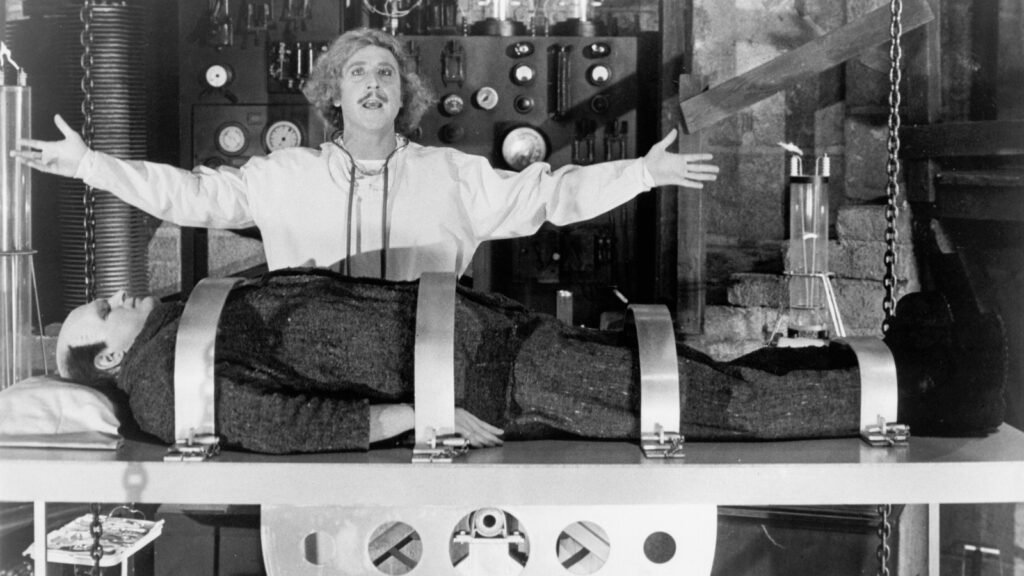
Say her name in the stables and the horses scream. Nobody in the film ever explains why — the housekeeper walks through her own castle trailing equine panic, and the picture just lets it ride, because the picture can afford to. Young Frankenstein (1974) is Mel Brooks’s black-and-white parody of Universal’s Frankenstein films, with Gene Wilder as Victor’s grandson. It is the rare spoof built like the thing it mocks: same fog, same laboratory, same crackling equipment — in some cases literally the same equipment, hauled out of a garage after forty years. Brooks and Wilder did not send up the old pictures from a safe distance. They moved into the castle, lit the candles, and played it straight enough that the jokes detonate twice as hard.
Quick Specs
- Director: Mel Brooks
- Screenplay: Gene Wilder and Mel Brooks
- Based on: the characters created in Mary Wollstonecraft Shelley’s Frankenstein; or, the Modern Prometheus (1818)
- Producer: Michael Gruskoff
- Starring: Gene Wilder, Peter Boyle, Marty Feldman, Cloris Leachman, Teri Garr, Kenneth Mars, Madeline Kahn; and Gene Hackman, uncredited, as Harold, the blind hermit
- Cinematography: Gerald Hirschfeld
- Editor: John C. Howard
- Music: John Morris
- Production companies: Gruskoff/Venture Films, Crossbow Productions, Jouer Limited
- Distributor: Twentieth Century-Fox
- Released: 15 December 1974 (New York); 18 December 1974 (Los Angeles)
- Running time: about 105 minutes (listings run 105–106; the AFI Catalog records variant durations)
- Certificate: PG
- Budget: about $2.8 million
“That’s Fronkensteen”
Get the name right, because the film’s first running gag depends on you getting it wrong. The hero is Dr. Frederick Frankenstein — spelled the family way — a lecturing physician at an American medical school who insists, through clenched teeth, that the name is pronounced “Fronkensteen.” It is a pronunciation, not a name: a man trying to put phonetic distance between himself and his grandfather Victor, the infamous mad scientist. Word arrives that he has inherited the family estate in Transylvania under the will of his great-grandfather, Baron Beaufort von Frankenstein, and off he goes, leaving his fussy fiancée Elizabeth behind to inspect the property.
At the station he is met by Igor — pronounced “Eye-gor,” the gag running in the opposite direction — the hunchbacked, bug-eyed grandson of Victor’s Igor. Not the 1931 film’s assistant, whatever your memory tells you: that man was named Fritz, and this Igor is the next generation of the help. With the lovely Inga, Frederick reaches the castle and its fearsome housekeeper, Frau Blücher, whose very name frightens horses. The film never explains the neighing. A popular story claims “Blücher” is German for “glue” — it is not; it is an ordinary German surname, and the glue explanation is a folk tale that has attached itself to the joke. The film leaves it unexplained because unexplained is funnier.
A haunting violin strain leads Frederick to the secret entrance of Victor’s laboratory, and to his grandfather’s private journal, How I Did It. The shame curdles into obsession. Soon he and Igor are digging up the corpse of a recently hanged criminal, and Igor is sent to steal the brain of Hans Delbrück, “scientist and saint.” Igor damages that brain in the theft and substitutes one labeled “Abnormal” instead — Frederick transplants it unknowingly, the Monster rises on Victor’s own equipment with kites harnessing the lightning, and when the frightened creature nearly strangles him, Igor finally admits whose brain it was: “Abby Normal.”
The town, the inspector and the creature
The townspeople, still carrying injuries from Victor’s monster, are not amused. Inspector Kemp — Kenneth Mars, one-armed and impenetrably accented, a deliberate parody of Lionel Atwill’s Inspector Krogh in Son of Frankenstein — visits the castle and extracts Frederick’s promise that there will be no new monster, while the sedated creature sits hidden nearby. Then Blücher releases the Monster herself: she reveals that the violin tune calms him, that Victor was her “boyfriend,” and that she played that tune to lure Frederick into finishing the work.
The Monster’s escape plays the 1930s picture book back with the pages shuffled. He meets little Helga at the well — the 1931 film‘s darkest scene inverted, ending with the child catapulted safely home by seesaw instead of drowned. Then comes the blind hermit: Gene Hackman, uncredited in the original theatrical run, as Harold, in a scene aimed squarely at Bride of Frankenstein. In 1935 the hermit got the soup into the bowl. Here he ladles it into the Monster’s lap, smashes the wine mug in the toast, and sets the Monster’s thumb alight with the cigar. Recaptured and calmed — Frederick locks himself in with the creature and wins him over with flattery and an embrace — the Monster is presented to the Bucharest Academy of Science, where the evening builds to “Puttin’ on the Ritz.” It ends, as it had to, in chains. But the film’s ending belongs to the couples, and get them the right way round: Frederick marries Inga, and Elizabeth marries the now-sophisticated Monster, who received some of Frederick’s stabilizing intellect in the final transfer — while Frederick, on his wedding night, discovers he received something substantial from the Monster in exchange.
Wilder’s idea, Wilder’s condition
The film began as Gene Wilder’s. During the last weeks of shooting Blazing Saddles in the Antelope Valley, Wilder told Brooks over coffee: “I have this idea that there could be another Frankenstein… What if the grandson of Dr. Frankenstein wanted nothing to do with the family whatsoever. He was ashamed of those wackos.” Brooks’s reply: “That’s funny.” The two of them wrote the script in about six weeks, and Wilder aimed the parody chiefly at four pictures: Frankenstein (1931), Bride of Frankenstein (1935), Son of Frankenstein (1939) and The Ghost of Frankenstein (1942).
Wilder also set the deal’s strangest term: Brooks could direct, but Brooks could not appear. In Brooks’s own words: “I wasn’t allowed to be in it. That was the deal Gene Wilder had. He [said], ‘If you’re not in it, I’ll do it.’… ‘You have a way of breaking the fourth wall, whether you want to or not. I just want to keep it. I don’t want too much to be, you know, a wink at the audience. I love the script.'” The condition barred Brooks from the screen — it did not keep him out of the picture entirely. Listen closely and he is there, uncredited, in voices only: the werewolf’s howl, the cat hit by a dart in the Kemp dart-game scene, and the voice of Victor Frankenstein himself.
Two studios, one argument about black and white
Columbia was in during the writing, and the deal died in negotiation — over two sticking points, not one, and the record weights them differently, so take both. The AFI Catalog says Columbia would not agree to Brooks’s budget of two million dollars; the fuller production account puts Columbia’s ceiling at $1.75 million against Brooks’s floor of at least $2.3 million, and adds that Columbia was also unhappy about making the film in black and white. Either way: the $2.3 million figure that trails this film through the trivia pages was Brooks’s asking floor, never the budget — the finished picture cost about $2.8 million. Brooks and producer Michael Gruskoff went to 20th Century-Fox, which acquired the screenplay (announced 8 June 1974) and met the higher number.
Fox then pushed back on black and white too — the studio feared European and television markets would not buy a monochrome film in 1974. Cinematographer Gerald Hirschfeld proposed a compromise: begin in black and white, then segue to color. Brooks refused it. The Library of Congress’s Registry essay carries his position in its strongest form: if he could not shoot it in black and white, he would quit. He got his way, and doubled down on the period grammar — iris outs, wipes, fades to black, period-style opening credits — and narrated the trailers himself, announcing that the film was in black and white and adding, as a joke, “No offense.”
The laboratory that came out of a garage
The crackling apparatus in Victor’s laboratory is not a replica and it is not a tribute built by a props department. It is the original equipment Kenneth Strickfaden created for the 1931 Frankenstein, reassembled from the pieces he had stored in his own garage. Strickfaden, then in his seventies, was engaged as a technical consultant and worked a full schedule on the picture, reconstructing some items and building new devices besides. His credit is worth printing exactly, because the trivia pages garble it: he is listed for “Frankenstein laboratory” and given special thanks in the opening credits — a credit that mattered to him, because he had never been credited for the 1931 film at all. The Baltimore medical-school opening was shot at the University of Southern California, and the “Puttin’ on the Ritz” sequence at the Mayfair Music Hall in Santa Monica, standing in for the Bucharest hall. Principal photography ran from 19 February to early May 1974.
The cast around the table
Wilder, 41 at the release, plays Frederick as a man dignity-checking himself every thirty seconds and losing. Peter Boyle, 39, is billed simply as the Monster — real pathos under the jokes, which is why the film’s heart works. Marty Feldman made his American film debut as Igor, a role Wilder wrote specially for him; the wandering hump was Feldman’s own gag, swapped from shoulder to shoulder on his own initiative until somebody noticed and it was written in. “What hump?” Teri Garr, who had auditioned for Elizabeth, was called back the next day to read for Inga and landed her first major role; Madeline Kahn, sought for Inga, wanted Elizabeth, and got her. Between them, the two women collected the film’s acting nominations: Leachman was a Golden Globe nominee for Best Actress in a Musical or Comedy, and Kahn for Best Supporting Actress.
“Puttin’ on the Ritz”
The film’s most famous sequence was nearly its biggest casualty. The song is Irving Berlin’s “Puttin’ On the Ritz,” and the scene — Frederick presenting “The Creature” to the Bucharest Academy of Science, first following simple commands, then both of them in top hat and tails for the number itself — exists because Wilder fought for it. On Brooks’s own telling, he felt a singing, dancing monster was too silly for the film’s fidelity to the old pictures; Wilder argued the number proved the Monster more than mechanically able to walk or move. Brooks yielded, shot it, and afterwards called it “the best thing in the movie.” The triumph lasts exactly as long as a stage light doesn’t: one bursts, the Monster panics, the crowd turns, and the creature is chained before the night is out. The sequence’s afterlife is its own: the rendition placed #89 on the AFI’s 100 Years…100 Songs list.
The money
The arithmetic, printed the way the record supports it and no further. The film cost about $2.8 million — The Numbers lists the production budget at $2,800,000, and the standard corporate history of Fox gives $2.78 million. Box Office Mojo’s lifetime accounting puts the domestic gross at $86,273,333 and the worldwide total at about $86.4 million, almost all of it earned at home. A $2.8 million black-and-white parody returning more than thirty times its cost: that is the whole story, and it needs no decoration.
What the critics made of it
Vincent Canby called it “Mel Brooks’ funniest, most cohesive comedy to date,” while warning that it would “be misleading to describe ‘Young Frankenstein’… as astoundingly witty” — it is, he said, “a great deal of low fun.” Roger Ebert gave it a full four stars: Brooks’s “most disciplined and visually inventive film (it also happens to be very funny).” Gene Siskel, at three stars of four, found it “very funny in its best moments, but they’re all too infrequent,” and the dissent ran colder still from Gary Arnold, who was “equally untickled” and charged that Wilder and Brooks “simply rely on the old movie plots to get them through a rambling collection of scene parodies.” Tom Milne split the difference with a knife in it: Marty Feldman’s “grotesquely unfunny mugging,” but the flower scene and the blind-man sequence “very close to brilliance,” and Boyle “one of the undiluted pleasures of the film (and the only actor ever to suggest that he might play the part as well as Karloff).” The guides kept the split: Leonard Maltin gave it three and a half of four — “One of the funniest (and most quotable) movies of all time” — while Leslie Halliwell managed two of four and still conceded it was Brooks’s most successful parody. Rotten Tomatoes, live-checked on 25 October 2026, stands at 95% from 74 reviews, under the consensus: “Made with obvious affection for the original, Young Frankenstein is a riotously silly spoof featuring a fantastic performance by Gene Wilder.”
The honors shelf
Keep the Oscar line exact, because it is the one everyone upgrades: at the 1975 Academy Awards the film received two nominations — Best Adapted Screenplay for Wilder and Brooks, and Best Sound for Richard Portman and Gene S. Cantamessa — and won neither. The wins came from the genre’s own houses: the Hugo Award for Best Dramatic Presentation in 1975, the Nebula Award for Best Script in 1976, and five Saturn Awards in 1976 — Best Horror Film, Best Director for Brooks, Best Supporting Actor for Feldman, Best Make-up for William Tuttle, and Best Production Design for Robert De Vestel and Dale Hennesy. The AFI placed it #13 on its 100 Years…100 Laughs list — the lowest of three Brooks films there, behind Blazing Saddles at #6 and The Producers at #11 — and Igor’s “What hump?” was an AFI 100 Movie Quotes nominee. In 2003 the National Film Preservation Board deemed it “culturally, historically or aesthetically significant” and selected it for the Library of Congress’s National Film Registry. Brooks, looking back in 2014, gave the verdict this page will leave standing: “by far the best movie I ever made. Not the funniest — Blazing Saddles was the funniest… But as a writer-director, it is by far my finest.” He and Thomas Meehan later adapted it as a Broadway musical, which opened in November 2007 and took three Tony nominations. The grandson who was ashamed of those wackos ended up the family monument. Pronounced, of course, Fronkensteen.