Your new friend has been in the house a week, and already she knows the hour you wake in the dark and the name you call in your sleep. She is beautiful, she is grieving, she is so terribly lonely — and every night a great cat pads across your counterpane and settles, purring, on your chest, and every morning you are a little less. You would not send her away for the world, fiend. That is rather the point of her.
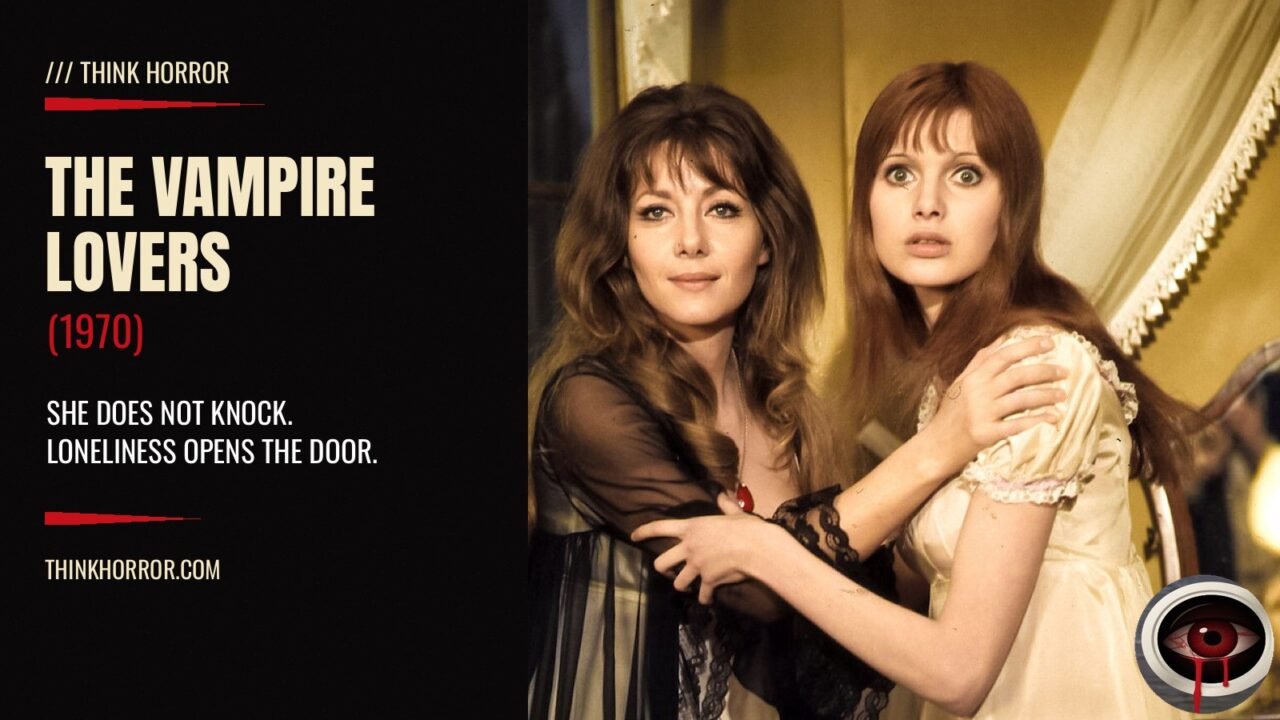
The Vampire Lovers (1970) is Hammer’s lush adaptation of Carmilla, in which Ingrid Pitt’s ageless countess seduces her way through two Styrian households.
A quarter of a century before Bram Stoker gave the world Dracula, J. Sheridan Le Fanu gave it Carmilla — a vampire who does not kick down doors or hypnotise from across the room, but arrives as a houseguest, all warmth and confidences, and is loved before she is feared. In 1970 Hammer finally brought her to the screen at full strength, and the result is the studio’s most decadent Gothic: a film where the monster is the most alive person in every room she enters, and the tragedy is that the rooms keep inviting her in.
Harper has a soft spot for predators with manners. Carmilla Karnstein has exquisite manners. She is also a grave that learned to walk, and The Vampire Lovers understands — as Le Fanu did — that the scariest sentence in horror is not “she is coming for you.” It is “she is already your dearest friend.”

The Review
The film opens in confession. Decades before the main action, Baron von Hartog (Douglas Wilmer) tells how he hunted the Karnstein vampires through their own crypt, staking them one by one — all but one. He caught a single revenant rising, a blonde Karnstein in a shroud, and took her head with the cold patience of a man who had already buried his grief and kept only the arithmetic. But Mircalla Karnstein’s grave eluded him. It is a prologue with a body count and a loose end, and the loose end has a name the film will keep rearranging: Mircalla, Marcilla, Carmilla — the same woman, wearing anagrams like changes of dress.
Years later she surfaces at a birthday ball, left in General Spielsdorf’s care as “Marcilla” by a countess in a hurry. The General’s niece Laura (Pippa Steel) gains a dazzling new friend — and begins to dream of a great cat smothering her in the dark. She wastes, she fades — and her dazzling friend is nowhere to be found when the household finally understands what has been feeding on her. What the feeding costs her waits below the gate. Then the countess’s carriage conveniently fails outside the Morton estate, and the houseguest — “Carmilla” now — is installed beside Emma Morton (Madeline Smith), Laura’s friend, who starts having the same dreams. The household’s defences assemble late and humanly: a doctor who has seen this pattern before (Ferdy Mayne), a butler named Renton who reads the local lore and rings Emma’s bed with garlic and crucifixes, a governess (Kate O’Mara) whose loneliness Carmilla reads like an open book. It does not go well for most of them. Vampire hunting, in this film, is what the men do in the final reel. Vampire surviving is what the women have been doing, badly outmatched, for the whole picture.
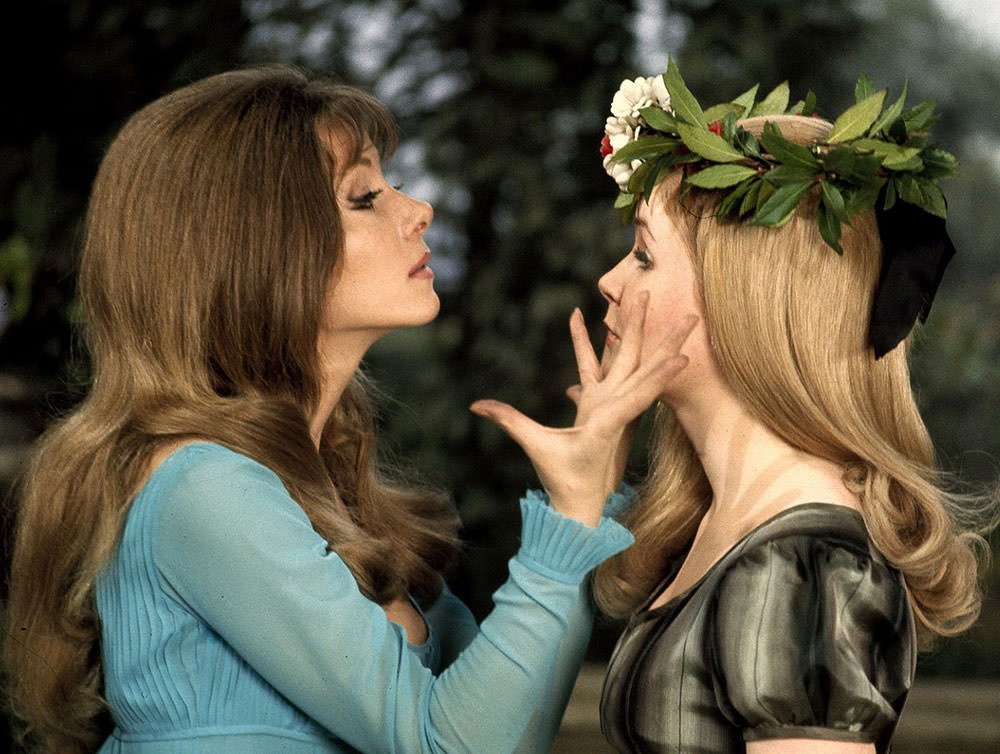
Ingrid Pitt. Everything else in this review is footnotes. Pitt plays Carmilla as appetite with perfect diction — amused, tender, faintly contemptuous of the century she’s walking through, and never, ever camp. Watch the garden still below: Laura is entranced, and Carmilla is smiling, and the smile is not cruelty. It’s recognition. She has done this for a hundred years and she will miss this girl the way you miss a summer. Pitt came to the role straight off Where Eagles Dare and walked into horror history in one film; the crypt has seen a great many screen vampires, and hers remains the one you’d most like to have dinner with and least like to survive.
It actually adapts Le Fanu. The anagram names, the cat-dreams, the portrait in the ruined castle, the friend who sickens by inches while the household calls it nerves — this is the novella’s machinery, honoured rather than looted. Carmilla preys in service of the novella’s real subject — intimacy: confidences at midnight, shared secrets, a devotion that curdles. Roy Ward Baker shoots it like a period romance that happens to have a crypt in it — candlelight, silk, Moray Grant’s rich colour — and the horror lands harder for being upholstered. When the General, the Baron and young Carl finally converge on Karnstein Castle, the film earns its Gothic thunder precisely because it spent an hour being quiet.
The supporting architecture. Peter Cushing, in what amounts to an extended guest turn, bookends the film with grief that curdles into resolve — nobody on earth sells “my niece is dead and I intend to be rude about it” like Cushing. Douglas Wilmer’s Hartog narrates the prologue like a man reading his own sins into the record. And Kate O’Mara’s governess is the film’s saddest mechanism: a woman so starved of being wanted that when Carmilla offers her eternity, the horror is that you understand her.
The structure repeats itself and knows it. Two households, two girls, the same courtship, the same dreams, the same belated doctor — the Laura movement plays almost entire, then the Emma movement replays it at greater length, and the middle of the film sags under the echo. A sterner editor could lose ten minutes and no blood. The male rescue party, meanwhile, spends most of the runtime being summoned, travelling, or explaining the plot to each other in carriages; when the climax arrives it is rousing, but the end dealt to Carmilla — by committee, as the gate below discusses — feels administratively neat for a creature who deserved a more personal apocalypse. And the film’s famous frankness is very much of its moment: sincere in Le Fanu, sold in the marketing as pure titillation, trimmed by censors on two continents. The picture’s heart is better than its poster, which is the most 1970 sentence Harper owns.
None of it sinks her. The Vampire Lovers was the first of Hammer’s Karnstein trilogy, the last Hammer production financed with American money, and the starting gun for a whole early-seventies cycle of Carmilla’s children — and at its centre stands a performance that has outlived every argument about the film around it. The crypt keeps a list of vampires who feel genuinely old. Pitt’s is near the top, and she is the only one who makes old feel like a love story.
Spoiler Section
Spoilers settle here, fiends — the deaths and the ending are discussed plainly.
Laura dies. The dreams, the wasting, the two small wounds on her breast — the first household ends in a grave, and Marcilla is gone before the household understands what it sheltered. She is not Carmilla’s first victim on screen, mind: the prologue’s tavern victim predates her by decades. She is simply the first this film makes you love before it loses her.
And Carmilla’s own end is committee work. The General, the Baron and young Carl converge on Karnstein Castle and find her in her coffin; the stake is driven — the reference books cannot even agree on which hunter holds it — and Hartog’s sword finishes the account he opened in the prologue. Emma survives: the garlic, the crucifixes and the hunters arriving together do for her what Laura’s household could not do in time. The countess goes back into the ground under all three of her names.
Trivia
- The censor blinked first. Hammer sent the script to the BBFC’s chief, John Trevelyan, before production. He warned them about the lesbian content, noting his office had cut some five minutes from The Killing of Sister George. Hammer replied that the lesbianism was not theirs — it was Le Fanu’s, in print since 1872 — and Trevelyan, to his credit, let it pass — take it up with the Irishman, sir; he’s been dead a century and he’s winning.
- Built for the new X. On July 1, 1970, the BBFC raised the X certificate’s minimum age from sixteen to eighteen, and The Vampire Lovers — shot that January and February — was Hammer’s first horror built deliberately for the franker adult territory the new X opened up.
- “Private Pitt reporting for duty.” By Ingrid Pitt’s own oft-told account, she was seated beside Hammer chief James Carreras at a film premiere dinner, called at his office the next day, and was offered “Carmilla, Mircalla and Marcilla” — not immediately realising all three were the same woman in the same film.
- The fangs incident. Madeline Smith has long retold the on-set mishap in which Pitt’s fangs fell out mid-scene — into Kate O’Mara’s cleavage. Pitt, hating the fangs and convinced they made her look hideous, eventually fixed them in place with a piece of chewing gum borrowed from a crew member.
- The yoghurt defence. Smith, twenty and by her own description “completely gormless and innocent,” recalled that a producer rang her worried she was not “voluptuous enough” — so she bought out a local dairy’s yoghurt and stuffed herself, in her words, “like you might fatten cattle — and it worked!” She has always been cheerfully blunt about the film’s exploitation element: “I was a very willing exploitee — I didn’t mind at all.”
- Success at speed. The sequel, Lust for a Vampire, followed within months — released in January 1971 — and Twins of Evil completed the Karnstein trilogy later that same year. The sequels progressively toned down what this one had pioneered.
Where to Watch
As of November 15, 2026, The Vampire Lovers streams free with ads on Tubi and Fawesome in the US, with a subscription on IndieFlix, and rents or buys through Fandango at Home. It is not currently on Shudder. On disc, Harper recommends Scream Factory’s Collector’s Edition Blu-ray from the 4K scan of the original camera negative: the fullest version of the film, with both beheadings — prologue and climax — restored to the length the censors trimmed in 1970.
Quick Specs
- Director: Roy Ward Baker
- Screenplay: Tudor Gates; adaptation by Harry Fine, Tudor Gates and Michael Style; based on “Carmilla” by J. Sheridan Le Fanu
- Starring: Ingrid Pitt (Marcilla / Carmilla Karnstein), Peter Cushing (General Spielsdorf), Madeline Smith (Emma Morton), Dawn Addams (The Countess), Kate O’Mara (Mademoiselle Perrodot), Pippa Steel (Laura Spielsdorf), George Cole (Roger Morton), Jon Finch (Carl Ebhardt), Douglas Wilmer (Baron Joachim von Hartog)
- Music: Harry Robinson
- Cinematography: Moray Grant
- Editor: James Needs
- Producers: Harry Fine and Michael Style
- Production Company: Hammer Film Productions, Fantale Films and American International Pictures
- Distributor: MGM-EMI (UK); American International Pictures (US)
- Premiered: September 3, 1970 (London premiere); UK release October 4, 1970; US opening October 28, 1970 (Chicago)
- Runtime: 91 minutes (UK cut); 89 minutes (US cut)
- Rating: 4 out of 5 ravens
- Budget: £165,227
- Box Office: No reliable total survives; AFI (via Variety) logged $151,675 as a cumulative US gross by May 1971
- On This Site: Hammer Films hub · The Vampire Lovers in the wiki · Ingrid Pitt · Peter Cushing
The Verdict
Rating: 4 ravens out of 5.
Four ravens — and every feather goes to the woman at the film’s centre: Pitt’s Carmilla is the screen vampire you would most like to have dinner with and least like to survive: appetite with perfect diction, in Hammer’s most decadent Gothic, where seduction is the haunting and friendship is the open door. Carmilla never knocks, fiends. Loneliness leaves the door open.
The weekly roundup
One letter a week, from the crypt.
- New reviews, with the ravens
- New wiki entries and news
- Cool stuff worth your night
Weekly. No spam, unsubscribe in one click.