
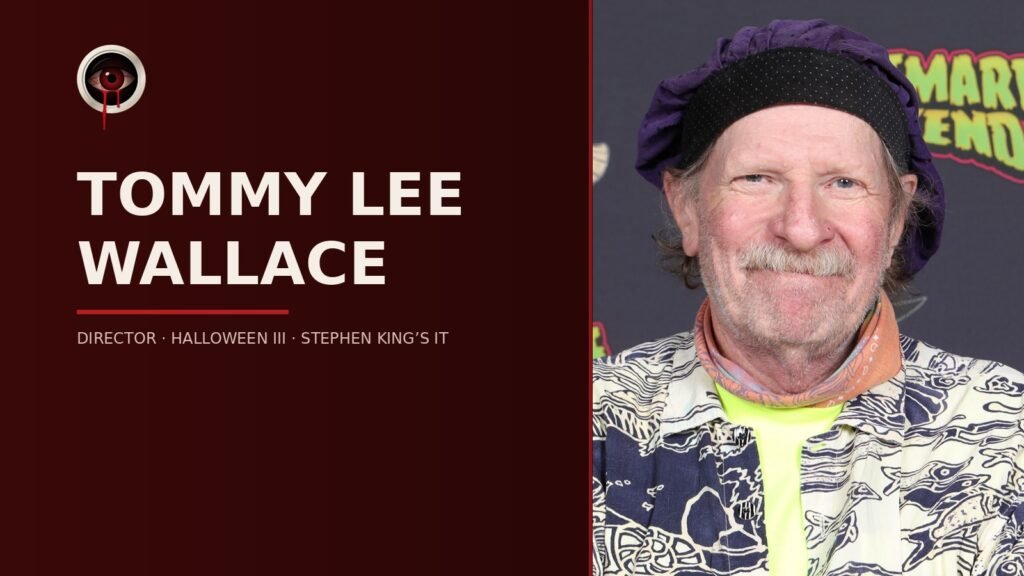
Tommy Lee Wallace (born 1949) is an American filmmaker: Carpenter’s design-and-editing right hand, and the director of Halloween III and Stephen King’s It.
Every John Carpenter film of the classic run has Tommy Lee Wallace somewhere inside it — designing the sets, cutting the film, building the most famous mask in horror out of a two-dollar Captain Kirk face. Then Wallace stepped into the director’s chair himself, and his career became a study in credit lines that lie: the Halloween sequel he refused, the Halloween film he directed that everyone credits to Carpenter, the Stephen King miniseries he rewrote and co-owns on screen that shorthand keeps handing to another man. This page is the corrected record.
Quick Specs
Born: September 6, 1949, Somerset, Kentucky (full name Thomas Lee Wallace)
Trained: B.F.A. in Design, Ohio University; M.F.A. program in film production, USC
Known for: directing Halloween III: Season of the Witch (1982), Fright Night Part 2 (1988) and Stephen King’s It (1990)
Earlier trades: production designer, art director, film editor, sound-effects editor
Kentucky Boys
Wallace was born in Somerset, Kentucky, and grew up in Bowling Green — the same town that produced John Carpenter, his childhood friend. He attended high school at Western Kentucky University’s teachers training school, took a B.F.A. in Design at Ohio University, and entered the M.F.A. program in film production at USC, where he spent five semesters and started working — art direction and editing on commercials and industrial films — before the degree was the point. When Carpenter started making features, his Kentucky friend was the natural first hire: a designer who could also cut film and build things, in an era when a low-budget crew was whoever would show up.
In Carpenter’s Shop
The apprenticeship credits, stated exactly, because they are so often inflated: on Dark Star (1974), Carpenter’s debut, Wallace was associate art director — Dan O’Bannon was the production designer. On Assault on Precinct 13 (1976) he was art director and sound-effects editor. On Halloween (1978) he was production designer, art director and location scout, and the film’s editor — a credit he shares, exactly as printed, with Charles Bornstein; the edit was never his alone and never Carpenter’s. Wallace also is the Shape in one of the film’s most famous shots: the masked figure who attacks Laurie in the closet is Wallace, not Nick Castle. And as production designer he built the Shape’s face. The production’s own oft-told account — Wallace’s and Carpenter’s, repeated across the film’s documentary record — runs: a Captain Kirk mask from Don Post Studios, cast from William Shatner’s face for The Devil’s Rain, bought for $1.98 at a costume shop on Hollywood Boulevard; Wallace widened the eye holes, altered the hair, and spray-painted it a bluish white. On The Fog (1980) he was again production designer and co-editor (Bornstein’s name prints first there), played several of the revenant ghosts, and — a trap for the unwary — is not the fisherman character named Tommy Wallace, who is George Buck Flower; Carpenter named the Fog’s characters after his collaborators. Wallace even sang for the shop: he performed the title song of Big Trouble in Little China (1986) as a member of Carpenter’s band, The Coup de Villes, alongside Carpenter and Nick Castle.
The Chair He Turned Down
When Halloween II was being set up, Carpenter — producing — offered the director’s chair to Wallace first, before Rick Rosenthal. Wallace’s own account is that he was open to it until he read the script: “I just hated it. It was everything that Halloween was not.” He has no role of any kind on Halloween II, and any record describing him as passed over has the story backwards. His first produced screenplay came the same year instead: Amityville II: The Possession (1982), written by Wallace and Dardano Sacchetti from Hans Holzer’s Murder in Amityville, and directed by Damiano Damiani — Wallace wrote it; he did not direct it.
Halloween III: Season of the Witch
Wallace’s feature directorial debut was Halloween III: Season of the Witch, released October 22, 1982 — directed by Wallace, produced by Carpenter and Debra Hill, who agreed to a third film only on condition it not be a Michael Myers sequel. The anthology idea was theirs: a series of stand-alone Halloween-night stories, of which Wallace has said this was meant to be the first. It remains the only Halloween film with no Michael Myers in it. Joe Dante was initially appointed to direct and left for Twilight Zone: The Movie; Wallace stepped in. Tom Atkins, Stacey Nelkin and Dan O’Herlihy star, Dean Cundey shot it, and Carpenter and Alan Howarth wrote the score — and the Carpenter stock company runs right through the soundtrack: the Silver Shamrock commercial’s announcer is Wallace’s own voice, the Santa Mira curfew announcements are Jamie Lee Curtis, uncredited, and Linda Challis is played by Nancy Kyes.
The writing credit is a three-layer trap, so here are the layers. The screen reads “Written by Tommy Lee Wallace” — his sole credit. Underneath it sits British writer Nigel Kneale, creator of Quatermass, who wrote the original screenplay and had his name removed after rewrites displeased him; and underneath that, by Wallace’s own account, he and Carpenter each did separate rewrites, with Carpenter taking no credit — Wallace himself calls his resulting sole credit “ridiculous… just so inaccurate.” Print it no simpler than that. The film grossed $14.4 million in the US — the only money figure about it that can be stated flatly, its reported budgets conflict — and it was the series’ poorest performer on release, savaged by reviewers who had come for Myers. Its re-evaluation since is equally a matter of record: Halloween III now holds a strong cult standing as the franchise’s strange, mean, beloved oddity (it stands at 51% on Rotten Tomatoes from 49 reviews — a number that would have been unthinkable in 1982). One more separation, because the two books are routinely confused: Wallace did not write the film’s novelization, under a pen name or any other. The 1982 paperback is Dennis Etchison writing as Jack Martin. Wallace’s own book on the film is forty years younger — see below.
Fright Night Part 2
Wallace directed Fright Night Part 2 (1988), written by Wallace, Tim Metcalfe and Miguel Tejada-Flores from Tom Holland’s characters: Roddy McDowall and William Ragsdale return as Peter Vincent and Charley Brewster, against a new villain — Regine Dandrige, Jerry’s sister, played by Julie Carmen, out for revenge. Holland could not return (he and Chris Sarandon were making Child’s Play); Wallace sought his advice anyway, and Sarandon visited the set. The film was made for $8 million and released first in Australia in December 1988, reaching the US only in a very limited run in May 1989, where it took just under $3 million. Its afterlife was worse than its release: rights limbo following the murder of distributor José Menendez kept it in home-video purgatory for decades, until the rights were cleared in 2025 and a Synapse Films 4K edition, with Wallace’s involvement, was announced for 2026. It stands at 43% on Rotten Tomatoes from 23 reviews — a sequel history keeps rediscovering late.
Stephen King’s It
The anchor of Wallace’s directing career is Stephen King’s It, the two-part ABC miniseries he directed in full, broadcast November 18 and 20, 1990. The teleplay credit must be printed as the release itself catalogues it: Part 1 by Lawrence D. Cohen; Part 2 by Lawrence D. Cohen and Tommy Lee Wallace. Cohen wrote the original drafts of both parts; Wallace rewrote them — heavily on Part 2, where, in his account, he restored the flashback structure of King’s novel that Cohen’s drafts had dropped and packed back in as much of what was memorable about the book as television allowed, keeping Part 2’s rhythm matched to Part 1. Any summary calling the miniseries simply “written by Lawrence D. Cohen” erases the director’s on-screen co-credit.
The production filmed over three months in Vancouver in mid-1990 on a $12 million budget — the standard reference figure, described in the production record as double the usual television budget of the day. Wallace and Cohen hand-chose most of the adult cast; Wallace wanted Tim Curry for Pennywise from the start (Malcolm McDowell, Roddy McDowell and Alice Cooper were also considered), and Curry’s Pennywise — opposite Richard Thomas, John Ritter, Annette O’Toole, Harry Anderson, Dennis Christopher, Tim Reid and Richard Masur, and the young cast led by Jonathan Brandis, Seth Green and Emily Perkins — became the performance the miniseries is remembered by. America watched: nearly 30 million viewers across the two nights made it ABC’s biggest success of 1990, and Part 2 was the most VCR-recorded program of November 1990, per Nielsen. Credit discipline on the honours: the miniseries’ Emmy went to composer Richard Bellis, and its Eddie Award to editors David Blangsted and Robert F. Shugrue — Wallace personally won nothing for It, and this page hands him no one else’s trophies. What he owns is the thing itself: a 70% Rotten Tomatoes standing from 69 reviews, and the defining screen Pennywise of a generation, inside the It franchise television built.
Television, Later Work, and the Author
Through the late 1980s and 1990s Wallace worked steadily in television — episodes of the revived Twilight Zone (including “The Leprechaun-Artist,” which he wrote and directed), Max Headroom, Tour of Duty, Baywatch and Flipper, and a run of TV movies: And the Sea Will Tell (1991), Danger Island (1992), Witness to the Execution (1994) and more. Around the television he directed the feature Aloha Summer (1988), wrote Far from Home (1989), and much later wrote the TV movie 12 Days of Terror (2004). With Carpenter and Bill Phillips he co-wrote the HBO western El Diablo (1990) — directed by Peter Markle, not by Wallace — and the script won the 1991 CableACE Award for Writing a Movie or Miniseries, shared by all three writers. His last feature directing of note is Vampires: Los Muertos (2002), the sequel to Carpenter’s Vampires, which he wrote and directed with Jon Bon Jovi in the lead; his most recent directing credit is the small 2013 production Helliversity. He has announced no retirement; he writes.
In November 2022 he published the book the whole career had been pointing at: Halloween 3: “Where the Hell Is Michael Myers?” — The Definitive History of Horror’s Most Misunderstood Film (BearManor Media), part Kentucky memoir, part production history, written — in his word — as truth-telling about the Kneale script and the rewrites, with a foreword by Tom Atkins. It was a Rondo Hatton Classic Horror Awards nominee in its year. The man who built the Myers mask out of a $1.98 Captain Kirk face, declined the Myers sequel, and directed the one Halloween film without him ended up, at 73, writing the book that set his own most-misunderstood film straight. The credit lines finally match the record: designer’s hands, editor’s patience, director’s chair — his.