
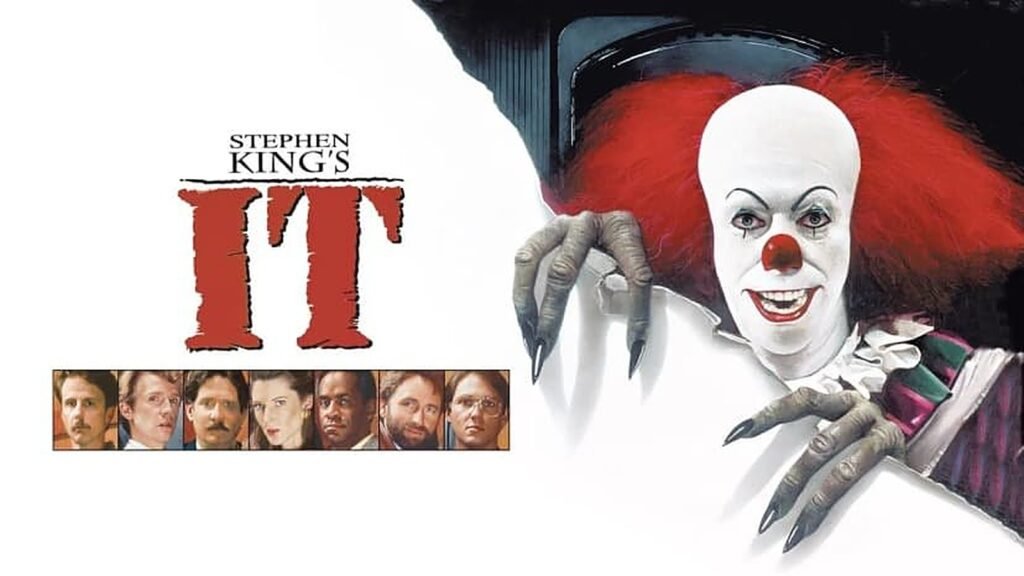
Stephen King’s It is a two-part 1990 ABC miniseries in which Tim Curry’s Pennywise haunts seven friends in 1960 and again in 1990.
In November 1990, ABC put a child-killing clown in prime time, two nights running, and nearly 30 million viewers showed up to meet him. It was the first made-for-television Stephen King adaptation since ’Salem’s Lot in 1979 — no cinema age gate, no gore to hide behind, just Tim Curry’s grin, a paper boat and a storm drain. It has been living in a generation’s nightmares ever since.
This is the record: the eight-hour version that became two nights, the director who walked away, Vancouver as Derry, the spider, and the home-video afterlife.
Quick Specs
Format: Two-part television miniseries
Network: ABC
Air dates: Part 1 — Sunday, November 18, 1990; Part 2 — Tuesday, November 20, 1990
Director: Tommy Lee Wallace
Teleplay: Part 1 — Lawrence D. Cohen; Part 2 — Lawrence D. Cohen and Tommy Lee Wallace
Based on: It by Stephen King (Viking first edition, September 15, 1986)
Starring: Tim Curry, Richard Thomas, John Ritter, Annette O’Toole, Harry Anderson, Dennis Christopher, Tim Reid, Richard Masur
Music: Richard Bellis
Cinematography: Richard Leiterman
Editors: David Blangsted and Robert F. Shugrue
Running time: 192 minutes (original broadcast version); 187 minutes (merged single-film version)
Production companies: Lorimar Television; Green/Epstein Productions; The Konigsberg & Sanitsky Company; DawnField Entertainment
Budget: A reported $12 million — producer Jim Green’s figure
Two Nights in Derry
In 1960, in Derry, Maine, seven outcast kids — the self-named Losers’ Club — are hunted by a shape-shifting evil that wears the face of Pennywise the Dancing Clown. It has already taken Bill Denbrough’s little brother Georgie, whose death at a storm drain is implied rather than shown. The Losers wound the creature with belief-powered silver and swear that if it ever returns, so will they. Thirty years later, in 1990, librarian Mike Hanlon — the one who stayed in Derry — sees the killings begin again and makes six phone calls. Six Losers come home. Stanley Uris does not: he dies by suicide after Mike’s call rather than face It again. The survivors descend into the sewers for the final confrontation.
The Romero Version That Never Happened
ABC did not start small. It green-lit It as an eight-to-ten-hour miniseries in four two-hour blocks, with George A. Romero directing and Lawrence D. Cohen — who had scripted Brian De Palma’s Carrie (1976) — adapting. ABC publicly announced six hours in June 1989; the plan then shrank to three parts and finally, after Tommy Lee Wallace signed on, to two nights.
Romero did real work: “I worked with the effects guys. I did [story]boards. I must have thousands of pages of scripts and notes.” He left for two documented reasons: a scheduling conflict with the 1990 remake of Night of the Living Dead, which he produced and co-wrote; and, in Cohen’s speculation, disappointment that “getting only four hours instead of eight took the magic out of the project for him.” Konigsberg and Sanitsky also stepped back over license-fee and budget disagreements; Green/Epstein took over and moved production to Vancouver.
Cohen received the novel manuscript in 1986 and wrote a 215-page teleplay. King reviewed drafts but stayed distant: “Steve was pretty much radio silent throughout the process,” Cohen said. Cohen first abandoned the novel’s interleaved flashbacks; Wallace’s Part 2 rewrite restored them, hence their shared credit. King’s expectations were low — “my expectations were in the basement… they were going to cram it into four hours, with commercials” — but he later called it “a really ambitious adaptation of a really long book” and said he was pleasantly surprised.
Vancouver Becomes Derry
The miniseries was shot over three months in mid-1990 in British Columbia, principally around Vancouver, and most of the supporting cast was drawn from Canadian talent because of it. New Westminster stood in for downtown Derry; the storm drain where Georgie dies is at 3rd Street and Liverpool Street in New Westminster, and the closing beat of Bill awakening Audra was shot at Columbia and 6th Street. Stanley Park supplied the Barrens exteriors, Beaver Lake and the Lost Lagoon; the Buntzen Lake Hydro Plant played the sewer plant; Beverly Marsh’s house was a real home at 417 Heatley Avenue in Vancouver. School scenes were shot at Vancouver-area schools (sources name both Saint Thomas Aquinas and Queen Mary Elementary; no source reconciles them).
Tim Curry’s Pennywise
Cohen wrote the part with no actor in mind. The names considered before Wallace arrived were Malcolm McDowell, Roddy McDowall and Alice Cooper. Wallace wanted Tim Curry, his Fright Night Part 2 collaborator, believing McDowall carried too much “sweetness”; he prevailed despite doubts that Curry was chiefly a comic actor. Curry took the role for its “subversive nature” — “both beguiling and murderous,” “a smile gone bad.” In 1990 he explained: “a clown is traditionally a very cozy, comforting image, and Pennywise is none of those things.” He used a Bronx accent, aiming for “an old-time Catskills comic.”
Bart Mixon designed the face, modelling Pennywise’s head on Lon Chaney Sr.’s Phantom of the Opera (1925) makeup, “stylized into a clown,” through three clay versions. His intent was friendly: “This creature is trying to lure children in, so he’s not going to be a monster at first.” Curry, fresh off Legend’s prosthetics, resisted heavy rubber. Wallace agreed: “With those eyes, and that mouth, and his crazy, sardonic sense of humor, less turned out to be more.” The bulbous forehead stayed for a “supernatural aspect”; the face was PAX paint, with yellow contacts and two sets of sharp teeth for the vicious beats — a smaller set for speech, a larger one for close shots. Curry had the cast’s earliest call, spending hours in makeup daily.
The child-cast stories need their counterweights. Emily Perkins said: “He really tried to intimidate us, because he wanted the fear to be real in our performances.” Wallace remembered Curry as “always well-prepared, easy on set, patient and low-key.” Chelan Simmons recalled an off-camera meeting in full costume: “He turned to me and said ‘Hi!’ in a very friendly voice, but it still scared me half to death!” Curry suffered a major stroke in July 2012, used a wheelchair afterwards, and shifted almost entirely to voice work. He died in August 2026, aged 80. At Fan Expo Canada in 2017 he blessed his successor: “I like [Bill] Skarsgård. I think he’s very clever… So I’m fascinated to see it.”
The Losers’ Club
Wallace brought the adult and child casts together for a couple of days though they share no scenes, so the pairings would align. The adults were Richard Thomas as novelist Bill Denbrough; John Ritter as architect Ben Hanscom, a King fan who told ABC, “I’ll play any part they want me to. I’ll play the girl”; Annette O’Toole as Beverly Marsh, cast at Ritter’s suggestion; Harry Anderson as Richie Tozier, changed to a late-night TV host; Dennis Christopher as Eddie Kaspbrak, a limousine-service operator living with his mother; Tim Reid as Mike Hanlon, Derry’s librarian and narrator; and Richard Masur as Stanley Uris.
The young Losers were Jonathan Brandis (young Bill), Emily Perkins (young Beverly), Brandon Crane (young Ben), Seth Green (young Richie), Adam Faraizl (young Eddie), Ben Heller (young Stanley) and Marlon Taylor (young Mike). Around them: Jarred Blancard and Michael Cole as young and adult Henry Bowers; Olivia Hussey as Bill’s wife, Audra; and Tony Dakota as Georgie. Crane later became the only 1990 Loser to appear in the new films, cameoing in It Chapter Two (2019) as an employee of adult Ben’s architecture firm.
Cutting a 1,138-Page Novel Down to Four Hours
The novel’s first edition runs 1,138 pages; Cohen had 215 pages of teleplay. The book’s children live in 1957–58 and its adults in 1985, on a 27-year cycle — the miniseries shifted both halves to 1960 and 1990 and stretched the cycle to 30 years. The adult Losers’ personal-life subplots went wholesale. The novel’s scene in which the young Losers, lost in the sewers after the first confrontation, bond through Beverly having sex with each of the boys was omitted entirely — unfilmable under 1990 network standards — and the Ritual of Chüd, the book’s psychic battle of wills, is absent: the climaxes are resolved by belief-powered silver and a physical assault on the spider. Cohen, looking back, wished he had found a way “to have the adults confront Pennywise in another way, in all his shapeshifting glory.”
Network standards shaped the horror itself. Blood could not issue from bodies, so it erupts from objects — sinks, balloons, photo albums. Georgie’s death could not be shown, so it is implied through dialogue. A wet, muscle-hung skeleton was rejected and became seaweed-draped instead: the governing rule was not showing children in jeopardy, in a story entirely about children in jeopardy. King singled out Richie’s reinvention as a TV talk-show comedian for criticism, calling him two-dimensional: “scumbag” and “sort of a kindhearted Buddy Hackett.”
The Spider at the End of the Sewer
The finale turns on the deadlights. Bill, Ben and Richie are transfixed by them; Eddie repeats his childhood “battery acid” inhaler attack and is mortally wounded; Beverly’s recovered silver earring frees the others; and the Losers kill It in its spider form by tearing and crushing out its heart. Bill then recovers Audra from the web, catatonic, and revives her by riding her downhill on his childhood bike, Silver.
Fantasy II, Gene Warren’s company, built the spider after ABC assigned it mid-work on Predator 2 with a 12-week deadline. From Bart Mixon’s “soft and fleshy” concept, Joey Orosco and Henry Mayo designed the full creature — spider abdomen and limbs fused with human shoulders, hips and torso — through more than sixteen concept sculptures; Aaron Sims built a stop-motion miniature used for nine shots. The full-size figure was a radio-controlled animatronic with performer Brent Baker inside after three months of training: a $200,000 build, 13 weeks to produce and shoot, 500 pounds, its head worked by three operators and its legs by six more.
It remains the production’s most argued-over build. Wallace approved a clay model of a “beefy and muscular, almost reptilian” spider; what arrived was “lean and mean,” its face far more visible than intended, with the finale scheduled for the last two days of filming and no time to fix it. Mixon countered that the animatronic “was capable of more than what you saw onscreen.” The cast nicknamed it the “Alaskan king crab.” King mocked it as “three Chevy headlights on the bottom of a wheelbarrow,” and the effects team made touch-ups after he voiced his disappointment during production. Curry’s verdict, years later: “I was very disappointed by the ending, when I turned into a rather unconvincing spider.”
Ratings, Reviews and Awards
Part 2 out-rated Part 1. Part 1 drew an 18.5 rating and 29 share, reaching 17.5 million households and finishing fifth for its week. Part 2 rose to a 20.6 rating and 33 share, 19.2 million households, second for its week. Across the two nights, nearly 30 million viewers watched — a different measure from households — and Cohen called it “the biggest success of 1990 for Capital Cities,” ABC’s owner. Part 2 was also November 1990’s most VCR-recorded program, with 1.96 million tape machines detected recording it.
Critics were mixed-to-positive from the start — the “beloved then, mocked now” story is wrong, because the ending was the problem from day one. Peter Farrell called it “the best horror show ever made for network television.” Matt Roush praised its kinship with “those Saturday matinee shockers that merrily warped a generation.” Praise concentrated on Part 1, the child cast and set pieces — the Chinese-restaurant fortune-cookie sequence was the most-cited scare — while the ending drew Ed Bark’s “hokey, feel-good” and Francesca Chapman’s “cop-out.” Retrospective aggregates sit at 70% on Rotten Tomatoes and 79 out of 100 on Metacritic.
Richard Bellis won the Primetime Emmy for Outstanding Achievement in Music Composition for a Miniseries or a Special (Dramatic Underscore) for Part 1, at the 43rd Primetime Emmys in 1991. Editors David Blangsted and Robert F. Shugrue were Emmy-nominated and won the ACE Eddie Award for Best Edited Miniseries. Brandon Crane was nominated for a Youth in Film Award, and the miniseries was nominated for the People’s Choice Award for Favourite TV Mini-Series, losing to The Civil War.
The Versions, the Documentary and the Remake
Home video made the miniseries immortal — and quietly changed it. The 1991 VHS and LaserDisc releases presented it as aired. In 1998, a single-cassette VHS first presented It as one continuous film: the merged edit every later release inherited, including the DVD of October 1, 2002 and the 2016 Blu-ray. The merged cut runs 187 minutes against the broadcast 192, and its substantive loss is Part 2’s opening minutes — Bill’s cab ride back through Derry, his hotel check-in opposite Nicola Cavendish’s over-eager desk clerk, and his wondering whether he should have returned — cut rather than re-composited, so the merged version jumps almost directly to Bill at the cemetery. The DVD cropped the 4:3 image to 16:9; the Blu-ray restored 4:3 and carries a commentary recorded around 2002 with Wallace and four cast members. Only the 1991 and 1993 two-tape VHS editions and the LaserDisc preserve the full broadcast cut.
The documentary Pennywise: The Story of IT, co-directed by John Campopiano and Christopher Griffiths, premiered at Sitges on October 15, 2021 and reached US theatres on July 8, 2022, built around more than 40 cast and crew interviews, Curry among them. The miniseries’ success kept It in circulation until Warner Bros. and New Line’s It (September 8, 2017), directed by Andy Muschietti with Bill Skarsgård as Pennywise, and It Chapter Two (September 6, 2019). The films use the novel’s 27-year cycle, not the miniseries’ 30 — but a doll replica of Curry’s Pennywise sits in the Neibolt Street clown room, and Chapter Two repeats “Kiss me, fat boy.” Our IT hub follows the whole saga.
Why It Still Floats
The miniseries’ deepest legacy is a generation’s fear of clowns — stated carefully, because the claim deserves care. EBSCO’s Psychology Research Starter on coulrophobia notes that Curry’s Pennywise is the portrayal “many adult coulrophobes cite as the genesis of their condition,” and the 1990 broadcast is widely credited with bringing the phobia into the mainstream. But killer clowns and “phantom clown” scares predate both the novel and the miniseries — American phantom-clown waves run back to at least 1981 — and coulrophobia is not a diagnosis recognised by the American Psychiatric Association. King, watching the clown-sighting wave of 2016, shrugged the whole furor into perspective: “The clown furor will pass, as these things do, but it will come back, because under the right circumstances, clowns really can be terrifying.” They float down in Derry. Thanks to two nights in November 1990, so does everybody who watched.