
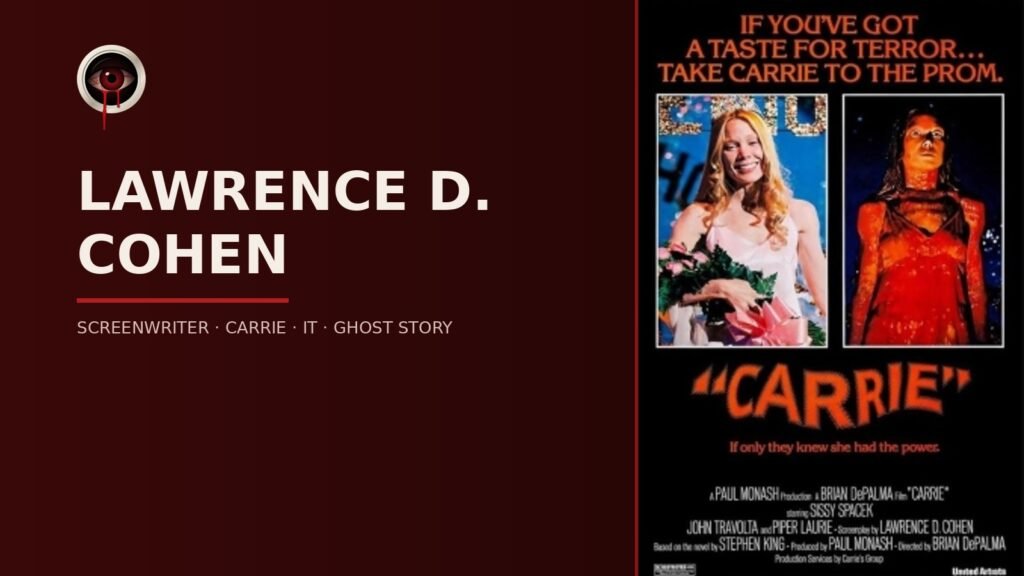
Lawrence D. Cohen is an American screenwriter — the first writer to adapt Stephen King for the screen, and King’s television adapter of choice.
Some careers are long lists. Lawrence D. Cohen’s is a short one with an outsized shadow: four Stephen King adaptations across thirty years, one Peter Straub adaptation, one Rodgers & Hammerstein teleplay, and the most famous flop in Broadway history — which he also wrote. He has no public birth date, no profile-driven legend, and a name shared with a Saint Paul mayor and a B-movie director, whose obituaries are not his. What is documented, and documented well, is the work — starting with the screenplay that opened the entire King canon to the movies.
Quick Specs
Occupation: screenwriter, producer, playwright
Known for: Carrie (1976), Ghost Story (1981), Stephen King’s It (1990), Carrie: The Musical
Stephen King adaptations: four — Carrie, It, The Tommyknockers, “The End of the Whole Mess”
Namesake warning: not Larry Cohen of It’s Alive, and not the Saint Paul mayor of the same name
Reviewer, Reader, and the Scorsese Orbit
Cohen began in New York as a theater and film reviewer — including a stint as the New York stringer for The Hollywood Reporter — and as a reader for producer David Susskind, reading the scripts, books and manuscripts submitted for production. That unglamorous job is where his career actually starts. In his own account, given in a 2015-era interview, he was reading for Susskind in 1973 when the manuscript of Carrie crossed his desk before Doubleday published it; he has said he “went insane for it” and could not persuade Susskind or the other producers he read for to option it — film interest only stirred after the paperback-rights sale. Print that as his telling, which is what it is; what the credit record shows next is verifiable on paper.
His earliest screen credits sit inside the Susskind–Scorsese New York world, and both are routinely mis-stated, so here they are exactly. On Alice Doesn’t Live Here Anymore (1974) Cohen was a production executive, billed “Larry Cohen” — Robert Getchell wrote that film; Cohen’s work was production-side, including a videotaped restructuring of scenes with Scorsese and Ellen Burstyn that went to Getchell for the rewrite. On Scorsese’s documentary Italianamerican (1974) he holds a treatment credit, shared with Mardik Martin — a document written to secure National Endowment for the Humanities funding, not a shooting script, on a film that is improvised conversation. A treatment and a production desk: that was the whole résumé when the Carrie assignment came.
Carrie (1976)
Carrie made three firsts with one credit. It was the first Stephen King novel published, the first King work ever adapted into a feature film — and Cohen’s own first produced feature screenplay, sole credit, from King’s novel, for director Brian De Palma and United Artists. His first draft followed the novel closely; United Artists accepted the second draft (dated January 20, 1976), and scenes were trimmed largely for money. King, 26, had been paid $2,500 for the film rights, by his own later account. United Artists allocated $1.6 million, the budget rose to $1.8 million, and the film grossed $33.8 million — and Cohen and King became friends during the production, which, in Cohen’s own words, is why the rest happened: “We became friends during the making of ‘Carrie,’ so I think he felt that ‘It’ would come out well, too.” The first King screenplay ever produced is still the template: Cohen’s Carrie is where the King screen canon begins.
Ghost Story (1981)
Between King assignments came the other great horror novelist of the era. Ghost Story — screenplay by Lawrence D. Cohen, solo, from Peter Straub’s 1979 novel (Straub’s name on some listings is the source-novel credit, not a screenplay credit) — was directed by John Irvin for Universal and released December 18, 1981. Cohen’s stated problem was scale: how much of Straub’s very large novel a single sub-two-hour film could not hold, and the film is a deliberate simplification of the book. The cast is a valedictory roll — Fred Astaire, Melvyn Douglas, Douglas Fairbanks Jr., John Houseman, Craig Wasson, Alice Krige — and it was the final film for Astaire and Fairbanks Jr. and the final completed film for Douglas. Made for $13.5 million, it took $23.4 million and became a commercial success despite mixed-to-negative reviews (Roger Ebert, against the grain, gave it three stars and called it “a good movie”). It stands at 28% on Rotten Tomatoes from 32 critics — a figure its cult afterlife has long since outrun.
Carrie: The Musical
Cohen is also a playwright, and the property followed him to the stage. Carrie: The Musical — book by Cohen, music by Michael Gore, lyrics by Dean Pitchford — began in 1981 and reached the stage with the Royal Shakespeare Company at Stratford-upon-Avon in February 1988, with Linzi Hateley as Carrie and Barbara Cook as Margaret White. Cook left after the tryout, following a technical accident; Betty Buckley — the film’s Miss Collins — played Margaret on Broadway, where the show opened at the Virginia Theatre on May 12, 1988, and closed on May 15, after 16 previews and 5 performances, at a cost of about $8 million. It is routinely cited among the most expensive flops in Broadway history; the standard history of Broadway flops is literally titled Not Since Carrie. Cohen, Gore and Pitchford stayed with it anyway: after a 2009 staged reading they heavily revised their own work for MCC Theater’s Off-Broadway revival, which opened March 1, 2012, was far better received, and became the official licensable version — the one Riverdale staged in 2018. Cohen is the only person with a writing credit on the 1976 film, the stage musical, and the 2013 remake.
It (1990) — and the Credit, Precisely
Cohen was hired to adapt Stephen King‘s It in 1986 — handed a manuscript of the novel at his New York apartment before the book was even published — and his finished teleplay ran 215 pages. The format kept shrinking under him: ABC first planned eight to ten hours across four blocks with George A. Romero directing; the order was cut to six hours, then three parts, then two, and Romero left. Tommy Lee Wallace signed on to direct after reading a draft of Cohen’s first part. The credit, printed as the release itself catalogues it: Part 1, teleplay by Lawrence D. Cohen; Part 2, teleplay by Lawrence D. Cohen and Tommy Lee Wallace. Cohen wrote both parts; when his second part — what Wallace called “a very interior melodrama” — needed rewriting on location in Vancouver and Cohen’s schedule would not permit the trip, Wallace rewrote it himself against the novel, restoring King’s flashback structure. Cohen did not quit the production, whatever the listicles say; his name stands on both parts’ writing, and he and Wallace together hand-chose most of the adult Losers. Choices of Cohen’s that survive on screen include holding back any early hint of the spider form; he has since said he wished he had been permitted a different ending from the novel’s. King, receiving drafts, stayed — in Cohen’s phrase — “pretty much radio silent.” The result, broadcast November 18 and 20, 1990, drew about 30 million viewers and became ABC’s biggest success of the year; the miniseries and its making are covered on their own page, and Cohen appears as himself in the documentary Pennywise: The Story of It (2021), still telling it.
The Later King Work, and South Pacific
The Tommyknockers (1993) — teleplay by Cohen, from King’s 1987 novel, directed by John Power, with Cohen also serving as a producer — aired on ABC May 9–10, 1993, filmed in New Zealand with Jimmy Smits and Marg Helgenberger, on a reported $12 million budget. In 2001 Cohen crossed genres entirely: his teleplay for Rodgers & Hammerstein’s South Pacific (ABC, March 26, 2001; Glenn Close, Harry Connick Jr.), on which he was also an executive producer — alongside, in one of the record’s neat loops, Michael Gore, his Carrie: The Musical composer. His adaptation wrote new material into the classic, including a first-meeting scene for Nellie and Emile at the officers’ club. (The stage book’s co-author Joshua Logan is not his co-writer; the 2001 teleplay is Cohen’s.) His fourth and, to date, last King adaptation is “The End of the Whole Mess” (2006), his teleplay from King’s short story for TNT’s Nightmares & Dreamscapes, directed by Mikael Salomon, starring Ron Livingston and Henry Thomas as the Fornoy brothers.
Carrie (2013) — the Shared Credit
When MGM and Screen Gems remade Carrie in 2013, Roberto Aguirre-Sacasa was hired to write a new, more faithful adaptation for director Kimberly Peirce — and the finished film’s screenplay credit is shared: Lawrence D. Cohen and Roberto Aguirre-Sacasa, as the AFI Catalog lists both men. Cohen did not write the remake alone, and he is not absent from it; his co-credit stands because the film derives from his 1976 screenplay. Made for $30 million, it grossed $84.8 million and stands at 51% on Rotten Tomatoes from 184 reviews. For the record’s other fences: Cohen has no credit on the 2002 television Carrie (written by Bryan Fuller) and none on The Rage: Carrie 2 (1999). His three Carrie credits are the film, the musical’s book, and the shared 2013 screenplay — no more, no fewer.
Why He Matters
Cohen is the bridge figure of the King screen canon: the first writer to adapt King at all, the writer the young King trusted with his two biggest novels for television, and a credited writer on King adaptations across five decades of productions — 1970s film, 1980s stage, 1990s and 2000s television, 2010s remake. The output is infrequent; the placement is foundational. Every King adaptation since 1976 has walked through a door Lawrence D. Cohen opened — usually without his name anywhere near the marquee, which is exactly why this page prints his credits the long way, precisely, and in full.